
Writing a legal memo isn't just an academic exercise; it's a foundational skill for any practicing legal professional. The process boils down to a clear, disciplined approach: you must define the legal question, structure your argument logically, and then draft a clear, objective analysis that's grounded in solid research.
Why Mastering the Legal Memo Matters
Think of the legal memorandum as the internal road map for a case. It’s not a persuasive brief designed to sway a judge. Instead, it’s an honest, unvarnished look at a legal issue, written for a supervising attorney, a partner, or even a client to understand the real-world strengths and weaknesses of their position. Its entire purpose is to be candid and objective. When that same analysis is formalized and addressed to a client or third party, it often takes the shape of an attorney opinion letter.
At its heart, a memo answers a specific legal question based on a particular set of facts. To pull this off, you have to nail three key tasks:
- Analyze the Facts: Sift through the client's story to find the legally significant details and filter out the noise.
- Research the Law: Dig into statutes and case law to find the controlling legal principles.
- Predict an Outcome: Use your research and analysis to make an educated prediction of how a court would likely rule.
The formal, multi-page memo you learned to write in law school is the classic format, but the core thinking process—define, structure, draft—is what truly matters.
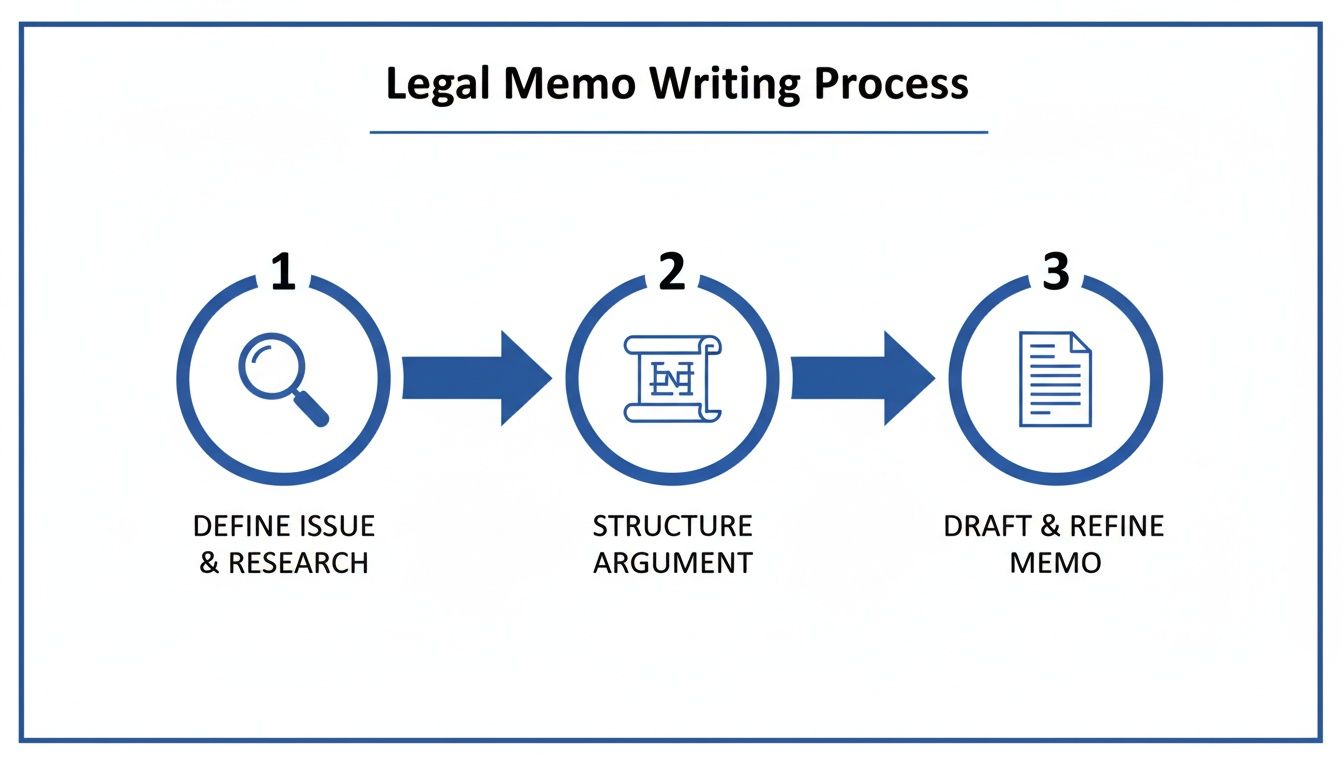
As you can see, the real work happens long before you start writing the final draft. It’s all about the setup.
The Shift in Modern Legal Communication
Let's be realistic—the legal world moves fast. The days of drafting a lengthy, formal memo for every single issue are fading. The data backs this up. A fascinating Georgetown Law study found that 75% of practitioners write no more than three formal legal memoranda per year, and a surprising 57% write none at all.
So, what does that mean? It means that the format is changing, not the skill. The rigorous analysis once reserved for a 20-page memo is now often delivered in a well-structured email or a concise internal summary.
The underlying principles of objective research, logical analysis, and clear writing are more critical than ever. Whether you have two hours or two weeks, the disciplined thinking that memo writing teaches is what separates good legal advice from bad.
Before we dive into the step-by-step process, it helps to have a high-level view of what we're building. Every section of a legal memo has a distinct job to do.
Key Components of a Legal Memorandum at a Glance
| Memo Section | Core Purpose |
|---|---|
| Heading | Identifies the recipient, author, date, and subject matter clearly and concisely. |
| Question Presented | Frames the specific legal issue(s) the memo will address. |
| Brief Answer | Provides a direct, "bottom-line-up-front" answer to the question(s). |
| Statement of Facts | Recounts the legally significant facts objectively, without argument. |
| Discussion | The analytical core; applies legal rules to the facts to explain the conclusion. |
| Conclusion | Summarizes the analysis and restates the predicted outcome. |
Understanding how these pieces fit together is the first step toward drafting a document that’s not just informative, but genuinely useful.
Deconstructing the Legal Memo: Anatomy of a Powerful Analysis
Think of a well-structured legal memo as a roadmap. It’s designed to guide a senior attorney or partner logically from their initial question to your well-reasoned answer. The format isn’t just a tradition; it’s a tool. Each section has a specific job, building on the one before it to create a persuasive and crystal-clear analysis.
To truly master the legal memo, you have to nail its fundamental components. While the Discussion section is where you’ll do the heavy lifting, it’s the opening parts—the Heading, Question Presented, Brief Answer, and Statement of Facts—that set the stage. Get these right, and your reader will instantly grasp the core issue, your conclusion, and the factual landscape.
The Opening Formalities: The Heading
Let's start with the easy part: the heading. It might seem basic, but precision here is non-negotiable. This section acts as an administrative label, ensuring your work is correctly filed, routed, and understood at a glance. It's the memo's business card.
Every legal memo heading needs these four elements:
- TO: The recipient's full name and title (e.g., Jane Doe, Senior Partner).
- FROM: Your full name and title (e.g., John Smith, Associate Attorney).
- DATE: The date you're submitting the final memo.
- RE: A short, descriptive subject line (the "RE" stands for "Regarding").
That RE: line is your first chance to frame the entire analysis. Don't be vague. "Memo on Johnson Case" tells your reader almost nothing. A busy supervising attorney needs more context than that.
Weak: RE: Jones v. Acme Corp.
Strong: RE: Potential Liability of Acme Corp. for Negligence Regarding the March 15 Warehouse Accident
See the difference? The strong example immediately tells the reader which legal issue and factual scenario you're about to dissect. It makes their job easier, which is always a good thing.
Framing the Core Issue: The Question Presented
This might be the single most important sentence in the entire document. The Question Presented has to be a single, clear, and neutral question that perfectly marries the determinative facts of your case with the relevant rule of law. Trust me, it’s much harder than it sounds.
A well-crafted Question Presented acts as the North Star for your entire memo. It tells the reader exactly what you're analyzing and why. The goal is to structure it so it can be answered with a simple "yes" or "no," even though your full analysis will be far more nuanced.
Pro Tip: A classic and effective way to structure this is the "under, does, when" formula. It forces you to weave together the controlling law, the precise legal question, and the key facts. For example: "Under [Controlling Law], does [Legal Question] when [Legally Significant Facts]?"
Imagine a case where a couple of park rangers got drunk on the job and removed warning signs.
Weak Question: Can the government be sued for the park rangers' actions? (This is way too broad and stripped of all crucial facts.)
Strong Question: Under the New Mexico Tort Claims Act, is the government liable for negligence when two on-duty park rangers, while intoxicated, removed bear warning signs from a campsite three days before replacements were installed, resulting in injury to campers?
The strong version is a work of art. It expertly threads the needle, connecting the jurisdiction (New Mexico), the legal standard (Tort Claims Act, negligence), and the specific facts that will make or break the case (on-duty, intoxicated, sign removal timing).
The Bottom Line Up Front: The Brief Answer
Once you've asked the question, you have to answer it. Immediately. The Brief Answer (sometimes called the Conclusion) gives a direct response—usually starting with "Yes," "No," or "Likely yes"—and follows it up with a tight summary of your reasoning. This is all about respecting the reader's time by putting the conclusion right at the top.
Think of it as the elevator pitch for your entire memo. In a single paragraph, you need to summarize the core of your legal analysis, hitting the key rules and facts that led you to your conclusion.
Let's stick with our park ranger scenario. A solid Brief Answer would read something like this:
"Likely yes. Under New Mexico law, the government can be sued for an employee's negligent actions if the employee was acting within the scope of their employment. Although the park rangers were intoxicated, New Mexico courts have held that an employee's actions are within the scope of employment unless they are motivated purely by personal reasons. Because the rangers were on-duty and carrying out an assigned task—removing signs—their actions likely fall within the scope of their employment, making the government liable for their negligence."
It’s direct, it gives the rule, it applies the facts, and it explains the outcome. No fluff.
Setting the Scene: The Statement of Facts
Finally, you need to tell the story. The Statement of Facts lays out the narrative of events that sparked the legal question in the first place. Your role here is to be an objective reporter, not a zealous advocate.
You must present all the legally relevant facts, and that includes the ones that might not be so great for your client. Your credibility is on the line. Organize the facts chronologically to keep the story clear and easy to follow. Don't forget specifics like dates, times, locations, and what people did. Every fact you put in this section is raw material for your Discussion—if you mention it here, you'd better be planning to use it in your analysis later.
Building Your Argument with IRAC and CRAC
The Discussion section is the analytical core of your entire legal memo. It's where the rubber meets the road. After laying out the facts and the questions, this is your moment to connect the legal principles to your client's specific situation. You're essentially showing your work and proving the conclusion you offered in the Brief Answer.
A powerful Discussion isn't just about solid research; it's about impeccable organization. Without a clear structure, your analysis can quickly devolve into a confusing jumble of case law and facts that obscures your point rather than clarifying it. This is where two time-tested frameworks come in: IRAC and CRAC.
Understanding the IRAC Framework
IRAC is the classic structure for legal analysis that's drilled into every 1L. It’s a straightforward, intuitive, and highly effective way to tackle a single legal issue. The acronym breaks down like this:
- Issue: State the specific legal question you’re about to analyze.
- Rule: Lay out the governing law, pulling from relevant statutes and case law.
- Analysis: This is the big one—apply the rule to the specific facts of your case.
- Conclusion: Answer the question you posed in the Issue section.
This format forces a disciplined, step-by-step approach. You address one piece of the legal puzzle at a time, repeating the IRAC structure for each distinct issue or sub-issue in your memo. It’s a clean way to build an argument from the ground up.
Exploring the CRAC Variation
A popular and, in my experience, more practical alternative is CRAC. It’s almost identical to IRAC but with one crucial tweak to the order. CRAC stands for:
- Conclusion: Start right away with the conclusion for the specific issue.
- Rule: Explain the governing law.
- Analysis: Apply that rule to your facts.
- Conclusion: Reiterate the conclusion, maybe with a bit more detail.
Many seasoned attorneys prefer CRAC because it mirrors the "bottom-line-up-front" approach that busy partners and clients appreciate. It tells the reader where you're headed from the jump, which makes a complex analysis much easier to digest. For learning purposes, either structure is perfectly fine, but you'll find CRAC is often favored in the fast-paced world of a law practice.
Applying the Framework to a Real Scenario
Let's make this concrete. We'll stick with our hypothetical case involving the intoxicated park rangers who took down bear warning signs in New Mexico. A central legal question is whether the government can be on the hook for their actions. To figure that out, we have to determine if the rangers were acting "within the scope of their employment."
The Rule Section: A Deeper Look
Your Rule section is the bedrock of your analysis. It's not just a laundry list of cases; it's where you synthesize information effectively from multiple sources to create a coherent legal framework. You'll likely start with the broad statute—here, the New Mexico Tort Claims Act—and then drill down to the specific tests established by case law.
For instance, New Mexico courts use a four-part test for scope of employment. A strong Rule section would articulate this test cleanly:
To be within the scope of employment, an employee's conduct must: (1) be of the kind the employee is employed to perform; (2) occur substantially within the authorized time and space limits of the employment; (3) be actuated, at least in part, by a purpose to serve the employer; and (4) if force is intentionally used, the force must not be unexpected by the employer.
This section requires more than just quoting; it’s about weaving principles together. It also gets into the weeds of how courts interpret statutory language. If you want to go deeper on that particular skill, our guide on what is statutory interpretation is a great resource.
The Analysis Section: The Heart of Your Argument
Here’s where you put the law to work. You have to explicitly connect each part of the rule you just laid out to the facts of your case. It’s not enough to state the facts and then state the rule; you have to show how they interact.
Let's break it down for our park ranger scenario using that four-part test:
- Kind of Conduct: The rangers were removing signs. That’s a task directly related to their duties as park maintenance staff. This fact lines up perfectly with the first part of the test.
- Time and Space: The incident happened while they were on duty, at a campsite inside the park. This satisfies the second element.
- Purpose to Serve: Now it gets tricky. This is the point we’ll fight over. Opposing counsel will argue their intoxication proves they were acting for personal reasons. But—and this is key—New Mexico case law suggests an employee must be motivated entirely by personal reasons to fall outside the scope. Since they were still doing their job (albeit badly), their actions were at least partly motivated by a purpose to serve their employer.
- Use of Force: They used an ax, but this is probably a red herring. The negligence claim is about the omission of the signs, not an assault, so this element is less relevant here.
By methodically walking through each part of the rule with specific facts, you build a logical, persuasive, and hard-to-refute case.
Drawing the Final Conclusion
Finally, your mini-conclusion for this sub-issue must circle back and decisively answer the question that kicked off your IRAC/CRAC block.
Example Conclusion: "Therefore, because the rangers were performing an assigned task during work hours within the park, their actions likely fall within the scope of their employment under New Mexico law, even with their intoxication. As a result, the government is likely liable for their negligence."
This disciplined approach—whether you choose IRAC or CRAC—is what powers a well-written legal memorandum. It transforms a pile of facts and law into a clear, reasoned, and professional legal analysis.
Weaving in Research and Nailing Your Citations
A legal memo without solid research and proper citations is really just a well-organized opinion. Its power, its entire reason for being, comes from the legal foundation you build with statutes, court decisions, and regulations. It’s not about just dropping in quotes; it's about weaving together different sources to form a clear, logical rule that you can apply directly to your client's situation.
This all starts with finding the controlling legal authorities. Your first task is to dig up the statutes that govern the issue and then find the court opinions that interpret those statutes. This is where you translate a client's real-world problem into a legal framework. It’s a make-or-break step, and if you want to sharpen your skills, our complete guide on how to do legal research breaks down the best strategies.
Once your sources are gathered, the real work starts. You need to read, digest, and piece them together to form the "Rule" section of your IRAC or CRAC. This is almost never a single, tidy statement from one case. Far more often, you’ll be combining a section of a statute with a multi-part test from a major case, and then maybe adding a layer of nuance from a more recent appellate decision.

From Piles of Research to a Synthesized Rule
Let’s say you’re analyzing a basic negligence claim. You can't just write, "Negligence requires duty, breach, causation, and damages." A truly professional Rule section will define each of those elements precisely as the jurisdiction's case law does, citing the source for each part of the definition.
Your rule synthesis might break down like this:
- Duty: Start with the general standard of care from a foundational case.
- Breach: Pull from a case with similar facts that found a breach.
- Causation: Explain both actual ("but-for") and proximate cause, citing the specific tests from that jurisdiction's key decisions.
This level of detail shows the reader you haven't just found the law—you understand how the pieces interlock. That’s what gives your analysis credibility.
Why Citations Are Non-Negotiable
Every single legal assertion you make needs to be backed by a citation. Think of citations as the currency of legal writing. They are the proof behind your claims and give the reader a roadmap to verify your work. Without them, your memo is just an unsubstantiated argument.
The two most common citation systems in the U.S. are The Bluebook and the ALWD Guide to Legal Citation. The formatting can feel tedious, I know, but the goal is to create a universal language so any lawyer can understand your sources at a glance. Just be consistent. Your firm or the court will have a preferred style, and you need to follow it to the letter.
A classic rookie mistake is the "drive-by" citation—just dropping a string of sources at the end of a long paragraph. Don't do it. Instead, connect each legal principle to its source as soon as you state it. This creates a direct, undeniable link between your assertion and its legal authority.
Using Technology to Work Smarter
The days of manually sifting through dusty reporters are mostly behind us. Modern tools, especially AI-powered assistants, can dramatically speed up the research and synthesis phase. These platforms can surface on-point precedents, pinpoint key language in statutes, and even help you structure your rule synthesis.
This isn't some far-off future; it's happening right now. The 2021 KPMG Global Legal Department Benchmarking Survey found that 28% of organizations have already implemented document automation and 37% use AI to pull information from legal documents. This directly impacts memo drafting by automating the once-painstaking work of finding and organizing legal sources.
AI assistants can help you:
- Quickly find relevant case law using plain-language searches.
- Spot conflicting opinions between different courts.
- Keep your research current by flagging cases that have been overturned.
And that brings me to a final, crucial point: always update your research one last time before finalizing your memo. The law is always in motion. A case that was good law last week could have been overruled yesterday. Using a citator service like Shepard's on LexisNexis or KeyCite on Westlaw isn't just a good idea—it's an absolute must.
Drafting More Efficiently with AI Legal Assistants
The old way of writing a legal memo—hours of painstaking research followed by a slow, deliberate drafting process—is changing. Modern AI legal assistants are here, not to replace our legal judgment, but to act as powerful collaborators that handle the grunt work. This frees us up to focus on what really matters: strategy and analysis.
Instead of staring at a blank page, you can use an AI tool to get the ball rolling. Think of it as an intelligent starting block that helps you bust through writer's block and build momentum. Just input the basic facts of your case, and you can get a structured outline in seconds, from the heading all the way down to the conclusion.
That first step alone can save you hours and ensures your memo is logically sound from the get-go. But that's where the real collaboration begins.
Accelerating Research and Drafting with AI
The real magic of an AI legal assistant is its ability to dive into massive legal databases and pull back synthesized, relevant information almost instantly. You can upload key case documents—a complaint, depositions, even client emails—and tell the AI to pull out the legally significant facts. This turns a tedious, critical task into an automated one, minimizing the risk that you'll miss a key detail buried in hundreds of pages.
When you get to building out your Discussion section, AI can be a game-changer. Here are a few ways I've seen it work in practice:
- Clarifying Complex Concepts: If you're wrestling with a tricky legal doctrine, you can ask the AI to explain it in plain English, citing examples from relevant case law.
- Finding On-Point Precedents: Just describe your fact pattern, and the AI can pull up relevant cases from your jurisdiction. This saves a ton of time you'd otherwise spend on manual keyword searches.
- Drafting Rule Sections: AI can help you weave together the law from multiple statutes and cases into a clear, coherent rule statement for your IRAC or CRAC analysis.
This isn't just a theory; it's happening right now. A recent report from Clio found that an incredible 96% of UK law firms have adopted AI, with 36% using it specifically for document drafting. The report also noted that 43% of solicitors saw a direct improvement in their work quality and productivity, which speaks volumes about how these tools are impacting legal work.
Maintaining Control and Ensuring Accuracy
The key to using AI effectively is to treat it like a highly capable paralegal, not a senior partner. Your legal expertise is still the most important part of the equation. The AI gives you the raw materials—an initial draft, case summaries, synthesized rules—but you are the final judge of quality and accuracy.
The goal of using AI in legal writing is not to automate thinking, but to accelerate it. Every AI-generated sentence must be scrutinized, every citation must be verified, and every argument must be refined with your own professional judgment.
Think of it as a feedback loop. The AI gives you a draft, you edit and sharpen it, and then you might ask it to expand on a specific point or find a case that argues the opposite. This back-and-forth makes you a faster and more thorough legal writer. If you want to dig deeper into the tech that powers these tools, it's worth exploring the value of large language model applications.
By bringing these tools into your workflow, you can turn memo drafting from a solitary, time-sucking chore into a dynamic, collaborative effort. For more strategies on this, check out our guide on using AI for legal research to see how you can integrate this tech into your daily practice.
Polishing Your Memo with a Proofreading Checklist
A brilliant legal analysis can be completely derailed by a few simple typos or a bad citation. After you've poured hours—maybe even days—into research and drafting, your brain starts to fill in the blanks, making it incredibly easy to miss your own mistakes.
That's why the final proofreading stage is so much more than a quick spell-check. It’s a deliberate, systematic review that elevates a good draft into a polished, professional document that a supervising attorney can trust.

Rushing this last step is a classic rookie mistake. All it takes is one misplaced comma in a statute or a citation to an overturned case to seriously damage your credibility.
Pro Tip: I always print a hard copy for my final review. There’s something about reading on paper that forces you to slow down. You’ll be amazed at the errors you catch that your eyes just glide over on a screen.
Your Final Review Checklist
Before that memo leaves your desk, run through one last, focused pass. I recommend going through this checklist methodically; it’s the best way to make sure every component is absolutely solid.
Content and Analysis
- Logical Flow: Read it aloud. Does each section actually flow into the next, or are there awkward jumps? Is your IRAC or CRAC structure consistent from start to finish?
- Factual Accuracy: Go back to your source documents and double-check every single date, name, and fact you've identified as legally significant. No assumptions.
- Connecting the Dots: Does your Analysis section explicitly tie every element of the rule to the specific facts of your case? You can't just state a conclusion; you have to show your work and demonstrate how you got there.
Clarity and Conciseness
- Objective Tone: Is your tone consistently professional and objective? Hunt down and eliminate any persuasive or argumentative language that might have slipped in. A memo analyzes, it doesn't advocate.
- Word Choice: Can you replace legalese or jargon with simpler terms? Swap out weak, passive phrases (like "it is the opinion that...") for strong, direct statements grounded in your analysis.
- Sentence Structure: Look for those long, winding sentences that try to do too much. Break them up. Varying your sentence length makes the entire document easier to read and digest.
Formatting and Citations
- Citation Check: Manually verify every single citation. Is it in the correct format (e.g., Bluebook or local court rule)? Does it point directly to the proposition it's supposed to support?
- Citator Update: This one is non-negotiable. Run a final check using a service like Shepard’s on LexisNexis or KeyCite on Westlaw. You absolutely must ensure every case you rely on is still good law the moment before you finalize the memo.
Frequently Asked Questions
Objective vs. Persuasive Memos: What's the Real Difference?
It all comes down to your audience and your goal. The kind of memo we're talking about in this guide is an objective memorandum. Think of it as an internal, confidential report for a supervising attorney. Your job is to be brutally honest and provide a neutral, balanced analysis of the law. The goal is to predict how a court is likely to rule, good or bad. A persuasive memo is a completely different beast. That’s your trial brief or a motion filed with the court. It’s an advocacy piece, crafted to persuade a judge or opposing counsel to see things your client's way. You're not just predicting the outcome; you're actively trying to shape it.
How Long Should a Legal Memo Be?
There’s no one-size-fits-all answer here. The length is dictated entirely by the complexity of the legal question you're tackling. • A simple memo on a single, well-settled issue might only need 2-3 pages. • A memo wrestling with multiple novel issues or a tangled factual history could easily run past 20 pages. > The golden rule is simple: be as concise as you can without sacrificing thoroughness. Before you write a single word, ask the assigning attorney if they have a page count in mind. It saves a lot of headaches later.
Can I Just Let AI Write the Whole Thing?
AI tools are incredible for speeding up the grunt work of legal research and helping you outline an initial IRAC analysis. They can find relevant cases and statutes in seconds, which is a massive time-saver. But they can't replace your professional judgment. Ever. Your critical thinking is the most important part of the process. You must always review, edit, and—most importantly—verify every single thing an AI tool generates. Think of it as a highly capable paralegal, not a replacement for your own legal mind and ethical obligations. --- Ready to draft legal memoranda faster and more accurately? LegesGPT combines an AI legal assistant with a comprehensive research database to help you build stronger arguments in a fraction of the time. Start your free 3-day trial today.