Think of a paralegal who could read, understand, and connect the dots across millions of legal documents in just a few seconds. That’s the promise of AI for legal research in a nutshell. This isn't about replacing lawyers; it's about giving them superpowers. It automates the soul-crushing data grunt work so legal minds can focus on strategy, argument, and winning cases.
Best AI tools for legal research at a glance
If you came here to pick a tool, start with this table. Every option below grounds its answers in a legal database rather than guessing, which is the one non-negotiable in AI legal research. The full ranking, including free options, is in our roundup of the best AI tools for legal research.
| Tool | Best for | Starting price | Free trial |
|---|---|---|---|
| LegesGPT | Solo and small firms: verified-citation answers, case law search, review, and drafting in one subscription | From $19.99/mo | 3-day, $1 |
| CoCounsel Legal | Firms on Westlaw that want agentic research with KeyCite flags | Custom (quote) | Demo; trial on Essentials |
| Lexis+ with Protégé | Enterprise firms on LexisNexis with Shepard's validation | Custom (quote) | 2-day |
| Vincent AI (vLex) | Cross-border research across 100+ countries | Custom (quote) | Free trial |
| Midpage | Budget case law search with an AI citator | $100/mo | 2-week, no card |
| Google Scholar | Free case law lookups, no AI answers, no citator | Free | Free |
Pricing for the quote-based tools is not published by the vendors, so confirm current figures before you budget. The rest of this guide explains how these systems work, where they pay off, and how to adopt one without exposing your firm to a fabricated citation.
The New Standard in Legal Intelligence

The legal profession has always run on information. For decades, the best-resourced firms held a massive advantage with their sprawling physical libraries and armies of associates dedicated to manual precedent searches.
Today, that advantage is shifting. It's no longer about who has the most data, but who can make sense of it the fastest.
AI directly tackles the data overload that modern legal professionals face every day. It changes legal research from a slow, linear chore into a dynamic, analytical conversation. Forget spending days wrestling with complex Boolean queries. Now, you can ask a plain-language question and get a synthesized answer back in moments.
From Tedious Searches to Strategic Insights
This shift saves more than just time—it fundamentally changes the job. By working alongside human experts, these intelligent systems help legal teams uncover critical precedents, untangle complex statutes, and build stronger cases than ever before. It allows for a depth of analysis that was simply impractical until now.
The arrival of a new generation of AI tools for legal research has set a new benchmark for what "legal intelligence" means. And the market is voting with its wallet, showing this is a core infrastructure upgrade, not some experimental add-on.
The global legal AI market was valued at USD 1.45 billion in 2024 and is on track to hit USD 3.90 billion by 2030, growing at a compound annual growth rate of 17.3% from 2025 to 2030, according to Grand View Research.
This isn't just a trend; it's a tidal wave. AI-powered research is no longer a concept for the future—it's a competitive necessity right now. Firms that get on board are gaining serious advantages:
- Faster Case Prep: Slashing the time needed for initial research and discovery from days to hours.
- Deeper Insights: Spotting patterns and connections across thousands of documents that a human researcher could easily miss.
- More Strategic Focus: Freeing up legal professionals to do what they do best: craft arguments and advise clients.
The real power of AI in legal research is its ability to move a lawyer's focus from finding information to interpreting it. It handles the 'what' so professionals can master the 'why' and the 'how.'
Platforms like LegesGPT are at the forefront of this movement, delivering powerful, easy-to-use tools that plug directly into a firm's daily workflow. By bringing AI into the fold, legal practices can operate with greater efficiency, accuracy, and foresight, effectively setting a new baseline for excellence in the profession.
How AI Unlocks Deeper Legal Insights
To really get what makes AI for legal research so powerful, you have to look under the hood. This isn't just abstract computer science; it's about practical tools designed to think, read, and reason in a way that mirrors what you already do, just at a massive, superhuman scale.
At the heart of it all are two key technologies that work in tandem. Think of them as a hyper-efficient two-person research team.
First up is Natural Language Processing (NLP). Picture NLP as a master linguist who also happens to be an expert lawyer. It’s trained to understand the incredibly dense and specific language of the law—all the jargon, complex sentence structures, and subtle nuances that define legal documents. When you ask a question in plain English, NLP is the one that translates it into a concept a machine can actually search for across millions of cases.
The second member of the team is Machine Learning (ML). This is your pattern-spotting genius. ML algorithms are trained on colossal datasets of legal documents, learning over time what makes a case relevant, how legal arguments are built, and which precedents carry the most weight.
From Query to Comprehensive Answer
Let's walk through how this duo gets the job done. Think of it like briefing an impossibly fast and knowledgeable research associate.
- You Ask a Question: You type a query into a platform like LegesGPT, something like, "Find precedents in California regarding breach of contract for software development failures."
- NLP Understands Your Intent: The NLP model instantly gets what you're after. It grasps the core legal concept (breach of contract), the specific context (software development), and the jurisdiction (California). Crucially, it knows you’re not just looking for keywords; you’re looking for the meaning behind them.
- ML Finds the Patterns: The ML model then scans a massive database of case law. Because it has learned from millions of prior examples, it identifies not just cases that mention your terms, but cases that are contextually similar, even if they use different phrasing. It then ranks them by relevance, citation frequency, and judicial authority.
This completely flips the script on legal research. You go from a scavenger hunt for keywords to a targeted search for legal concepts. The system doesn't just find documents; it understands the relationships between them.
AI fundamentally changes the research workflow from finding sources to analyzing insights. It presents the most relevant information first, allowing you to bypass the noise and focus directly on building your argument.
Beyond Simple Document Retrieval
The partnership between NLP and ML unlocks capabilities that go way beyond what a traditional search bar can offer. Instead of just dumping a list of documents on your screen, modern AI for legal research gives you a synthesized, actionable output.
For instance, after finding the relevant cases, the AI can group them by argument, summarize key holdings, and even point out conflicting rulings. It can analyze the sentiment of judicial language to give you a sense of how a court might view a certain line of reasoning. This is a game-changer for complex tasks; you can learn more about how LegesGPT helps with intelligent AI document review to spot risks and obligations in minutes.
Ultimately, these technologies work together to hand you a structured, coherent, and cited report that serves as a powerful starting point for your legal strategy. It's an approach that saves countless hours and uncovers connections that even a diligent human researcher, buried under deadlines, might otherwise miss.
Putting AI to Work: Practical Use Cases
Understanding the tech is one thing, but seeing AI for legal research in action is where it really clicks. Moving from theory to practice, you can see how legal professionals are already using these tools to build stronger cases, close deals faster, and get a real competitive edge.
The impact is clearest in high-stakes, document-heavy areas where speed and accuracy are everything. Think of it as upgrading from a manual handsaw to a precision laser cutter—the job is the same, but the efficiency and quality of the result are worlds apart.
This is how the core AI technologies, NLP and ML, work together to turn raw data into something you can actually use.
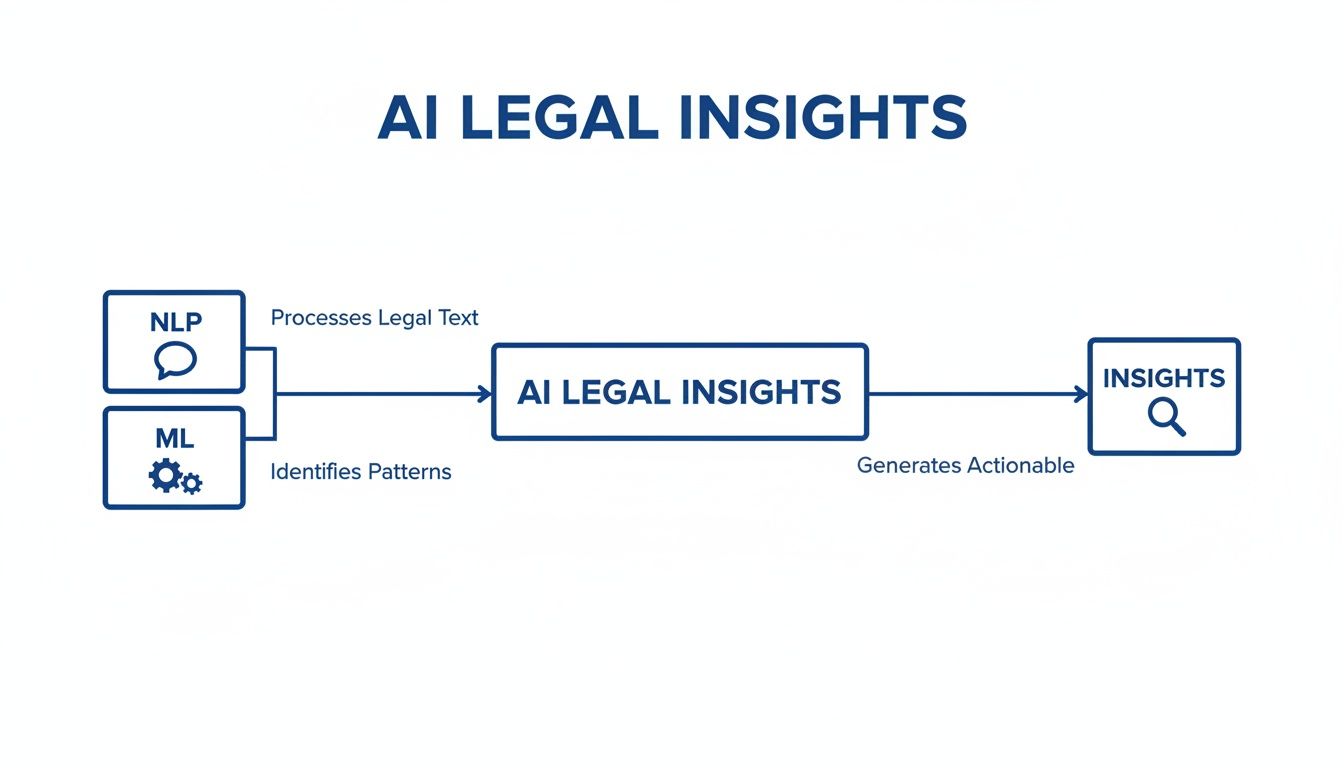
This flow from data to intelligence is what powers all the practical applications we’re about to cover.
Accelerating Litigation Preparation
For litigators, preparation is everything. AI acts like a tireless research assistant, digging up obscure precedents that could become the linchpin of an argument.
Imagine an associate drafting a motion to dismiss. Instead of spending days wrestling with Boolean searches, they can now ask a direct question and get a ranked list of the most relevant case law in minutes. It's a game-changer.
This speed lets legal teams explore more angles and pressure-test their arguments against a wider range of counter-arguments, especially once they adopt the kind of disciplined habits covered in how legal professionals effectively use AI for legal research. This isn't just about saving time; it's a strategic advantage that can directly influence the outcome of a case. It's no wonder that 38% of legal professionals already plan to use AI-powered predictive analytics for trial preparation.
Transforming Contract Review and Due Diligence
Transactional law is another area seeing massive benefits. Manually reviewing a 100-page contract to flag risky clauses or non-standard terms is a slow, error-prone grind. AI tools can perform this task in a fraction of the time with far greater consistency.
AI doesn't just find keywords in a contract; it understands context. It can identify a missing indemnification clause or flag a liability cap that deviates from industry norms—tasks that require both legal knowledge and painstaking attention to detail.
This is invaluable during due diligence for a merger or acquisition. An AI can analyze thousands of contracts and corporate records to pinpoint potential liabilities that a human team, facing a tight deadline, could easily miss.
Key applications include:
- Risk Identification: Automatically flagging ambiguous language, unfavorable terms, or missing clauses that create future legal exposure.
- Clause Extraction: Instantly pulling specific provisions (like change of control or confidentiality) from hundreds of documents into a single, organized summary.
- Compliance Checks: Comparing contract terms against internal playbooks or regulatory requirements to ensure consistency and adherence to standards.
By automating the initial slog, AI frees up attorneys to focus on high-value work like negotiation and strategic advice. You can explore more specific legal use cases for AI to see just how broad the applications are.
Building a Stronger Foundation for Your Arguments
Ultimately, the practical value of AI in legal research comes down to building a more solid foundation for every legal task.
Whether you're drafting a simple memo or preparing for oral arguments, the strength of your position depends on the quality of your research. These tools provide a deeper, broader, and faster way to gather the necessary evidence and precedents. For a deeper dive into modern research workflows, check out our guide on how to do legal research.
By integrating AI, firms aren't just becoming more efficient. They're equipping their teams to deliver higher-quality work and achieve better outcomes for their clients.
Integrating AI into Your Legal Practice

Bringing AI for legal research into your firm is a strategic move that can give you a serious competitive edge. But diving in without a plan is a recipe for wasted money and frustrated lawyers. A thoughtful, phased rollout is the key to making sure this investment actually pays off.
The journey starts with an honest look at your practice's biggest headaches. Where are the real bottlenecks? Is it the endless grind of initial discovery, the slog of complex contract reviews, or the constant struggle to keep up with compliance changes across different jurisdictions?
By zeroing in on these high-impact areas, you can figure out exactly where AI will deliver the most immediate and noticeable value. This isn't about solving every problem overnight. It's about targeting the specific workflows where a boost in efficiency will make a real difference, right away.
Choosing the Right AI Platform
Once you know what problems you need to solve, it's time to find the right tool for the job. Not all AI platforms are built the same, and the legal tech market is getting more crowded by the day. You have to look past the slick marketing and focus on what actually matters for your practice.
A truly useful platform is more than just a fancy chatbot. You need a comprehensive solution that brings together multiple functions essential to how your firm operates. You can get a head start by checking out our comparison of the best legal research tools for lawyers to see how the top contenders stack up.
When you're vetting potential platforms, make a checklist of your non-negotiables:
- Jurisdictional Coverage: Does this tool actually cover the federal and state case law your practice deals with every day? Is it up to date?
- Security Protocols: How is confidential client data being protected? Insist on enterprise-grade encryption and read their data privacy policies closely.
- Citation and Verifiability: The AI absolutely must provide clear, accurate citations for everything it generates. Your team needs to be able to verify sources in seconds.
- User Interface: Is the platform actually easy to use? A tool with a steep learning curve will just gather digital dust, no matter how powerful it claims to be.
Launching a Pilot Program
Instead of unleashing a new tool on the entire firm at once, start small with a pilot program. Pick a tech-savvy team or a specific practice group to test the platform on a handful of real cases. This gives you a controlled environment to see what it can really do.
Track the important metrics. How much time did the team save on their initial research? Did they uncover arguments or precedents they might have missed otherwise? The goal here is to gather hard data that shows a clear return on investment (ROI). That data is your best weapon for getting skeptical partners on board.
A successful pilot program does more than just prove the technology works; it creates internal champions who can advocate for broader adoption and share their positive experiences with colleagues.
This approach takes the risk out of the implementation. You get to work out all the kinks and answer tough questions on a small scale before you even think about a firm-wide launch.
Overcoming Adoption Hurdles with Training
Even with all the buzz around legal AI, adoption is still a mixed bag. North America is leading the charge, making up over 46% of the legal AI market, but plenty of lawyers around the world are still hesitant. Many are wary of relying on an algorithm for high-stakes decisions, fearing it might make a critical error or miss some crucial nuance. You can explore these global trends in this in-depth market analysis.
Good change management is what gets you over this hump. It starts with leadership communicating a clear message about why the firm is adopting AI—not as a replacement for lawyers, but as a tool to make them better, faster, and more effective.
And comprehensive training is simply non-negotiable. Don't just show your team how to log in. Run practical workshops that walk them through the kind of use cases they handle every week. When a lawyer sees firsthand how AI can help them build a stronger motion or analyze a dense contract in a fraction of the time, that skepticism quickly melts away. By taking these deliberate steps, your firm can confidently bring AI on board as a powerful new ally in the practice of law.
Navigating the Ethical and Practical Challenges
Let's be clear: while AI for legal research is a game-changer, adopting it responsibly means going in with your eyes wide open. These tools come with limitations, but they aren't roadblocks. Think of them as manageable risks that demand awareness and a smart game plan. The goal is to make this powerful technology serve your professional judgment, not replace it.
Topping the list of concerns for any lawyer is accuracy. Large language models, the engines behind many AI tools, can sometimes produce information that sounds completely authoritative but is flat-out wrong. This phenomenon has a name: "hallucinations." It’s when the AI essentially invents facts, cases, or citations that aren't grounded in its training data.
For a legal professional, building an argument on a fabricated case isn't just a mistake—it's a potential disaster that could lead to flawed legal strategy and even professional sanctions. This is exactly why human oversight isn't just a "best practice"; it's a non-negotiable part of any workflow involving AI.
Ensuring Accuracy and Avoiding Hallucinations
The most direct way to fight hallucinations is to demand verifiability. A dependable legal AI tool has to show its work, period.
The core principle is simple: if you can't verify the source, you can't trust the output. An AI-generated answer without a clear, accurate citation is just an unsubstantiated claim.
This is where platforms like LegesGPT make a real difference. By baking verifiable citations into every piece of legal information it surfaces, the system lets you click straight through to the original case law or statute. It closes the loop between AI-driven speed and the diligence your practice requires, making verification a seamless part of the process, not an extra chore.
Here are the essential checks for any AI-generated legal output:
- Source Verification: Does the citation actually link to a legitimate legal source?
- Contextual Relevance: Is the cited passage used correctly and relevant to your legal question?
- Current Validity: Has the case been overturned or the statute amended? The best tools are built on up-to-date legal data.
Protecting Client Confidentiality and Data Privacy
Beyond getting the facts right, data security is paramount. The entire legal profession is built on a foundation of trust and confidentiality. When you upload a client's sensitive contract or type details about a case into an AI platform, you need absolute certainty that the information stays protected.
This means you have to choose a platform with serious, enterprise-grade security. Look for vendors who are transparent about their data handling protocols, encryption standards, and who has access to what. Consumer-grade AI tools just aren't built to handle the sensitive nature of legal data, making a professional-grade solution a must-have.
It’s no surprise that while 50% of legal professionals who haven’t used AI tools worry about output quality, 13% are specifically concerned about data security. These aren't idle fears; they highlight why choosing a vendor that prioritizes both accuracy and privacy is critical.
The Indispensable Role of Human Oversight
Finally, we need to talk about algorithmic bias. AI models learn from the massive datasets they're trained on. If that data reflects historical biases—whether in case law or society at large—the AI can learn and even amplify them. An algorithm might, for example, give undue weight to certain legal arguments or precedents simply because they appear more frequently in the data, potentially skewing its output.
This is another area where a lawyer’s expertise is irreplaceable. Your role is to apply critical thinking, ethical judgment, and a deep understanding of legal nuance to whatever the AI gives you. The technology is a powerful assistant, one that can surface information and spot patterns you might miss. But the final strategic calls? Those must always remain in human hands.
Understanding these challenges—accuracy, security, and bias—and putting practical strategies in place allows law firms to confidently use AI for legal research to elevate their practice without compromising their professional or ethical duties.
To help your firm get started, we've put together a practical checklist to guide your conversations with vendors and internal teams.
A Practical Risk Mitigation Checklist for Legal AI
| Risk Area | Mitigation Strategy | Key Question to Ask Vendors |
|---|---|---|
| Accuracy & Hallucinations | Insist on tools with built-in, verifiable citations for every claim. Implement a mandatory "verify-then-trust" workflow for all AI-generated outputs. | "How do you ensure every piece of legal information is tied to a verifiable source? Can I see an example of your citation process?" |
| Data Privacy & Security | Choose enterprise-grade platforms with end-to-end encryption, clear data handling policies, and robust access controls. Avoid consumer AI tools for client work. | "Where is our data stored? Who has access to it? Are you SOC 2 compliant or do you follow equivalent security standards?" |
| Algorithmic Bias | Train legal teams to critically evaluate AI outputs for potential bias. Use AI as a starting point for research, not the final word. | "What steps have you taken to mitigate bias in your training data and algorithms? How do you test for and address biased outputs?" |
| Confidentiality | Confirm that your data is not used to train the vendor's public models. Ensure a strong data processing agreement (DPA) is in place. | "Does my firm's data, including our queries and uploaded documents, contribute to training your general AI models?" |
| Human Oversight | Establish clear firm-wide policies that define the role of AI as an assistant, not a replacement for professional judgment. Mandate human review on all critical work. | "What features does your platform have to facilitate human review and collaboration on AI-generated research?" |
By proactively addressing these areas, you can ensure that your firm's adoption of AI is not just innovative but also responsible, ethical, and secure. This isn't about avoiding risk entirely; it's about managing it intelligently.
So, What's Next? Putting AI to Work in Your Practice
The takeaway here is simple: AI for legal research isn't some far-off concept anymore. It's a practical, here-and-now tool that delivers real gains in speed, depth, and strategic insight. We’re seeing a fundamental shift in how lawyers prep for cases and build arguments, and these tools are at the heart of it. The legal field isn't adopting AI to replace lawyers, but to amplify their expertise.
Getting started isn't about chasing the newest shiny object. It’s a strategic move to give your practice the horsepower it needs to stay competitive and deliver better outcomes for your clients. The time to see what this technology can do for your firm is now, and it’s a lot more straightforward than you might think.
From Theory to Practice: Making the Leap
Moving forward starts with a quick, honest look at how you work today. The goal is to find the biggest time-sinks and resource drains in your practice—the exact spots where technology can give you the biggest lift.
- Find Your Biggest Bottleneck: Is it the slog of initial discovery? The headache of multi-jurisdictional research? Or maybe the tedious process of reviewing dense contracts? Pinpoint that pain, and you can find a tool that solves a real, immediate problem.
- Think Augmentation, Not Replacement: Frame this as a way to empower your team. The idea is to free them up from the grunt work to focus on the high-value strategic thinking that only a lawyer can do.
- Demand Verifiable Accuracy: Make sure any platform you look at, like LegesGPT, provides clear, direct citations for every single finding. Trust has to be built on a foundation of verifiable truth. No exceptions.
Adopting AI isn't really a technological overhaul. Think of it as a strategic upgrade—an investment in your firm's most valuable asset: the time and intellect of your legal professionals.
This is your chance to redefine what’s possible in your practice. By taking that first step to explore a platform built for the way modern lawyers work, you can start putting this powerful technology to use.
If you want to see exactly how AI for legal research can fit into your day-to-day, take a look at a solution built for precision and security. See how LegesGPT can transform your research and help you build stronger cases, faster.
Frequently Asked Questions
Is AI for Legal Research Secure Enough for Confidential Client Data?
Yes, but this is where you have to be careful. You should only consider enterprise-grade platforms built from the ground up with security in mind. The best tools use end-to-end encryption and follow strict data handling protocols specifically designed to protect client confidentiality. Always do your homework. Dig into a provider's security certifications and data policies to make sure they meet your firm's compliance standards and your ethical duties to protect sensitive client information.
Can AI Completely Replace Human Lawyers for Research?
Not a chance. Think of AI as the world’s fastest, most tireless paralegal, not a replacement for an attorney. It's incredibly good at the grunt work—sifting through mountains of data to find relevant cases, statutes, and documents in minutes instead of days. But the real work of a lawyer—strategic thinking, understanding legal nuance, advising a client, and using professional judgment—is still a fundamentally human skill. The winning combination is AI's speed paired with a lawyer's expertise and critical analysis. > AI handles the mechanical task of finding information, freeing you up to focus on the strategic work of building a winning argument. It's an amplifier for your expertise, not a substitute for it.
How Difficult Is It to Get a Legal Team Up and Running on These Tools?
It's far easier than you might think. Modern legal AI tools are designed to be intuitive. Many use simple, conversational interfaces that feel more like sending a message than constructing a complex search query. Most lawyers can get the hang of it in just a few hours. The learning curve is much gentler than with older, legacy research software. You don't need to master complicated Boolean search strings; you just ask questions in plain English. This makes getting your team on board a much faster and less disruptive process.
What Is the Typical Return on Investment for Adopting Legal AI?
The ROI shows up in a few key areas: a dramatic reduction in billable hours spent on research, the ability to handle more cases at once, and ultimately, better outcomes for clients. We consistently hear from firms that cut their initial research time from days down to a matter of hours. This efficiency boost is huge. It lets attorneys move on to higher-value strategic work, manage a larger caseload, and deliver results to clients faster. That directly improves both the firm's bottom line and client satisfaction, making the business case for adoption pretty clear. --- Ready to see how LegesGPT can transform your research workflows and deliver a measurable return? Explore our platform and start your free trial to experience the future of legal work.