
Any good lawyer will tell you that effective legal research comes down to a simple, repeatable process: frame the legal question, find the relevant law, and verify that what you found is still good law. Nail this workflow, and you'll move from uncertainty to a strong, defensible legal argument with speed and precision.
Your Blueprint for Effective Legal Research
This is your practical guide to conducting legal research in today's demanding environment. We're moving beyond dusty law books to the digital strategies that define efficient, modern practice. The platform you choose is part of that, and our guide to the best legal research tools compares the leading options. After all, successful research isn't just about finding information—it’s about finding the right information with confidence.
Modern legal research has become a critical productivity factor in a global legal services market worth over USD 1 trillion annually. For in-house teams, this is directly tied to the bottom line; median total legal spend hit USD 3.1 million in 2023. Since research hours are a huge part of that spend, even small efficiency gains can translate into massive savings. You can read the full report on the legal services market to see the complete financial breakdown.
The Modern Research Workflow
Having a structured method saves time, prevents errors, and helps you build stronger arguments from the get-go. It keeps you from falling into the common trap of diving into databases without a clear plan, a mistake that almost always leads to wasted hours and irrelevant results. A clear process ensures every step you take is purposeful.
This simple diagram breaks down the core process of any solid research project.
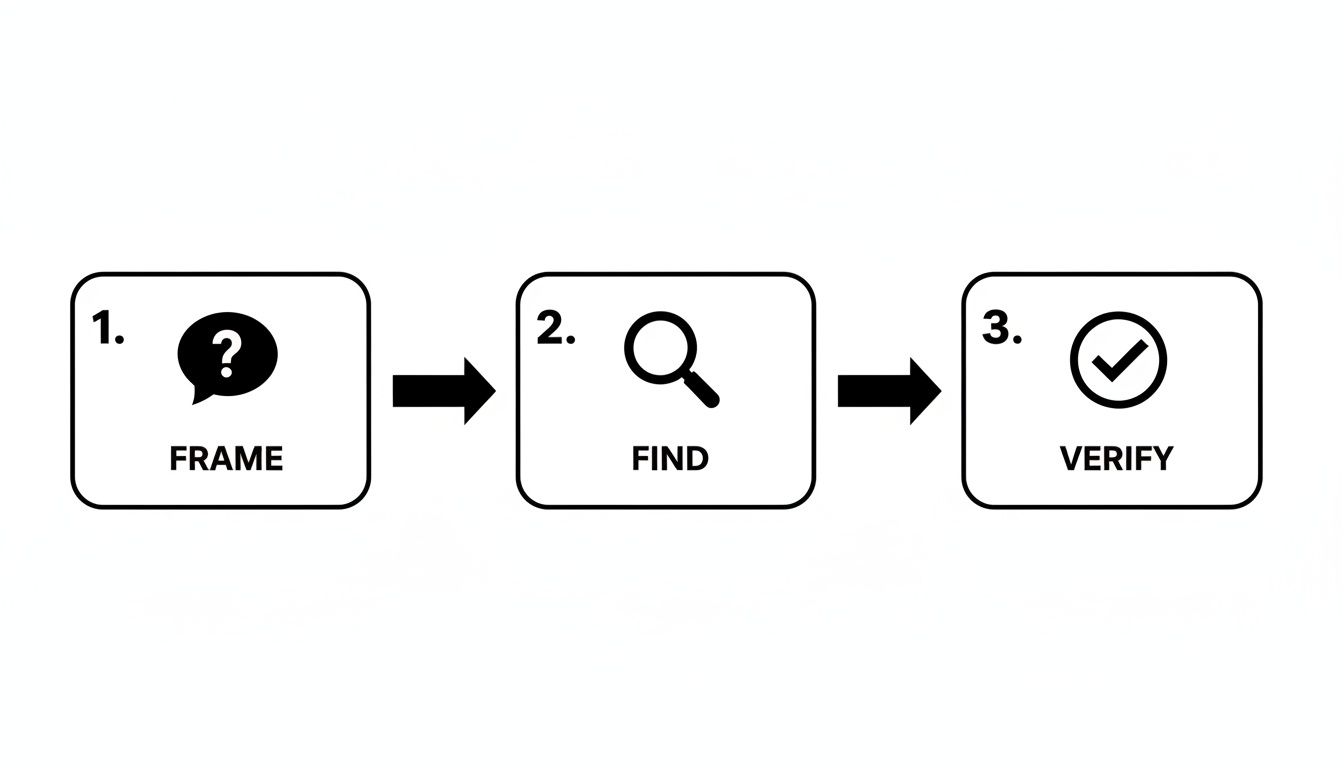
This workflow shows how each stage—framing the issue, finding the law, and verifying its status—is distinct but interconnected. One flows directly into the next.
This guide will walk you through a repeatable system built for today's legal landscape, covering everything from foundational steps to advanced techniques with a focus on practical application. The goal is to give you a reliable blueprint you can apply to any legal question, no matter how complex.
The core of excellent legal research isn't about knowing every law. It's about knowing how to find, interpret, and validate the specific law that applies to your unique situation. This skill is what separates good practitioners from great ones.
By mastering this system, you can expect to:
- Reduce Wasted Time: Stop chasing down irrelevant rabbit holes and focus only on what matters.
- Increase Confidence: Build arguments on a solid foundation of current, authoritative law.
- Improve Outcomes: Deliver more accurate, thorough, and persuasive legal analysis.
Whether you're a seasoned attorney, a paralegal, or a business owner trying to understand your obligations, this structured approach will change how you view legal challenges.
To help you visualize the entire process, here's a quick summary of the core components we'll be covering in detail.
Core Components of the Legal Research Workflow
| Stage | Objective | Key Action |
|---|---|---|
| 1. Define the Issue | Clarify the core legal question and relevant facts. | Conduct a client interview; use issue-spotting frameworks. |
| 2. Choose Jurisdiction | Identify which federal, state, or local laws apply. | Determine where the events occurred and where parties reside. |
| 3. Select Sources | Find both background context and binding authority. | Start with secondary sources (treatises) then move to primary (cases, statutes). |
| 4. Conduct Searches | Retrieve relevant documents from legal databases. | Use Boolean operators, natural language queries, and filters. |
| 5. Use a Citator | Verify that your legal authorities are still valid. | Shepardize (Lexis) or KeyCite (Westlaw) every primary source. |
| 6. Evaluate Authority | Determine if a source is binding or persuasive. | Analyze court hierarchy and the facts of the precedent case. |
| 7. Document & Cite | Organize your findings and create proper citations. | Use citation management tools and follow Bluebook or local rules. |
This table lays out the roadmap. Now, let’s dive into the first and most critical stage of this process.
Start by Defining Your Legal Question

Before you ever open a database or type a single search query, the most critical work begins. Every minute you spend right now clarifying the legal issue will save you hours of wasted, aimless searching later on. This isn't just a preliminary step; it's the foundation of your entire research project. Get this right, and everything else falls into place.
A vague starting point like, "Can my client sue their supplier?" is a recipe for disaster. It's an open invitation to go down a dozen different rabbit holes, none of which lead to a clear answer. You have to translate a messy, real-world problem into a precise legal question.
To do that, you need to dig into the facts. Who are the people involved? What, exactly, is the dispute about? Where did everything happen? And most importantly, what does the client actually want to achieve? Answering these questions turns a broad problem into a targeted mission.
Frame Your Issue with the TARP Method
One of the best frameworks I've found for breaking down a legal problem is the TARP method. It’s a simple acronym that forces you to identify the essential elements of any dispute, ensuring you have all the core facts before you start searching.
Here’s the breakdown:
- T (Thing or Subject Matter): What’s at the heart of the dispute? It could be something physical, like a defective piece of machinery, or intangible, like a business contract or a trademark.
- A (Action or Cause of Action): What is the actual legal claim? Think in terms of legal theories like "breach of contract," "negligence," or "wrongful termination."
- R (Relief or Remedy): What does the client want the court to do? This could be money (damages), an order to stop someone from doing something (injunction), or an order compelling them to follow through on a promise (specific performance).
- P (Parties): Who are the individuals or companies involved? Get specific about their roles—"landlord" and "tenant," not just "two people."
Running your facts through this method transforms a jumbled story into an organized set of searchable concepts. You're building the initial vocabulary that will guide you to the right statutes and case law.
Identify the Correct Jurisdiction
With a solid grasp of the facts, your next move is to pin down the correct jurisdiction. This is a crucial fork in the road. Getting it wrong means every case and statute you find could be completely irrelevant to your problem.
Does the issue fall under a federal law, like intellectual property or bankruptcy? Or is it a state-level matter, like most contract disputes and personal injury claims? The location where events happened and where the parties live or do business are the key signposts here.
Don’t just guess on jurisdiction. A contract signed in Texas between a company based in California and a supplier in New York could trigger the laws of multiple states. Sometimes, your first research task is simply figuring out which state's law even applies.
From Facts to Keywords
Now you’re ready to build your initial "search vocabulary." With your issue framed by TARP and your jurisdiction identified, you can generate a list of keywords and phrases that will become the building blocks for your database searches.
Let's walk through a quick example.
Scenario: A software company in Seattle finds out a former employee is now using their proprietary code at a competitor's office across town. The company wants the ex-employee to stop immediately and pay for any damages.
Here’s how we’d break that down using TARP to generate keywords:
| TARP Element | Scenario Details & Keywords |
|---|---|
| Thing | Proprietary software code, source code, trade secrets, confidential information |
| Action | Misappropriation of trade secrets, breach of non-disclosure agreement (NDA), copyright infringement |
| Relief | Injunction (to stop the use), monetary damages, compensatory damages |
| Parties | Former employee, current employer (competitor), software company |
| Jurisdiction | Washington state law (location of parties and actions), potentially federal law (copyright) |
See what we did there? We moved from a chaotic situation to a clear, organized research plan with a list of actionable search terms. Now you know exactly what you’re looking for and where to begin the hunt.
Navigating Primary and Secondary Sources

Once you’ve nailed down your legal question and jurisdiction, you’re faced with the next challenge: knowing where to actually look. The world of legal information is split into two camps: primary sources and secondary sources. Understanding the difference isn't just an academic exercise; it's a strategic choice that shapes your entire research plan.
Think of primary sources as the law itself. They’re the official, binding rules handed down by a government body with the authority to make them. They are the bedrock of any legal argument because they are what courts are obligated to follow.
Secondary sources, on the other hand, are everything written about the law. They describe, analyze, and critique it. While not legally binding, they are incredibly powerful tools for getting up to speed on a topic you know nothing about.
The Role of Primary Authority
Primary sources are the end game of your research because they represent binding or persuasive authority. Knowing the different types of primary sources of information is crucial for building a winning argument.
These are the sources you'll ultimately cite:
- Case Law: These are the written decisions from courts. Opinions from higher courts in your jurisdiction are binding authority, meaning lower courts have no choice but to follow them.
- Statutes: These are the laws passed by legislatures like Congress or a state assembly. You’ll find them organized and compiled in official codes.
- Regulations: Executive agencies like the EPA or SEC create these rules to carry out the mission given to them by statutes.
- Constitutions: As the supreme law of the land (or state), these documents establish the fundamental structure of government and are the ultimate legal authority.
No matter how persuasive a law review article seems, a statute or a controlling court opinion will always win. Your goal is to find and rely on these primary sources.
The classic rookie mistake is stopping at a secondary source. Never cite a treatise for a legal rule if you can find the actual case or statute it's talking about. Always, always go back to the source itself.
Using Secondary Sources Strategically
While primary sources are your destination, secondary sources are often the best map to get you there. Diving headfirst into a dense statute or decades of case law without any context is a recipe for frustration and wasted hours. A much smarter approach is to start broad and then narrow your focus.
Imagine you get a case involving a niche area of environmental law you’ve never touched before. Instead of trying to read the entire Clean Air Act from scratch, you could start with a legal treatise or encyclopedia on the topic.
Secondary sources serve a few key purposes:
- Education: They give you a comprehensive overview of a legal area, explaining the key concepts, historical context, and major tests courts use.
- Finding Primary Sources: The footnotes are a goldmine. The authors have already done the heavy lifting, and their citations point you directly to the most important statutes and cases.
- Learning the Lingo: They teach you the specific “terms of art” and keywords you’ll need to run effective database searches. For instance, reading up on recent developments in case law analysis from a secondary source can give you the vocabulary to find exactly what you need.
A Practical Workflow
The most effective researchers use both types of sources in a logical sequence. You start with secondary materials to build your foundation and then pivot to primary authority to construct your argument.
Start Broad (Secondary Sources):
- Legal Encyclopedias: Resources like American Jurisprudence (Am. Jur.) or Corpus Juris Secundum (C.J.S.) are fantastic for getting a high-level summary of almost any legal topic.
- Treatises: These are deep-dive books written by experts on a specific area of law, like the legendary Corbin on Contracts. They provide nuance and detailed analysis.
- Law Review Articles: Looking for an analysis of a narrow, developing, or controversial legal issue? Scholarly articles are your best bet. They often highlight circuit splits or propose new legal theories.
Then Get Specific (Primary Sources):
- Find the Statutes: Armed with keywords and concepts from your background reading, you can now locate the relevant sections in the official statutory code much more easily.
- Find Landmark Cases: The treatises and articles you read will have already pointed you to the most important, foundational cases. Start there.
- Expand Your Search: Use the cases you found as a launching point to find more recent decisions that cite them, bringing your research up to the present day.
This structured approach keeps you from getting lost in the weeds. You’ll build a solid understanding of the legal landscape before you start drilling down into the specific, binding rules that will ultimately decide your case.
Mastering Search Techniques in Legal Databases

Once you’ve framed your legal issue and picked your sources, it’s time to dive into the massive legal databases—the Westlaws and LexisNexises of the world. This is where the real work begins. But just typing a few keywords into the search bar is like trying to catch a specific fish with a giant net. You’ll get a lot you don’t need and probably miss what you were looking for.
Effective legal research means moving beyond basic keyword searches. You have to learn how to build queries with surgical precision.
This isn't just a matter of convenience; it's a professional necessity. Information overload is a huge problem in the legal field. Wolters Kluwer’s 2022 Future Ready Lawyer Survey found that 79% of lawyers see managing the rising volume and complexity of information as a top challenge, yet only 34% feel their organization is prepared for it. This gap is exactly why mastering search is no longer optional. You can see the full analysis of these legal industry trends to grasp the scale of the issue.
Constructing Powerful Search Queries
The secret to taming these databases lies in using special commands, often called Boolean operators and proximity connectors. These operators are like a secret language that tells the database exactly how to treat your search terms, turning a vague guess into a targeted command.
A simple search for "contract breach" might pull up thousands of irrelevant cases. But a well-crafted query can find only the cases where those two words appear in the same paragraph, instantly improving the quality of your results.
Professional legal research isn't just about finding documents that contain your keywords. It's about finding documents where those keywords appear in a meaningful, legally relevant relationship to one another.
Common Boolean Operators and Search Modifiers
Here’s a quick reference table for the most essential search operators you’ll use in any database. Knowing these by heart will save you countless hours.
| Operator/Symbol | Function | Example Usage |
|---|---|---|
| AND | Narrows results; finds documents containing all specified terms. | "fiduciary duty" AND "misappropriation" |
| OR | Broadens results; finds documents with at least one of the terms. | "trade secret" OR "confidential information" |
| /p | Finds terms within the same paragraph. | "wrongful termination" /p "at-will employment" |
| /s | Finds terms within the same sentence. | "defective product" /s "strict liability" |
| " " | Searches for an exact phrase. | "summary judgment" |
| ! or * | A root expander that finds variations of a word root. | negligen! (finds negligent, negligence, etc.) |
Mastering these connectors allows you to define the precise context you need, which is the absolute foundation of efficient research.
A Practical Search Example
Let's put this into practice. Imagine you need to find cases in the Ninth Circuit from the last five years that discuss a "breach of fiduciary duty" specifically in the context of a corporate director.
A novice search might look like this: breach of fiduciary duty corporate director
This will pull in a ton of noise. A much more powerful query would be: ("breach of fiduciary duty" /p "corporate director")
This refined search tells the database to only return cases where the exact phrase "breach of fiduciary duty" appears in the same paragraph as "corporate director." From there, you just need to apply filters.
- Jurisdiction Filter: Select "Federal" and then "9th Circuit."
- Date Filter: Set a custom range for the last five years.
- Court Level Filter: You could even specify "Court of Appeals" to exclude trial court decisions if you want.
By combining a strong query with precise filters, you can shrink a sea of thousands of potential results down to a handful of highly relevant cases in just a few minutes. This is the core skill of modern legal research. For more on this, you can explore our guide on the best legal research tools for lawyers to see which platforms offer the most robust filtering options.
Verifying Your Sources with Citators
Finding a case that looks perfect for your argument is only half the battle. The final, non-negotiable step is to verify that it's still "good law." Case law is a living thing; a new decision from a higher court can overturn a previously solid precedent overnight, making it completely worthless to you.
This is where citators come in. These are tools built into legal databases, with the most famous being Shepard's on LexisNexis and KeyCite on Westlaw. A citator does two critical things:
- Checks Validity: It tells you if your case has been reversed, overruled, or criticized by later court decisions. You’ll see visual cues, like a red flag or a yellow triangle, that immediately alert you to negative treatment.
- Finds Related Authorities: It gives you a list of every other case, statute, and law review article that has ever cited your case. This is an incredibly powerful way to find more recent and relevant authorities on your topic.
Ignoring the citator is one of the most dangerous mistakes you can make in legal research. Relying on a case that’s been overturned will destroy your credibility and undermine your entire argument. Always check your sources.
Leveraging AI for Smarter Legal Research
The next big leap in legal research is already here, and it's driven by artificial intelligence. AI is fundamentally changing the old workflows, moving us far beyond the clunky keyword-and-connector searches we all learned. It's about understanding legal concepts, context, and intent—not just matching words on a page. To see this in practice, our guide on how legal professionals use AI for legal research walks through the workflows that actually save time, and our ranking of the best AI tools for legal research compares the platforms that cite real law.
Instead of wrestling with Boolean operators, you can now ask a direct question in plain English. For example, you can simply ask an AI assistant to "summarize the controlling case law on the 'inevitable disclosure' doctrine in the Seventh Circuit" and get a structured, coherent answer in seconds. This isn't just faster; it's a smarter way to work.
The Rise of AI Legal Assistants
This new wave of technology, including tools like LegesGPT, acts more like a highly capable research assistant than a static database. These platforms are built to grasp the nuances of legal questions and deliver synthesized answers complete with verifiable citations. This directly solves one of the biggest time-sinks in traditional research: manually piecing together a coherent narrative from dozens of different documents.
Here are a few ways this new approach makes a real difference in daily practice:
- Instant Summaries: Get a quick, accurate summary of a lengthy judicial opinion or a dense statute before you commit to reading the whole thing.
- Document Analysis: Upload a contract or pleading, and the AI can flag potential risks, pull out key clauses, and even suggest language to strengthen your position.
- Conceptual Exploration: Ask broad questions about a legal doctrine to quickly build your foundational knowledge before diving deep into the primary sources.
These features let you get to the heart of the matter faster, freeing up your time to focus on strategy and crafting better arguments. You can see how a purpose-built AI legal chatbot can handle these complex questions and provide answers with direct citations.
Navigating Ethical Considerations
The power of AI in legal research comes with serious responsibilities. Accuracy, client confidentiality, and avoiding the unauthorized practice of law are non-negotiable. It's a tension the industry is grappling with.
A 2023 LexisNexis survey found that while 77% of legal professionals see AI positively, 87% named ethics and accuracy as their top concerns. This shows a clear demand for domain-specific tools built on a foundation of verifiable sources.
AI is a powerful tool, not a replacement for a lawyer's professional judgment. The final word on any legal conclusion must always come from a qualified human who has verified the AI's output against primary sources.
The most talked-about risk is "hallucinations," where an AI confidently invents information, including completely fake case citations. In law, this is a catastrophic failure. It’s absolutely vital to implement strategies to reduce AI hallucinations and demand accuracy. This is why tools that ground their answers in a closed, verifiable database of case law and statutes are the only responsible choice for professional use.
Below is an example of an AI interface designed specifically for legal work, with a clear emphasis on verification and source transparency.
This design gets right to the point. It lets you ask questions in plain English and receive structured answers that are directly tied to real sources.
Always treat AI-generated content as a starting point—think of it as an incredibly fast, well-organized first draft of your research memo. Your professional duty is to take that draft, check every single citation, analyze the sources in their full context, and apply your own legal reasoning to reach a final, defensible conclusion.
Frequently Asked Questions
How Do I Know When I’m Done Researching?
There's no magic bell that rings, but you get a feel for it. The clearest sign is when you start seeing the same cases and statutes cited over and over again in different sources. You're hitting a point of saturation. When every new search path leads back to authorities you've already found, and your citator checks confirm you have the latest, most relevant cases, you’re probably there. The goal isn't to read everything ever written on a topic. It's to be confident you've found the controlling law for your specific facts and can explain the legal landscape without being surprised.
What Are the Biggest Mistakes People Make?
It's easy to fall into a few common traps, especially when you're just starting out or under a tight deadline. Steering clear of these will make your research faster and far more reliable. Here are the pitfalls I see most often: • A Vague Starting Point: Jumping in without a clearly defined legal question and jurisdiction is a recipe for hours of aimless, frustrating searching. • Stopping at Secondary Sources: Treatises and law review articles are great maps, but they are not the destination. It's a critical error to rely on them without pulling and reading the primary cases and statutes they cite. • Skipping the Citator: This one is non-negotiable. Forgetting to use a citator to confirm a case is still "good law" can completely torpedo your argument. • Overly Broad Searches: Using generic terms that pull up thousands of irrelevant hits wastes your most valuable resource: time. • Quitting Too Soon: Finding one good case feels great, but it’s dangerous. The next case you find could be the one that completely changes the analysis. > The most dangerous assumption in legal research is that the first good case you find is the last word on the subject. The law is constantly evolving; what was true last year might not be true today. Always verify, always update.
How Can I Do Legal Research on a Tight Budget?
You absolutely do not need an eye-watering subscription to a major legal database to do effective research. This is a huge challenge for solo practitioners and small firms, but it’s completely solvable if you know where to look. Start with free government resources. Official state legislature websites are the definitive source for statutes. Federal court sites, accessible via PACER for minimal cost, give you direct access to case law. Here are some other go-to options for budget-friendly research: • Google Scholar: Don't underestimate it. Google Scholar has a surprisingly robust and searchable database of state and federal cases, and it's completely free. • Local Law Libraries: County and university law libraries are gold mines. Most provide free on-site access to premium databases like Westlaw or LexisNexis. Some even offer remote access to local residents. • AI-Powered Tools: Newer platforms often have more flexible pricing, like free trials or pay-as-you-go plans, making them a great cost-effective alternative for specific research tasks. It takes a bit more legwork to piece things together, but you can get excellent results without breaking the bank.
What’s the Difference Between Binding and Persuasive Authority?
Getting this right is fundamental. The weight an authority carries in your argument depends entirely on whether a court must follow it or just may consider it. Binding authority (also called mandatory authority) is law a court has no choice but to follow. Think of it as a direct order. This includes: • Statutes from the legislature governing that court. • Decisions from a higher court within the same judicial food chain. For example, a California Superior Court is absolutely bound by a ruling from the Supreme Court of California. There's no wiggle room. Persuasive authority, on the other hand, is anything a court can look to for guidance but isn't required to follow. This bucket includes: • Decisions from courts in other states. • Opinions from lower courts in the same jurisdiction. • Secondary sources like treatises, law review articles, and legal encyclopedias. While it isn't controlling, persuasive authority can be incredibly powerful, especially when you're dealing with an "issue of first impression"—a legal question the court hasn't decided before. A well-reasoned opinion from another state's supreme court can give a judge a solid framework for their own thinking. --- Ready to transform your legal research from a time-consuming chore into a strategic advantage? LegesGPT uses AI to provide instant, structured answers with verifiable citations, helping you build stronger arguments faster. Start your free 3-day trial and experience a smarter way to work by visiting https://www.legesgpt.com.