
AI adoption at law firms has moved from experiment to expectation, and the question in 2026 is no longer whether one associate should try a chatbot but which tools the whole practice should standardize on. Firms that roll out AI across legal research, document review, drafting, intake, and billing close matters faster, catch more risks, and spend fewer billable hours on routine work than firms that still do everything manually.
The market is crowded, though, and the tools are not interchangeable. A research platform grounded in Westlaw content solves a different problem than a Word add-in that redlines contracts, or a practice management suite that automates intake and billing.
In this guide we compare the 7 best AI tools for law firms in 2026 from the firm's side of the table: what to standardize on across intake, practice management, billing, document automation, and research, and how to roll it out firm-wide. (If you are choosing an assistant for your own desk rather than for the practice, see our separate roundup of the best AI legal assistants.) For each tool you get what it actually does, key features, real pricing where it is published, honest pros and cons, and a decision framework to pick the right stack for your firm.
TL;DR: For most law firms, LegesGPT is the best AI tool in 2026: verified-citation legal research, document review, and contract drafting in one platform from $19.99/month with a 3-day $1 trial. Thomson Reuters CoCounsel Legal wins for Westlaw-centric firms, Lexis+ with Protégé for Shepard's-validated research, Bloomberg Law for clause benchmarking, Clio for firm operations, Harvey for Am Law 100 scale, and Spellbook for Word-native contract redlining.
Best AI tools for law firms: a brief overview
- LegesGPT: Best overall for law firms. Combines cited legal research, document review, and clause-by-clause contract drafting at a self-serve price.
- Thomson Reuters CoCounsel Legal + Westlaw Advantage: Best for firms already in the Westlaw ecosystem that want agentic AI grounded in editorially enhanced content.
- LexisNexis Lexis+ with Protégé: Best for citation-validated research. Every AI answer can be checked with the integrated Shepard's Citations Service.
- Bloomberg Law: Best for transactional teams that want clause benchmarking backed by EDGAR market data.
- Clio Manage AI + Clio Draft: Best for law firm operations. Automates intake, calendaring, billing narratives, and court forms.
- Harvey: Best for Am Law 100 firms and large legal departments that need secure, customizable AI at enterprise scale.
- Spellbook: Best for contract drafting and redlining inside Microsoft Word.
| Tool name | Key strength | Pricing | Platforms |
|---|---|---|---|
| LegesGPT | Cited research, document review, and contract drafting in one platform | From $19.99/month; 3-day $1 trial | Web |
| Thomson Reuters CoCounsel Legal + Westlaw Advantage | Agentic AI grounded in Westlaw editorial content | Custom quote | Web |
| LexisNexis Lexis+ with Protégé | Shepard's-validated AI research and drafting | Custom quote | Web, DMS integrations |
| Bloomberg Law | Clause benchmarking with EDGAR market data | Custom quote | Word, Web |
| Clio Manage AI + Clio Draft | Practice automation from intake to billing | Published per-user tiers; free trial | Web |
| Harvey | Secure enterprise AI workflows at scale | Custom quote, enterprise only | Web |
| Spellbook | Drafting and redlining inside Word | Team licensing; 7-day trial | Word add-in |
1. LegesGPT, best overall AI platform for law firms
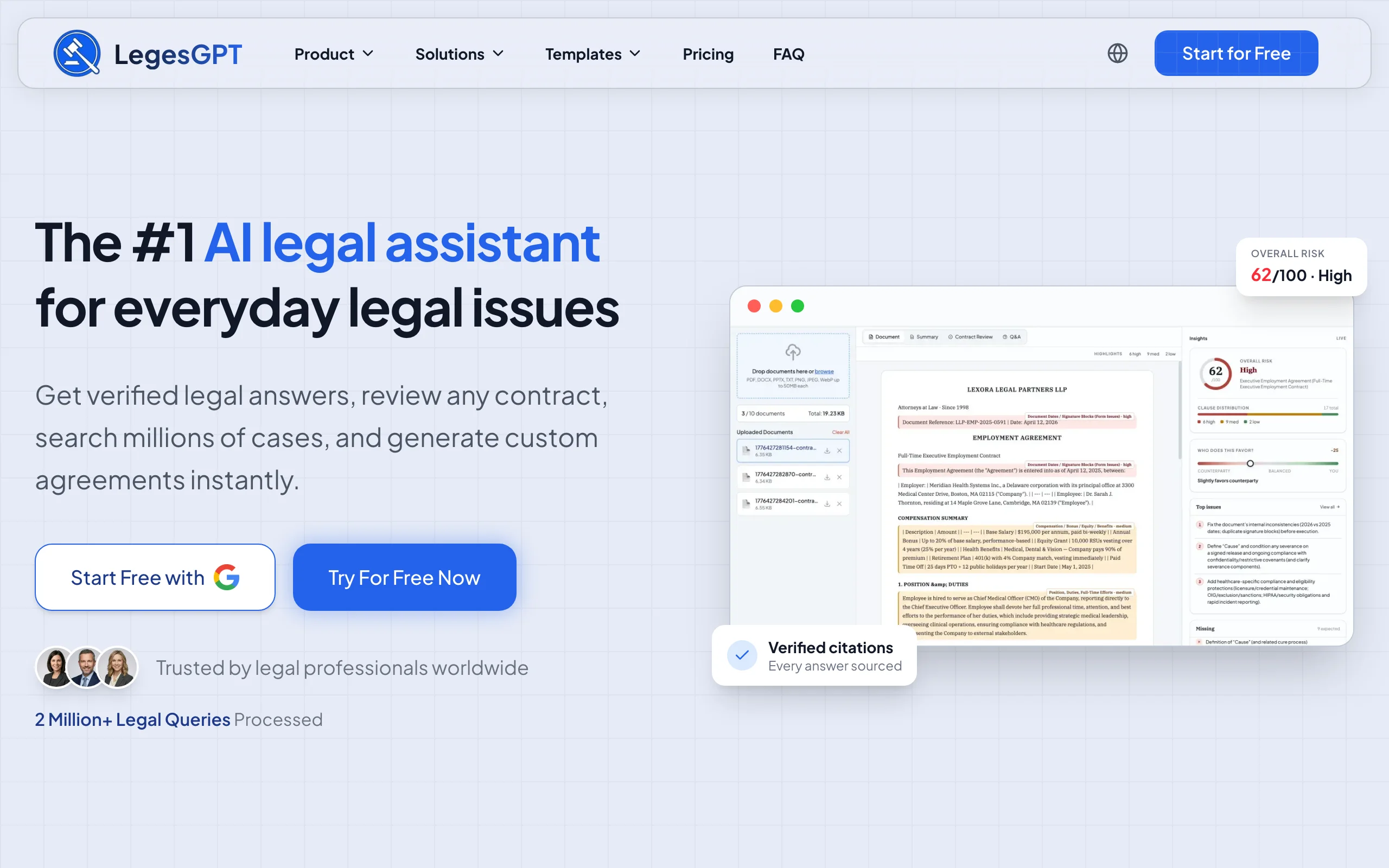
LegesGPT is an all-in-one AI legal platform built around the daily work of a law firm: research, document review, and drafting. Ask a legal question in plain language and it answers with verified citations that link to the underlying case law and statutes, so an associate can validate an argument or prepare for a deposition without opening a second research subscription.
The same workspace handles documents. Upload contracts, discovery documents, or images of legal text and the AI extracts key terms, flags risks, and produces plain-language summaries, and you can chat with a document to drill into specific clauses. When the firm needs new paper, the drafting flow produces agreements clause by clause from a plain-English description, then adds a signature and exports a ready-to-send PDF or editable DOCX.
Key features
- Citation-backed answers to plain-language legal questions, with direct links to the case law and statutes behind them
- Case law and statute search for building arguments and validating precedents
- AI document review with risk flags, key-term extraction, summaries, and chat-with-document
- Clause-by-clause AI contract drafting with signature and PDF/DOCX export, plus 100+ free legal templates
- Deep Research mode with real-time web search for fast-moving legal questions
Best for
- Solo lawyers and 2-50 attorney firms that want research, review, and drafting in one subscription
- Litigation teams that need cited answers fast, without an enterprise contract
- Transactional practices drafting and reviewing recurring agreements
Pricing
- Basic: $19.99/month for cited research, document upload and review, and Deep Research
- Plus: $49.99/month adds AI document generation, 50 document reviews per month, and priority support
- Premium: $99.99/month unlocks unlimited document review
- 3-day trial for $1; annual billing saves 30% (see LegesGPT pricing)
Pros
- One platform covers research, review, and drafting, so smaller firms avoid stacking three subscriptions
- Verified citations reduce hallucination risk compared with general-purpose chatbots
- Self-serve signup with transparent pricing and no sales cycle
Cons
- Newer brand with a smaller market footprint than Westlaw or LexisNexis
- Web-only: no Word add-in or public API
2. Thomson Reuters CoCounsel Legal + Westlaw Advantage, best for firms in the Westlaw ecosystem
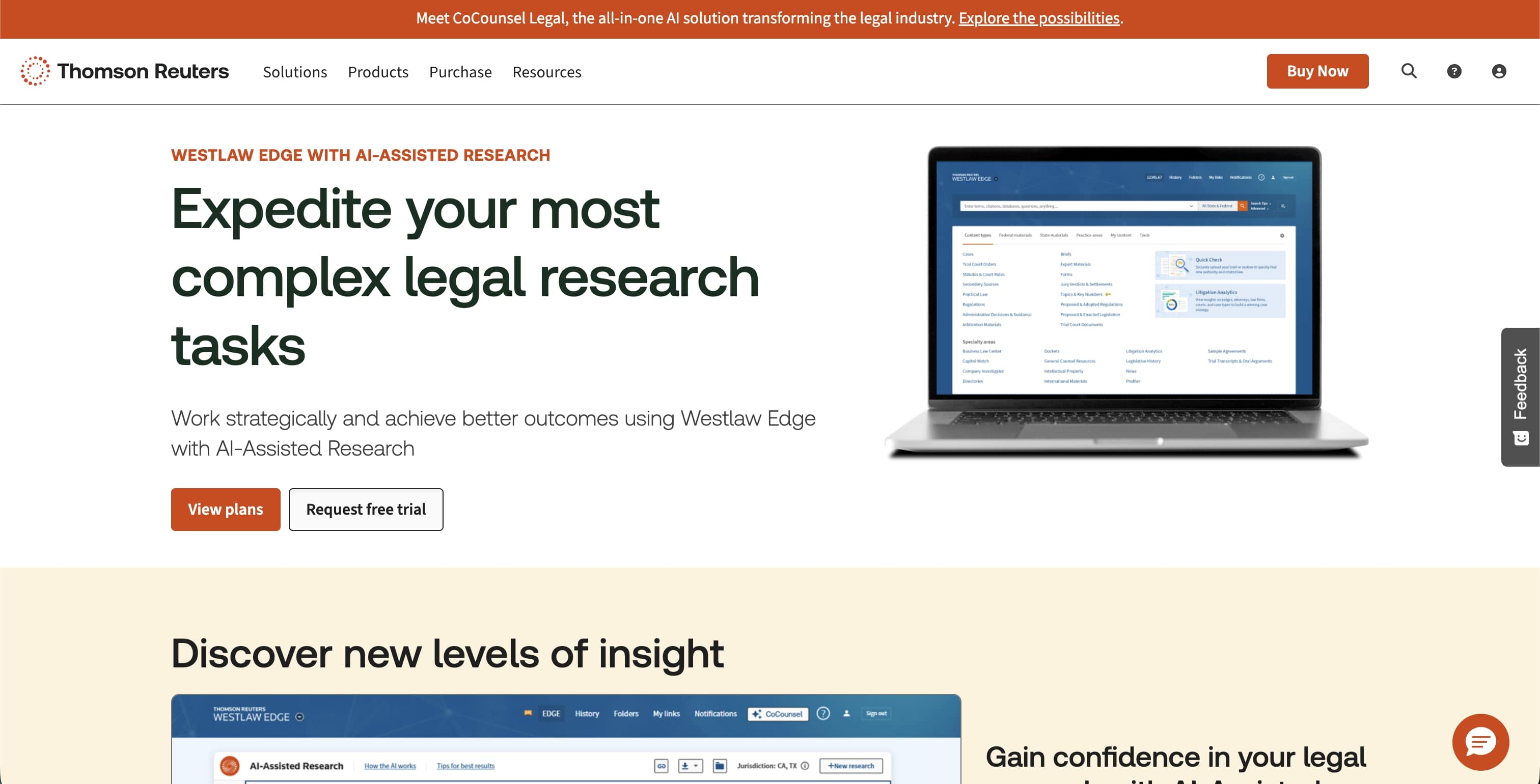
Thomson Reuters pairs its authoritative legal content with agentic AI across Westlaw Advantage (the successor to Westlaw Precision) and CoCounsel Legal, which relaunched as a fully agentic platform in August 2026. Its differentiator is grounding: AI outputs draw on editorially enhanced primary and secondary sources, the Key Number System, and headnotes, which keeps research answers relevant and verifiable for high-stakes work.
CoCounsel extends that foundation into workflow skills. It drafts legal memoranda, analyzes document sets for key facts, and helps prepare for depositions by summarizing complex case files. For litigators, Claims Explorer analyzes a fact pattern and returns potential causes of action with supporting case law.
Key features
- AI-assisted research that answers complex legal questions with narrative responses citing Westlaw content
- CoCounsel drafting and summarization for memos, briefs, and client communications
- Document review across large volumes to extract clauses and find case-relevant evidence
- Claims Explorer for mapping fact patterns to potential causes of action
Best for
- Am Law 200 firms and corporate legal departments
- Practices already relying on Westlaw Precision or Westlaw Advantage and Practical Law
Pricing
- Enterprise subscription with custom quotes based on firm size, practice areas, and features
- Best value when bundled with existing Thomson Reuters products
Pros
- The most authoritative U.S. editorial content behind any legal AI
- Trusted citator and Key Number System grounding for reliable outputs
Cons
- Pricing is opaque and requires a sales process
- Full value depends on committing to the broader Thomson Reuters ecosystem
3. LexisNexis Lexis+ with Protégé, best for Shepard's-validated research
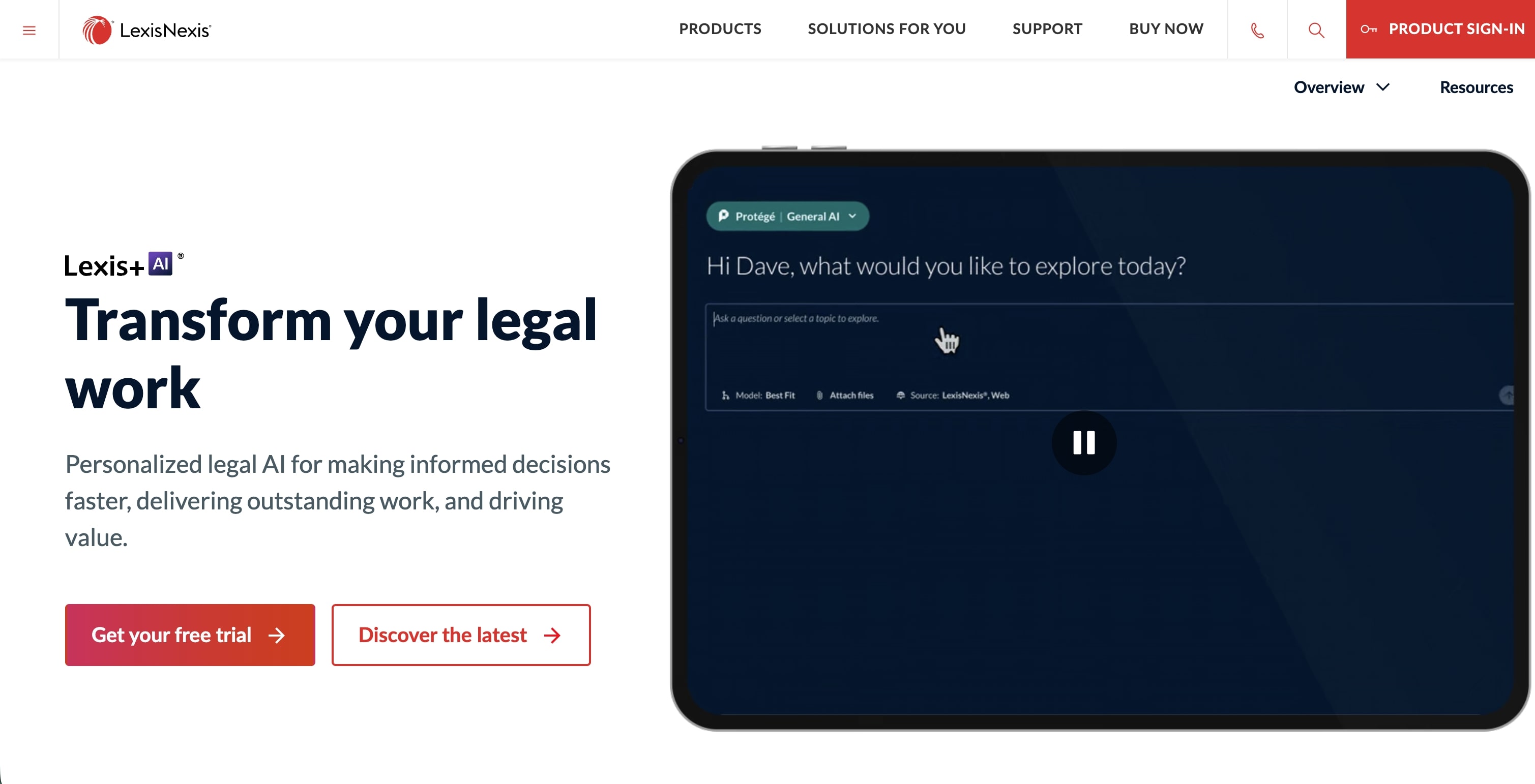
Lexis+ with Protégé, which replaced Lexis+ AI in February 2026, is the LexisNexis answer to verified generative AI. Its core promise is that every AI output is grounded exclusively in the LexisNexis repository, and every citation can be checked with the integrated, industry-standard Shepard's Citations Service. That citation-first approach directly targets the hallucination risk that keeps many firms away from general-purpose AI.
Beyond research, the Protégé assistant drafts contracts, motions, and client letters as review-ready Word documents, analyzes uploaded documents to extract arguments and facts, and Protégé Workrooms give firms secure shared spaces for working with clients and co-counsel. Integrations with document management systems like iManage and SharePoint embed the AI in existing firm workflows and keep sensitive client data in a controlled environment.
Key features
- Conversational research with summarized answers and direct links to source material
- AI drafting for demand letters, clauses, and motions with jurisdictional awareness
- Document upload for analysis, summarization, and argument extraction
- Shepard's validation on citations, plus iManage and SharePoint integrations
Best for
- Firms of all sizes already invested in the LexisNexis ecosystem
- Legal teams where citation validation is non-negotiable
Pricing
- Custom subscription pricing, typically bundled with a broader Lexis+ subscription
Pros
- Industry-standard citator integrated into the AI workflow
- Secure enterprise integrations for document-heavy practices
Cons
- Quote-only pricing and ecosystem lock-in similar to Westlaw
4. Bloomberg Law, best for data-backed clause benchmarking
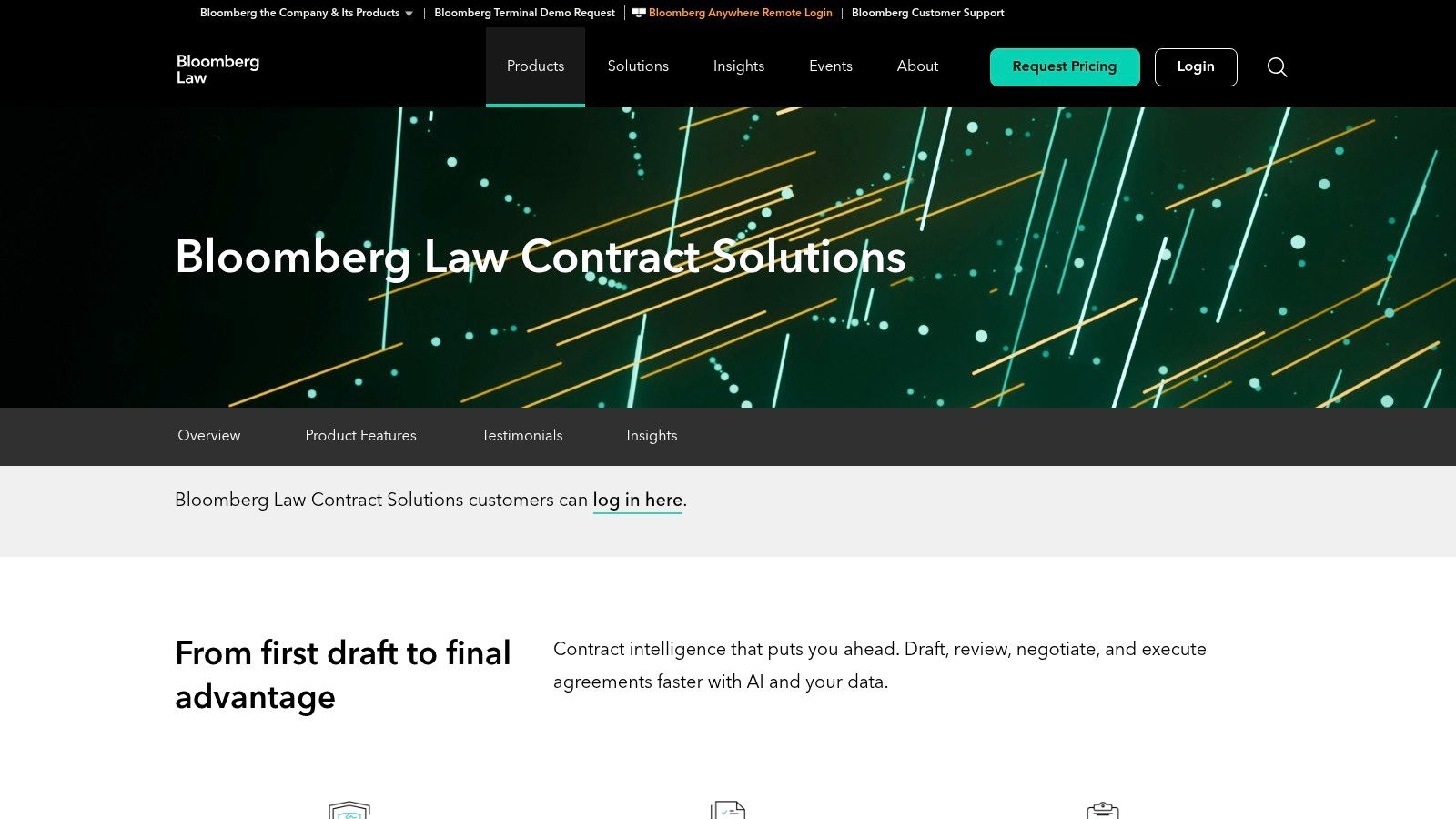
Bloomberg Law carves out a transactional niche by combining legal research with financial data analytics inside the contract workflow. Tools like Draft Analyzer, Clause Adviser, and Contract Assistant work directly in Microsoft Word, so attorneys can redline, benchmark, and standardize clauses without switching contexts.
The unique asset is data: clause language is benchmarked against millions of agreements in the EDGAR database, giving negotiation positions an empirical footing most competitors cannot match. AI research features like Points of Law help distill complex arguments and surface seminal cases.
Key features
- Draft Analyzer and Contract Assistant inside Word for clause guidance and draft comparison
- Clause Adviser benchmarking against millions of EDGAR contracts
- Intelligent playbooks to enforce firm-wide contract standards
- Points of Law and AI research enhancements for faster case-finding
Best for
- In-house legal departments and law firm transactional teams
- Practices standardizing contract language with data-driven guidance
Pricing
- Enterprise subscription; custom quote via consultation
Cons
- Enterprise focus with no self-serve option
- Strongest for transactional work; less relevant for litigation-first firms
Pros
- Word-native workflow with no context switching
- Proprietary market data behind every clause recommendation
5. Clio Manage AI + Clio Draft, best for law firm operations
Clio embeds AI into the most widely used cloud practice management platform, targeting the administrative bottlenecks that quietly consume billable hours. Manage AI parses court filings into calendar entries, summarizes client communications, and generates billing narratives; Clio Draft automates document assembly and fills U.S. court forms from case data.
This is operational AI rather than deep legal research, and that is its strength: the wins are immediate, measurable, and require almost no training for staff who already live in Clio.

Key features
- Court filing PDFs turned into structured data and calendar events automatically
- AI summaries of case developments and client communications
- Billing narrative generation and task prioritization
- Clio Draft templates and extensive U.S. court form libraries
Best for
- Solo practitioners and small to mid-size firms
- Firms that want operational efficiency inside their existing practice management hub
Pricing
- Transparent per-user monthly or annual tiers; AI features in higher tiers or as add-ons
- Free trials available
Pros
- Published pricing and a low learning curve
- Practical automation across intake, calendaring, and billing
Cons
- Not a legal research or contract analysis tool
- Court form automation is U.S.-centric
6. Harvey, best for Am Law 100 and enterprise legal teams
Harvey is a purpose-built AI platform for elite law firms and corporate legal departments. Its standout capabilities are Vault, a secure workspace for analyzing confidential documents without exposing them to model training, and Workflow Agents that automate entire multi-step task chains like due diligence reviews or compliance checks. The Knowledge product returns citable answers to research questions.
Harvey's enterprise-grade security and customization have driven significant adoption among Am Law 100 firms, and that is exactly who it is built for: organizations deploying AI at scale on sensitive matters.
Key features
- Vault secure workspaces for confidential document analysis
- Workflow Agents for repeatable multi-step processes like lease reviews and due diligence
- Citable research answers grounded in authoritative sources
- Enterprise security and custom deployment options
Best for
- Am Law 100 firms and global professional services organizations
- Large in-house departments deploying AI across many teams
Pricing
- Enterprise subscription through a direct sales process; no public pricing
Pros
- Best-in-class security posture for sensitive client matters
- Proven adoption at the largest firms in the market
Cons
- No self-serve access, trials, or published pricing
- Procurement and onboarding are built for large organizations, not small firms
7. Spellbook, best for Word-native contract redlining
Spellbook brings AI contract review, drafting, and negotiation directly into Microsoft Word, which is why its adoption curve is so fast: lawyers keep working in the document they already have open. It suggests alternative clauses in real time, flags aggressive or missing terms, and summarizes agreements for clients.
Playbooks let firms codify negotiation stances and review standards so every contract is checked against the same positions, and the Associate agent reviews multiple documents in tandem for consistency and cross-references.
Key features
- Real-time drafting and redlining suggestions inside Word
- Detection of unusual, risky, or missing clauses in third-party paper
- Playbooks that standardize the firm's negotiation positions
- Associate agent for multi-document consistency review
Best for
- Small and mid-size firms with a transactional focus
- Contract teams that live in Microsoft Word
Pricing
- Team-based licensing with a custom quote
- 7-day free trial to validate fit before committing
Pros
- Near-zero learning curve for Word-centric lawyers
- Fast, visible time savings on contract review and markup
Cons
- Focused on transactional work only
- Per-seat licensing requires a sales conversation
How to choose the best AI tool for your law firm
There is no single best tool for every firm; there is the best tool for your workflow, budget, and existing stack. Work through these four questions.
1) Match the tool to your primary workflow
- If research is the bottleneck: LegesGPT for self-serve cited answers, or CoCounsel Legal and Lexis+ with Protégé if you are already paying for their content ecosystems
- If contracts are the bottleneck: Spellbook for Word-native redlining, Bloomberg Law for clause benchmarking, LegesGPT for drafting plus review in one place
- If operations are the bottleneck: Clio for intake, calendaring, and billing automation
2) Match the tool to your firm's size and budget
- Solo and small firms should start with published, self-serve pricing: LegesGPT from $19.99/month or Clio's per-user tiers
- Am Law and enterprise teams with procurement processes can justify Harvey, CoCounsel Legal, Lexis+ with Protégé, or Bloomberg Law quotes
- Run the price-to-value math: an enterprise platform must save many associate hours per month to beat a $19.99 subscription that covers most of the same daily tasks
3) Decide whether to build on your existing stack
- A Westlaw firm gets compounding value from CoCounsel Legal; a Lexis firm from Lexis+ with Protégé
- Word-centric contract teams should shortlist Spellbook and Bloomberg Law first
- If you are not locked into any ecosystem, a standalone platform like LegesGPT avoids paying for content you will not use
- If your practice centers on M&A and deal work, our roundup of the best AI tools for corporate lawyers breaks down options for transactional teams
4) Pilot with a small team before a firm-wide rollout
Pick one tech-receptive team and a narrow, measurable use case: 20 standard agreements through a contract tool, or three research memos through an AI assistant. Define KPIs up front (time saved, error rate, billable hours recovered, user satisfaction), train the pilot team on prompting and limitations, and run a security review before expanding. For the wider stack beyond AI, see our roundup of the best legal tech tools for law firms.