
At its heart, statutory interpretation is the art and science of figuring out what a law actually means. Legislatures write the laws, but it’s up to lawyers and judges to apply those words to messy, real-world situations—especially when the language is vague or a scenario pops up that lawmakers never saw coming.
Deciphering the Language of Law
Think of it like being a detective for legal texts. Laws are written down, but words aren't always crystal clear. The world also has a knack for changing in ways no one could have predicted. This creates a core problem: How do we take a law written years ago and apply it fairly to a dispute happening today? That’s where interpretation comes in.
Let's take a simple example. Imagine a local ordinance that states, "No vehicles are allowed in the park." On the surface, that seems straightforward. But what happens when real life intervenes?
- Does this rule ban a toddler's toy car?
- What about an ambulance rushing to an emergency inside the park?
- Or a motorized wheelchair that someone with a disability relies on to get around?
A judge can't just flip a coin. They need a consistent, structured method to determine what the city council meant by the word "vehicle." This process isn't about guesswork; it's about preventing arbitrary rulings and ensuring the law is applied the same way for everyone. It involves a careful look at the text, how the law is put together, and sometimes, the original problem the law was designed to solve.
The Two Major Philosophies
The entire field really boils down to a tug-of-war between two main philosophies. On one side, you have textualism, which is all about sticking to the ordinary, dictionary meaning of the words in the statute. A textualist judge would say their job is to enforce what the law says, not to speculate on what the legislature might have intended.
On the other side is purposivism. This approach encourages judges to look beyond the black-and-white text to understand the law's underlying purpose—the "mischief" it was created to fix. A purposivist would dig into legislative history and context to avoid a result that, while technically correct, feels completely absurd or goes against the spirit of the law.
These ideas aren't new. Their roots stretch all the way back to 16th-century English common law. Early courts came up with frameworks like the literal rule, the golden rule (to avoid nonsensical outcomes), and the mischief rule, which was famously laid out in Heydon's Case (1584). In the United States, the landmark case Church of the Holy Trinity v. United States (1892) is a classic example of purposivism in action. The Supreme Court looked past the literal text of a labor law to honor what it believed was Congress's real intent. You can dive deeper into the history on Wikipedia.
This debate is far from academic. It has huge, real-world impacts on everything from civil rights cases to complex business regulations. The interpretive theory a judge chooses can literally decide who wins a lawsuit, how a company is regulated, or how far the government's power can reach. You can see how these principles operate within specific legal frameworks by reading our guide on what is jurisdiction in law.
To help clarify these competing ideas, let's break them down. The table below offers a quick look at the main approaches judges use when they're tasked with interpreting a statute.
Key Approaches to Statutory Interpretation at a Glance
| Approach | Core Principle | Primary Tools Used |
|---|---|---|
| Textualism | The law means what it says, based on the ordinary meaning of the words used. | Dictionary definitions, grammatical rules, canons of construction (e.g., ejusdem generis). |
| Purposivism | The law should be interpreted to fulfill its intended purpose or solve the problem it was designed to address. | Legislative history (committee reports, floor debates), preambles, societal context. |
| Intentionalism | The goal is to figure out what the specific legislators who wrote the law intended to accomplish. | Legislative history, drafters' notes, statements from bill sponsors. |
| Mischief Rule | Focuses on identifying the "mischief" or defect in the common law that the statute was enacted to remedy. | Historical legal context, reports from law reform commissions. |
Each of these methods provides a different lens through which to view the same set of words, often leading to very different conclusions about what the law demands.
The Great Debate: Textualism Versus Purposivism
At the heart of statutory interpretation lies a deep, philosophical divide over a judge's fundamental role. Should a judge act as a strict referee, enforcing the law exactly as it's written? Or should they be more of a problem-solver, working to ensure the law achieves what the legislature originally intended?
This tension fuels the most enduring debate in the legal field: the battle between textualism and purposivism. These aren't just abstract theories; they are competing roadmaps that tell judges where to look for meaning when a law's words are open to question. The path a judge chooses can change everything.
This concept map helps visualize how these two core philosophies branch off from the central challenge of interpreting a statute.
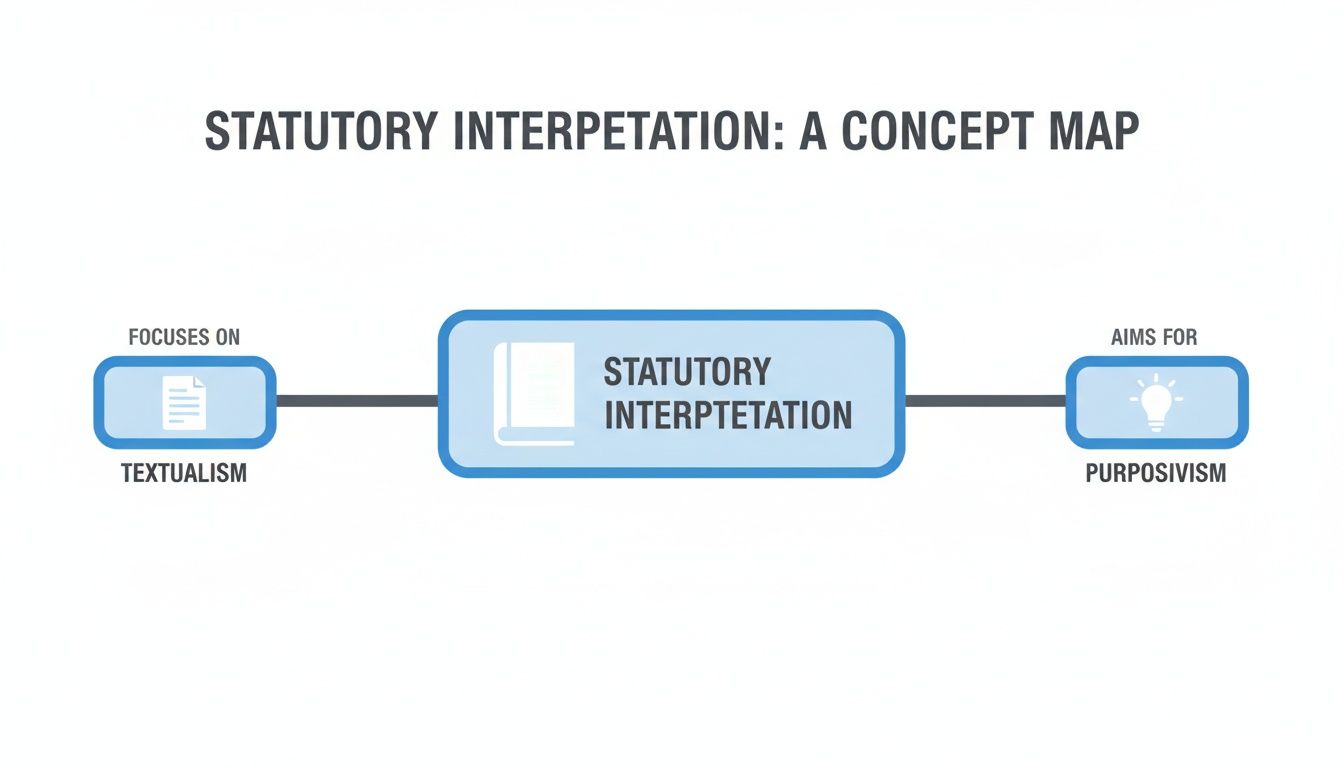
As you can see, both approaches start with the same document—the written law. But they quickly diverge by prioritizing different sources of meaning, often leading to starkly different outcomes.
The Textualist Philosophy: What the Words Say
Textualism insists that the only valid source for interpreting a law is the law’s text itself. Its champions, like the late Supreme Court Justice Antonin Scalia, argue that a judge’s job is simply to read the words and give them their plain, public meaning from the time they were enacted.
The logic is rooted in democratic accountability. Lawmakers vote on a specific set of words, not on unstated intentions or committee room debates. For a textualist, relying on legislative history is like judging a movie based on early script drafts instead of the final cut that was actually released. Only the final text has the force of law.
Textualism's Core Belief: A judge must enforce the clear meaning of a statute, period. It doesn't matter if the result seems odd or if it contradicts what some think the "spirit" of the law was. This discipline is seen as a vital check on judicial power, stopping judges from injecting their own policy views into their rulings.
This approach aims for consistency and predictability. By sticking to the text, the law becomes more stable, allowing ordinary people and businesses to know their rights and obligations without having to hire a historian to decode legislative intent.
The Purposivist Philosophy: Why the Law Was Passed
Purposivism, on the other hand, starts from the premise that you can't understand a law without understanding its purpose. Advocates of this view see laws as tools designed to solve specific problems in society. A judge's main task, then, is to interpret the statute in a way that helps it achieve its goal.
Think of a park sign that reads, "No Vehicles in the Park." A rigid textualist might say this bars an ambulance from entering to save a life. A purposivist, however, would ask why the rule exists—likely to ensure pedestrian safety and tranquility. They would conclude the rule wasn't meant to prevent emergency services, and the ambulance should be allowed in to fulfill the greater purpose of protecting human life.
Purposivists are far more willing to look beyond the text, consulting legislative history and other external sources to grasp the context behind a law. They argue that ignoring this context can lead to absurd results that lawmakers never could have intended.
How These Theories Collide in the Real World
The difference here isn't just academic—it's the engine that drives the outcomes of real-world legal battles. To really see the contrast, let's look at how the two leading theories stack up side-by-side.
Textualism vs Purposivism: A Head-to-Head Comparison
| Dimension | Textualism | Purposivism |
|---|---|---|
| Primary Focus | The ordinary meaning of the statutory text. | The underlying purpose or goal of the statute. |
| Key Question | "What do the words say?" | "What problem was Congress trying to solve?" |
| Use of Outside Sources | Heavily restricted. Avoids legislative history. | Embraced. Uses legislative history, reports, and context. |
| Judicial Role | Faithful agent of the text. | Pragmatic partner in achieving legislative goals. |
| Main Goal | Predictability, consistency, judicial restraint. | Avoiding absurd results, ensuring justice. |
| Famous Proponent | Justice Antonin Scalia | Justice Stephen Breyer |
This table shows two fundamentally different views of the law. One sees it as a precise instruction manual, while the other sees it as a mission statement.
Let’s apply this to a hypothetical case:
- The Statute: Congress passes the "Secure Systems Act" in 1990, making it illegal to "knowingly access a protected computer without authorization."
- The Case: An employee has a valid password to access her company’s database. However, she uses that access to download a confidential client list to give to a competitor, a use expressly forbidden by company policy.
- The Textualist Judge: This judge focuses on "without authorization." The employee did have authorization to access the computer system itself. They would likely rule that while her actions were wrong, they didn't violate this particular statute because her initial access was permitted.
- The Purposivist Judge: This judge would look into the why behind the 1990 Act, finding it was passed to stop corporate espionage. They would argue that using authorized access for an unauthorized purpose violates the entire point of the law and would likely rule against the employee.
Over the last few decades, this debate has reshaped American law. Textualism, once a minority view, has seen its influence skyrocket, appearing in under 20% of Supreme Court opinions in the 1970s to over 40% in the Roberts Court. Yet purposivism remains a powerful counterweight, figuring in about 35% of cases.
Interestingly, the lines often blur. Even justices known for their textualist approach sometimes consult statutory history, as one analysis found they did in over a fifth of their opinions. You can find a deeper dive into these judicial interpretation trends on Virginia Law Review. Ultimately, the interpretive philosophy a judge brings to the bench remains one of the single most important factors in determining how a case will be decided.
Mastering the Canons of Construction
If broad philosophies like textualism and purposivism are the strategic blueprints for statutory interpretation, then the canons of construction are the real-world tools a lawyer uses on the job. Think of them less as rigid, unbreakable laws and more as a collection of time-tested guidelines and logical arguments that help you build a case for what a statute actually means.
At their core, these canons are simply rules of thumb for reading legal text. They give judges and lawyers a shared language to argue about grammar, context, and consistency. Mastering them is a non-negotiable skill for anyone trying to understand—or influence—how a law will be applied.
To get a handle on them, it helps to split the canons into two main camps: textual canons, which deal with the nuts and bolts of language, and substantive canons, which are about advancing broader policy goals.
Textual Canons: How to Read the Words on the Page
Textual canons are all about teasing out meaning directly from the words, sentences, and structure of the statute itself. They’re built on the fundamental assumption that legislatures choose their words carefully and mean what they say.
The big one—the starting point for almost every analysis—is the Plain Meaning Rule. This principle is simple: if the words of a law are clear and direct, you apply them exactly as written. No need to go digging for some hidden legislative intent.
Of course, legal language is rarely that straightforward. That’s precisely why the other textual canons exist—to help us navigate the inevitable ambiguities.
-
Ejusdem Generis (of the same kind): This one comes into play when a law lists several specific things and then tacks on a general phrase at the end. The canon tells us that the general phrase should be limited to other items of the same type. For example, if a park rule bans "cars, trucks, motorcycles, and other motorized vehicles," ejusdem generis suggests a gas-powered scooter is out, but an electric wheelchair probably isn't, because it’s a different kind of thing altogether.
-
Noscitur a Sociis (it is known by its associates): This is the idea that a word is defined by the company it keeps. You can figure out a term's meaning by looking at the other words around it. If a statute mentions "drilling, blasting, and other activities," you'd naturally assume "activities" refers to more construction-type work, not something like "recreational activities."
-
Expressio Unius Est Exclusio Alterius (the express mention of one thing excludes all others): This canon works from the premise that if lawmakers took the time to list specific items, they did so for a reason—and anything not on that list was intentionally left out. If a company policy says you can get reimbursed for "flights and hotels," this rule implies you're out of luck when it comes to that rental car.
These linguistic tools provide a structured, predictable way to break down a statute’s text. They are the absolute bedrock of any good textualist argument.
Substantive Canons: Promoting Bedrock Values
While textual canons are focused on how to read the words, substantive canons are about what we should be trying to achieve with our reading. These are policy-driven principles that guide courts to interpret laws in a way that favors certain fundamental values, unless the legislature has been crystal clear about doing the opposite.
Substantive canons often act as judicial tie-breakers. When a statute is truly ambiguous, these canons nudge the interpretation toward an outcome that upholds core principles like fairness, justice, and constitutional stability.
They’re a safety net, really, ensuring that a poorly worded law doesn't accidentally trample on fundamental rights. Some of the most critical substantive canons include:
-
The Rule of Lenity: This one is specific to criminal law. It says that if a criminal statute is ambiguous, it must be interpreted in the way most favorable to the defendant. The logic is simple: you can’t punish someone unless the law gives them fair, clear notice that their conduct is illegal.
-
Constitutional Avoidance: A very powerful tool. This principle directs judges to choose a reading of a statute that avoids creating a constitutional problem. If one interpretation makes the law potentially unconstitutional and another doesn't, the court should always pick the latter to preserve the legislature's work.
-
Presumption Against Preemption: In a federal system like the one in the United States, this canon is vital. It holds that a federal law shouldn’t be interpreted as overriding state law unless Congress has made its intent to do so unmistakably clear. It’s all about protecting the delicate balance of power between the federal government and the states.
These canons aren't just academic exercises; they have massive real-world impact, often defining the line between government power and individual liberty. Getting a firm grasp on both textual and substantive canons is absolutely essential for anyone tasked with the complex job of interpreting a statute.
Using Legislative History Effectively
When the words of a statute don't give you a clear answer, where do you turn next? For many lawyers and judges, the answer is legislative history—the paper trail a bill leaves on its journey to becoming law. Think of it as the director's commentary for a statute.
This collection of documents includes everything from committee reports and floor debates to earlier drafts of the bill. For anyone trying to understand what the legislature was thinking, this is often the first stop.
A purposivist judge sees legislative history as a goldmine. It's a direct window into the problem lawmakers were trying to fix, offering clues to decipher ambiguous phrases. A detailed committee report, for example, can feel like a Rosetta Stone, translating fuzzy legal language into a clear purpose.
Textualists, on the other hand, are deeply skeptical. They argue that the only thing that matters is the final text that was actually voted on and passed into law. To them, digging through committee reports and debate transcripts is like "looking over a crowd and picking out your friends"—it's far too easy for a judge to find a quote that supports their own preconceived notions.
What Counts as Legislative History
Not all historical documents are created equal. In the eyes of the court, a clear hierarchy has emerged, and knowing it is key to building a solid argument.
-
Committee Reports: These are the heavyweight champions. Written by the very committee that studied and shaped the bill, these reports explain the purpose behind its provisions. Courts give them immense weight because they reflect the shared understanding of the lawmakers who knew the bill best.
-
Sponsor Statements: What did the bill's sponsor have to say? Their statements are also highly persuasive. The logic is simple: the person who championed the legislation is probably the best authority on its goals.
-
Rejected Proposals: Sometimes, what isn't in the law is just as important as what is. If Congress considered and then rejected specific language, that’s a powerful sign that the final text was meant to exclude that very idea.
-
Floor Debates: Statements from individual legislators during a heated floor debate are at the bottom of the list. It’s tough to argue that a single senator's spontaneous remarks represent the will of the entire body.
Knowing how to find and weigh these sources is a core skill in learning how to do legal research. It's what separates a good legal argument from a great one.
The Dangers of Misinterpretation
Wielding legislative history effectively requires more than just finding the right documents; it requires understanding the messy reality of how Congress works. Research in the Yale Law Journal shows that courts often get this wrong simply because they don't grasp congressional procedure.
For instance, knowing that over 70% of proposed amendments fail might stop a lawyer from arguing that one rejected amendment reveals the definitive "intent" of Congress. Before the 1980s, legislative history was cited in up to 35% of Supreme Court cases. While that figure dropped to around 15% under Justice Scalia's textualist influence, a study found it was still mishandled in 40% of those instances due to this procedural knowledge gap. You can dive deeper into these fascinating findings on Georgetown Law's scholarship repository.
The Bottom Line: Legislative history is a powerful but double-edged sword. Used wisely, it illuminates a law's purpose. Used carelessly, it can become a tool for judges to impose their own views instead of following the law as written.
Ultimately, whether you're a textualist, a purposivist, or somewhere in between, you can't ignore legislative history. Understanding its sources, its hierarchy, and its pitfalls is non-negotiable for anyone serious about statutory interpretation.
How Landmark Cases Have Shaped Statutory Interpretation
Theories about how to read a law are just that—theories. It's in the courtroom where they spring to life. Landmark cases show us how a judge’s choice between competing philosophies can cause massive shifts in American law, changing everything from civil rights to how businesses operate. When you dig into these pivotal decisions, you see exactly how the abstract debate over interpreting statutes creates very real consequences for everyday life.
These cases are more than just legal history; they’re powerful stories that reveal how a focus on text versus purpose can send judges down completely different paths.
The Purposivist Approach in Church of the Holy Trinity v. United States
One of the classic examples every law student learns is Church of the Holy Trinity v. United States from 1892. The whole mess started with a federal law that made it illegal for an employer in the U.S. to pay for a foreigner’s trip to America "to perform labor or service of any kind."
A New York church hired a rector from England and, as part of the deal, paid for his travel. At first glance, this looked like an open-and-shut case. The church clearly violated the plain text of the law, since a rector was undeniably performing a "service."
But the Supreme Court decided to look deeper. They dug into the legislative history and found that Congress passed the law to stop big companies from importing huge numbers of unskilled laborers, which was suppressing wages for American workers. It was never meant to apply to professionals.
By looking past the literal words to the law's underlying purpose, the Court dodged what it felt would be an absurd and unfair outcome. For over a century, this case stood as a cornerstone of purposivist thinking, showing how judges could use intent to guide their rulings.
The Textualist Revolution in Bostock v. Clayton County
Jump ahead to 2020, and the Supreme Court was grappling with another massive interpretive puzzle in Bostock v. Clayton County. The case was actually a combination of three lawsuits brought by employees who were all fired soon after their employers found out they were gay or transgender.
The entire legal fight came down to one phrase in Title VII of the Civil Rights Act of 1964, which bans employment discrimination "because of... sex." The employers argued that back in 1964, "sex" only meant the biological difference between male and female. They insisted that Congress had no intention of protecting LGBTQ+ people.
In a stunning decision, the Court went with a purely textualist approach. Writing for the majority, Justice Neil Gorsuch argued that the text itself was all that mattered. He explained that it's impossible to discriminate against someone for being gay or transgender without firing them for traits that would have been perfectly fine in a person of a different sex.
For example, if a boss fires a male employee for being attracted to men but wouldn't fire a female employee for the same reason, that decision is undeniably made "because of sex."
The Bostock ruling is a masterclass in modern textualism.
- Focus on Text: The Court completely set aside arguments about what Congress might have intended back in 1964.
- Ordinary Meaning: It zeroed in on the direct, logical meaning of the words "because of sex."
- Broad Impact: The decision extended workplace protections to millions of LGBTQ+ Americans—an outcome the original lawmakers almost certainly never imagined, but one the Court decided the text itself required.
These two cases perfectly illustrate how much an interpretive method matters. Holy Trinity used purpose to narrow a law's scope, while Bostock used text to expand one. An AI Legal Case Researcher can be an incredibly helpful tool for analyzing these precedents and seeing how different interpretive approaches play out in court.
These examples prove that the method a judge chooses is often just as important as the law itself. For anyone wanting to dive into specific judicial rulings, LegesGPT provides an amazing way to search and analyze millions of pieces of case law in seconds.
Frequently Asked Questions
What's the Real Difference Between Statutory Interpretation and Statutory Construction?
You'll hear lawyers and judges use these terms almost interchangeably, and for the most part, that's fine. But if you want to get technical, there's a subtle but important difference. Interpretation is all about figuring out the plain meaning of the words on the page. Construction, on the other hand, kicks in when the text is ambiguous and you have to apply that meaning to a messy, real-world set of facts. In the day-to-day grind, "statutory interpretation" has become the go-to phrase for the whole shebang.
So, Who Wins: Textualism or Purposivism?
This is the million-dollar question in modern legal theory, and the truth is, neither one is definitively "correct." It’s the central debate. Textualists champion their method as the most faithful to the democratic process, keeping judges from legislating from the bench. Purposivists fire back that their approach is the only way to truly honor what lawmakers intended and avoid nonsensical outcomes. > The reality on the ground? The winning approach often comes down to the court you're in, the judge on the bench, and the legal traditions of that jurisdiction. A sharp lawyer knows how to argue a case from both angles, ready to pivot depending on the audience.
How Do Government Agencies Fit into All This?
Administrative agencies like the EPA or the SEC are on the front lines, interpreting statutes every single day. They do it when they write new rules and when they enforce existing ones—they are the ones who have to make these laws work in the real world. For a long time, courts followed a doctrine called Chevron deference. This meant that if a statute was ambiguous, the court would defer to the agency's reasonable interpretation of it. This gave agencies a massive amount of influence over how laws actually function.
Do the Canons of Construction Ever Clash?
Absolutely. In fact, it happens all the time. A classic conflict is when the canon every word must have a meaning runs headfirst into the canon that tells judges to avoid an absurd result. What do you do when giving every word meaning leads to a ridiculous outcome? That's where a lawyer earns their keep. The art of advocacy is about weaving a compelling story for why one interpretive rule should outweigh another in your client's specific situation. You have to use the statute's text, structure, and underlying purpose to convince the court that your chosen canon is the right one for the job. Often, the entire case hangs on that choice. --- Ready to make your legal research faster and more accurate? LegesGPT combines a powerful AI legal assistant with a massive database of cases and statutes to give you instant, citation-backed answers. Stop spending hours on manual research and start building stronger arguments today. Try LegesGPT with a free 3-day trial.