
At its most basic level, what is jurisdiction in law? It's the court's official power to hear a case and make a decision that actually sticks. Without jurisdiction, a court is just a room with people in it—its rulings are legally meaningless.
Jurisdiction Explained: The Power to Hear a Case
Think of jurisdiction as the gatekeeper of the courthouse. Before a single argument is made or one piece of evidence is presented, the court has to answer a crucial question: "Do I even have the right to be here?" It's the very first hurdle in any lawsuit, the foundation the entire case rests on.
Imagine a referee trying to call a soccer match happening in a different stadium miles away. Their whistle and rulings would be totally irrelevant because they're outside their designated field of play. A court acting without jurisdiction is in the exact same boat—its decisions have no legal force.
The Scope of a Court's Power
Jurisdiction isn’t a universal key that opens every legal door. It’s a very specific framework that defines a court's authority based on a few critical factors: geography, the type of legal issue, and its power over the people or companies involved. For a case to move forward, the court must have the right mix of these powers.
This system is all about fairness and order. It stops a court in, say, California from dragging in a Florida resident who has never set foot in the state. It creates a predictable set of rules so everyone knows where a lawsuit can—and can't—be filed.
Jurisdiction is the bedrock of judicial authority. It ensures that legal power is exercised logically, fairly, and within constitutionally defined limits, preventing legal chaos and protecting the rights of all parties.
Why This Concept Is Essential
Grasping the concept of jurisdiction is non-negotiable for anyone involved in the legal system. It dictates where you can sue someone, where you might get sued, and which specific courthouse is the right one for your problem.
Getting it wrong can be a disaster. Filing a case in a court that lacks the proper jurisdiction leads to some painful outcomes:
- Immediate dismissal of your case, which means you’ve wasted a ton of time and money.
- A worthless judgment. Even if you win, you won't be able to enforce it.
- Potential legal sanctions for bringing a lawsuit in the wrong place.
That's why figuring out the correct jurisdiction is the absolute first step in any legal strategy. It shapes everything that follows, and it’s a question you need to answer with 100% certainty before you even think about filing.
The Essential Types of Jurisdiction
To really get a handle on what jurisdiction means in the legal world, you have to understand that it’s not just one big concept. It's actually a combination of different kinds of authority a court needs to have. Think of it like a three-legged stool—if you kick out any one of the legs, the whole thing comes crashing down.
For a court to properly hear a case, it has to have power over the people involved, the specific legal issue, and often, the geographic location of the dispute. These pillars are what make legal proceedings fair and prevent chaos. Let's break down each one.
Personal Jurisdiction: The Power Over the Parties
First up is personal jurisdiction. This is all about the court's power over the actual people or companies in the lawsuit. It’s the "who" in the jurisdictional puzzle. At its core, it ensures a court can’t just yank someone from across the country into a lawsuit without a good reason.
Imagine you live in Oregon and a process server hands you a lawsuit from a court in Florida. The suit is over a fender bender that happened right in your hometown. It would be completely unfair to force you to fly thousands of miles and hire a Florida lawyer to defend yourself in a state you have no connection to. Personal jurisdiction is the legal principle that prevents this exact scenario.
So, how does a court get this power? It hinges on whether the defendant has what the law calls “minimum contacts” with the state where the court sits. This isn't just a casual connection; it means the person or company has purposefully taken advantage of the benefits and protections of that state.
What counts as minimum contacts? It usually boils down to a few common-sense scenarios:
- Living in the state: If you're a resident, you're fair game for that state's courts. This is the clearest example.
- Doing business in the state: If a company actively sells products or has an office there, it should expect to be sued there.
- Causing an injury in the state: If you cause a car accident or some other harm within a state, its courts have power over you for that specific incident.
- Owning property in the state: This can give a court jurisdiction for any disputes directly related to that property.
Ultimately, this is all about fairness. The legal system works on the idea that if you choose to engage with a state in a meaningful way, you have to be ready to answer for your actions in that state's courts.
Subject-Matter Jurisdiction: The Power Over the Issue
Next, we have subject-matter jurisdiction, which is about the court's authority to hear a specific type of case. This is the "what" of jurisdiction. Not every court can handle every legal problem; many are highly specialized.
Think of the court system like a hospital. You wouldn’t ask a cardiologist to set your broken arm, and you wouldn't go to a podiatrist for an eye infection. Each doctor has a specific field of expertise. In the same way, our legal system directs certain cases to courts designed to handle them.
For example, many courts have very specific, limited authority:
- Bankruptcy Courts: These are federal courts with exclusive power over all bankruptcy cases. A state family court simply can't touch them.
- Family Courts: At the state level, these courts specialize in divorce, child custody, and adoption matters.
- Traffic Courts: These local courts are set up to handle minor issues like speeding tickets and other moving violations.
- Probate Courts: These courts oversee the process of validating wills, settling estates, and appointing guardians.
This division of labor is incredibly important. It allows judges to become true experts in their fields, which leads to smarter and more consistent rulings. If a court doesn’t have subject-matter jurisdiction, any judgment it makes is worthless.
A court acting without subject-matter jurisdiction is like a referee from the wrong sport trying to officiate a game. No matter how well-intentioned their calls are, they lack the fundamental authority to make them, rendering the entire proceeding void.
Territorial Jurisdiction: The Power Over the Location
Finally, there’s territorial jurisdiction, which defines a court's authority by its geographic borders. This is the "where." It simply means a court can only hear cases connected to events or parties within its specific city, county, or state lines.
This idea often overlaps with personal jurisdiction, but its focus is strictly on the physical reach of the court's power. For example, a municipal court in Los Angeles generally can’t hear a case about a landlord-tenant dispute that happened entirely in San Francisco. That case belongs in the court system governing the territory where the apartment is located.
This geographic boundary keeps the legal system organized. It makes sure that cases are heard by local courts that understand local ordinances and are easily accessible to witnesses. Without it, plaintiffs could "forum shop" by filing lawsuits in random courts across the country, creating a logistical nightmare for everyone else.
International Jurisdiction: A Global Perspective
In our modern world, disputes don't always stop at the border. This is where international jurisdiction comes in. It's the framework that determines which country's courts have the right to hear a case involving parties or events from different nations, and it’s often governed by a complex web of treaties and agreements.
For example, international business contracts almost always include a "forum selection clause," where both parties agree upfront which country's courts will handle any disagreements. This is absolutely critical for global commerce, where legal predictability is everything.
We see this most clearly in international arbitration, where statistics show that around 90% or more of cases at major institutions are international. The Singapore International Arbitration Centre (SIAC), for instance, reported that 89% of its 886 new cases in 2025 were international. Likewise, the London Court of International Arbitration (LCIA) handled 318 arbitrations under its rules in 2024, with 95% involving international parties. These specialized tribunals gain their jurisdiction directly from the contracts signed by parties from all over the world. You can explore more about these global arbitration trends to see just how businesses manage cross-border legal risk.
How Courts Determine Their Authority
So, we know what the different types of jurisdiction are, but how does a court actually figure out if it has the power to hear a case? Courts don't just grab cases they find interesting; they follow a strict, methodical process to confirm a case truly belongs in their courtroom. This isn't just bureaucratic red tape—it's essential for ensuring the entire legal process is fair and legitimate.
At its heart, this process is all about establishing connections. Does the person being sued have a genuine link to the state? Is the legal issue something this specific court is even allowed to decide? Answering these questions means applying well-established legal tests that have been shaped by decades of case law.
The Minimum Contacts Standard
When it comes to personal jurisdiction, the foundational test is the minimum contacts standard. This principle is all about fairness, making sure it’s reasonable to force a person or company to show up and defend a lawsuit in a particular state. A court will look for proof that the defendant deliberately took advantage of the benefits and protections of that state's laws.
Think of it as leaving a footprint. If a company based in Texas builds a website to sell products directly to people in California, ships its goods there, and runs ad campaigns targeting Californians, it has clearly created a connection. Those actions are the "minimum contacts" that give a California court the right to exercise jurisdiction over the Texas company if a dispute pops up.
This standard is crucial because it stops a court from unfairly dragging a defendant across the country when they have no meaningful connection to the area.
This flowchart breaks down exactly how a court analyzes its authority, walking through the essential questions of personal, subject-matter, and territorial jurisdiction.
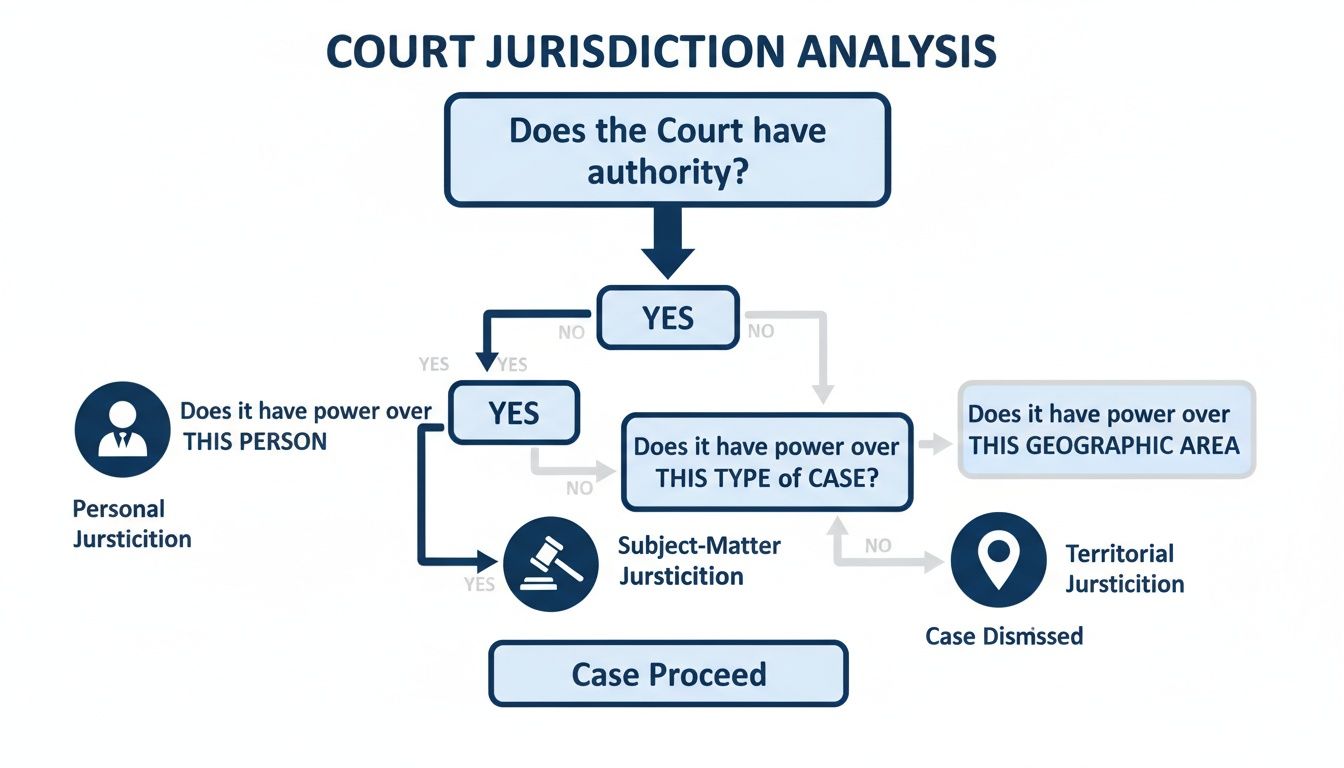
As you can see, each type of jurisdiction works like a checkpoint. A case has to get through every gate before a court can even begin to look at the facts of the dispute.
Using Long-Arm Statutes to Reach Across Borders
To put the minimum contacts test into action, states rely on long-arm statutes. These are specific laws that spell out the exact circumstances under which a court can claim jurisdiction over an out-of-state defendant. In essence, these statutes give the court a "long arm" to reach beyond its own state lines and pull a defendant into a lawsuit.
These laws typically kick in when a defendant does things like:
- Transacting any business within the state.
- Committing a wrongful act (like causing an injury) inside the state.
- Owning or using property within the state.
If a defendant's actions fit into one of these buckets, the long-arm statute is triggered, and the court can legally assert its power. To get a full picture of the prerequisites for a court to hear a case, it's also worth exploring the legal concept of standing.
Determining Subject-Matter Authority
Figuring out subject-matter jurisdiction is much more black-and-white. It's less about abstract ideas of fairness and more about following the rules. The court simply looks at the laws that created it to see what kind of cases it's allowed to handle. For federal courts, jurisdiction is mostly limited to two main areas.
- Federal Question Jurisdiction: This comes into play whenever a case is centered on the U.S. Constitution, a federal law, or a treaty. If the core legal fight is about federal law, a federal court is the right place for it.
- Diversity Jurisdiction: This applies to lawsuits between citizens of different states, but only if the amount in dispute is more than $75,000. The idea here is to provide a neutral playing field and avoid any potential home-court advantage a state court might give its own resident.
The clarity and effectiveness of these rules can have a huge impact on legal predictability. According to the World Justice Project's 2025 Rule of Law Index, Denmark leads the pack with a score of 0.90, while the U.S. is ranked 27th out of 143 countries at 0.68. These scores reflect how well a country's entire legal system functions, including its jurisdictional framework. The same 2025 index is a bit concerning, showing that the rule of law weakened in 68% of countries that year, which just highlights how important strong, clear jurisdictional standards really are.
Ultimately, determining a court's authority is a foundational step that blends constitutional principles of fairness with hard-and-fast statutory rules. For any lawyer, analyzing these factors is a critical part of building a case strategy, and that often requires a deep dive into legal history. You can find millions of searchable court opinions and precedents by exploring our extensive case law database at https://www.legesgpt.com/case-law-ai.
Getting into the Weeds: Advanced Jurisdictional Concepts
The lines on the map get blurry fast when business deals and personal interactions stretch across states and countries. Suddenly, the question "what is jurisdiction in law?" isn't so simple. The foundational rules of who can be sued and where start to give way to more nuanced concepts designed for our interconnected world. Getting a handle on these ideas is absolutely essential for anyone looking to manage legal risk today.
A big one is international jurisdiction. This is the framework that decides which country's courts get to hear a case when the people or events involved are scattered across the globe. Without international treaties and agreements creating a predictable system, cross-border disputes would be utter chaos.
Concurrent vs. Exclusive Jurisdiction
Another layer of complexity pops up when more than one court could legitimately hear the same case. This is where we get the distinction between concurrent and exclusive jurisdiction. Think of it like driving to a destination: sometimes there's only one highway that will get you there, and other times, you have several routes to choose from.
-
Concurrent Jurisdiction: This happens when a case could be filed in either state or federal court. A classic example is a lawsuit between citizens of different states involving more than $75,000. The plaintiff can bring that case in federal court, but they could often just as easily file it in state court. It's their choice.
-
Exclusive Jurisdiction: This is the one-highway scenario. Only one specific type of court has the power to hear the case. For instance, federal courts have the final say on matters like bankruptcy, patent infringement, and copyright law. You simply can't file a patent lawsuit in a state court; it’s not an option.
When you have concurrent jurisdiction, the decision of where to file is purely strategic. A good lawyer will carefully analyze which court system—state or federal—offers a more favorable playing field for their client. This kind of analysis requires some serious legal digging. If you're looking to sharpen those skills, our guide on how to do legal research breaks down the entire process.
The Power of Forum Selection Clauses
In the world of business, nobody likes leaving jurisdiction to chance. To lock in some predictability, companies use a powerful tool in their contracts: the forum selection clause. It's a simple provision where everyone agrees, right from the start, which court will handle any fights that come up later.
For example, a tech company in California signing a deal with a supplier in New York can bake in a clause that says, "Any disputes arising from this contract shall be litigated exclusively in the state courts of California." Just like that, they’ve prevented either side from dragging the other into a New York court, saving a massive amount of time and money by setting the battlefield before a shot is even fired.
A well-drafted forum selection clause is a critical risk management tool. It provides certainty and control, allowing businesses to avoid costly legal battles over where a lawsuit should be heard and instead focus on the actual substance of the dispute.
These clauses are even more crucial in global commerce. In international arbitration, jurisdiction is everything. The International Chamber of Commerce (ICC), for example, registered 894 new cases in 2025 involving parties from 147 jurisdictions. Businesses strategically picked neutral ground, with France chosen as the seat in 82 cases, followed by the UK (78) and Switzerland (53). This shows a clear preference for reliable legal systems where you know a judgment will be enforced.
Why Jurisdiction Matters in the Real World

It’s easy to dismiss jurisdiction as a technicality for lawyers, but in reality, it's the bedrock of any legal action. It determines whether a court can even hear your case and whether a hard-won judgment is worth anything at all. Getting this wrong isn't just a minor setback; it can sink your entire case before it even starts.
Think of it like trying to cash a check at the wrong bank. You can have a valid check, fill out the deposit slip perfectly, and stand in the right line, but if you're not at the bank that holds the funds, they simply have no authority to help you. Filing a lawsuit in a court without jurisdiction is the exact same problem—your pleas will fall on deaf ears.
Service of Process and the Power of a Judgment
Before any court can flex its legal muscle, the defendant has to be officially brought into the fold. This is done through a formal process called service of process, which is just the legal term for delivering the lawsuit papers and giving the other side a chance to defend themselves.
But here’s the catch: you can follow the service rules to the letter, but if the court that issued the documents has no jurisdiction, it's all for nothing. The service is invalid, and the case can’t move forward.
This leads us to the most critical point: a judgment handed down by a court without jurisdiction is legally void. It's a paper tiger. You can't use it to collect money, seize property, or compel anyone to do anything. All the time and money you poured into the lawsuit? Wasted.
A court's judgment is only as strong as its jurisdiction. Without the proper authority, a ruling is unenforceable, effectively making the entire legal process a waste of time and resources.
Distinguishing Jurisdiction from Venue
People mix these two up all the time, but the difference is huge. While they both deal with the "where" of a lawsuit, they answer fundamentally different questions.
- Jurisdiction asks: Does this court have the power to hear this case and rule on these parties? It’s about a court’s fundamental authority.
- Venue asks: Of all the courts that have jurisdiction, which specific courthouse is the most logical and convenient location? It’s about geography and logistics.
Imagine a contract dispute that happened in Los Angeles. The state courts of California almost certainly have jurisdiction. But the correct venue would be a courthouse in Los Angeles County, not one up in San Francisco. A venue mistake can usually be fixed by transferring the case. A jurisdiction mistake is fatal—the case gets thrown out.
When Courts Decline to Hear a Case
Here's another twist: just because a court has jurisdiction doesn't mean it has to take the case. Under a legal principle called forum non conveniens (a Latin phrase for an "inconvenient court"), a judge can dismiss a case if they believe another court is far better suited to handle it.
You see this a lot in international disputes. A New York court might technically have jurisdiction over a lawsuit involving a German company and an accident that occurred in France. But if all the evidence, witnesses, and relevant laws are in France, the New York judge will likely send the case there, concluding it’s the more sensible forum.
These practical considerations are vital, impacting everything from case strategy to the operational mechanics of the legal system, like using legal court transcription services to create an accurate record. Everything hinges on a court's foundational power.
A Risk Checklist for Businesses and Individuals
Thinking about jurisdiction from day one can save you from a world of legal pain. Whether you're a business owner drafting a contract or an individual facing a dispute, getting ahead of these issues is smart risk management. For a deeper dive into protecting your interests, check out our dedicated resources for the modern business owner.
Here is a practical checklist you can use to start spotting jurisdictional red flags before they become full-blown crises.
Jurisdictional Risk Assessment Checklist
| Checklist Item | Key Consideration | Actionable Step |
|---|---|---|
| Contract Clauses | Where will disputes be handled? What law will apply? | Insert a clear "forum selection clause" and a "choice of law" clause into every contract. |
| Online Business | Where are your customers? Do you target specific states? | Understand that actively marketing to customers in a state can create "minimum contacts," subjecting you to their courts. |
| Service of Process | How will you notify the other party if there's a problem? | Confirm you know the correct address and method for serving legal documents according to the rules of that jurisdiction. |
| Enforcing a Judgment | If you win a lawsuit, can you actually collect? | Before filing, confirm the court has proper jurisdiction so your judgment will be valid and enforceable. |
By treating jurisdiction as a core strategic issue, not a legal afterthought, you can navigate the system with more confidence. It's the first and most important step in ensuring your rights are protected by a court with the real power to act.
Frequently Asked Questions
Can You Just Agree to Jurisdiction in a Contract?
Yes, you absolutely can. In fact, it's one of the most common and powerful tools in business contracting. This is done through what's called a forum selection clause. This is a specific section of the contract where both parties agree, in advance, which court system will handle any future disagreements. For instance, a software company in California and a client in New York might agree that any lawsuit must be filed in the state courts of Delaware. This simple clause provides certainty and helps avoid an expensive, time-consuming fight over where to fight later on.
What Happens If Someone Files a Lawsuit in the Wrong Court?
The case gets thrown out, simple as that. If a court doesn't have the proper jurisdiction—either personal or subject-matter—the lawsuit is dead on arrival. The defendant's lawyer will immediately file a motion to dismiss, and the judge will grant it. This isn't just a small setback. The person who filed the lawsuit (the plaintiff) has just wasted a ton of time and money. They might be able to start over in the correct court, but only if the statute of limitations hasn't run out. It's a costly and completely avoidable mistake. > A jurisdictional challenge isn't a minor legal tactic; it's a direct attack on the court's fundamental power. If successful, it stops a lawsuit in its tracks before the merits of the case are ever considered.
How Does Jurisdiction Work for Online Businesses and E-commerce?
This is where things get really interesting in the modern age. The core question is whether a business has "purposefully availed" itself of a particular state's market. Just having a website that someone in Alaska can look at isn't enough to drag you into an Alaskan court. That's considered "passive." But the moment your online business starts actively targeting customers in Alaska—running local ads, offering specific shipping options, or providing customer service there—you're probably creating the "minimum contacts" needed for that state's courts to claim jurisdiction. Any company selling online needs to think very carefully about where its digital footprint is landing.
Can a Court in One State Enforce a Judgment from Another?
Yes, and this is a cornerstone of the American legal system, thanks to the Full Faith and Credit Clause of the U.S. Constitution. This constitutional mandate requires every state to respect the judicial decisions of all other states. So, if you win a $100,000 judgment in a Texas court against someone who lives in California, you don't have to start from scratch. You can take that certified Texas judgment to a California court, which will domesticate it and help you collect on the defendant's assets in California. The crucial caveat here is that the original Texas court must have had proper jurisdiction to begin with.
Is It Possible for a Defendant to Waive Their Right to Challenge Jurisdiction?
Definitely, but only for personal jurisdiction. A defendant can waive this right in a couple of ways. They might do it explicitly by signing a contract with a forum selection clause. Or, they can do it implicitly by simply showing up and arguing the case without first objecting to jurisdiction. If you file a response and start debating the facts, you've likely given up your right to complain about being in the wrong court. Subject-matter jurisdiction, however, can never be waived. This is about the court's inherent power, granted by law. The parties can't just agree to give a court authority it doesn't have. A court has a duty to confirm its own subject-matter jurisdiction, and the issue can be raised at any point in the case—even by the judge. --- Stop wondering and start getting answers. LegesGPT provides an AI-powered legal assistant that can help you understand complex topics like jurisdiction, review contracts for potential risks, and access millions of case precedents instantly. Take control of your legal research by visiting https://www.legesgpt.com to start your free trial.