
Think of a memorandum of understanding form as the essential pre-game huddle before you sign a legally binding contract. It's a template for a structured "handshake" agreement, letting everyone involved sketch out their intentions, roles, and what they're bringing to the table. The whole point is to make sure you're all on the same page before things get serious.
Your Starting Point for a Solid MOU

Before you start sinking time and money into a new venture, you need a solid foundation. That's exactly where a Memorandum of Understanding (MOU) comes in. Don't think of it as the final, locked-in blueprint for a house. Instead, see it as the initial architectural sketch—the one all the partners agree on before a single shovel hits the dirt.
A well-drafted MOU brings clarity to the table right away, which drastically cuts down the risk of arguments later. Its real job is to capture the spirit of the deal, making sure every collaborator has the same vision for the project's goals and who is responsible for what. For anyone running a business or advising one, it's a non-negotiable first step.
MOU vs LOI vs Contract Key Differences
People often toss around terms like MOU, Letter of Intent (LOI), and contract as if they're interchangeable, but that’s a rookie mistake. Each of these documents serves a very different purpose and, crucially, carries a different legal weight. Getting them mixed up can accidentally lock you into legal obligations you weren't ready for.
I've put together a quick comparison to help you see the distinctions at a glance.
In my experience, the simplest way to think about it is this: An MOU is for cooperation, an LOI is for acquisition or a specific transaction, and a contract is for creating hard, legally enforceable promises. Knowing which tool to pull out of the toolbox is half the battle.
This guide will walk you through creating an MOU that works, without all the dense legalese. To get you started right now, you can download the attorney-vetted memorandum of understanding form included in this guide. And if you need other templates, feel free to check out our full library of legal templates for various business needs.
MOU vs LOI vs Contract Key Differences
Here's a quick-reference table to distinguish the legal standing, purpose, and common use cases for these three critical business documents.
| Document Type | Legal Binding Nature | Primary Purpose | Common Use Case |
|---|---|---|---|
| MOU | Generally non-binding | To outline a cooperative relationship and mutual goals | Two non-profits agreeing to collaborate on a community project |
| LOI | Typically non-binding | To express one party's intent to pursue a transaction | A company stating its serious interest in acquiring another business |
| Contract | Legally binding | To create enforceable rights and obligations | A formal agreement for the sale of goods or provision of services |
Understanding these differences ensures you’re setting the right expectations from the outset of any negotiation.
Breaking Down the Key Clauses in Your MOU
Turning a blank memorandum of understanding form into a useful document is about much more than just plugging in names and dates. Every clause has a job to do, and together they form the blueprint for your potential partnership. Let’s get past the legal definitions and talk about what these clauses actually do in the real world.
This isn't about memorizing jargon. It’s about understanding the 'why' behind each section. Once you know the function of each part, you can draft an MOU that gives everyone clear direction but still has the flexibility for the collaboration to evolve.
Identifying the Parties and Purpose
First things first, you have to be crystal clear about who is involved. This sounds obvious, but you’d be surprised how often it gets messy. Use the full, correct legal names for any individuals and the official registered names for companies, along with their main business addresses. This puts all the key players on the record, officially.
Right after that comes the Purpose clause. This is the soul of your MOU. It's where you define the mission of your collaboration. You want to avoid being so vague that it's meaningless ("to work together") but also avoid being so restrictive that you box yourselves in. A great Purpose clause hits that sweet spot, spelling out the main goals of the partnership.
- Weak Example: "To partner on a marketing initiative."
- Strong Example: "To jointly develop and execute a co-branded digital marketing campaign targeting small business owners in the SaaS industry, with the shared goal of generating qualified leads for both parties."
See the difference? The second example sets a clear direction and even defines what success looks like, but it doesn't dictate every single tactic. It leaves room for creativity.
Outlining Roles and Responsibilities
This is where the handshake starts to look like a real plan. The Roles and Responsibilities section is all about who does what. Think of it as a high-level project plan, assigning ownership to the major pieces of the collaboration.
Being specific here is your best friend. Spelling out who is on the hook for what is one of the single best ways to head off disputes down the road. For example, don't just say "Party A will handle marketing." Break it down into something actionable:
- Party A: Responsible for creating all social media assets, managing the ad spend budget (not to exceed a pre-agreed limit), and providing weekly performance reports.
- Party B: Responsible for writing all blog and email content, managing the email distribution list, and coordinating with industry influencers for promotion.
A well-defined Roles and Responsibilities clause is the operational core of the MOU. It transforms abstract intentions into a concrete, actionable framework that both sides can refer back to as the project progresses.
Key Terms and Conditions
Even though most of an MOU is non-binding, you can still include specific terms that set important ground rules or carry a bit more weight. These clauses usually tackle the practical realities of working together and address potential friction points before they blow up.
Term and Termination: This clause simply states how long the MOU is good for. Is it tied to a specific project timeline, like six months? Or is it ongoing until someone decides to call it quits? It should also lay out a simple way to end the arrangement, like giving 30 days' written notice.
Confidentiality: This is a big one. If you’re going to be sharing sensitive information, a confidentiality clause is non-negotiable. This is one section you can, and often should, write to be legally binding. It ensures that trade secrets, customer data, or proprietary tech stays protected even if the partnership fizzles out.
Disclaimer of Binding Agreement: This is arguably the most important clause in a non-binding MOU. It's the "we're just talking" provision. It explicitly states that the document is a statement of intent and doesn't create a legally enforceable contract. This language is your safeguard against a court later interpreting your handshake deal as an accidental formal agreement.
For a deeper dive into the fine points of reaching agreements, check out our guide on essential contract negotiation tips. And just as clear clauses are essential for your MOU, seeing how other formal agreements are built can be incredibly valuable. Exploring different Service Level Agreement Templates can provide excellent examples of how to define responsibilities with precision.
Navigating International Partnerships and Enforceability
When your partnership crosses borders, the humble MOU suddenly gets a lot more complicated. What passes for a simple "gentleman's agreement" in your home country might be viewed completely differently through another nation's legal lens. Steering through these global waters requires more than a standard template; you need a sharp eye for how different legal systems treat these preliminary agreements.
The real trick is striking the right balance between flexibility and protection. You want the MOU to foster open collaboration, of course, but you also have to protect your intellectual property and set clear ground rules that stick, regardless of where your partners are. This is where getting the drafting right really matters.
Crafting Enforceable Clauses in a Non-Binding World
Even if your MOU is mostly a non-binding handshake, you can—and should—carve out specific clauses and make them legally enforceable. I've found this hybrid approach gives you the best of both worlds. The secret is to use precise, mandatory language for only those key sections, while leaving the rest of the document aspirational.
- Confidentiality Clause: This is the most common and critical clause to make binding. If you're sharing proprietary data or trade secrets, this section must explicitly state that its terms are legally enforceable, no matter what the rest of the MOU says.
- Exclusivity Clause: If you're agreeing not to negotiate with anyone else for a set period, that promise needs to have legal teeth. Making the exclusivity provision a binding obligation can stop a partner from taking your joint concept and shopping it around.
- Dispute Resolution: Laying out a clear process for handling disagreements is absolutely essential in international deals. You can make it a binding requirement to first try mediation in a neutral location before anyone even thinks about filing a lawsuit.
The core of any MOU, especially an international one where clarity is king, boils down to a few foundational elements.
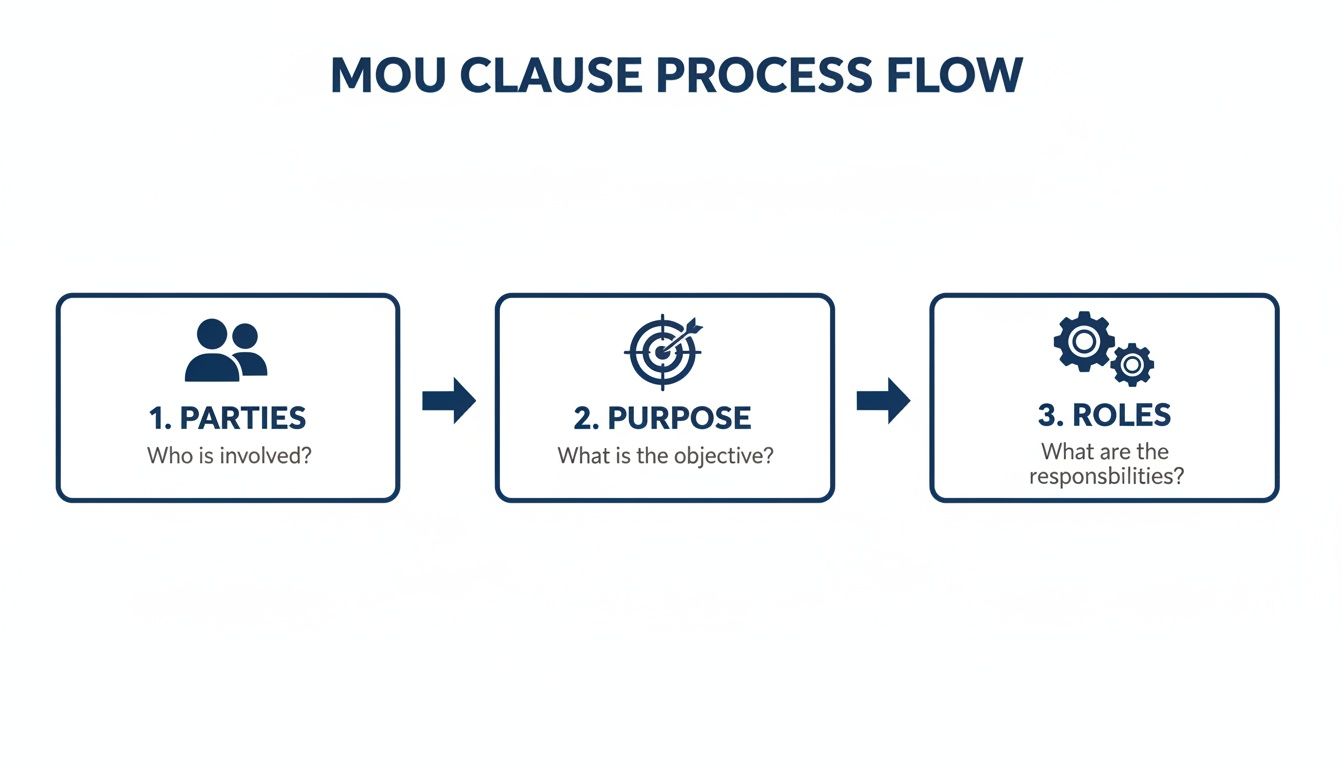
This flow really gets to the heart of it: identifying the parties, defining the purpose, and assigning the roles are the building blocks. Get these right, and you’ve created a clear narrative for the partnership.
Jurisdiction and Governing Law Considerations
Choosing the "governing law" is probably one of the most critical decisions you'll make in an international MOU. This clause dictates which country's laws will be used to interpret the agreement. Skip it, and you could find yourself in a costly, tangled legal battle just to figure out where a dispute should be heard. This is far from a mere formality; it has a direct impact on your rights and obligations. You can dive deeper into what jurisdiction in law means and its implications for your agreements in our detailed article on the topic.
The global trend towards more direct partnerships only highlights the MOU's importance. The World Economic Forum notes that while massive trade agreements have declined, bilateral agreements—which often start with an MOU—have surged by 24%. But this trend carries risk. In some markets, poorly drafted MOUs have been linked to dispute rates as high as 15-20%, a stark reminder of the high stakes involved in getting the details right.
An international MOU isn't just a document; it's a diplomatic tool. The goal is to create a framework that respects cultural and legal differences while clearly protecting the core interests of all parties involved. Always assume it will be read by lawyers from different backgrounds and strive for unambiguous clarity.
Real-World MOU Examples from Health to Fintech
A memorandum of understanding form is much more than a fill-in-the-blanks document. It’s a strategic tool, and you can really see its power when you look at how it’s used in high-stakes industries. Forget the theory for a moment. When you see how MOUs drive collaborations in global public health or fast-moving fintech, you start to appreciate just how flexible and essential they are.
In these fields, an MOU isn't just a casual handshake. It's the foundational blueprint for massive, often multi-million dollar projects. It’s where success isn't just about profit, but is measured in human lives saved or secure financial transactions processed.
Global Health Pacts and Public Outcomes
If you want to see an MOU in its most structured and impactful form, look no further than international public health. These aren't vague agreements; they are meticulously detailed roadmaps for achieving life-or-death objectives, often spanning years. Getting the clarity right on funding, who does what, and how you’ll measure success is absolutely critical.
A great case study is how the United States' Global Health Strategy uses MOUs as the bedrock of its five-year bilateral health pacts. Take the recent MOU with Malawi—it’s a $936 million commitment over five years aimed squarely at tackling HIV, malaria, TB, and maternal health. What’s brilliant about these agreements is their intense focus on data. They spell out targets like the percentage of patients receiving antiretroviral therapy or the number of new polio cases, turning the MOU into a powerful accountability tool. You can see more on how these agreements shape global health policy.
The real lesson from these health MOUs is their obsession with metrics. The agreement isn't about good intentions; it’s about defining success with hard numbers. This elevates the MOU from a simple statement of cooperation to an operational guide for delivering real public health victories.
Fintech Innovation and Regulatory Compliance
Now, let's pivot from the deliberate world of public health to the breakneck pace of financial technology. Here, the MOU plays a totally different but equally vital role. Speed and agility are everything, but so is navigating the labyrinth of international financial regulations. An MOU lets innovative companies map out a partnership quickly, avoiding the deal-killing delays of a full-blown contract negotiation.
Imagine two fintech firms looking to make a splash. One has killer blockchain technology, and the other is a master of payment processing. They want to launch a compliant crypto payment system in a new market. Their MOU is the essential first step to get things moving.
- Technology Integration: It will define, at a high level, how the blockchain platform will connect with the payment gateway.
- Compliance Framework: The document will assign responsibility for making sure the joint product meets local anti-money laundering (AML) and know-your-customer (KYC) rules. This is non-negotiable.
- Revenue Sharing Model: It will sketch out a preliminary model for splitting transaction fees, which sets the stage for the formal financial agreement.
In this scenario, the MOU is all about rapid deployment. It gets the partners aligned on their tech and regulatory game plan, helps secure buy-in from investors, and lets them start the foundational work while the lawyers draft the exhaustive contracts in the background. It's the perfect example of how an MOU can balance the need for speed with the absolute necessity of getting the regulatory details right.
Common MOU Drafting Mistakes to Avoid

Knowing how to fill out a memorandum of understanding form is one thing. Knowing what not to do? That's what can save a partnership from imploding before it even gets off the ground. I've seen seemingly small errors in language create massive confusion or, even worse, saddle a client with legal obligations they never intended to take on.
One of the most common pitfalls is simply being too vague. An MOU that states the parties will "collaborate on marketing efforts" is just asking for trouble. What does that actually mean? Who's footing the bill? What are the specific deliverables? This kind of ambiguity leaves the door wide open for mismatched expectations and, inevitably, disputes down the road.
Another classic mistake is accidentally making the MOU a binding contract. This often happens with a simple word choice. Using obligatory language like "shall," "must," or "will" can instantly transform your flexible agreement into a rigid legal commitment. Stick to aspirational terms like "intend to" or "aim to" to maintain the non-binding spirit of the document. It's a subtle but critical distinction.
Imprecise Language and Its Consequences
Ambiguity is the mortal enemy of a successful MOU. When roles and responsibilities aren't spelled out with crystal clarity, you can bet that crucial tasks will fall through the cracks. The result is almost always a cycle of finger-pointing and frustration.
A well-drafted MOU is a document of precision. Its primary job is to eliminate uncertainty by clearly articulating the who, what, and when of the collaboration, leaving no doubt about each party's role.
Imagine a tech startup and a design agency agreeing to "develop a new app." It sounds great, but without defined milestones, a clear owner for the intellectual property, or specific resource commitments, that project is doomed. A simple disagreement over the project's scope can quickly poison the well and end the entire partnership.
A lack of clarity is one of the biggest—and most avoidable—drafting mistakes. For more on creating unambiguous documents, this ultimate guide to creating better documentation offers some fantastic insights.
The High Stakes of Getting Terms Right
The inherent flexibility of an MOU is one of its greatest strengths, especially when you're working in fast-moving or innovative sectors. A recent agreement between Sumsub and the Global On-chain Economy (GOE) Alliance is a perfect example. Their MOU sets the stage for establishing compliant crypto payments for tourism in Vietnam, a move that could slash forex costs by 5-7% on every transaction.
This kind of venture requires navigating a complex and evolving regulatory landscape where a rigid, formal contract would be too slow and cumbersome. The MOU gives them a framework to map out a compliant path forward together. This is absolutely critical in an industry where crypto compliance gaps are responsible for a staggering 30% of all AML fines.
Frequently Asked Questions
Is an MOU Actually Non-Binding?
Usually, yes, but this is a classic "it depends" situation that trips people up. The bulk of an MOU is meant to capture the spirit of an agreement, not create ironclad legal obligations. But—and this is a big but—certain parts of it can absolutely be made binding on purpose. Think about clauses that need real teeth, like confidentiality, exclusivity, or rules about handling intellectual property. We often draft these sections with very specific, mandatory language to ensure they hold up in court. This hybrid approach gives you the best of both worlds: the flexibility of a handshake deal with legally enforceable protection for your most critical assets.
When Should I Use an MOU Instead of a Full-Blown Contract?
An MOU is your go-to document in the early stages of a potential partnership. It's perfect for when you've agreed on the big picture but aren't ready to get bogged down in the nitty-gritty details of a formal contract. Use it to map out everyone's roles, define the shared goals, and clarify responsibilities. It’s all about making sure you’re on the same page before anyone starts investing serious time or money into hammering out a formal deal. The MOU serves as a roadmap, aligning all the parties on the key milestones first. > Here’s how I think about it: The MOU is the architectural blueprint everyone agrees on. The final contract is the detailed construction plan that specs out every last wire and pipe. You can't build the house without the blueprint. What’s the real difference between an MOU and a Letter of Intent (LOI)? They’re often used interchangeably, but there's a subtle distinction in their typical use. An MOU is generally about mutual cooperation—two or more parties agreeing to work together toward a common goal. An LOI, in contrast, tends to be more transactional. It’s often a one-way street, where one party signals a serious intention to do a deal with another, like in a potential business acquisition. So, think MOU for collaboration, LOI for a transaction.
Can My MOU Accidentally Turn Into a Contract?
Yes, and you need to be very careful about this. A judge doesn't care what you titled the document. If it looks like a contract, smells like a contract, and has all the key ingredients of a contract (like a clear offer, acceptance, and an exchange of value), a court might just decide it is a contract. This is precisely why a disclaimer of binding agreement clause is non-negotiable. You have to explicitly state that the MOU is not intended to create legally binding obligations. Another pro tip is to stick with aspirational language. Using phrases like "the parties anticipate" or "the goal is to" instead of "the parties shall" can save you from accidentally creating a contract you weren't ready for. --- Ready to draft documents with confidence and clarity? LegesGPT is an AI-powered legal assistant that streamlines contract review, research, and drafting. Identify risks, extract key terms, and build stronger agreements faster. Start your free 3-day trial today.