
When you sit down to draft a legal brief, you're not just writing a document. You're building a structured argument for a court, piece by piece. It all starts with a clear caption, moves into framing the core issues with your "questions presented," tells a compelling story in the statement of facts, and then delivers the knockout punch in the argument section. You wrap it all up with a specific request for what you want the court to do—the relief.
This entire process is a delicate blend of deep legal research, sharp strategic writing, and—this is crucial—unwavering attention to the specific rules of that jurisdiction. The goal is simple: convince a judge your client should win.
The Anatomy of a Persuasive Brief
Think of a legal brief as your main weapon of persuasion. It's the most direct, uninterrupted chance you get to speak to the court and guide a judge through your reasoning. Dropping the ball on its structure or purpose is a rookie mistake that can sink even a rock-solid case.
At the end of the day, every brief is doing two things at once: informing and persuading.
- To Inform: You have to lay out the facts, the case's history, and the controlling legal rules in a way that’s impossible to misunderstand.
- To Persuade: You must then take those rules and apply them to your facts so logically that the reader can't help but agree with you.
This dual mission means you have to be obsessed with your audience—the judge and their clerks. These are smart, busy, and inherently skeptical people who are drowning in paperwork. Your brief needs to be a lifeline, offering them a clear, easy-to-follow path through the legal maze.
The Shift to Efficient Drafting
Crafting a compelling brief has always been a marathon, not a sprint. Before modern tools came along, lawyers routinely spent 12-15 hours on a single appellate brief. Some analyses even showed that brief preparation could eat up over 40% of all billable hours in a litigation practice. You can find more of these eye-opening legal industry trends on Clio's blog.
Now, AI tools for legal drafting — like LegesGPT — are completely changing the game. They handle the tedious, mechanical parts of drafting, freeing you up to focus on what really matters: crafting a winning strategy and telling a persuasive story.
A well-crafted brief doesn't just list arguments; it creates a world for the reader. In that world, the facts and the law can only point to one possible outcome—yours. It’s all about giving the court clarity and, more importantly, confidence in their decision.
To master the art of drafting a legal brief, you first have to understand its component parts. The table below breaks down the essential sections that form the backbone of any effective brief.
Anatomy of a Persuasive Legal Brief
This table serves as a quick-reference guide, breaking down the essential sections of a standard legal brief and their primary functions.
| Section | Purpose | Key Elements |
|---|---|---|
| Caption | To formally identify the case and the court. | Case name, court name, docket number, title of the document. |
| Questions Presented | To frame the legal issues for the court, ideally leading to a "yes" or "no" answer in your favor. | A concise, neutral-sounding question that subtly frames the issue from your perspective. |
| Statement of Facts | To tell a persuasive, fact-based story of the case. | A chronological and compelling narrative, citing directly to the record for every assertion. |
| Argument | To apply the law to the facts and persuade the court. | Point headings (conclusions), rule explanation (cases, statutes), application of the rule to the facts, and a mini-conclusion. |
| Relief Requested | To tell the court exactly what you want it to do. | A clear and specific statement of the order or judgment you are seeking (e.g., "reverse the lower court's decision"). |
Once you understand how each of these pieces works, you can start fitting them together to build a powerful and convincing argument.
Mastering the Core Components of Your Brief
A powerful legal brief is more than just a collection of arguments; it's a carefully constructed narrative designed to persuade. Every section has a specific job, and understanding how they fit together is the first step toward drafting a brief that a judge will actually want to read. Getting the structure right isn't about blindly following rules—it’s about building a logical path that leads the reader straight to your conclusion. That same persuasive structure carries over to specific filings, like the motion to dismiss format.
Think of it as a blueprint. You lay the foundation, build the framework, and then use the right tools to bring it all together.
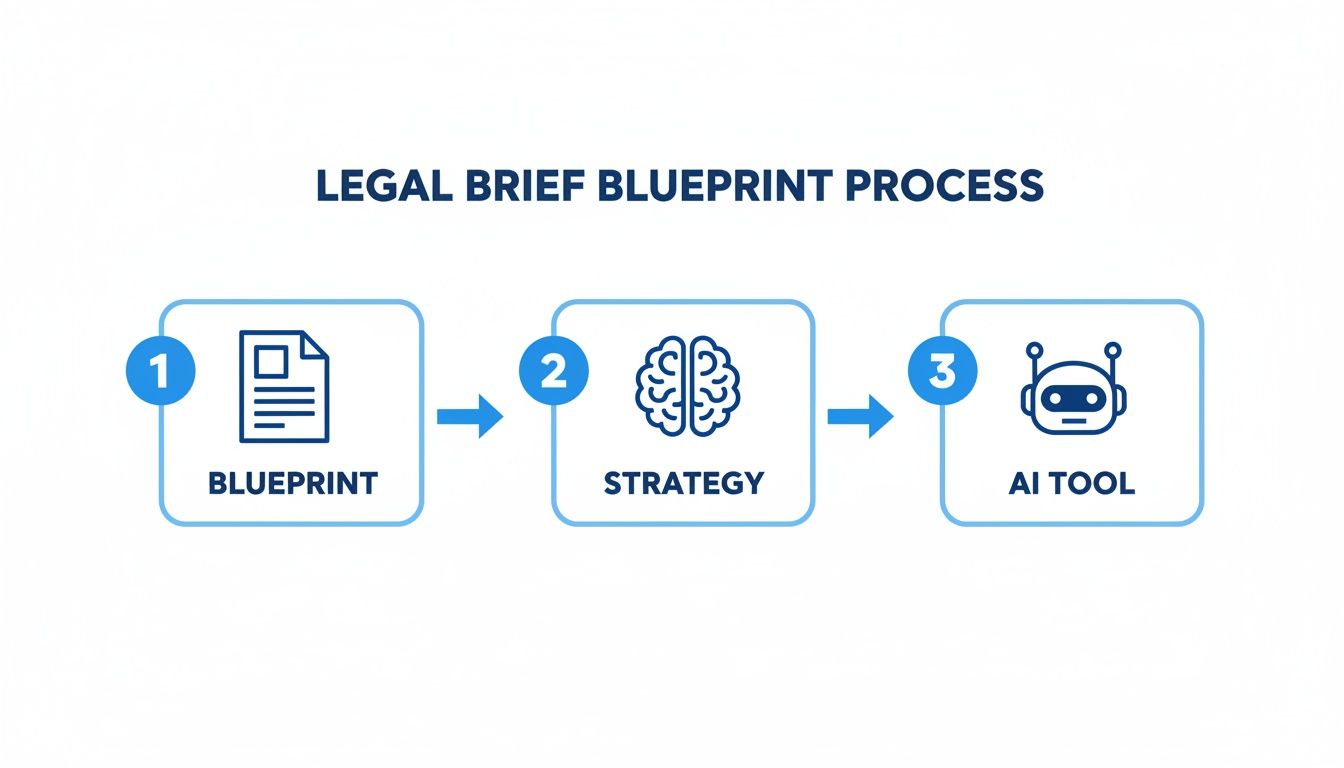
As you can see, the most effective approach starts with a solid legal strategy. Only then can technology truly enhance the process, rather than just automating a flawed plan.
Framing the Narrative from the Start
Your brief’s opening sections—the Caption, Introduction, and Questions Presented—are your first and best chance to frame the entire dispute. The Caption is just the basics: court, parties, and case number. Simple.
But the Introduction and Questions Presented? That's where you start to win. Your Introduction should be a concise roadmap of your entire argument, telling the judge exactly where you're going and why you deserve to win before they even get to the facts. Don't waste this space rehashing procedural history.
The Questions Presented are even more crucial. Your goal is to phrase the legal issues in a way that makes your answer seem like the only possible outcome. A well-drafted question feels neutral on the surface but subtly guides the reader toward your point of view from the very beginning.
Building a Persuasive Factual Foundation
Next up are the Statement of the Case and the Statement of Facts. Far too many lawyers treat these sections as a dry recitation of events. That’s a huge missed opportunity. While you absolutely must remain objective and cite every single assertion to the record, your real job is to tell a story—a story that makes your client’s position feel not just right, but inevitable.
Here are a few tips I've learned for crafting a powerful Statement of Facts:
- Go Chronological: It’s almost always the clearest and most effective way to present the narrative. Don't get fancy unless you have a very good reason.
- Let the Facts Argue for You: Instead of saying a car was "driving fast," state that it was "traveling at 85 mph in a 45 mph zone." The facts themselves are far more persuasive than your characterization of them.
- Kill the Adjectives: Your credibility plummets the moment you use argumentative language or emotional appeals in the fact section. A neutral, dispassionate tone is key. The same discipline applies when you're writing a witness statement to support those facts, since a credible, factual account is what holds up under scrutiny.
The Statement of Facts is where most cases are won or lost. By the time the judge finishes reading the facts, they should already want you to win. The Argument section that follows is just there to give them the legal justification they need.
Keeping track of every fact, exhibit, and citation is no small task. This is where tools like cloud-based legal case management software can be a lifesaver, helping you keep your record organized and your citations pristine.
Constructing an Unbreakable Argument
The Argument is the engine room of your brief. This is where you bring the law and your facts together. The single best way to structure each point is by using a time-tested framework like IRAC (Issue, Rule, Application, Conclusion) or its cousin, CREAC (Conclusion, Rule, Explanation, Application, Conclusion).
This structure isn't just academic; it forces clarity and discipline.
- Issue/Conclusion: Start each section with a strong point heading that flatly states the conclusion you want the court to reach on that issue.
- Rule: Lay out the governing legal principles, citing binding statutes and controlling case law. You can find the strongest precedents by digging into American https://www.legesgpt.com/case-law-ai.
- Application: This is where the magic happens. You have to meticulously apply the rule to the specific facts of your case. Don't just state the law and then state your facts—show the court precisely how they connect.
- Conclusion: Briefly restate your conclusion for that point, tying it all together.
While these principles are timeless, technology is changing how we execute them. The Federal Rules of Appellate Procedure are notoriously rigid—so rigid that violations led to 12% rejection rates in some circuits between 2015-2020. Now, AI is helping lawyers meet these exacting standards. By 2024, AI adoption soared to 79% among US lawyers, with 31% using generative tools specifically for briefs. That’s a massive jump from just 19% in 2023.
Finally, your Conclusion and Request for Relief must be razor-sharp. The Conclusion should briefly summarize your main points. More importantly, the Request for Relief must tell the court exactly what you want it to do—reverse a decision, grant a motion, affirm a judgment. Be specific. Leave no room for interpretation.
Fueling Your Argument with Strategic Research
A brilliant argument without solid legal authority is just an opinion. The research phase isn’t just about finding cases; it’s about building the steel framework that will support your entire brief. This is where you transform your client’s story from a simple claim into a compelling legal conclusion the court can adopt.

Think of yourself as a legal architect. You need to find the right materials—statutes and case law—to construct an airtight argument around the facts of your case.
Binding vs. Persuasive Authority: Know Your Arsenal
First things first, you’re hunting for binding precedent. These are decisions from higher courts in your jurisdiction that your judge must follow. This is your most powerful weapon. Start your search here, looking for statutes and cases that are directly on point.
But what happens when the law is silent on your specific issue? This is where the real art of advocacy begins. You’ll turn to persuasive authority. These are sources the court isn't obligated to follow but can be influenced by, such as:
- Decisions from courts in other states or federal circuits.
- Rulings from lower courts that got it right.
- Respected legal treatises, restatements, and law review articles.
Wielding persuasive authority skillfully shows the court you've thought deeply about the issue and can guide them to a just and well-reasoned outcome, especially in a case of first impression.
To do this well, you have to be able to read and digest complex legal texts efficiently. Reading case law is a unique skill, so it’s always a good idea to improve reading comprehension skills to quickly pull out the critical holdings and nuanced arguments you need.
Keep Your Research Organized from the Start
Don't let your research become a chaotic mess of open tabs and random documents. A disorganized research file inevitably leads to a disorganized brief.
Before you write a single word of the argument, create an outline that mirrors its structure (think IRAC). Under each point, drop in the cases, statutes, and even key quotes you find. This simple system keeps you focused and prevents you from falling down unproductive rabbit holes. It also makes drafting feel less like starting from scratch and more like assembling a puzzle with all the pieces in front of you.
For a more detailed breakdown of effective research strategies, our guide on https://www.legesgpt.com/blog/how-to-do-legal-research offers a practical framework.
Citations and Cite-Checking: Your Credibility Is on the Line
In front of a judge, your credibility is everything. And nothing torpedoes it faster than a sloppy, inaccurate citation. Every legal statement you make must be perfectly cited according to your jurisdiction's rules, whether that's the Bluebook, the ALWD Guide, or a local style manual.
Cite-checking is tedious but absolutely essential. It’s more than just formatting.
- Verify the source: Does the case you cited actually exist at that volume and page number?
- Check for accuracy: Does the case really say what you claim it says? No stretching the holding.
- Update your cases: Use a citator like Shepard's or KeyCite to make sure your authority is still good law and hasn't been overturned or criticized into oblivion.
This is where modern tools can save you from a major headache. AI legal assistants like LegesGPT, for example, can use a Deep Research Mode to instantly pull relevant case law from a massive database. It can give you the current status of a case and generate citations in the correct format, all while you focus on the substance of your argument. It’s about working smarter, ensuring your legal foundation is rock-solid without spending countless hours on manual verification.
Writing Prose That Persuades and Wins
You've done the heavy lifting—the research is solid, and your outline is tight. Now comes the part where you stop being an architect and start being a storyteller. This is the moment you transform a dry collection of facts and statutes into a narrative so compelling that the judge can't help but be led to your conclusion.

Persuasive writing in a legal brief has nothing to do with dramatic flair or emotional pleas. It's about precision. It's about building an argument so logical and clear that it feels inevitable.
Embrace Plain English and Ditch the Jargon
There was a time when legal writing was a fortress of dense, impenetrable prose. Thankfully, that era is over. Judges are people, and like all people, they appreciate writing that gets straight to the point. Ditch the "heretofores" and "whereases" and opt for simple, direct language.
This isn't just about style—it actually impacts results. The courts have shown a clear preference for conciseness. A 2022 analytics study revealed a 35% drop in remand rates for filings that were ambiguous before the legal community started embracing plain English. And since the 2018 reforms, briefs under 10,000 words have been winning 22% more often in federal appeals. For more on this trend, check out the Federal Bar Association's 2025 legal industry report.
Think of your brief less like an academic treatise and more like a high-stakes instruction manual. Every sentence must have a job to do.
Master the Art of the Topic Sentence
After reading the first sentence of any paragraph, your reader should know exactly what that paragraph is about. Strong topic sentences are your argument’s signposts, guiding the judge through your reasoning step by step. They are, in essence, mini-conclusions that set the stage for the evidence and analysis that follow.
Let's look at the difference:
- Weak: "In Smith v. Jones, the court addressed the issue of negligence."
- Strong: "The Smith v. Jones decision establishes that a defendant cannot be held liable for unforeseeable events."
The second version is doing real work. It immediately tells the reader the paragraph's purpose and how it fits into your larger argument. You've moved from passive reporting to active persuasion. For a deeper look at this kind of structural writing, our guide on how to write a legal memorandum covers many of the same core principles.
Frame the Issues from Your Client’s Perspective
Winning a case is about more than just laying out the facts. It’s about framing the entire dispute in a light most favorable to your client. This starts with how you phrase your Questions Presented and should flow through every single section of your brief.
The most persuasive briefs don't just tell the court what happened; they explain why it matters. They create a narrative where the law and facts naturally converge to support only one logical outcome—the one you are asking for.
Get ahead of your opponent. Acknowledge their likely counterarguments and dismantle them with your own logic and authority. This shows the court you've considered all the angles and that your position is the most well-reasoned one on the table, which builds incredible credibility.
Using AI to Refine and Polish Your Draft
Once you have a solid draft down, technology can be a powerful ally in taking your writing from good to great. AI assistants like LegesGPT go far beyond simple spell-checking, helping you analyze your prose for clarity, tone, and persuasive punch.
Here’s how you can use it to polish your draft:
- Suggesting Clearer Phrasing: Paste a convoluted sentence, and the AI can offer simpler, more direct alternatives.
- Identifying Passive Voice: The tool can flag passive constructions, helping you switch to stronger, active-voice sentences that convey more authority.
- Ensuring Consistent Tone: It can scan your document to ensure your tone remains professional and assertive, catching spots where you might sound overly aggressive or hesitant.
This isn’t about handing the reins over to a machine. It’s about using a smart tool to sharpen your own work. The strategy and the narrative are still yours, but AI can be the tireless editor that helps you perfect your writing faster.
Common Drafting Pitfalls and How to Avoid Them
Even seasoned attorneys can fall into common traps that weaken their arguments. Being aware of these pitfalls is the first step toward avoiding them. Here’s a quick guide to some of the most frequent mistakes and how to steer clear.
| Common Pitfall | Why It's a Problem | Effective Solution |
|---|---|---|
| Overusing Legal Jargon | It makes the brief hard to read and can obscure the core of your argument. Judges are busy and prefer clarity. | Swap complex terms for plain English. If a legal term of art is necessary, define it simply on its first use. |
| Passive Voice Constructions | It weakens your assertions and can make your writing feel hesitant or indirect. | Use active voice whenever possible. For example, instead of "The ball was thrown by him," write "He threw the ball." |
| Weak Topic Sentences | The reader doesn't know the purpose of the paragraph, forcing them to hunt for your point. | Start every paragraph with a clear topic sentence that states the conclusion of that paragraph. Think of it as a mini-thesis. |
| Ignoring Counterarguments | It makes your argument seem one-sided and less credible. The judge will think of them anyway. | Address potential counterarguments proactively and explain why they fail. This shows thoroughness and builds trust with the court. |
| Long, Dense Paragraphs | "Walls of text" are visually intimidating and make it difficult for readers to digest information. | Break up your writing into short, focused paragraphs of 2-4 sentences. Use headings and bullet points to improve scannability. |
| Inconsistent Tone | Shifting between aggressive, passive, and overly formal tones can confuse the reader and undermine your authority. | Read your draft aloud to catch tonal shifts. Use an AI tool to check for consistency and maintain a confident, professional voice throughout. |
By keeping these solutions in mind during your editing process, you can ensure your final brief is as polished and persuasive as possible, giving your client the best chance at a favorable outcome.
Polishing Your Brief for Maximum Impact
You've done the heavy lifting—the research, the analysis, the writing. But don't sprint through the finish line. The final steps in preparing your brief are just as crucial as the first. A polished, perfect document does more than just look professional; it telegraphs your credibility and your respect for the court. This is your last chance to make sure everything clicks.
Think about it: a single typo or a sloppy formatting choice can be incredibly distracting. It can pull a judge right out of the flow of your argument. Worse, it can suggest a lack of care or attention to detail, and that's a perception no lawyer can afford.
Nail the Jurisdictional Formatting Rules
Before you even dream of filing, you need to master the court's local rules. Every single jurisdiction has its own set of rigid, non-negotiable requirements for things like:
- Font and Font Size: Is it Times New Roman 14-point? Century 12-point? Guessing isn't a strategy.
- Margins: One-inch margins are a common default, but never assume. Look it up.
- Page or Word Limits: Busting these limits is one of the quickest ways to get your brief kicked back without a second glance.
- Citation Format: Does this court live by the Bluebook, ALWD, or its own quirky local style?
Ignoring these rules is a rookie mistake with serious consequences. Even with all the tech at our fingertips, the human element of following directions is paramount. Courts reject a staggering 15-20% of briefs every year for simple formatting errors. For lawyers using tools like LegesGPT, which can pull from millions of cases to produce cited drafts in seconds, this means more time to focus on crafting winning arguments and less on grunt work. You can dig into more eye-opening legal industry data in Clio's annual report.
A brilliant argument in the wrong font is still a rule violation. Don't let a simple formatting mistake stop a judge from ever reaching the merits of your case.
A Layered Approach to Editing and Proofreading
One read-through is never enough. It just isn't. To catch everything from a flawed legal premise to a stray comma, you need to edit in layers. Go through the document multiple times, and give each pass a specific mission.
- The Big Picture Edit: First, read only for the strength of your legal argument. Are your points logical? Is the analysis sharp? Is your application of the law to the facts truly persuasive?
- The Structural Edit: Now, forget the substance and focus on the skeleton. Do the topic sentences act as clear signposts for the reader? Do paragraphs flow naturally into one another? Is the overall organization intuitive?
- The Cite-Check: This one is a grind, but it's non-negotiable. Go through every single citation. Confirm the case or statute exists, that it stands for what you say it does, and—most importantly—that it’s still good law.
- The Final Proofread: This is your last defense against typos and grammatical gremlins. A classic trick is to read the brief backward, sentence by sentence. It forces your brain to see the words themselves, not the argument you already know is there.
Using Technology for the Final Polish
The final stretch is also where smart technology can give you a real edge. While you should never outsource your final substantive judgment, AI tools can automate some of the most tedious and time-consuming tasks.
This is where a tool like LegesGPT really shines. It can generate a perfectly formatted Table of Authorities (TOA) in an instant, a task that used to eat up hours of a paralegal's or associate's time. It can also run a final consistency check on your citation format and flag potential grammatical errors you might have become blind to after reading the draft a dozen times.
By letting technology handle these mechanical tasks, you save your brainpower for one last, comprehensive read-through. This combination of human expertise and technological efficiency is how modern briefs are perfected, ensuring that what lands on the judge’s desk is not only procedurally flawless but as persuasive as it can possibly be.
Frequently Asked Questions
How Long Should a Legal Brief Be?
This is a trick question, because the answer is almost never up to you. The length of your brief is dictated by court rules, and you absolutely must follow them. For instance, under Federal Rule of Appellate Procedure 28, a principal brief generally can't exceed 13,000 words. But here's the key: never treat that limit as a target. Busy judges and their clerks are reading mountains of material. A concise, powerful argument that gets straight to the point is always more persuasive than a bloated brief that uses every last word allowed. Check the local rules for your specific court—they vary wildly—and then focus on being as efficient and impactful as possible within that space.
What's the Single Biggest Mistake to Avoid?
I see this all the time, and it's a credibility killer: failing to actually answer the “Question Presented.” A drafter will state the question beautifully, then launch into a meandering summary of case law in the Argument section, never explicitly connecting the dots. They never tell the judge why those cases mean their client should win. Your argument needs a rigid logical backbone. A simple framework like IRAC (Issue, Rule, Application, Conclusion) is your best friend here. It forces you to connect the law to your facts and draw a firm conclusion for the court. Of course, the other common mistakes are the unforced errors—typos, citation blunders, and formatting slip-ups. They scream carelessness and can get your brief struck. > The most persuasive brief is one that makes the judge's job easy. A clear structure isn't just a suggestion; it's a sign of respect for the court's time and a hallmark of a professional, confident argument.
Can I Just Use an AI Tool to Write the Whole Thing?
AI tools like LegesGPT are fantastic for speeding things up, but think of them as a highly skilled paralegal, not a replacement for your legal judgment. They’re best used to do the heavy lifting, not to fly the plane solo. Here’s where AI really shines: • Kicking off your research and pulling relevant cases in minutes. • Generating a solid, jurisdiction-specific outline to get you started. • Drafting an initial version of dense sections, like the Statement of Facts. • Finding on-point case law and providing verifiable citations. This can easily cut your drafting time by more than 50%. But the strategy, the subtle framing, and the persuasive voice? That has to be yours. The core of advocacy is still a human skill.
How Do I Make My Statement of Facts Persuasive Without Being Argumentative?
Mastering this is an art. A great Statement of Facts tells a story that guides the reader to your conclusion before they even reach your argument. The secret is using objective language while carefully curating the sequence of events. Start with a theme that frames the narrative from your client's perspective. Then, lay out the facts—chronologically is usually best—in a way that emphasizes the moments that help your case and exposes the gaps in your opponent's. Stick to precise, vivid details but kill the adverbs and adjectives. Don't say, "the defendant recklessly drove." Instead, state, "the defendant's vehicle entered the intersection at 60 mph, 25 mph over the posted speed limit, without braking." Let the facts do the heavy lifting for you. --- Ready to build stronger arguments faster? LegesGPT combines an AI legal chatbot with access to millions of cases, statutes, and articles to deliver instant, well-structured answers with verifiable citations. Start your 3-day trial and experience measurable productivity gains at https://www.legesgpt.com.