
A solid supplier contract is far more than just a legal document; it's the blueprint for a successful partnership. But the foundation for that blueprint is poured long before you ever write a single clause. It all starts with rigorous due diligence to make sure you're partnering with someone who is reliable, capable, and financially stable.
Building the Foundation Before You Draft

Jumping straight into drafting a contract without properly vetting a supplier is like building a house on a shaky foundation—it's just asking for trouble down the road. This pre-drafting phase is where you'll head off the vast majority of future risks. A well-vetted partner is simply less likely to cause disruptions, quality headaches, or damage to your reputation.
This deep-dive investigation, what we call supplier due diligence, involves a thorough look into your potential partner's operations, finances, and reputation. It's about confirming they can actually walk the talk and that their standards align with your own. I’ve seen firsthand how skipping this step leads to costly disputes, supply chain meltdowns, and legal battles that even the most ironclad contract can't fully fix.
Assessing Financial Stability and Health
Before you commit to a long-term relationship, you absolutely have to verify that your potential supplier is on solid financial ground. A partner teetering on the edge of bankruptcy is a massive liability. Their financial distress can quickly become your problem, leading to sudden shutdowns, incomplete orders, or a nosedive in quality as they start cutting corners.
To get a clear picture of their financial health, you'll want to:
- Request Financial Statements: Ask to see recent balance sheets and income statements. You're looking for healthy cash flow, manageable debt, and a track record of profitability.
- Run a Credit Check: Use a reputable business credit reporting agency. This will give you a clear view of their payment history and overall creditworthiness. A pattern of late payments to their own suppliers is a major red flag.
- Check for Liens or Judgments: A quick search of public records can uncover any legal or financial baggage that might point to deeper problems. This kind of lien check matters even more in trade-heavy deals, where our guide to reviewing a construction contract before you sign walks through lien waivers, retainage, and change-order scope.
This isn't about being nosy; it’s about making sure the partner you’re counting on will still be in business next year.
"I can't tell you how many businesses fixate on the lowest price, only to find out their new supplier doesn't have the financial runway to handle a large order or survive a market downturn. Verifying financial health upfront prevents a full-blown crisis later."
Verifying Operational Capacity and Quality Control
Can they actually handle your volume? And can they meet your quality standards? The promises made in a sales pitch need to be backed up by real, tangible operational capabilities. A mismatch here is a recipe for delays, frustration, and disappointed customers.
Your due diligence has to confirm they can perform. Honestly, nothing beats an on-site visit to see their operation with your own eyes. Whether in person or through detailed inquiries, you need to get a handle on their:
- Production Capacity: Do they have the right equipment, staff, and space to meet your needs now and as you grow?
- Quality Management Systems: Dig into their quality control processes. Are they ISO 9001 certified? How do they handle defects? What does their return or rework process look like?
- Supply Chain Resilience: Ask them about their suppliers. A heavy reliance on a single source for a critical raw material could become a hidden risk for your business, too.
Evaluating Compliance and Reputation
At the end of the day, your supplier becomes an extension of your brand. Their ethics, their compliance with regulations, and their reputation in the market will reflect directly on you. It's critical to make sure their values and practices are in lockstep with yours.
Do some digging. Look for any history of labor disputes, environmental violations, or data breaches. A simple online search can often turn up customer reviews, news articles, and general industry sentiment. Protecting your brand’s good name starts with choosing partners who operate with integrity. For more ideas on how to structure these relationships, exploring some free business agreement templates can provide a good baseline for standard expectations. All this groundwork ensures the contract for supplier you ultimately draft is with a partner who has earned your trust.
Drafting the Essential Clauses of Your Supplier Contract
After all the due diligence, you've found a supplier you trust. Now comes the critical part: getting it all down on paper. A solid contract for supplier does more than just protect you when things go south; it's your operational playbook. It sets expectations and gives both sides a clear definition of what a successful partnership looks like.
The real goal here is to stamp out any and all ambiguity. Every responsibility, deadline, and dollar should be defined so clearly that there’s simply no room for misinterpretation. Let's dig into the core clauses that every strong supplier agreement needs.
Defining the Scope of Work and Deliverables
This clause is the heart of the entire agreement. If you get the Scope of Work (SOW) wrong, nothing else matters. It needs to be a painfully specific, crystal-clear description of the exact goods or services your supplier will provide.
Vague language is your worst enemy. "Supplier will provide marketing services" is a recipe for disaster. A well-drafted SOW, on the other hand, might read: "Supplier will deliver twelve (12) blog posts per month, each between 1,000-1,200 words, optimized for SEO based on keywords provided by the client, and two (2) social media posts per day on platforms X and Y." See the difference?
Your SOW should nail down these specifics:
- The Goods or Services: Itemize everything. Get granular.
- Quantity and Specifications: Think model numbers, material grades, or specific service levels.
- Timelines and Milestones: What is due, and when is it due? Set hard deadlines.
- Acceptance Criteria: How will you sign off on their work? Define exactly what "done" looks like.
Getting this right creates a shared benchmark for success. It becomes the yardstick you'll use to measure their performance from day one.
Establishing Clear Payment Terms
Money is one of the biggest friction points in any business relationship, but it doesn't have to be. A detailed payment clause takes all the guesswork out of the equation, ensuring your supplier gets paid correctly and you're never surprised by an unexpected invoice. If money terms are the sticking point, our guide on how to write a payment contract walks through milestone and installment structures step by step.
Of course, you’ll state the agreed-upon price, whether it’s a fixed fee, an hourly rate, or a per-unit cost. But you have to go deeper than just the number.
A common mistake I see is teams agreeing on a price but failing to define the "how" and "when." This inevitably leads to arguments over invoicing, payment cycles, and late fees—all of which could have been avoided with a few extra sentences in the contract.
Be sure to cover:
- Payment Schedule: Is it payment on delivery, Net 30, or tied to specific project milestones?
- Invoicing Procedure: How are invoices submitted? Who gets them? What information is required for an invoice to be considered valid?
- Late Payment Penalties: What happens if a payment is late? Spell out any interest or fees.
- Expense Reimbursement: If you’re covering expenses, define exactly which ones are reimbursable and the documentation needed.
Setting Performance Standards and Quality Metrics
How do you know if your supplier is doing a good job? Hope isn’t a strategy. You need objective, measurable Key Performance Indicators (KPIs) written directly into the contract. This is how you turn subjective feelings into hard data.
For a software provider, this could be 99.9% uptime or a support ticket response time under 24 hours. For a parts manufacturer, it might be a defect rate below 1% or an on-time delivery rate of 98%.
These metrics serve two vital functions. They act as an early warning system if performance starts to dip, and they give you the legal grounds for action if the supplier consistently fails to meet their obligations. This level of detail is no longer optional; it's standard practice. The contract lifecycle management market is seeing a 12-15% CAGR as more companies treat their contracts as dynamic operational tools, not just static legal files.
To really get a handle on this, it helps to understand the fundamentals of similar agreements. For a closer look at structuring these kinds of deals, our guide on the essential components of a sales contract is a great place to start.
Getting these foundational clauses right is non-negotiable. They form the bedrock of your supplier relationship. The table below breaks down the most critical clauses you'll encounter, what they're for, and what you should be thinking about as you draft them.
Key Clauses in a Supplier Contract
| Clause | Purpose | Key Drafting Considerations |
|---|---|---|
| Scope of Work (SOW) | To explicitly define all goods, services, and deliverables. | Be hyper-specific. Include quantities, specifications, timelines, and acceptance criteria. Avoid vague language at all costs. |
| Payment Terms | To outline all financial obligations, including price, schedule, and procedures. | Specify the exact price, payment schedule (e.g., Net 30), invoicing process, and any penalties for late payments. |
| Performance Metrics | To set objective, measurable standards for quality and service levels. | Define specific KPIs (e.g., 99.9% uptime, <1% defect rate) that are measurable and relevant to the service. |
| Term and Termination | To define the contract's duration and the conditions for ending the relationship. | State the start and end dates. Detail conditions for termination "for cause" (breach) and "for convenience" (without cause). |
| Confidentiality (NDA) | To protect sensitive information shared between both parties. | Clearly define what constitutes "Confidential Information" and outline the obligations for handling it. |
| Intellectual Property | To determine ownership of any IP created or used during the engagement. | Clarify who owns pre-existing IP versus any new IP developed under the contract. This is crucial for creative or tech services. |
| Indemnification | To allocate financial responsibility for losses or damages arising from the contract. | Define each party's obligation to cover losses resulting from their own negligence, breach, or IP infringement. |
| Limitation of Liability | To cap the total amount of damages one party can claim from the other. | Often capped at the total contract value or fees paid over a specific period (e.g., 12 months). Exclude gross negligence. |
| Governing Law | To specify which jurisdiction's laws will be used to interpret the contract. | Choose a jurisdiction that is practical and has a well-developed body of commercial law (e.g., Delaware, New York). |
Think of these clauses as the building blocks of your agreement. Each one addresses a specific area of risk and responsibility, and together, they create a comprehensive framework that keeps your partnership on track.
Shielding Your Business: Risk, IP, and Compliance
Once the operational nuts and bolts are tightened, it's time to build the armor around your agreement. This is where you shift from defining the "what" and "how" of the work to protecting your business from the "what-ifs." This part of the contract is your defense, shielding your intellectual property, confidential data, and bottom line from unforeseen trouble.
Think of it this way: your scope of work and payment terms are for when everything goes right. These next clauses are for when things go wrong. Skipping them is like leaving your company’s back door wide open.
Who's on the Hook? Indemnification and Liability
When something goes sideways, the first question is always, "Who pays?" This is where risk allocation clauses come in, and the two heavy hitters are indemnification and limitation of liability. They're a tag team that defines financial responsibility.
Indemnification is essentially a "hold harmless" promise. One party agrees to cover the other's back if a specific problem arises, usually from a third-party claim. For instance, you should always have your supplier indemnify you against IP infringement claims. If they build a piece of software for you using code they didn't have the rights to, and you get sued, this clause puts them on the hook for the legal fallout—not you.
Of course, no supplier will sign up for a blank check of infinite risk. That’s why we have the Limitation of Liability (LOL) clause. It puts a ceiling on the total amount of damages one party can claim. This cap is often tied to the total fees paid under the contract over a specific period, like the previous 12 months. The goal isn't to get out of responsibility but to make the risk predictable and insurable for everyone involved.
A smart contract creates a reasonable balance of risk, it doesn't just dump 100% of it on the supplier. Trying to force incredibly one-sided terms is a red flag for good partners. They'll either walk away or, more likely, just bake the cost of that extra risk right into their price.
Protecting Your Crown Jewels: Confidentiality and IP
Bringing a supplier into the fold often means sharing sensitive information—your "secret sauce," customer lists, or future product plans. This is where confidentiality and IP ownership clauses become your most important guards.
A Confidentiality Clause, which can be part of the main agreement or a separate NDA, is a legally binding gag order. It stops the supplier from sharing your secrets. You need to clearly define what you consider "Confidential Information" and spell out their duty to protect it. For a much deeper look at getting this right, our guide to creating a strong confidentiality agreement has you covered.
The Intellectual Property (IP) Clause is all about ownership. Who owns what’s created? Be brutally clear. You need to distinguish between:
- Pre-existing IP: The tools and know-how each party brings to the table.
- Newly Created IP: Anything new developed specifically for the project. The rule of thumb is simple: if you paid for it, you own it.
Let's say you hire a creative agency to design a new brand logo. The contract must state, without a shred of ambiguity, that your company owns the final design. Otherwise, you could find yourself in a nasty dispute over who actually holds the rights.
The Safety Net: Insurance and Compliance
Finally, your contract must insist that the supplier carries adequate insurance. Think of this as a financial backstop. If they have to cover a major indemnification claim, their insurance policy ensures they have the cash to do it, protecting both of you from financial ruin.
Be specific about the types and minimum coverage amounts you require:
- Commercial General Liability: Your standard protection against property damage or bodily injury.
- Professional Liability (Errors & Omissions): A must-have for service providers. It covers losses caused by their negligence or mistakes.
- Cyber Liability: Absolutely critical if your supplier will access, store, or handle any of your company or customer data.
These contractual protections are just one piece of a much larger puzzle. To truly get ahead of supplier-related issues, it pays to explore dedicated Third-Party Risk Management (TPRM) strategies. As supply chains get more complicated—with the global contract logistics market set to grow by 3.3% and 73% of businesses changing sourcing plans due to tariffs—this kind of oversight is no longer optional.
Negotiating Your Supplier Agreement Like a Pro
The draft is finished, but the real work is just beginning. Negotiation is where a good supplier contract becomes a great one—the foundation for a genuine strategic partnership. Too often, people walk into this process seeing it as a battle, but that’s a rookie mistake. A successful negotiation isn't about crushing the other side; it’s about finding that sweet spot where both parties win, strengthening the relationship right out of the gate.
Your mindset going in is half the battle. You're there to get the best possible terms for your business, of course, but you also need the supplier to feel respected and motivated to bring their A-game. This collaborative spirit often reveals creative solutions that a purely adversarial approach would completely miss. It's the difference between a long-term partnership and a transactional, price-driven one-off.
Preparation Is Your Greatest Advantage
There's no faster way to leave money on the table than to walk into a negotiation cold. The best negotiators I've known have done 90% of their work before they even sit down. This isn't just about knowing what you want; it's about understanding their position as well as you understand your own.
First, get your own house in order. What are your absolute must-haves, and where do you have some wiggle room?
- Pinpoint Your Deal-Breakers: These are the hills you're willing to die on. Think critical terms like IP ownership, data security protocols, or essential quality standards. Know them cold.
- List Your "Nice-to-Haves": These are your bargaining chips. Maybe you can be flexible on payment terms in exchange for a longer warranty, or vice-versa.
- Research the Market: Ground every single one of your positions in data. Knowing the industry standard for pricing, service levels, or lead times gives your arguments undeniable weight.
This groundwork creates your roadmap. When the conversation gets tangled, you'll know precisely which points are worth fighting for and which you can concede to build goodwill and push the deal across the finish line.
Understanding the Other Side of the Table
Every supplier is driven by more than just the bottom line. To be a truly effective negotiator, you have to get inside their head. What do they really care about? Sometimes, a concession that costs you next to nothing is a massive win for them.
Think about what your supplier might value beyond a higher price tag:
- Predictable Cash Flow: Offering to pay on Net 15 instead of Net 45 terms can be an incredibly powerful, low-cost bargaining chip for you.
- Guaranteed Volume: A longer-term contract or a minimum order commitment gives them stability, which often translates into better pricing for you.
- A Marketing Win: Could you offer a public case study, a glowing testimonial, or a co-branded press release? These things can be worth more to them than a few extra percentage points on the price.
I once worked on a deal where the supplier was completely dug in on their final price. We were at a stalemate. Instead of walking away, we offered to feature them in an upcoming industry press release. That "free" concession was all it took for them to agree to our preferred liability cap—a term that was far more valuable to us in the long run.
By following the 70/30 rule (that’s 70% listening, 30% talking), you’ll start to pick up on these underlying interests. The entire dynamic shifts from a tug-of-war over a single number to a collaborative session where you're both solving a puzzle.
Common Pitfalls and How to Sidestep Them
Even with flawless preparation, it's surprisingly easy to fall into common traps during the heat of a negotiation. Just being aware of them is the first step to staying on track. The key is to keep your eyes on the strategic prize and not get distracted by ego or pressure tactics.
One of the biggest blunders I see is negotiating term by term. Don't agree on price, then move to delivery, then tackle the warranty. You have to discuss all the major points as a holistic package. This allows you to make smart trade-offs, like accepting a slightly higher price in exchange for a rock-solid indemnification clause. Viewing the contract for supplier as a whole ensures you get the best overall deal, not just a win on a single line item.
Using Technology For Smarter Contract Management
Let's be honest: relying on spreadsheets and dusty filing cabinets to manage supplier contracts is just asking for trouble. It's not just slow; it’s a recipe for missed deadlines, costly errors, and lost opportunities. Moving to dedicated technology isn't a luxury anymore—it's a basic operational need for any company that's serious about managing risk and getting the most out of its supplier relationships.
This is where Contract Lifecycle Management (CLM) software changes the game. Think of it as a central, secure hub for every single agreement. It cuts through the chaos of scattered documents and creates one definitive source of truth that your legal and procurement teams can access whenever they need it.
Moving From Manual Chaos To Automated Clarity
The real magic of modern CLM tools is their knack for automating the tedious, mind-numbing tasks that eat up your team's day. Instead of someone manually checking a calendar for renewal dates, the system pings you with an alert automatically. No more digging through ancient email chains to confirm a supplier's obligations—you can pull up the exact clause in seconds.
This automation injects a much-needed dose of precision into contract oversight. For procurement teams, this means you can:
- Never miss a renewal again. Get automated reminders 30, 60, or 90 days before a contract expires, giving you plenty of time to renegotiate or explore other options.
- Keep suppliers accountable. Easily track and monitor key deliverables and service levels to make sure you're getting exactly what you paid for.
- Standardize your process. Use pre-approved templates and clause libraries to build consistent, compliant contracts every time. This helps clamp down on rogue spending and unvetted terms.
The Rise Of AI In Contract Analysis
Artificial intelligence takes this a massive step further. AI-powered tools, like LegesGPT, can chew through a dense, 50-page supplier agreement in minutes—a task that would take a paralegal hours. This tech can instantly spot missing clauses, flag risky or unusual language, and pull out key details like liability caps, payment terms, and termination conditions.
This isn't just about speed; it's about making smarter decisions. By turning unstructured legal text into useful data, you can see where your risks are concentrated across your entire supplier base. Tools that offer AI Powered Document Processing are becoming indispensable for making sense of the mountains of information locked away in these documents.
The biggest win here is freeing up your best people to do what they do best. Instead of getting bogged down in boilerplate, they can focus on negotiating better terms, strengthening supplier partnerships, and tackling genuine business risks.
The entire negotiation process, from prep to signature, becomes faster and more informed when powered by technology.
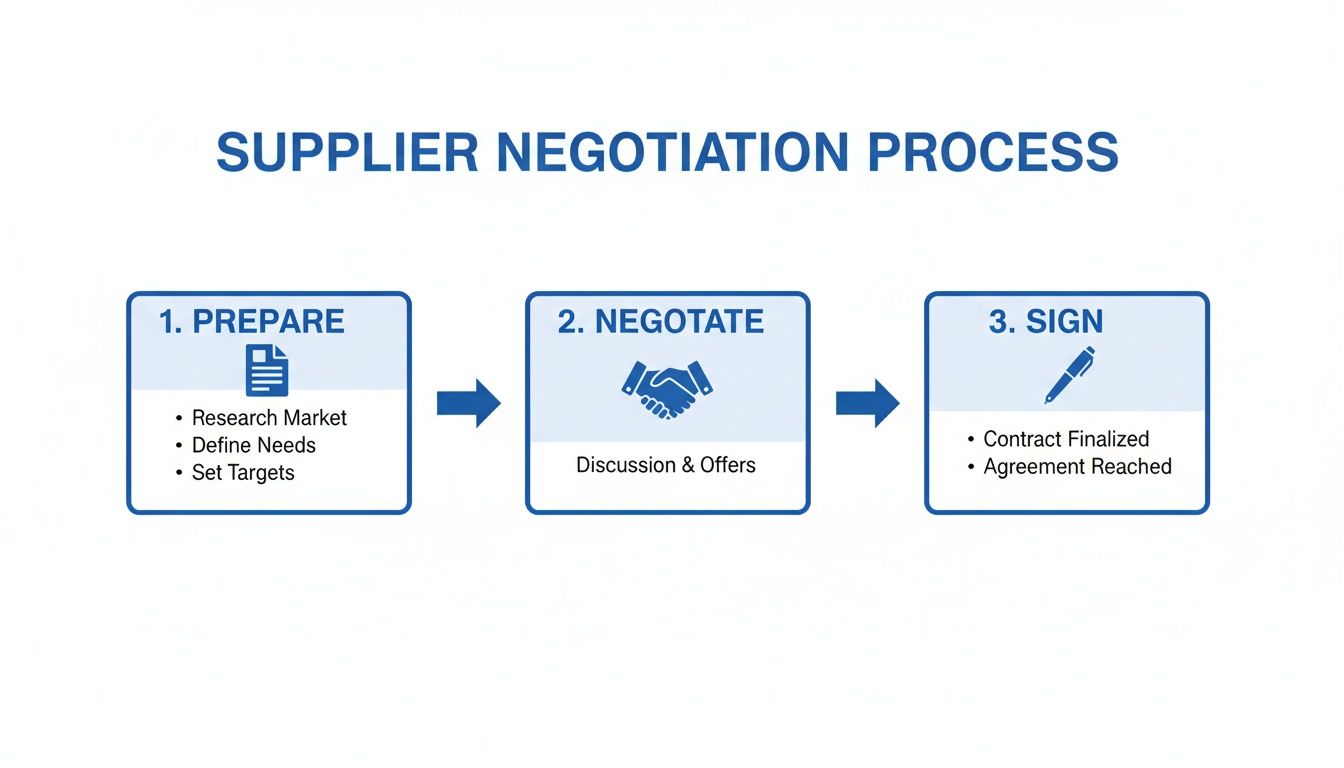
Each of these stages—preparation, negotiation, and signing—is supercharged by having a centralized, data-rich CLM system at your fingertips.
A Practical Comparison
The difference between the old way and the new way is night and day. Where a manual review is slow, subjective, and prone to fatigue, an AI-driven approach offers lightning speed and data-backed consistency. Just look at how they stack up on common tasks.
Manual vs AI-Powered Contract Review
| Task | Traditional Method | AI-Powered Method (e.g., LegesGPT) |
|---|---|---|
| Initial Risk Assessment | Hours or days of manual reading by a paralegal or lawyer. Highly subjective. | Seconds. Scans entire document, flags non-standard clauses, and assigns a risk score. |
| Extracting Key Terms | Manually copy-pasting dates, renewal terms, and liability caps into a spreadsheet. | Automatic. Extracts and organizes all key data points into a searchable dashboard. |
| Finding Specific Clauses | Tedious "Ctrl+F" searches, often missing variations in language. | Instant. Natural language search finds concepts, not just keywords (e.g., "how do we end this agreement?"). |
| Ensuring Compliance | Cross-referencing against an internal playbook or checklist manually. Easy to miss things. | Automatic. Compares the contract against your pre-defined legal playbook and flags deviations. |
| Version Control | Confusion over email attachments (e.g., "Supplier_Agreement_v4_FINAL_final2.docx"). | Centralized. A single source of truth with a clear audit trail of all changes and comments. |
At the end of the day, adopting this technology isn't just about buying software. It's an investment in a smarter, more resilient, and more profitable supply chain. It's about giving your team the tools they need to give every single supplier contract the strategic attention it deserves.
Got Questions About Supplier Contracts? We’ve Got Answers.
When you're dealing with supplier agreements, questions are bound to come up. It doesn’t matter if you’re staring at your very first contract or managing a whole portfolio of them—certain issues and gray areas seem to pop up time and time again. Getting straight answers is the only way to protect your business and make smart decisions.
Here, we'll walk through some of the most common questions we hear about the contract for supplier process. Think of this as a quick, practical guide to help you handle these situations with a bit more confidence.
Supplier Contract vs. Purchase Order: What's the Real Difference?
This is easily one of the most frequent points of confusion, and getting it wrong can be a costly mistake. The distinction is actually quite simple.
A Purchase Order (PO) is for a one-off transaction. Think of it as a specific, tactical order: "We need 500 units of Part X delivered by next Friday for this price." It’s short-term and focused on the what, when, and how much of a single purchase.
A supplier contract, on the other hand, is the foundation of the entire relationship. It’s a strategic document that sets the ground rules for how you'll work together over the long haul. While a PO is about a single order, the contract covers the heavy-hitting, big-picture items:
- Liability and Indemnification: Who’s on the hook if things go sideways?
- Confidentiality: How is your company's sensitive information going to be protected over the life of the partnership?
- Dispute Resolution: What’s the agreed-upon process for sorting out disagreements without heading straight to court?
- Intellectual Property: Who owns the brilliant ideas or designs that come out of your collaboration?
You don't get that level of protection from a PO. You issue POs under the umbrella of a master supplier agreement, which provides the critical legal framework for every transaction that follows.
How Can I Make Sure My Contract Is Actually Enforceable?
A contract that can't be enforced is just an expensive piece of paper. To make sure your supplier agreement is legally binding, it needs a few fundamental components.
First, you need a clear offer and acceptance—one side makes a proposal, and the other agrees to it. Next, there has to be consideration, which is just the legal term for an exchange of value (e.g., they provide services, you provide money). Finally, the terms must be legal, clear, and signed by people who actually have the authority to commit their companies.
Expert Tip: The biggest enemy of enforceability is ambiguity. Vague language is where contracts go to die and disputes are born. Make sure every key obligation—from payment terms and delivery schedules to quality standards—is defined with crystal clarity. This is where an AI contract review tool can be a lifesaver, quickly flagging vague clauses or risks that could weaken your agreement down the line.
What Should I Do If a Supplier Breaches Our Contract?
It happens. Your supplier misses a major deadline or delivers a batch of goods that are completely out of spec. What's your next move? The very first thing you should do is pull out the contract.
A well-written agreement will have a section—usually titled "Breach of Contract" or "Termination"—that lays out the exact playbook. Typically, that process looks something like this:
- Send a Formal Written Notice: You can’t just pick up the phone. You need to formally notify the supplier in writing that they are in breach, clearly stating which part of the contract they've failed to uphold. This formal step is known as a notice to cure, and getting its wording right is what keeps your termination rights intact.
- Give Them a "Cure Period": Most contracts build in a chance for the supplier to fix the problem. This "cure period" is often 15 to 30 days.
- Follow the Agreed-Upon Next Steps: If the supplier doesn't—or can't—resolve the issue within that window, the contract will spell out your options. This could mean terminating the agreement, seeking financial damages, or pursuing other remedies you both agreed to upfront.
Through all of this, document everything. Every email, every phone call, every formal notice needs to be recorded. Sticking to the process in your contract is your single best defense if the situation gets worse and you need to prove you did everything by the book.
Ready to take the guesswork out of your legal work? LegesGPT is an AI-powered legal assistant that helps you review contracts, identify risks, and get instant answers to your legal questions. Start your free trial and experience a smarter way to manage your agreements. Learn more at LegesGPT