
Think back to the old way of reviewing contracts. Remember the endless nights, the tower of coffee cups, and that nagging fear of missing one crucial clause hidden somewhere in a 50-page document? That high-stakes, manual grind is quickly becoming a thing of the past. AI for contract review isn't some far-off idea; it's a very real and essential tool for legal teams, business owners, and paralegals right now.
Why AI Is the New Legal Standard
The traditional method of contract analysis is a tough gig. It's reactive by nature and a massive time sink. A single, moderately complex agreement can easily eat up hours—or even days—of a professional's time, creating frustrating bottlenecks that slow the entire business down.
Even worse is the ever-present risk of human error. A missed auto-renewal date, an overlooked liability clause, or an inconsistent term can lead to serious financial and legal headaches. The reality is, this manual process just can't keep up with the speed and volume of business today.
This is where AI for contract review completely flips the script. It brings a proactive, data-informed approach to the table, turning what was once a tedious chore into a genuine strategic advantage.
From Manual Burden to Strategic Asset
Let's be clear: these tools aren't here to replace legal experts. Think of them as a highly skilled assistant, one that supercharges your abilities and frees you up to focus on the work that truly matters. The AI handles the mind-numbing, line-by-line scanning, while you provide the critical thinking, negotiation strategy, and client advice that no technology can replicate.
This partnership empowers professionals in a few key ways:
- Speed and Efficiency: You can analyze documents in minutes that would have taken hours, dramatically speeding up deal cycles and getting approvals faster.
- Enhanced Accuracy: The software catches subtle deviations, inconsistencies, and risky language that the human eye might miss, especially after a long day.
- Proactive Risk Mitigation: It automatically flags non-standard clauses, missing sections, or obligations that could create future problems for the company.
- Data-Driven Insights: You can look across your entire contract portfolio to spot trends, standardize your terms, and arm yourself for better negotiations down the road.
By automating that initial, heavy-lifting phase of review, AI allows legal professionals to stop being document checkers and start being strategic advisors. That's where the real value is.
As the legal world changes, more and more firms are seeing that old methods won't cut it. They're looking for better ways of mastering contract review with modern tools. This guide will give you a straightforward map to understanding how this technology works, its real-world benefits, and how you can use it to get a serious competitive edge.
How AI Actually Reads and Understands Legal Language
To get comfortable with AI reviewing your contracts, it helps to pull back the curtain and see how it actually works. It's not magic. Think of it less like a mysterious black box and more like a hyper-efficient legal analyst who has read and perfectly memorized millions of contracts, never forgetting a single detail.
This capability is built on a few core technologies working together. Let’s break them down.
The first piece of the puzzle is Natural Language Processing (NLP). At its heart, NLP is what allows a computer to make sense of human language. It’s the same tech that powers Siri or Google Translate, letting them parse sentences and understand requests.
For AI in contract review, NLP is the initial step of breaking down dense legal text into its building blocks—words, sentences, and clauses. It figures out the basic grammar and structure, which is the foundation for any deeper analysis.
This diagram illustrates how AI takes the slow, one-step-at-a-time manual process and turns it into a fast, comprehensive analysis.
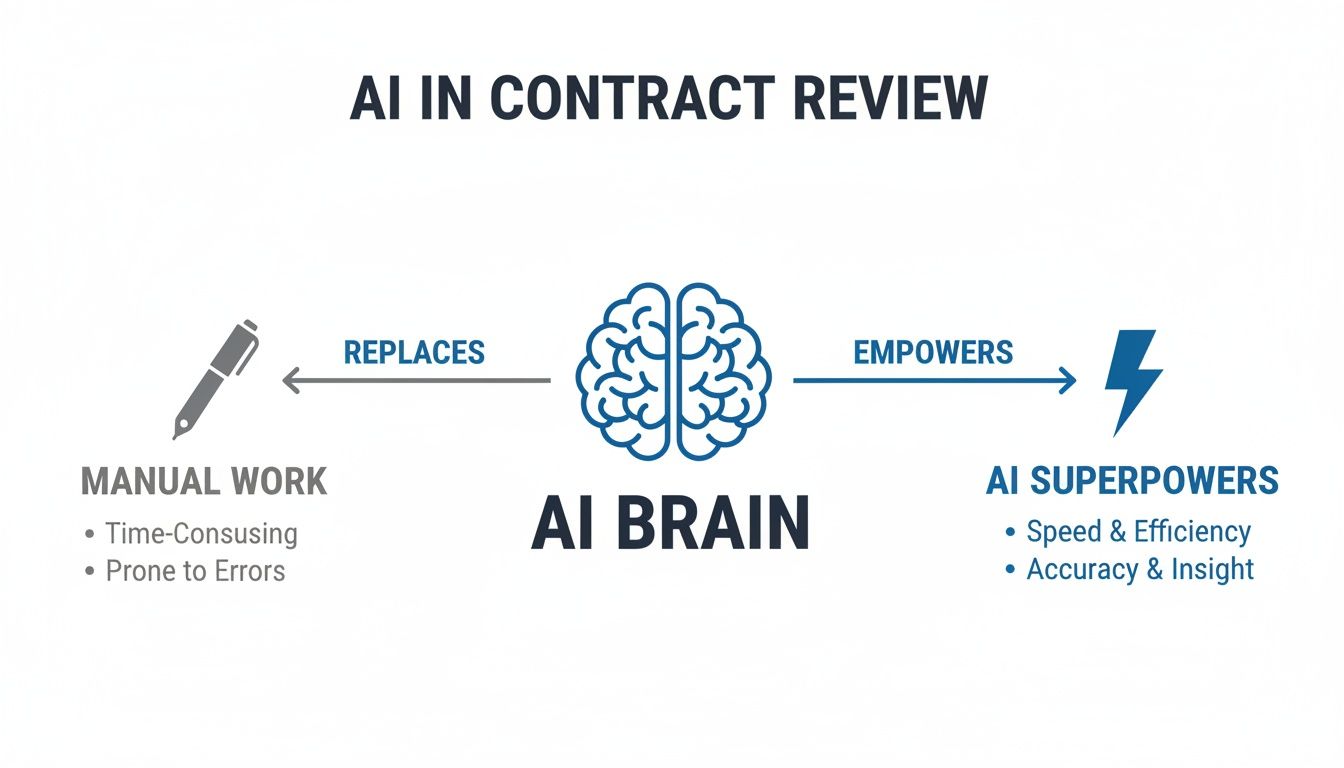
As you can see, it’s not about just doing the old job faster; it's about creating entirely new ways to find insights and spot risks.
From Words to Meaning with Machine Learning
Once NLP has mapped out the language, the next layer kicks in: Machine Learning (ML). If NLP is how the AI reads, ML is how it learns. A machine learning model is trained on a massive library of legal documents—we're talking thousands upon thousands of NDAs, MSAs, and employment agreements.
During this training, the model starts to recognize patterns. It learns what a standard "Limitation of Liability" clause contains, how an "Indemnification" clause is usually phrased, and which words signal a high-risk provision. It’s not just looking for keywords; it’s learning the context that gives those words meaning.
This is how the AI develops an almost instinctual feel for what’s standard in a contract and, more importantly, what isn't.
The Power of Large Language Models
The most sophisticated piece of this entire system is the Large Language Model (LLM). LLMs are the powerful engines, like the one inside LegesGPT, that tie everything together. Having been trained on an incredible amount of text data, an LLM can grasp nuance, context, and even legal intent with stunning accuracy.
Here’s a look at how it all comes together when you review a contract:
- Ingestion and Structuring (NLP): You upload a document. The NLP component immediately scans it, identifying the different sections, clauses, defined terms, and parties involved.
- Pattern Recognition (ML): The ML model then analyzes this structured data. It compares every single clause against the millions of patterns it has learned, instantly flagging a non-standard payment term or a missing confidentiality clause because it deviates from the established norm.
- Insight Generation (LLM): Finally, the LLM pulls all these findings together. Instead of just showing you a red flag, it can explain why something is a risk, summarize the key obligations for your team, and even suggest safer, alternative language.
The real breakthrough is the AI’s ability to move beyond simple keyword searching to genuine contextual understanding. It knows that "terminate for convenience" has a profoundly different legal impact than "terminate for cause," even though the words are similar.
This layered approach is what gives AI contract review its punch. It doesn’t just skim the words on the page. It understands their legal weight, their relationship to the rest of the document, and the potential risk they pose to your business, delivering an analysis that is both incredibly fast and impressively deep.
What You Really Gain from Smarter Contract Analysis
It’s one thing to understand the tech behind AI for contract review, but what really matters is the tangible value it brings to your business. Let's get past the jargon and look at how this actually impacts your team's efficiency, your company's risk profile, and your bottom line. These are the real reasons teams are making the switch.
The most immediate win is a massive cut in review time. We’ve all been there—spending hours, sometimes days, poring over dense legal documents. AI tools can shrink those review cycles from a full day's work down to just a few minutes, which completely changes the pace of business. If you want to see how this works step by step, our practical guide to AI legal document review walks through the whole workflow.
Close Deals Faster and Cut Down on Costs
When legal reviews are faster, deals close faster. It’s that simple. Your sales team isn't left in a holding pattern waiting for legal's green light, so they can get agreements signed and bring in revenue sooner. On the procurement side, it means getting new vendors onboarded and critical resources in place without those frustrating bottlenecks.
This newfound speed has a direct impact on your budget. By automating the most tedious part of the review, you slash the billable hours tied to each contract. This frees up your legal experts—whether they’re on your payroll or an outside firm—to apply their skills to high-stakes negotiations and strategic advice instead of getting bogged down in administrative tasks.
Now, imagine that effect multiplied across hundreds or even thousands of contracts every year. The savings in operational costs add up fast, giving departmental budgets more breathing room and boosting the company's overall financial health.
AI fundamentally changes the economic equation of contract management. It shifts resources away from low-value, repetitive tasks and reinvests them into strategic activities that drive business growth and protect the company.
Improve Accuracy and Sidestep Risks
Beyond just being fast, AI offers a level of consistency that’s tough for any person to match. After staring at dense legal language for hours, fatigue is inevitable. That’s when critical details get missed. An AI, on the other hand, never gets tired or loses focus.
It’s incredibly good at spotting subtle inconsistencies, flagging any deviations from your standard templates, and catching ambiguous wording that could spark a dispute down the road. For example, an AI can instantly tell you if the indemnification clause in a new vendor agreement doesn't match your company’s playbook—a small but crucial detail a busy lawyer might overlook.
This all adds up to proactive risk management. The system becomes your first line of defense, automatically pinpointing non-standard or dangerous clauses before a signature ever hits the page.
- Liability Exposure: It can instantly flag unlimited liability clauses or one-sided indemnification terms.
- Compliance Gaps: It checks that contracts align with regulations like GDPR or CCPA.
- Unwanted Obligations: It spots tricky auto-renewal clauses or unclear termination rights that could lock you into a bad deal.
This capability is making a huge difference for legal teams everywhere. AI contract review software can cut analysis times by 25-50% and catch risks that overworked humans often miss. For high-volume work like NDA reviews or compliance checks, the time savings can be as high as 75%. This allows legal pros to shift from monotonous processing to high-value strategic work. You can dig deeper into these numbers by exploring the Future of Legal Work research.
By catching these problems early, you bolster your legal protections, sidestep expensive litigation, and create a stronger, more consistent contract portfolio. Moving from a reactive to a proactive stance on risk is one of the most powerful benefits of bringing AI for contract review into your workflow. For a closer look at the mechanics behind this, see our guide on how AI improves accuracy in contract review.
AI Contract Review In The Real World
Theory is great, but the real test of any technology is how it performs in the day-to-day grind. This is where AI for contract review stops being a buzzword and becomes a genuinely useful tool that solves actual problems. Let's walk through a few mini-stories to see how this plays out for different professionals.
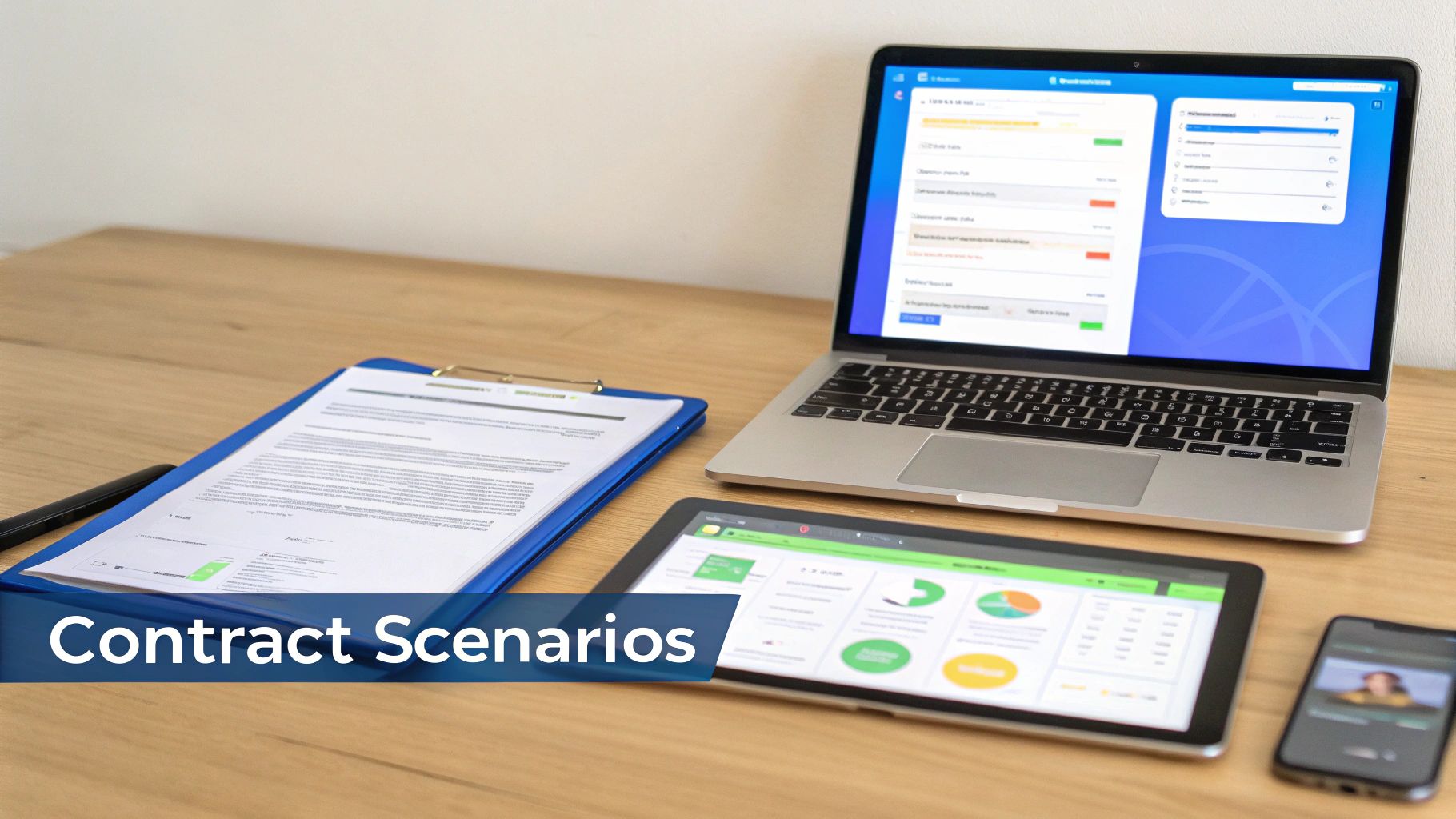
Each of these scenarios shows how the technology bends to fit a specific need, turning what used to be a high-stakes, time-draining task into a much more efficient and manageable workflow.
The Startup Founder and The Commercial Lease
First up, meet Alex. He's the founder of a growing tech startup who just found the perfect office space. The catch? He's been handed a dense, 40-page commercial lease agreement. Legal fees are a huge line item for a young company, but he also can't afford to expose his business to unnecessary risk.
Instead of spending days trying to parse the legalese himself, Alex uploads the lease to an AI platform. In minutes, he gets a clear summary of his key obligations. More importantly, the system flags a one-sided indemnification clause that heavily favors the landlord and points out an unusual maintenance fee buried deep in an appendix.
Armed with this specific, actionable information, Alex can have a much smarter, quicker, and more cost-effective conversation with his lawyer to negotiate better terms.
The outcome? The AI didn't replace his lawyer, but it made the entire process faster and more strategic. Alex saved a bundle on billable hours and confidently signed a lease that actually protected his company’s interests.
The Paralegal and The NDA Pile-Up
Now, let's look at Maria, a paralegal at a mid-sized corporation. The sales team is killing it, which is great, but it also means they're bringing in dozens of potential partners every week. This has created a massive bottleneck, as every new relationship requires a signed Non-Disclosure Agreement (NDA) that must stick to the company's strict policy.
Maria’s old workflow was painfully manual: open each NDA, compare it line-by-line against their standard template, and flag any differences for the general counsel. With a stack of fifty NDAs, this could easily eat up a week.
Using an AI tool, she can now process the entire stack at once. The AI instantly compares all fifty documents against the company’s approved template and isolates the three NDAs containing non-standard language. It highlights the exact clauses that were changed, letting Maria escalate only the true exceptions. This is just one way AI can transform your whole document review process.
The outcome? Maria cleared the backlog in under an hour, not a week. The sales team can move faster with new partners, and the legal department gets to focus its expertise on the agreements that genuinely need a human touch.
The Corporate Lawyer and M&A Due Diligence
Finally, there’s David, a corporate lawyer deep in a major acquisition. A huge part of his due diligence is reviewing thousands of contracts from the target company. He's looking for hidden liabilities, change of control clauses, or unusual termination rights that could sink the deal.
Manually, this task would require a small army of junior associates working around the clock for weeks, with a high risk of burnout and missed details. Instead, David’s firm uses an advanced AI platform to analyze the entire contract portfolio from the data room.
The AI is given specific instructions: identify all contracts that lack assignment clauses, flag any with termination-for-convenience rights, and extract the value of all customer agreements set to expire within the next 12 months.
The AI acts as a tireless researcher, sifting through immense volumes of data to find the specific risks and opportunities that are critical to the deal’s valuation. It turns a chaotic data dump into an organized, searchable source of truth.
The outcome? The initial due diligence phase wraps up in days, not weeks, and at a fraction of the cost. David’s team gets a detailed report of potential red flags, allowing them to jump straight to assessing their impact and advising the client on negotiation strategy.
Manual vs AI-Powered Contract Review
Seeing these scenarios side-by-side really drives home just how much the workflow changes when AI is brought into the mix. The table below breaks down the key differences.
| Metric | Manual Review Process | AI-Powered Review (with LegesGPT) |
|---|---|---|
| Speed | Hours or days per document | Minutes per document; thousands in a day |
| Accuracy | Prone to human error and fatigue | High consistency; flags subtle deviations |
| Cost | High (billable hours, internal resources) | Low (predictable subscription fee) |
| Strategic Value | Reactive; focuses on finding errors | Proactive; provides data for strategic decisions |
Ultimately, the shift from manual to AI-powered review is less about replacing people and more about augmenting them. It frees up expert human talent from tedious, repetitive work so they can focus on the high-level strategic thinking that really matters.
How to Choose and Implement Your AI Contract Tool
Making the switch to an AI-powered contract workflow is a big move, but picking the right tool doesn't have to be a headache. To compare the leading options side by side, see our roundup of the best AI contract review software. The real goal isn't just to find a solution with a long list of technical features; it's to find one that actually solves your team's day-to-day problems. A great implementation comes down to choosing a platform that's accurate, easy to use, secure, and plays nicely with the systems you already have.

The market for AI for contract review is definitely heating up, but getting started comes with real-world hurdles. While legal and business teams are excited about the potential for efficiency, the data tells a story of caution. Recent insights on AI adoption in legal tech show that 61% of teams point to a lack of time for implementation, 59% are concerned about data privacy, and 51% struggle with integrating new tools into their existing software.
These numbers make it clear: a successful rollout is more about operational readiness than just buying the latest tech.
Your Evaluation Checklist
When you're looking at different AI contract tools, it’s best to focus on a handful of core criteria that truly affect how useful the software will be. Think of this as your must-have list for finding a partner, not just another piece of software.
- Proven Accuracy: First and foremost, the tool has to be reliable. Don't just take the vendor's word for it. Ask for performance metrics, but more importantly, run your own documents through it. Can it consistently spot the right clauses, dates, and obligations without mistakes?
- Ease of Use: Your team shouldn't need a degree in computer science to figure it out. A clean, intuitive interface is a make-or-break factor for adoption, especially for colleagues in sales, HR, or procurement who aren't in legal tech all day.
- Seamless Integration: The best tools don't force you to change how you work—they fit right in. Look for integrations with the software your team already relies on, like Microsoft Word, Google Drive, or your CRM. This avoids creating more work.
- Rock-Solid Security: Contracts are filled with your company's most sensitive information. You need to verify the platform's security protocols. Ask about data encryption, access controls, and look for key compliance certifications like SOC 2 or ISO 27001.
A powerful tool that is too complicated for your team to use is ultimately worthless. Prioritize a solution that feels like a natural extension of your workflow, not a barrier to it.
At the end of the day, the goal is to make your team’s life easier. The right platform, especially a well-designed contract management software for small business, should feel like an immediate upgrade.
Strategies for a Smooth Implementation
Once you’ve picked your tool, how you introduce it to your team is just as important as the technology itself. A smart, phased rollout can prevent frustration and build excitement for wider adoption across the company.
The trick is to avoid the "big bang" approach, where everyone is suddenly forced to use a new system overnight. That’s a recipe for confusion and resistance. A much better way is to start small with a focused pilot project that delivers a quick win and proves the tool’s value.
A Step-by-Step Pilot Project Plan:
- Identify a Pain Point: Start by picking one specific, repetitive task that everyone agrees is a bottleneck. Reviewing standard NDAs or checking sales agreements against your company playbook are perfect candidates.
- Select a Small Team: Pull together a small group of enthusiastic early adopters to act as your champions. This could be one lawyer and a couple of people from the sales team who are feeling the pain the most.
- Define Success Metrics: Before you start, decide what success looks like. Set clear, measurable goals. For example, you might aim to cut the average NDA review time from 48 hours to 4 hours, or ensure 100% of new vendor contracts are scanned for a specific risky clause.
- Train and Support: Give your pilot team hands-on training and a direct line to someone who can answer their questions immediately. Good support is crucial in the early days.
- Share the Results: Once the pilot is a success, shout it from the rooftops! Use the metrics you set to create a compelling story about how the AI saved time, lowered risk, and even helped close deals faster.
This method creates undeniable proof that the technology works. When other departments see the tangible benefits, they’ll be asking to use it, turning the full rollout from a push into a pull.
The Future of Legal Work Is Augmented Intelligence
If there’s one central message to take away from this guide, it’s this: AI for contract review is not about replacing legal professionals. We’re stepping into an era of augmented intelligence, where human expertise gets a massive boost from powerful technology. The goal isn’t to make lawyers obsolete, but to finally free them from the monotonous, low-value work that eats up their days.
By letting AI handle the initial, line-by-line slog, skilled minds can focus on what they do best. This means more time for strategic negotiation, untangling complex problems, and building the kind of solid, consultative relationships that clients truly value. It’s a fundamental shift from administrative drudgery to high-impact advisory work, where human judgment and experience are everything.
This change is happening fast, and the latest trends point toward a smarter, more integrated future for managing contracts.
The Expanding Role of Generative AI
We are now seeing the next chapter in this journey with the rise of generative AI. These advanced models are moving beyond simple analysis and into the realm of creation, which has the potential to reshape the entire contract lifecycle. This technology is quickly evolving from a curious novelty into a standard part of the legal toolkit.
In-house lawyers who were once on the fence are now jumping in. Recent reports show a major shift: 46% of generative AI users are now drafting contract templates with it, and 21% are using it directly for reviews. This kind of rapid adoption shows that the barriers are coming down as professionals see the practical benefits firsthand. You can discover the full insights from Juro's latest report to see the data for yourself.
This trend hints at a future where AI doesn’t just review third-party paper. It will also help draft stronger first versions, suggest alternate clauses, and even redline documents automatically based on a company’s playbook.
The future of legal work is a collaborative one. AI will handle the data processing and pattern recognition at a scale no human can match, while legal experts will provide the critical thinking, ethical oversight, and strategic direction that no machine can replicate.
Your Place in a Smarter Legal Industry
Getting on board with this shift isn't just an option—it's essential for staying competitive. The tools and platforms we've talked about in this guide offer a clear path to working smarter, not harder. They give you the ability to deliver faster, more accurate, and more strategic legal services. This isn't just about contracts, either; it's touching every part of the legal field. To see how this applies elsewhere, check out our guide on using AI for legal research.
The final takeaway is really a call to action. Start exploring the tools out there. Kick off a small pilot project. Begin building the skills you'll need to thrive in this new environment. By taking these steps, you’re securing your place at the forefront of a more intelligent and efficient legal industry.
Common Questions About AI for Contract Review
It's only natural to have questions when you're thinking about bringing a new piece of technology into your workflow. And when that technology touches something as sensitive as your contracts, you need to be absolutely sure you can trust it. Let's walk through some of the most common concerns we hear from legal teams considering AI for contract review.
Getting clear answers is the first step. You need to feel confident in both the technology and the process behind it before moving forward.
How Secure Is My Confidential Data?
This is usually the first question on everyone's mind, and for good reason. Handing over sensitive legal and commercial information requires an immense level of trust. Any worthwhile AI platform is built from the ground up with enterprise-grade security at its core.
Think of it as multiple layers of defense:
- Data Encryption: Your data is scrambled and unreadable both when it's being sent to the platform (in transit) and when it's being stored (at rest).
- Access Controls: Strict permissions are put in place so only the right people in your organization can access specific documents. No one else gets a peek.
- Compliance Certifications: The best vendors prove their security by undergoing rigorous independent audits. Look for certifications like SOC 2 and ISO 27001, which verify their security measures are up to snuff.
Many data privacy questions are also tied to regional laws. A practical AI GDPR compliance guide is a great resource for understanding how modern platforms are built to handle these specific requirements.
Is AI Analysis As Accurate As a Human Lawyer?
This question gets to the very nature of the human-AI partnership. The best way to look at it is that they are two different specialists with complementary skills. An AI is a master of scale and consistency. It can scan thousands of documents for a specific clause deviation without getting tired or letting its attention wander. It will catch that one subtle wording change in an indemnification clause across 500 different agreements—a near-impossible task for a human.
A human lawyer, on the other hand, brings strategy, nuance, and negotiation savvy to the table. The AI acts as an incredibly powerful paralegal, flagging potential issues with lightning speed. The lawyer then uses that intelligence to make the final, strategic call.
The goal of AI isn't to replace a lawyer's judgment, but to supercharge it. It frees the legal professional from exhaustive, repetitive tasks so they can focus on high-value thinking and client advice.
Can AI Understand Contracts from Different Jurisdictions?
Legal standards can vary wildly from one state or country to the next. A clause that’s perfectly fine in New York might be completely unenforceable in California. This is where the training data for the AI becomes critical.
Advanced AI platforms are trained on massive, diverse datasets that include legal documents from all over the world. This allows the AI to provide jurisdiction-specific insights. For example, when reviewing an employment contract, a well-trained AI can flag a non-compete clause that's likely to be problematic under specific state laws, giving you an immediate heads-up. This is especially valuable for reviewing a physician employment contract, where restrictive covenants and non-competes are often the highest-stakes terms.
Do I Need to Be a Tech Expert to Use These Tools?
Absolutely not. While the technology running in the background is incredibly complex, the part you interact with is designed for lawyers, not software developers. The best AI for contract review tools have simple, intuitive interfaces that make perfect sense from day one.
You can typically upload documents, run an analysis, and get back a clear, actionable summary with just a few clicks. Many of these tools also plug right into the software you already use every day, like Microsoft Word or Google Drive, making the whole process feel natural and seamless.
Ready to see how an AI-powered legal assistant can reshape your contract review process? LegesGPT combines sophisticated AI with a user-friendly design to deliver faster, more reliable insights. Start your 3-day trial today and experience the future of legal work.