
A notice to cure is a formal, written heads-up one party gives to another when a contract has been broken. Think of it as a final warning shot—it outlines the problem and gives the offender a specific window of time, called the cure period, to fix their mistake before the contract is terminated or lawyers get involved.
What Is a Notice to Cure and Why Does It Matter
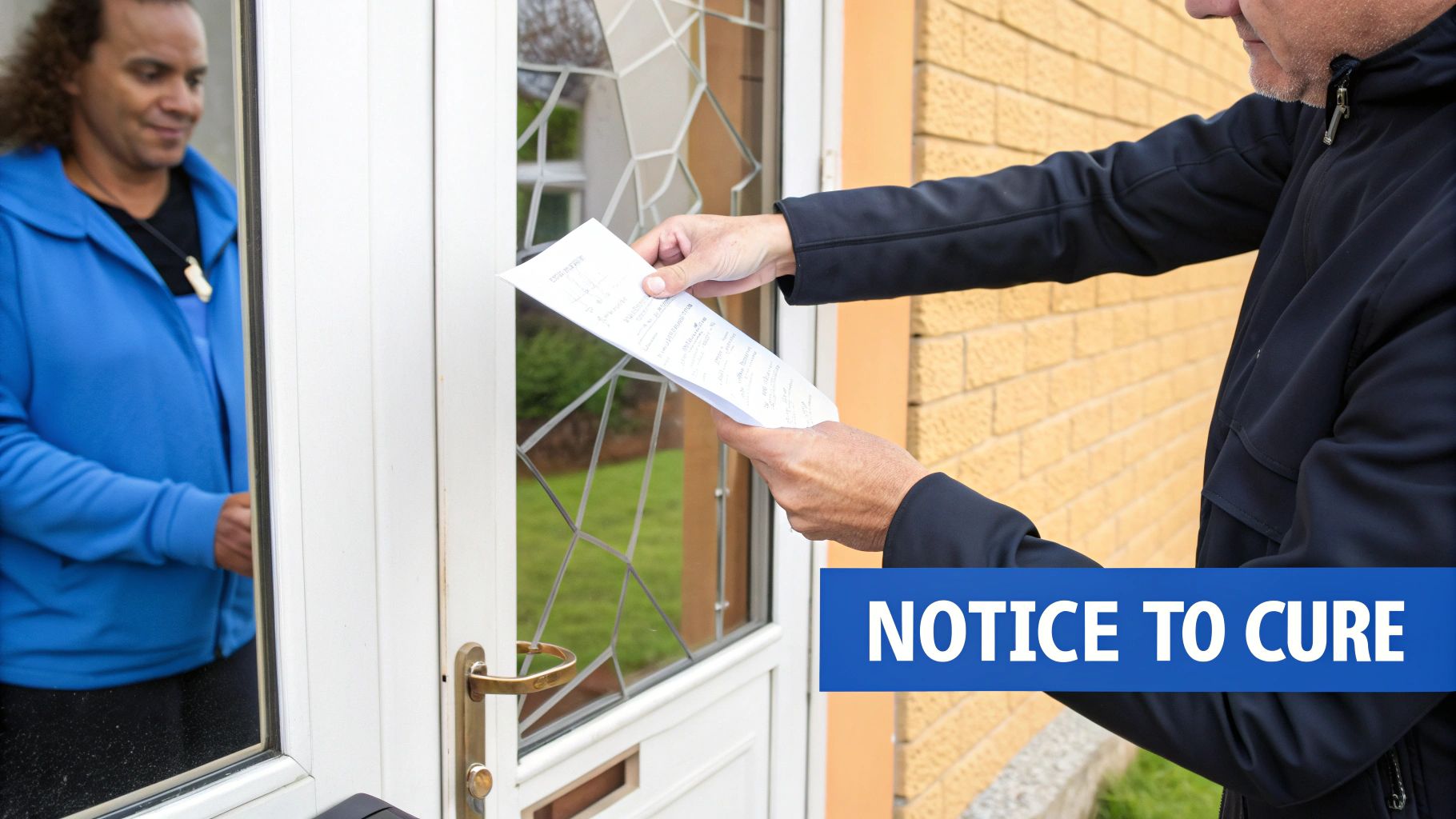
Let’s put this in a real-world context. Imagine you hired a marketing agency to run a campaign. The agreement clearly states they will deliver 10 high-quality blog posts per month, but halfway through, you've only received five low-effort articles.
Instead of immediately firing them and heading to court, you send a notice to cure. This document officially lays out the issue (the missing, subpar content) and gives them a reasonable deadline—say, 15 days—to deliver the remaining posts and meet the quality standard.
That's a notice to cure in a nutshell. It’s not an instant contract termination or a lawsuit. It’s a formal, structured opportunity to get things back on track and, hopefully, salvage the business relationship.
The Core Purpose of a Cure Notice
At its heart, a notice to cure is about two things: formally documenting a contract failure and offering a chance to make it right. Before you can truly see its value, you need to understand the problem it’s designed to solve—namely, what is a breach of contract. This notice acts as a crucial bridge between spotting a breach and taking more drastic, and often expensive, action.
Here’s what it really accomplishes:
- It De-escalates the Situation: Sending a notice is a non-confrontational first move. It shows you're acting in good faith to resolve the problem before burning bridges.
- It Provides Crystal Clarity: There’s no room for misinterpretation. The notice spells out exactly what went wrong and the specific steps required to fix it.
- It Creates a Paper Trail: This is huge. It establishes a legal record showing you properly notified the other party and gave them a fair chance to correct their error.
A well-drafted notice to cure is more than just a formality; it is a strategic tool that can prevent minor disputes from spiraling into costly legal battles, safeguarding both the contract and the professional relationship.
Why This Document Is Indispensable
In many business agreements, sending a notice to cure isn’t just a good idea—it’s a contractual obligation. Look for a "cure provision" or "right to cure" clause in your contracts. This language legally requires you to give the other party an opportunity to fix a mistake before you can claim a material breach and walk away.
Ignoring this step can backfire, badly. If you terminate a contract without sending a required notice, a court could rule that you were the one who breached the agreement, potentially leaving you on the hook for damages. It’s a simple document, but it’s a cornerstone of good contract management that protects your legal rights by demonstrating fairness and due diligence.
The Legal Power Behind a Notice to Cure
A notice to cure is far more than just a strongly-worded letter. It's a formal legal document with real teeth. But where does it get its power? It isn't just magic; the authority comes from two distinct sources: the specific terms you agreed to in your contract and the laws of the land.
Getting a handle on these sources is absolutely essential. It’s the difference between sending a notice that gets results and firing off an empty threat that goes straight into the trash. This legal backing is what turns a simple piece of paper into a serious tool for enforcing a contract.
Power Granted by the Contract Itself
Most well-written contracts include clauses that lay out the ground rules for what happens when someone messes up. These are typically called "cure provisions" or a "right to cure" clause. Think of them as a pre-agreed roadmap for fixing problems.
This clause is your instruction manual, spelling out exactly how to issue a valid notice. It will usually specify things like:
- The timeline: How much time the other party has to correct their mistake (e.g., 15, 30, or 60 days).
- The delivery method: The required way to send the notice, often certified mail, to prove it was received.
- The content: The specific information that must be in the notice for it to count.
Sticking to these contractual rules isn't optional. If your agreement says to send the notice by certified mail but you just dash off an email, your notice could be thrown out. This level of detail is precisely what gives the notice its power within your specific agreement. When you're drafting new agreements, using a solid business contract template can help make sure you don't miss these critical details.
The cure provision in a contract is a safety valve. It’s designed to preserve the agreement by creating a clear, mutually agreed-upon path to resolution, preventing one party from terminating the contract impulsively over a fixable issue.
Authority Derived from Statutory Law
Sometimes, the law steps in. Even if your contract says nothing about a cure period, federal, state, or local laws might require one anyway. This means you could be legally obligated to give the other party a chance to fix their breach before you can take more drastic action.
These legal requirements are especially common in certain areas, usually to protect consumers or tenants from unfair treatment. They provide an extra layer of protection, ensuring people get a fair shot to make things right before facing serious consequences.
For instance, countless landlord-tenant laws require a landlord to give a tenant a notice to cure a lease violation—like having an unauthorized pet—before starting eviction proceedings. Similarly, consumer protection laws often give someone who's behind on a loan a right to cure the default before the lender can repossess their car or home. A great example is California's SB 84 which, if it ever becomes law (it cleared the state Senate in 2025 but remained stalled in the Assembly as of mid-2026), would grant small businesses a 120-day cure period to fix accessibility issues before they can be hit with a lawsuit for damages.
The Critical Importance of Precision
Whether its authority comes from a contract or a statute, a notice to cure's effectiveness boils down to one thing: precision. Every single detail matters.
A seemingly small procedural mistake can completely undermine your position. It could invalidate your notice and put your legal rights at risk.
Let's say you give someone a 10-day cure period, but the contract clearly required 15 days. If you move to terminate the contract after day 10, the other side could turn around and claim that you are the one who breached the contract by not following the agreed-upon process. This kind of self-inflicted wound can transform a clear-cut case into an expensive legal battle you might lose. The rules aren't just suggestions—they are the very foundation of the notice’s legal power.
How to Draft an Effective Notice to Cure

When a contract goes off the rails, your first instinct might be to pick up the phone. But to protect your legal rights, you need to move from theory to practice and draft a solid notice to cure. This isn't just about sending a letter; it’s about creating a precise legal instrument. A sloppy notice can be completely ineffective, but a well-written one can be the key to resolving a dispute before it spirals out of control.
Think of it like giving a contractor a punch list for an unfinished kitchen remodel. A vague complaint like "the cabinets are wrong" won't get you anywhere. A detailed list specifying "the drawer pulls on the lower cabinets are brushed nickel instead of the agreed-upon matte black" provides an undeniable, actionable roadmap for fixing the problem. Your notice has to do the same thing.
The goal here is to strip out all emotion and ambiguity. The document should be a straightforward, fact-based communication that clearly states the problem, how to fix it, and what happens if it isn't fixed.
The Anatomy of a Powerful Notice
To be legally sound, your notice needs to include several critical components. Leaving any of them out could make the whole document worthless in a dispute. A strong notice acts as a firm but fair directive, leaving absolutely no room for misinterpretation.
Here’s a foundational checklist to make sure you hit every essential point:
- Properly Identify All Parties: Start with the basics. Use the full legal names and official addresses for both you (the non-breaching party) and the party in breach.
- Reference the Governing Contract: Pinpoint the exact agreement that has been violated. Make sure to include its official title and the date it was signed.
- Provide a Detailed Description of the Breach: This is the heart of the notice. Be specific. Quote the exact clause or section of the contract that was breached and then explain precisely how it was breached. Stick to the facts.
- Outline Specific Corrective Actions: Don't just point out the problem; spell out the solution. Provide a clear, step-by-step list of what the other party must do to "cure" the breach. The more detailed, the better.
- Set a Reasonable Cure Period: Give a firm, unambiguous deadline for the corrective actions to be completed. This timeline must be reasonable and in line with any period specified in your contract or by law.
- State the Consequences of Failure to Cure: Make it crystal clear what will happen if the deadline is missed. This usually means stating your intent to terminate the contract and pursue all available legal remedies, including seeking damages.
From Vague to Valuable: A Before-and-After Example
Let's look at how a weak notice can be transformed into one that gets results.
- Before (Ineffective): "You are in breach of our agreement. You have 5 days to fix the problems with your deliveries or the contract is terminated."
This is legally flimsy. It doesn't identify the specific agreement, explain what the "problems" are, or detail what "fixing" them actually involves. A notice this vague would likely be thrown out in a commercial dispute.
- After (Effective): "This letter serves as a formal Notice to Cure pursuant to Section 7.2 of the Service Agreement dated January 15, 2026. You are in breach for failing to meet the delivery requirement outlined in Section 4.1, which states 'a minimum of 100 units shall be delivered on the first of each month.' To cure this breach, you must deliver the 100 units for June 2026 no later than June 15, 2026. Failure to do so will result in the immediate termination of the agreement."
This version is professional, specific, and impossible to misunderstand. It creates a solid legal foundation for whatever comes next. It’s no surprise that properly drafted notices can de-escalate breaches and boost resolution rates by 30-40%. On the flip side, arbitration data shows that vague notices lead to dismissed claims in as many as 25% of cases.
The objective of a notice to cure is not to win an argument, but to achieve compliance. Stick to the facts, cite the contract, and provide a clear path to resolution. Emotional or accusatory language only serves to escalate conflict and undermine your professional standing.
Always write your notice as if a judge or arbitrator will one day be reading it—because they might. A well-crafted notice, much like a formal demand letter, can often get the job done long before you ever see a courtroom.
How Cure Periods Work in Different Legal Fields
The core idea behind a notice to cure is simple: it’s a chance to fix a mistake. But don't let that simplicity fool you. How this concept plays out in the real world changes dramatically depending on the legal arena you're in.
What works in a simple business deal could be a catastrophic failure in a government contract. The rules, the stakes, and the timelines shift entirely. A one-size-fits-all approach is a recipe for disaster, so let's break down how this powerful document works across a few key fields.
Commercial Contracts
In the day-to-day world of business, the notice to cure is the workhorse of contract management. Its power comes directly from the "cure provision" that was negotiated and written into the agreement itself. Think of this clause as a private set of rules for how the parties handle a breach.
Here, the problems are often tangible and easy to define:
- Late Payments: A notice might give a client a set period, like 10 days, to settle an overdue invoice before further action is taken.
- Subpar Performance: A software developer could get a notice to fix critical bugs within 30 days to meet the standards laid out in their service-level agreement.
- Supply Chain Failures: A manufacturer might issue a notice to a supplier who delivered defective parts, demanding good replacements by a specific deadline.
The beauty of it is the flexibility. The cure period, the way the notice is delivered, and the specific actions required are all things the parties themselves agreed to when they signed the contract. It’s a practical tool designed to get business back on track.
Government Contracting
Everything changes when you're dealing with the U.S. government. A "Cure Notice" in this context is a formal, high-stakes warning shot, strictly governed by the Federal Acquisition Regulation (FAR). It's not a friendly suggestion—it's a legally required step before the government can drop the hammer with a "default termination."
A default termination is a black mark on a company's record that can kill its chances of winning future government work for years. The Cure Notice usually gives a contractor a shockingly short window, often just 10 days, to fix the problem. This isn't a negotiation; it's a command.
In government contracting, a Cure Notice is less of a collaborative tool and more of a final, formal warning. The power dynamic is heavily skewed, and the timeline for correction is unforgiving, reflecting the government's need for strict adherence to contract terms.
If the contractor fails to "cure" the issue within that tight deadline, the contracting officer has the green light to terminate the contract for default. The financial and reputational fallout can be severe.
Data Privacy Law
A newer and fast-growing field for the cure concept is data privacy. In this space, it’s not about a contract between two businesses, but about a company's legal duty to the public. Many modern privacy laws now include a statutory "right to cure," which acts as a built-in grace period for businesses.
This provision essentially forces a state's Attorney General to notify a company of a compliance violation before levying massive fines. As of 2026, roughly 20 U.S. states have comprehensive data privacy laws, and many of them include a right to cure that gives businesses a chance to fix things, with cure periods typically ranging from 30 to 60 days—though several states (including California, Colorado, Connecticut, Delaware, and Oregon) have since let their cure periods expire. For example, Virginia’s law (like Indiana’s and Kentucky’s, which took effect in 2026) provides a non-expiring 30-day right to cure, giving businesses a permanent window to address compliance gaps. You can dive deeper into a comparison of these state privacy law enforcement provisions to see just how much they vary.
This same legal framework pops up in other regulated areas, too. For instance, understanding how cure periods are used by property management companies is critical in landlord-tenant law, where state statutes often demand a notice before an eviction can proceed. You can see how this works by checking out our guide on the notice to vacate process. Ultimately, these legally required cure periods are designed to protect businesses from immediate, crippling penalties for what are often unintentional mistakes.
Comparison of Cure Periods Across Legal Domains
The notice to cure is a versatile legal tool, but its implementation varies significantly across different fields. The table below highlights these key differences, showing how the same basic concept is adapted to fit the specific needs and power dynamics of each area.
| Legal Domain | Typical Cure Period | Governing Authority | Consequence of Failure to Cure |
|---|---|---|---|
| Commercial Contracts | 10-30 days | The contract itself (cure provision) | Breach of contract, potential termination, lawsuit for damages |
| Government Contracting | 10 days (Strict) | Federal Acquisition Regulation (FAR) | Termination for default, financial penalties, bar from future contracts |
| Data Privacy Law | 30-60 days (where still available) | State statutes (e.g., VCDPA, Texas TDPSA) | Statutory fines, enforcement action by Attorney General |
As you can see, what starts as a flexible, privately negotiated tool in commercial deals becomes a rigid, high-stakes mandate in government and regulatory settings. Understanding which set of rules you're playing by is the first step to handling a notice to cure effectively.
Your Action Plan for Responding to a Notice to Cure
Getting a formal notice to cure can land like a punch to the gut. It's easy to feel defensive or even panicked. But the single most important thing to remember is this: a notice isn't just an accusation; it's a lifeline. It gives you a structured opportunity to fix a problem and, hopefully, salvage the relationship.
Ignoring it is the worst thing you can do. A calm, strategic response is your best path forward. The moment that notice arrives, a clock starts ticking. Your job is to shift from reacting emotionally to solving the problem methodically, all while protecting your legal rights and showing good faith.
This flowchart maps out those crucial first moves, whether you're dealing with a business contract, a government project, or even a privacy issue.
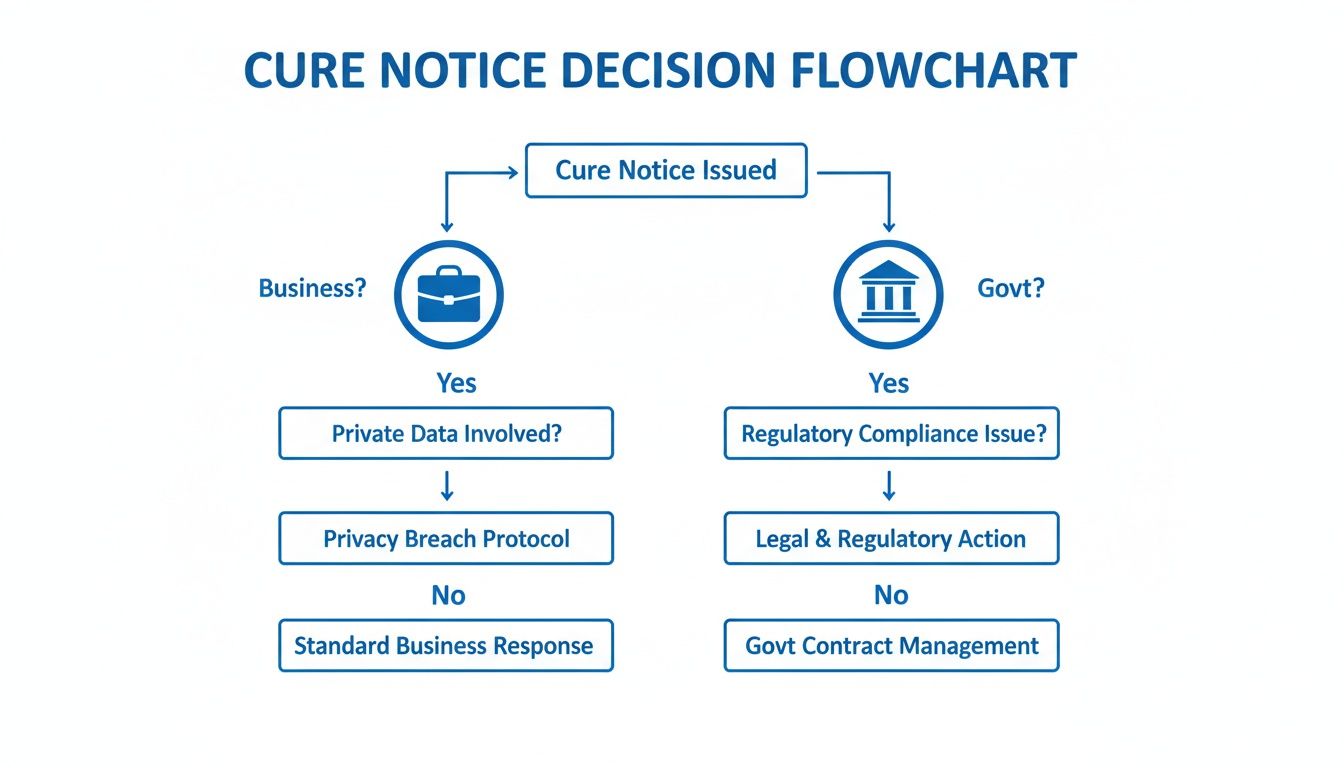
As you can see, the core actions are universal. No matter the context, you need to acknowledge the notice, figure out what's going on, and keep the lines of communication open.
Step 1: Acknowledge and Investigate
Before you even think about building a defense, send a simple, professional confirmation that you've received the notice. This small gesture immediately shows you're taking the matter seriously and establishes a professional tone.
With that out of the way, it's time to become a detective. Launch an internal investigation to get to the bottom of the claims. Is the alleged breach legitimate? Get your team together, pull out the contract, and gather every relevant email, report, and document. This fact-finding mission is the foundation of your entire response.
Step 2: Formulate Your Formal Response
Once you have a clear picture of the situation, you can draft your official reply. How you respond depends entirely on whether you agree with their claim or not.
If you agree a breach occurred: Your tone should be cooperative and focused on the solution.
- State Your Intent: Clearly communicate that you plan to cure the breach within the given timeframe.
- Outline Your Plan: Lay out the specific steps you’ll take to make things right. Be detailed.
- Confirm the Timeline: Reiterate the deadline and confirm your commitment to meeting it.
If you dispute the breach: Your response needs to be firm but professional. The goal is to state your case without burning bridges.
- State Your Disagreement: Clearly explain why you believe no breach has occurred, sticking to the facts.
- Provide Evidence: Back up your position by referencing specific contract clauses and attaching supporting documents.
- Suggest a Path Forward: Propose a meeting or call to discuss the disagreement, leaving the door open for a resolution.
No matter which path you take, document everything. Keep a meticulous record of every phone call, email, and action you take. This paper trail is your absolute best defense if things escalate.
Step 3: Execute the Cure and Confirm Completion
If a cure is required, get to work and follow your plan precisely. The specific terms of your contract are everything here. For example, in U.S. government contracting, a cure notice often comes with a very tight 10-day window to fix the problem.
Consider the case of a contractor, Fricke, who received notices for late deliveries of grave markers. They successfully delivered all 11 overdue items within the cure period. Despite this, the government terminated their contract for entirely different reasons not mentioned in the notice—a move that was later challenged in court. This highlights just how crucial it is to not only perform the cure but also to document it flawlessly. You can read more about how this case led to a finding of an improper default termination.
Once you've completed all the corrective actions, send one final piece of correspondence: a "Notice of Cure Completion." This closes the loop officially and creates a record that you fulfilled your end of the bargain, cementing your legal position.
Navigating the Cure Process: Common Pitfalls and Best Practices
When you're dealing with a notice to cure, whether you're sending one or on the receiving end, the devil is truly in the details. One small mistake can take a simple corrective action and blow it up into a messy, expensive legal fight. The whole point of the cure process is to solve problems, not create new ones.
The entire framework rests on two pillars: clarity and good faith. If either one is shaky, the whole thing can come crashing down, often leading you straight to the courtroom you were trying to avoid in the first place.
Common Mistakes That Can Derail a Notice
Even with the right intentions, it's easy to make a misstep that renders your notice useless or, worse, puts you in a legally vulnerable position. Most of the time, these blunders come down to fuzzy details or letting emotions get in the way of a professional exchange.
Here are a few of the most common—and damaging—errors to watch out for:
- Being Too Vague: A notice that just says "the work is subpar" is a waste of time. You have to be specific. Point to the exact clause in the contract that was violated and spell out precisely what needs to be done to make it right.
- Setting Unreasonable Deadlines: Demanding a major construction defect be fixed in 24 hours isn't just unrealistic; it can be seen as a sign of bad faith. The timeline for the cure has to be reasonable and should reflect what the contract allows.
- Using Emotional or Accusatory Language: Remember, a notice to cure is a formal legal document, not an angry email. Keep it professional. Stick to the objective facts of the situation to avoid making the conflict worse.
- Ignoring the Notice: If you're the one who receives a notice, the absolute worst thing you can do is ignore it. In the eyes of the law, silence can look like an admission of guilt, and you'll lose your chance to negotiate or explain your side of the story.
Think of a notice to cure as a clear, straightforward roadmap back to compliance. Any confusion, ambiguity, or hint of bad faith doesn't just undermine its purpose—it can be turned into a weapon against you later on.
Best Practices for Both Sides of the Table
To keep the process moving smoothly, both the sender and the recipient need to handle things with a cool head and a strategic mindset. The key is communicating clearly and genuinely trying to fix the problem as the contract dictates.
For the Sender (The Non-Breaching Party)
- Get Hyper-Specific: Don't leave any room for interpretation. Identify the contract, quote the exact clause that's been breached, and give a detailed, step-by-step list of what needs to be done.
- Keep a Paper Trail: Document everything. Hold on to receipts for certified mail, save copies of all emails, and note down the dates and times of any conversations. You need a complete record.
- Stay Professional: Your tone matters. Write the notice from a neutral, objective standpoint. Your goal is to get the other party to comply with the contract, not to pick a fight.
For the Recipient (The Breaching Party)
- Acknowledge Receipt Right Away: The moment you get the notice, send a brief, written confirmation back. It’s a simple act that shows you’re taking the issue seriously and acting in good faith.
- Investigate and Follow Up: Look into the claims immediately. Whether you agree with the alleged breach or not, communicate your findings and what you plan to do next—always in writing.
- Document Your Fix: If you perform the cure, document every single thing you do. Take pictures, save receipts, and keep notes. Once you're done, send a formal "Notice of Cure Completion" to officially close the loop and create a final record showing you've fulfilled your obligations.
Common Questions About Notices to Cure
Even when you understand the basics, the real world always throws a few curveballs. Let's tackle some of the most frequently asked questions that pop up when you're either sending or receiving a notice to cure.
What Happens If I Disagree with the Notice?
So, you've received a notice to cure, but you believe the claims are completely off base. What do you do? The single worst thing you can do is ignore it. Silence can easily be mistaken for an admission that the alleged breach is real.
Your first move should be to respond—promptly and in writing. Keep your tone professional and stick to the facts. Clearly lay out why you dispute the claims, pointing to specific parts of the contract or providing evidence that backs up your side of the story. It's often a smart move to suggest a meeting to talk things over. Getting a lawyer to help you draft this response is always a good idea; they can protect your legal position while keeping the lines of communication open.
Is a Verbal Notice to Cure Ever Enough?
In a word: no. While it might seem easier to just pick up the phone, a verbal warning has almost zero legal standing. The vast majority of contracts—and the laws that govern them—are crystal clear on this: the notice must be in writing.
Think of it this way: a written notice creates a paper trail. It's undeniable proof that you sent it and they received it. A phone call? That's just a "he said, she said" situation waiting to happen, leaving you completely exposed if things go south.
Always, always put it in writing and send it exactly how the contract tells you to, whether that's certified mail or another specified method. This protects everyone involved.
Can the Cure Period Deadline Be Extended?
Yes, but it's not automatic. An extension of the cure period has to be agreed upon by both parties. If you've been sent a notice and you legitimately need more time to fix the issue, you have to be proactive.
Don't wait until the day before the deadline. Reach out to the other party in writing as soon as you know you need more time. In your request, explain why you need the extension, propose a new, realistic deadline, and ask for their formal written agreement. If the other party sees you're making a genuine effort to solve the problem, they're often willing to grant a reasonable extension.
Notice to Cure vs. Notice of Default: What's the Difference?
This is a crucial distinction. These two notices sound similar, but they represent very different points in a dispute and carry wildly different weights.
- A Notice to Cure is basically a warning shot. It says, "Hey, there's a problem here, and you have X days to fix it before things get serious." Its goal is to resolve the issue and get the contract back on track.
- A Notice of Default is the official declaration that the problem was not fixed. It states that the breach occurred, the cure period has expired, and the contract is now in default. This is the final step before moving toward termination or legal action.
The easiest way to remember it is that the notice to cure is the opportunity, while the notice of default is the consequence.
Navigating the fine print of contract breaches and legal notices demands precision. LegesGPT acts as an AI-powered legal assistant to help you review contracts, understand your obligations, and draft clear, effective communications. Instead of guessing, get instant, well-supported answers. You can learn more about the LegesGPT platform here.