
Reviewing contracts manually is slow, expensive, and prone to human error. A single missed clause in a vendor agreement or employment contract can cost thousands in legal fees or expose your business to unnecessary risk. AI contract review software changes the equation by scanning documents in minutes, flagging risks, extracting key terms, and suggesting redlines based on your playbook.
In this guide, we compare the 7 best AI contract review tools available in 2026. We cover their core features, pricing, strengths, and which type of legal professional or business each one fits best.
Best AI contract review software: a brief overview
- LegesGPT: Best overall for lawyers and law firms: AI-powered contract analysis with document review, risk identification, and coverage across 38+ countries, starting at $19.99/month.
- Ironclad: Best for enterprise contract lifecycle management: a full CLM platform with agentic AI (Jurist), workflow automation, and deep enterprise integrations.
- SpotDraft: Best for in-Word contract review: its VerifAI add-in reviews contracts against custom playbooks directly in Microsoft Word, with on-device AI for privacy.
- Juro: Best for business-led contracting: a browser-native platform that lets sales and commercial teams self-serve on contracts while legal retains oversight.
- Spellbook: Best for individual lawyers and drafting: a GPT-powered Word assistant with transparent pricing and market benchmarking for deal points.
- Icertis: Best for large enterprise compliance: an enterprise-grade platform trusted by 33% of the Fortune 100 for high-volume contract intelligence.
- Agiloft: Best for customizable contract workflows: a no-code CLM platform with AI review built into the base package and flexible workflow configuration.
| Tool name | Key strength | Pricing | Best for |
|---|---|---|---|
| LegesGPT | AI review + research + templates in one platform | From $19.99/mo; 3-day free trial | Lawyers, law firms |
| Ironclad | Full CLM with agentic AI and enterprise integrations | Custom; ~$30K-$120K/year | Mid-market to enterprise legal teams |
| SpotDraft | In-Word AI review with on-device processing | Custom; from ~$299/mo for startups | Growing companies, tech legal teams |
| Juro | Browser-native contracting with unlimited users | Custom; ~$450-$990/mo | Business and commercial teams |
| Spellbook | Transparent pricing with market benchmarking | From $20/mo (Pro); $40/user/mo (Team) | Solo lawyers, small legal teams |
| Icertis | Enterprise-scale contract intelligence | Custom; premium pricing | Fortune 500, regulated industries |
| Agiloft | No-code customizable CLM with AI included | From ~$6K/year; scales to $60K+ | Teams with unique workflow needs |
1. LegesGPT, best overall for lawyers and law firms
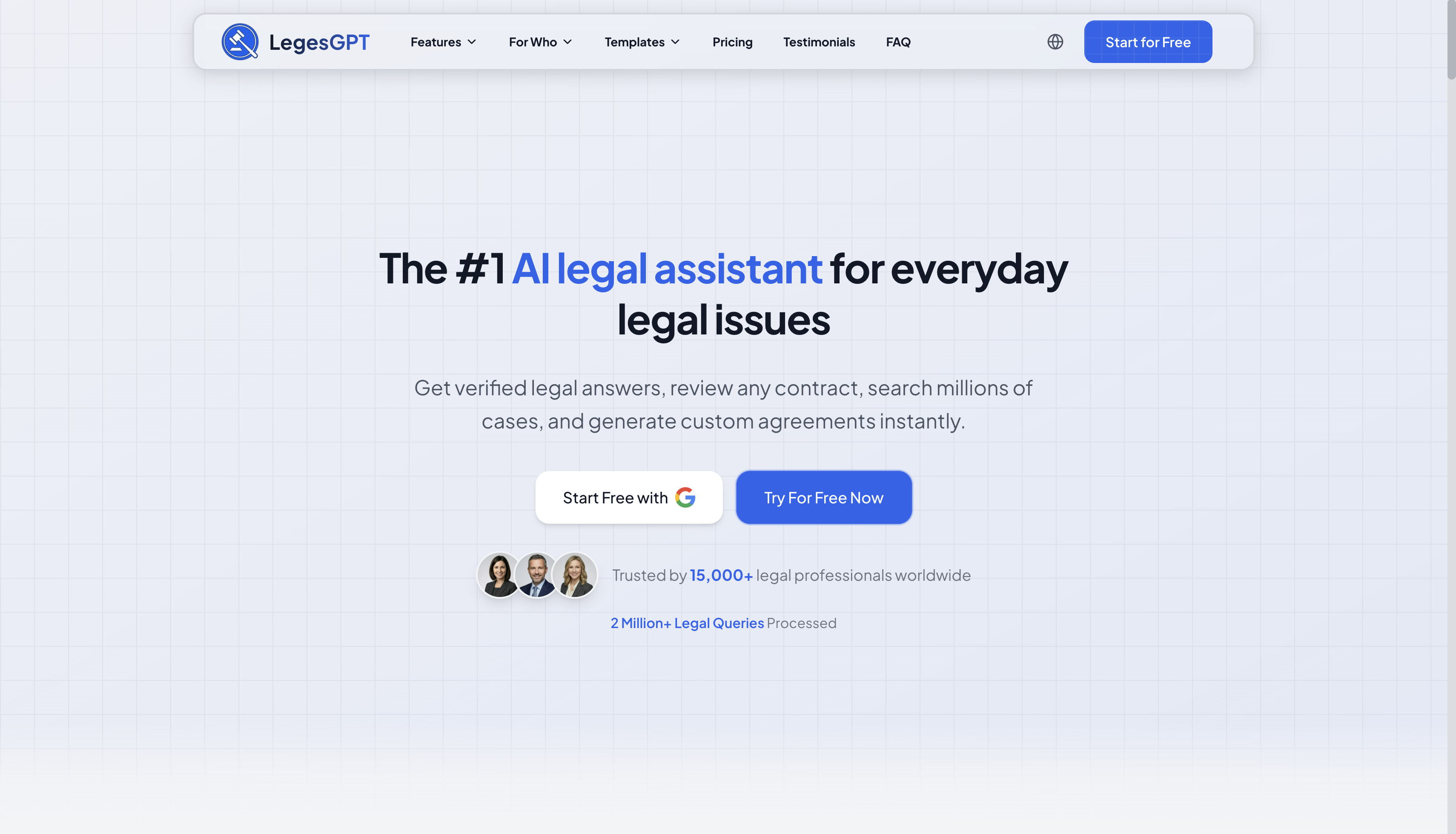
LegesGPT combines AI contract review with legal research and document templates in a single platform. Unlike enterprise CLM tools that require lengthy onboarding and five-figure annual commitments, LegesGPT is built for everyone who deals with contracts: solo lawyers, law firms, paralegals, law students, business owners, and individuals who need professional-grade ai contract analysis without the enterprise price tag.
What sets it apart is the combination of document review with access to 500K+ court cases, 100K+ statutes, and 250K+ legal articles. You can upload a contract, get a risk assessment, and research the relevant legal standards in the same tool. The platform covers 38+ countries, which is rare for tools in this price range.
Key features
- Document upload and AI analysis for contracts, briefs, and agreements (PDF, Word, PowerPoint, images)
- Risk flagging and key clause extraction with verifiable citations
- 38+ country jurisdiction coverage for cross-border contract work
- Deep Research mode for complex legal scenarios requiring multi-step reasoning
- 100+ attorney-drafted legal document templates for common contract types
- Web search integration for current regulatory developments
Best for
- Lawyers handling contract review alongside case research
- Law firms managing client contracts, vendor agreements, and employment contracts efficiently
Pricing
- 3-day free trial on all plans (with $1 activation fee)
- Basic at $19.99/month, Plus at $34.99/month (50 document reviews), Premium at $69.99/month (unlimited reviews + Deep Research)
- Annual billing saves 30%
Pros
- All-in-one platform: contract review, legal research, and templates in one subscription
- 500K+ court cases and 100K+ statutes available alongside document analysis
- Significantly more affordable than enterprise CLM tools ($19.99/mo vs $30K+/year)
- Accessible to lawyers, law firms, and legal professionals of all sizes
- Self-serve signup with no sales cycle or long-term contracts required
Cons
- Not designed for large legal departments needing full lifecycle management
- Document review features require the Plus plan ($34.99/month) or higher
- Credit-based system on Plus plan caps reviews at 50/month
2. Ironclad, best for enterprise contract lifecycle management
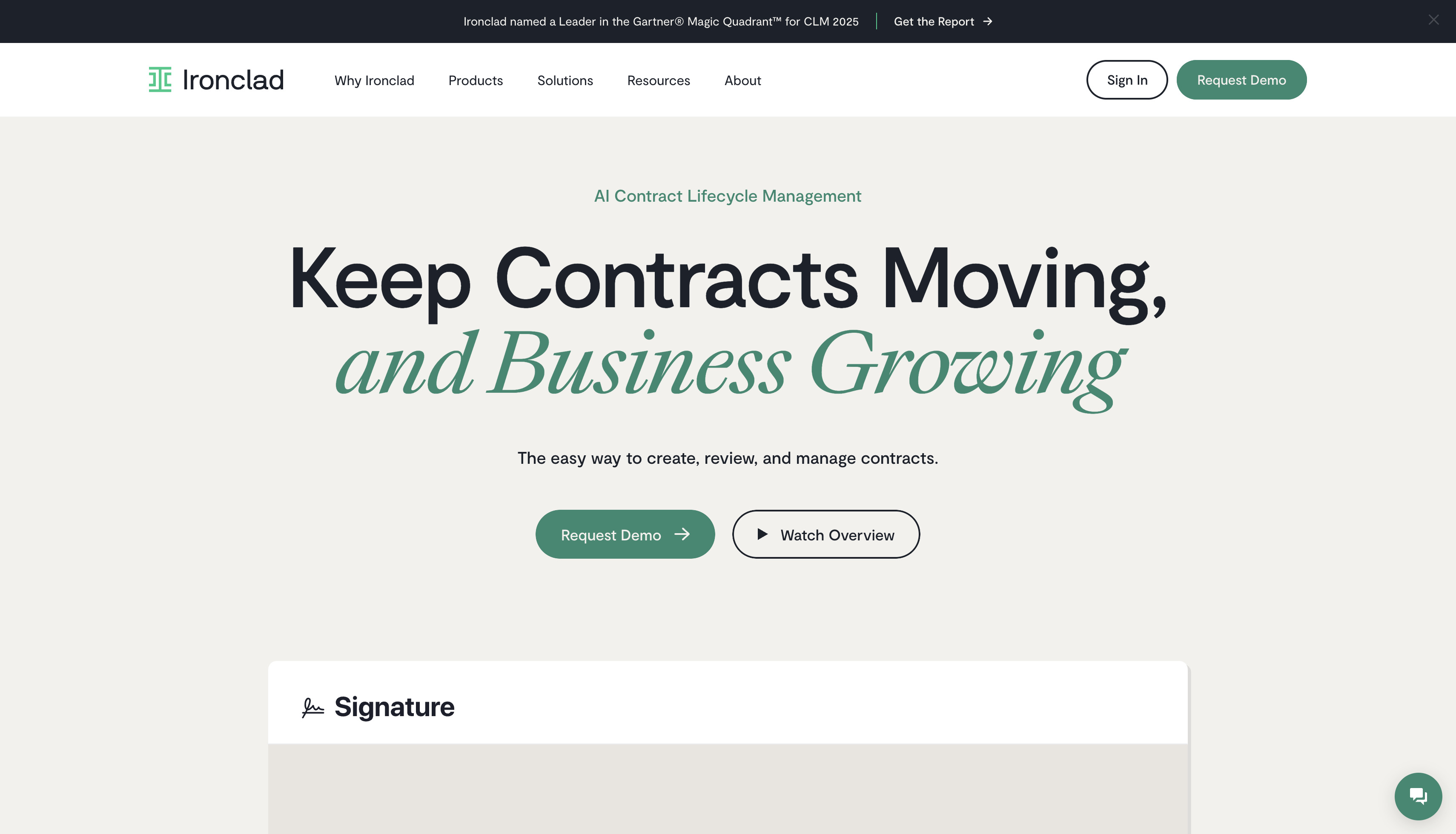
Ironclad is a full contract lifecycle management platform that handles everything from contract creation to execution, storage, and renewal. Its AI assistant, Jurist, uses a multi-agent architecture to review contracts against your playbooks, redline documents, and extract data from 194+ contract properties.
The platform is built for legal teams that manage high volumes of contracts across departments. Workflow automation routes contracts for approval without email chains, and integrations with Salesforce, Slack, and other enterprise tools keep everything connected. Ironclad was named a Leader in the 2025 Gartner Magic Quadrant for CLM, and a Forrester study documented 314% ROI for its customers.
Key features
- Jurist AI assistant with multi-agent architecture for review, redlining, intake, and search
- AI data extraction for 194+ contract properties (values, dates, counterparties, obligations)
- No-code workflow automation for routing, approvals, and notifications
- Native e-signature built into the platform
- Deep integrations with Salesforce, Slack, and enterprise tools
Best for
- Mid-market to enterprise legal teams managing 500+ contracts per year
- Organizations that need full lifecycle management, not just review
- Companies already using Salesforce or other enterprise CRM/ERP systems
Pricing
- Custom, quote-based pricing (not publicly listed)
- Median buyer pays approximately $39,713/year (per Vendr marketplace data)
- Range: $30,000 to $120,000+/year depending on users, volume, and features
Pros
- All-in-one CLM covering the entire contract lifecycle from creation to renewal
- Intuitive workflow builder; rated 4.5/5 on G2
- Gartner Magic Quadrant Leader (2025) with documented 314% ROI
- Enterprise-grade security: SOC 1/2 Type 2, ISO 27001, GDPR, HIPAA
Cons
- Pricing starts at $30K+/year, putting it out of reach for solo practitioners and small firms
- Steep learning curve for advanced workflow configuration
- Metadata extraction accuracy requires manual correction in roughly 20% of cases
3. SpotDraft, best for in-Word contract review
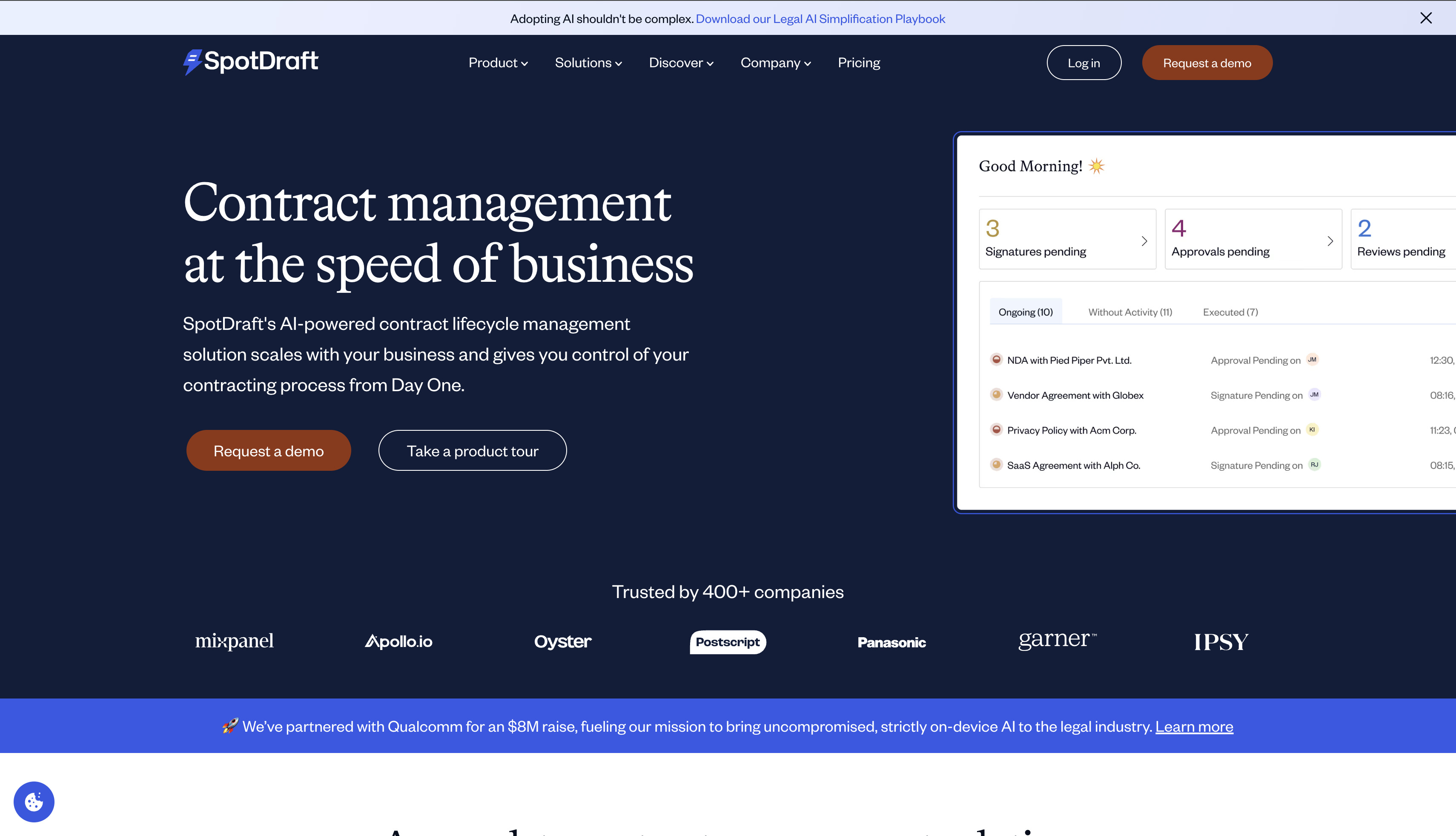
SpotDraft built its reputation on VerifAI, a Microsoft Word add-in that reviews contracts against your custom playbooks using generative AI. You write your review criteria in plain English, then VerifAI highlights non-compliant clauses and key risks with one click. The company claims 70% faster contract review compared to manual processes.
The standout development is on-device AI. Backed by an $8M investment from Qualcomm Ventures in January 2026, SpotDraft now runs VerifAI locally on Qualcomm Snapdragon laptops. No contract data leaves your device. For privacy-conscious organizations handling sensitive agreements, this is a meaningful differentiator.
Key features
- VerifAI Microsoft Word add-in for AI-powered contract review against custom playbooks
- On-device AI processing (no data leaves the device on supported hardware)
- Smart data capture extracting 1,000+ types of contract metadata
- Full CLM with contract repository, search, and renewal tracking
- Compliant e-signatures (ESIGN, EIDAS)
Best for
- Legal teams at fast-growing tech companies scaling their contract operations
- Organizations that require on-device processing for data privacy compliance
- Lawyers who prefer working in Microsoft Word and want AI review without switching tools
Pricing
- Custom pricing based on user count or contract volume
- SpotDraft Vault (startup plan) available at $299/month via NachoNacho
- Enterprise quotes required for full platform access
Pros
- VerifAI works inside Microsoft Word, eliminating context-switching
- On-device AI is a genuine privacy advantage for sensitive contracts
- Strong collaboration features similar to Google Docs
- Backed by Qualcomm Ventures; valuation trending toward $400M
Cons
- Templates are managed by SpotDraft's team; users cannot make minor template edits themselves
- Pricing transparency is poor; expect a lengthy sales process
- Advanced features and analytics are gated behind higher tiers
4. Juro, best for business-led contracting
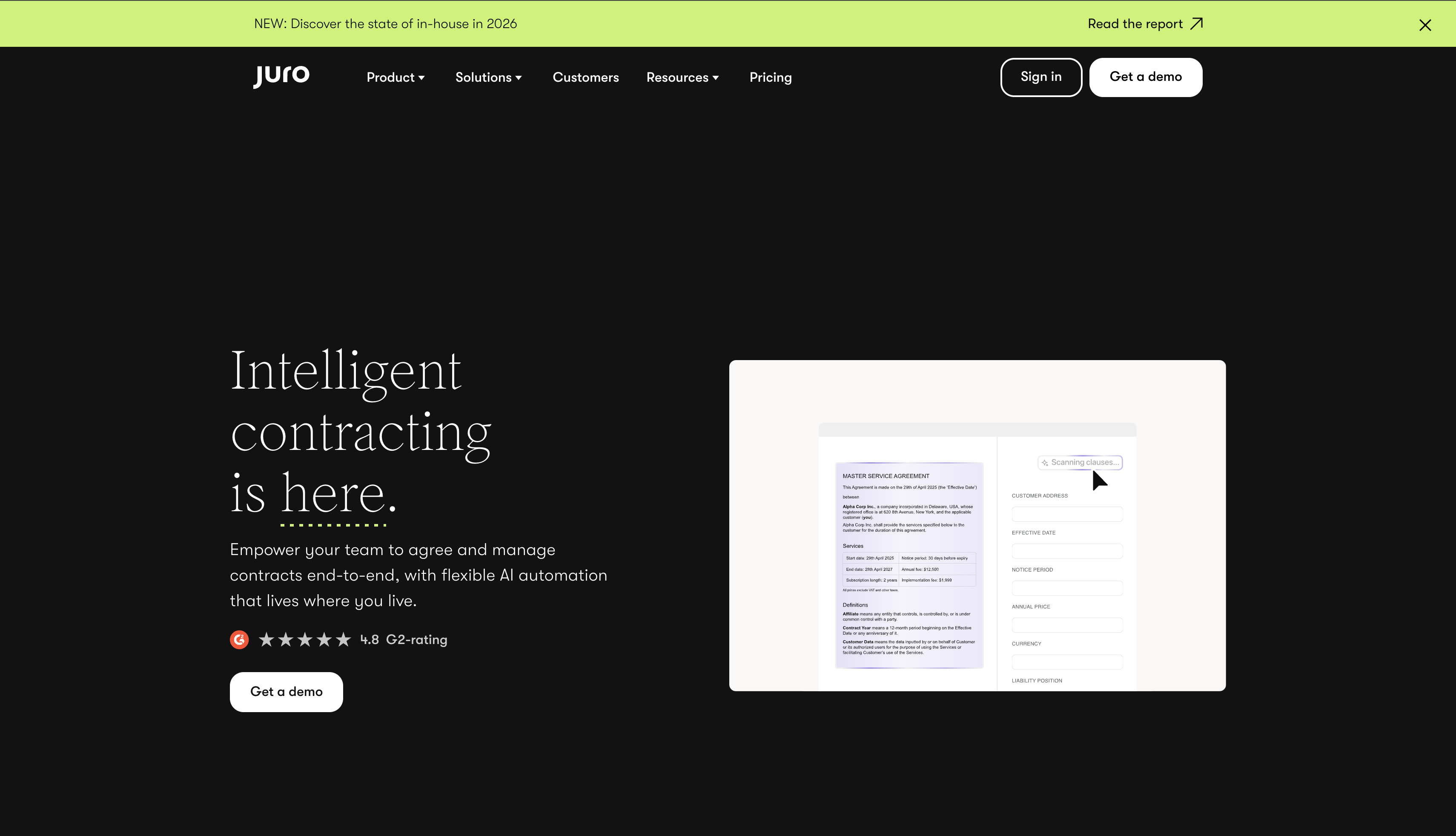
Juro takes a different approach to contract review by making the entire process browser-native. There is no download-edit-upload cycle. Legal teams create templates and playbooks, then sales, procurement, and other business teams self-serve on contracts directly in the browser with real-time collaboration.
The AI Contract Review Agent reviews and redlines third-party contracts against your playbooks and is available inside Juro, Slack, Microsoft Teams, and Microsoft Word. The unlimited-users pricing model means you can give every stakeholder access without per-seat cost anxiety. For mid-market companies where contracts touch multiple departments, Juro reduces the bottleneck on legal.
Key features
- AI Contract Review Agent that redlines third-party contracts against your playbooks
- Browser-native editor with real-time collaboration (no Word required)
- AI Extract for analyzing incoming PDFs, tagging metadata, and triaging contracts
- Unlimited users, templates, and workflows on all plans
- Integrations with Salesforce, HubSpot, Workday, and others
Best for
- Mid-market companies where sales and commercial teams handle contract volume
- Organizations that want to reduce legal's role as a bottleneck on routine agreements
- Teams that need real-time collaboration on contracts without file versioning issues
Pricing
- Custom pricing based on contract volume, types, and integrations
- Does not charge per user (unlimited users on all plans)
- Estimated range: $450 to $990/month depending on features and volume
Pros
- Browser-native editor eliminates the download-edit-upload cycle entirely
- Unlimited users model makes it cost-effective for large cross-functional teams
- Reduces contract turnaround time by 60%+ according to company data
- Fast onboarding; some users close deals within days of adoption
Cons
- Struggles with complex, heavily redlined contracts (browser editor can feel sluggish)
- Counterparties must sign up to collaborate, which creates friction
- Reporting is high-level; exporting granular metrics requires API calls or manual work
5. Spellbook, best for solo lawyers and small teams
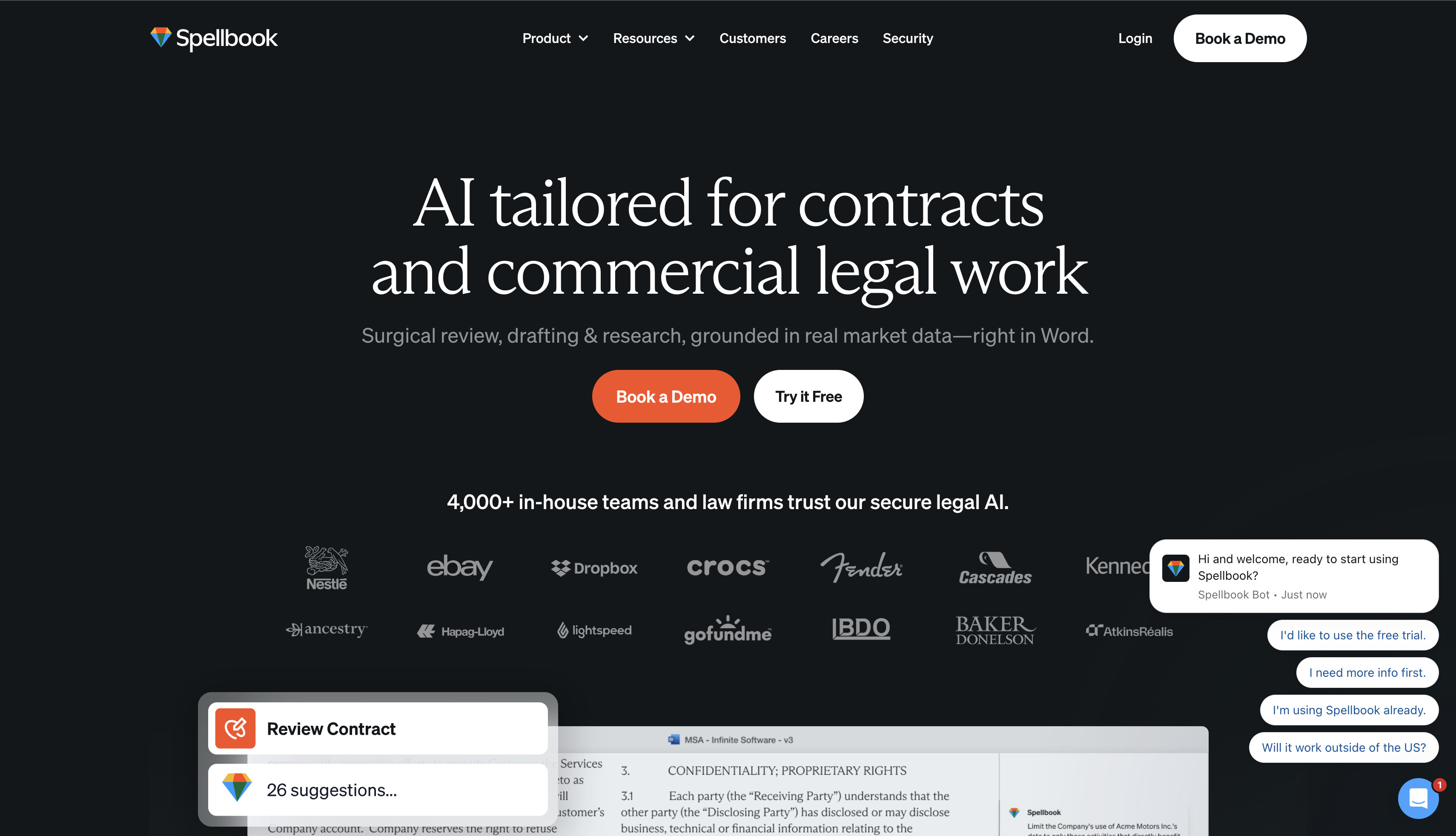
Spellbook is a GPT-powered AI assistant built directly into Microsoft Word for contract drafting and review. What makes it stand out in a crowded market is pricing transparency: $20/month for individuals, $40/user/month for teams, with a clear feature breakdown at each tier.
The Market Comparison feature, launched recently, analyzes 250 deal points using anonymized benchmarking data. You can see how your contract terms compare to market standards, which is useful during negotiations when you need data to support a position. Spellbook also maintains a zero data retention policy (SOC 2 Type II, GDPR, CCPA compliant), meaning your contract data is not stored or used to train models.
Key features
- AI contract review, drafting, and clause suggestions inside Microsoft Word
- Market Comparison: benchmarks 250 deal points against anonymized market data
- Spellbook Library: learns from your firm's precedent documents
- Zero data retention policy (SOC 2 Type II, GDPR, CCPA compliant)
- Industry benchmark database for identifying compliance gaps
Best for
- Solo lawyers and small firms that want AI contract review at a predictable monthly cost
- Transactional attorneys who draft and review contracts daily in Microsoft Word
- Lawyers who need market benchmarking data to support negotiation positions
Pricing
- Pro: $20/month (limited functionality, individual use)
- Team: $40/user/month (collaboration features, shared libraries)
- Enterprise: approximately $179/user/month (full feature access, custom deployment)
Pros
- Most transparent pricing of any tool in this list; no sales calls required for basic plans
- Zero data retention policy provides genuine privacy assurance
- Market Comparison feature offers unique benchmarking intelligence for negotiations
- Works inside Microsoft Word, keeping lawyers in their familiar environment
Cons
- AI capabilities are focused on drafting and review; no legal research or case law database included
- Limited to contract work; does not cover broader legal research needs
- Enterprise tier pricing ($179/user/month) approaches competitor levels
6. Icertis, best for large enterprise compliance
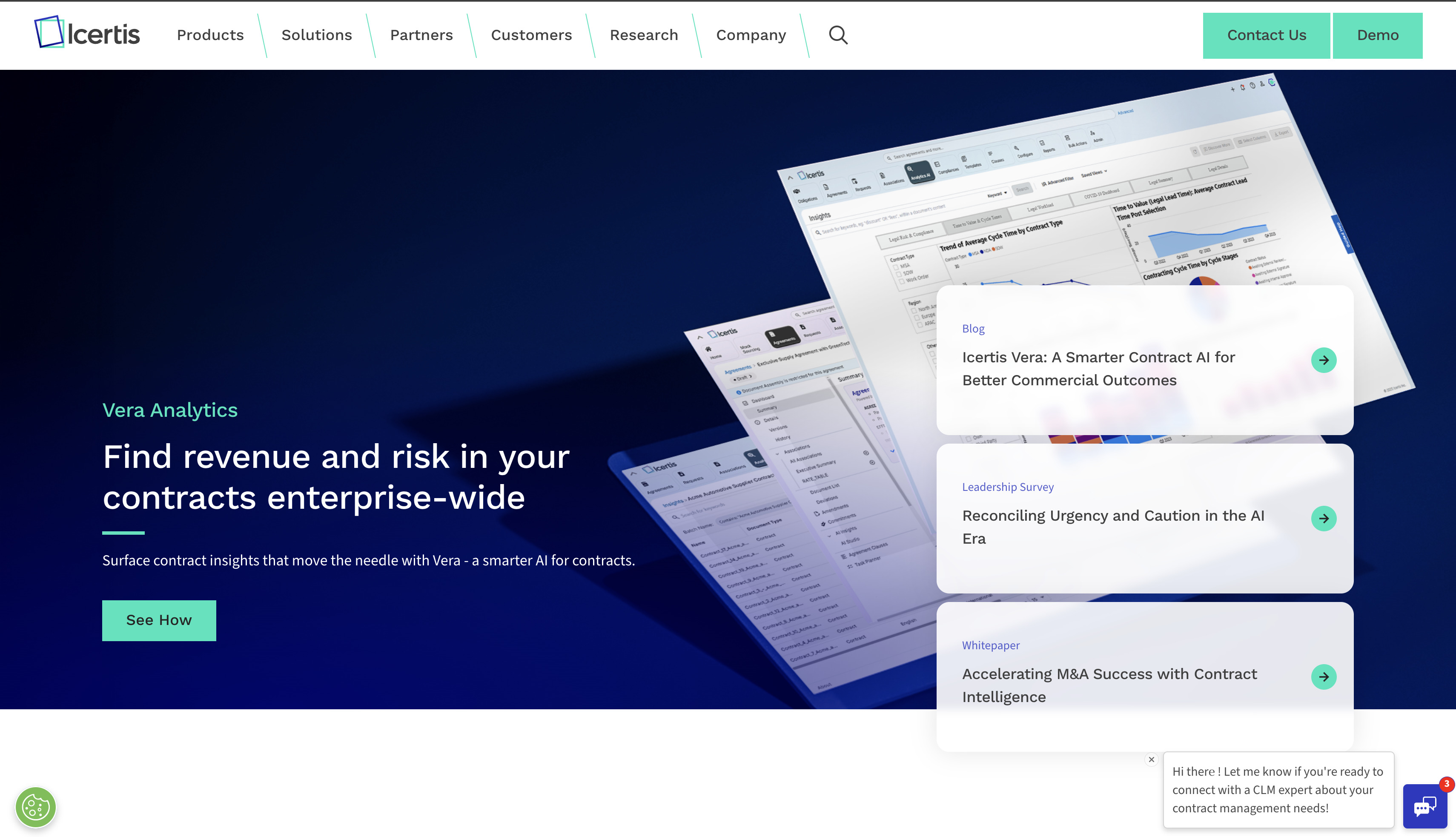
Icertis Contract Intelligence (ICI) is the enterprise heavyweight of this list. Trusted by 33% of the Fortune 100, it transforms contracts from static documents into structured data assets. The platform extracts insights, identifies risks, tracks obligations, and provides recommendations across the entire contract lifecycle at massive scale.
This is not a tool for individuals or small teams. Icertis is built for organizations managing 10,000+ contracts with complex compliance requirements across multiple departments, regions, and regulatory frameworks. The platform integrates directly with SAP, Salesforce, and other ERP/CRM systems, making it a natural fit for companies with established enterprise infrastructure.
Key features
- AI-powered contract intelligence with risk identification and obligation tracking
- Configurable workflows for approvals, notifications, and escalations
- Advanced analytics and reporting on contract performance and compliance
- Enterprise integrations with SAP, Salesforce, and procurement platforms
- Dedicated AI applications for automating specific contract workflows
Best for
- Fortune 500 companies managing 10,000+ contracts annually
- Organizations in regulated industries (pharma, financial services, manufacturing) with strict compliance needs
- Procurement and legal teams that need cross-departmental contract visibility
Pricing
- Custom quotes only (not publicly disclosed)
- Positioned as a premium solution; generally cost-prohibitive for SMBs
- Modular design allows organizations to pay for specific feature modules
Pros
- Manages contracts at massive scale (10M+ contracts across its customer base)
- Industry-leading AI for risk identification and obligation tracking
- Seamless integration with enterprise ERP and CRM systems
- Gartner Customers' Choice vendor with 90% customer recommendation rate
Cons
- Implementation is lengthy and requires significant technical involvement
- Very expensive; pricing is prohibitive for small and mid-sized organizations
- Custom configurations can be difficult to maintain during platform updates
7. Agiloft, best for customizable contract workflows
Agiloft takes a no-code approach to contract management. Instead of forcing your team into a fixed workflow, the platform lets you configure approval chains, notification rules, and review processes to match how your organization actually works. AI contract review is included in the base package (through the Screens technology acquisition), not sold as an add-on.
The Obligation Management feature, launched in December 2025, uses AI to automatically extract and track commitments from contracts: SLAs, renewals, compliance deadlines, payment milestones. ConvoAI adds natural language search across your entire contract repository, so anyone can find specific clauses or terms without asking the legal team.
Key features
- AI contract review included in the base package (no extra cost)
- ConvoAI: natural language search across your full contract repository
- AI-powered obligation management for SLAs, renewals, compliance, and payments
- No-code platform for configuring custom workflows, approvals, and automations
- Three tiers: Essentials, Advanced, Premium
Best for
- Mid-market to enterprise teams with unique or complex approval workflows
- Organizations that need flexibility beyond out-of-the-box CLM solutions
- Legal teams that want AI contract review without paying for it as a separate module
Pricing
- Starts at approximately $6,000/year for basic plans
- Scales to $60,000+/year for enterprise solutions
- Add-ons available for AI Platform, ConvoAI, and Integration Hub
Pros
- Extremely customizable no-code platform; adapts to unique workflows without developer resources
- AI review included in the base package at no extra cost
- Fair pricing relative to enterprise competitors (starting at $6K/year vs $30K+)
- Users report becoming productive within 15 minutes of training
Cons
- Interface can feel dated and complex for first-time users
- Initial workflow configuration is time-consuming despite no-code positioning
- AI functionality requires customers to train the model on their own data (not pre-built)
How to choose the best AI contract review tool
1) What is your contract volume and team size?
This is the most important decision factor. It determines whether you need a full CLM platform or a focused review tool.
- If you are a lawyer, law firm, business owner, or individual handling fewer than 100 contracts per month: LegesGPT or Spellbook give you AI review at $14-40/month without enterprise overhead
- If you manage 500+ contracts across multiple departments: Ironclad, Juro, or Agiloft provide the workflow automation and collaboration features that justify their higher cost
- If you are a Fortune 500 with 10,000+ contracts and strict compliance: Icertis is built for that scale
2) Do you need just contract review, or full lifecycle management?
Some tools focus on reviewing and redlining contracts. Others manage the entire lifecycle from creation to renewal.
- For focused AI review and analysis: LegesGPT, Spellbook, and SpotDraft excel at reviewing contracts quickly without requiring you to adopt a new platform for everything else
- For end-to-end lifecycle management: Ironclad, Icertis, Juro, and Agiloft handle creation, routing, approval, execution, storage, and renewal in a single system
- For review plus legal research: LegesGPT is the only tool on this list that combines contract review with a legal research database (500K+ cases, 100K+ statutes)
3) What is your budget?
The pricing range across these tools spans from $14/month to six figures annually. Be realistic about what you can sustain.
- Under $50/month: LegesGPT ($19.99-$69.99/mo) and Spellbook ($20-$40/user/mo) are your best options
- $5,000-$30,000/year: Agiloft and SpotDraft offer solid mid-market value
- $30,000+/year: Ironclad, Icertis, and Juro serve the enterprise tier
4) How important is data privacy for your contracts?
If you handle sensitive agreements (M&A, employment, trade secrets), how your data is processed matters.
- For on-device processing (no data leaves your machine): SpotDraft's VerifAI on supported Qualcomm hardware
- For zero data retention: Spellbook's SOC 2 Type II certified policy
- For enterprise-grade compliance: Ironclad (SOC 1/2, ISO 27001, HIPAA) and Icertis offer the broadest certification coverage
Frequently Asked Questions
What is AI contract review software?
AI contract review software uses natural language processing and machine learning to analyze legal documents, extract key terms, flag risks, and suggest edits. Instead of reading every clause manually, the AI scans the document against your review criteria or industry standards and surfaces the issues that need human attention.
What is the difference between AI contract review and CLM software?
AI contract review focuses specifically on analyzing and redlining documents. CLM (contract lifecycle management) software manages the entire process from contract creation through execution, storage, and renewal. Some tools like LegesGPT and Spellbook focus on review, while others like Ironclad and Icertis offer full lifecycle management with AI review as one feature.
Can AI contract review software replace a lawyer?
No. AI contract review tools are designed to assist legal professionals, not replace them. They handle the time-consuming first pass (extracting terms, flagging risks, checking compliance), but a qualified attorney should always review the output and make final decisions. The value is in speed and consistency, not autonomy.
Is there an affordable AI contract review tool for solo lawyers?
Yes. LegesGPT starts at $19.99/month with document review available on the Plus plan at $34.99/month. Spellbook offers a Pro tier at $20/month. LegesGPT is designed for solo lawyers and law firms who need AI assistance without enterprise pricing.
Which AI contract review tool is best for large enterprises?
For organizations managing thousands of contracts with complex compliance requirements, Icertis and Ironclad are the established leaders. Both offer enterprise-grade security, deep ERP/CRM integrations, and the scalability to handle high-volume contract portfolios.
How accurate is AI contract review?
Accuracy varies by tool and contract type. Most tools perform well on standard commercial agreements (NDAs, vendor contracts, employment agreements) but may struggle with highly specialized or unusual provisions. The best approach is to test any tool with 3-5 real contracts from your practice area before committing. Always verify AI output against the source document.
Is it safe to upload confidential contracts to AI review tools?
Reputable tools offer enterprise-grade security (SOC 2, ISO 27001, encryption at rest and in transit). Check each tool's data handling policy. Spellbook offers zero data retention. SpotDraft's on-device AI processes documents locally. For the most sensitive work, choose a tool with certifications that match your compliance requirements.
Which tool is best if I need contract review and legal research?
LegesGPT is the only platform on this list that combines AI contract review with a legal research database covering 500K+ court cases and 100K+ statutes across 38+ countries. If your workflow involves reviewing a contract and then researching the applicable law, having both in one tool saves time and subscription costs.