

An attorney opinion letter isn't just another piece of legal paperwork. It's a formal, written analysis from a lawyer that offers a professional judgment on the legal standing of a specific transaction or issue.
Think of it like getting a structural engineer's report before buying a house. That report doesn't guarantee the house will never have problems, but it gives you expert assurance that, based on a thorough inspection, the foundation is solid. An opinion letter does the same for a business deal, giving third parties like lenders or investors the confidence they need to proceed.
What Exactly Is an Attorney Opinion Letter?

At its heart, an attorney opinion letter is a critical risk-management tool. It’s far more than a simple summary of facts; it’s a lawyer’s considered conclusion, reached only after a deep dive into company records, transaction documents, and the relevant laws. The party receiving the letter—often a bank, an investor, or the other side of a merger—relies on it as a formal piece of legal due diligence. It confirms that the core components of the deal are legally sound.
Picture this: a bank is about to lend millions for a major corporate acquisition. Before wiring that money, the bank needs to know the loan agreement is actually enforceable and that the company borrowing the funds is a real entity with the legal authority to take on that debt. The opinion letter delivers this exact assurance, serving as the legal green light from a trusted expert.
Why All the Formality?
The true power of an attorney opinion letter is its ability to cut through the fog of complex transactions. By providing a clear, formal statement, it shifts some of the legal risk and analytical heavy lifting from the parties involved in the deal to the lawyer issuing the opinion. This gives everyone at the table the confidence to sign on the dotted line.
This short table breaks down the primary roles an attorney opinion letter plays, helping you quickly grasp its importance in different scenarios.
Key Functions of an Attorney Opinion Letter
| Function | Description | Common Scenario |
|---|---|---|
| Verify Legal Status | Confirms a company is properly formed, legally registered, and in good standing with the state. | A startup seeking its first round of venture capital funding. |
| Confirm Authority | Assures that the company has the power to engage in the transaction and its officers are authorized to sign. | A mid-sized business selling a major asset or division. |
| Assess Enforceability | Provides a professional judgment that the contract is valid and can be enforced in court. | A lender finalizing a large commercial real estate loan. |
Essentially, the opinion letter provides a solid legal foundation for the entire transaction, reducing uncertainty and perceived risk for everyone involved.
The opinion letter transforms intricate legal analysis into a clear, reliable statement that allows business to move forward. It’s the legal backbone of the deal.
It's More Than Just a Letter
While the recipient gets the immediate benefit, the law firm issuing the letter has a lot on the line. Drafting one is a serious undertaking that involves meticulous due diligence and puts the firm's reputation—and its malpractice insurance—at risk. A flawed or incorrect opinion can have severe consequences.
That high-stakes reality is precisely what makes these letters so valuable. The recipient knows the lawyer has done their homework, reviewed every relevant document, and carefully weighed the legal angles before signing off. As we'll see later, advanced tools like LegesGPT can help lawyers navigate this complex research and drafting process with greater accuracy and efficiency.
The Role of Opinion Letters in High-Stakes Deals

In the high-pressure world of major business transactions, an attorney opinion letter is more than just another document—it’s a critical stabilizing force. It bridges the gap between a deal's promise and its legal reality, giving parties the confidence to move forward with significant investments.
Think of it as the final, expert sign-off before a complex financial engine roars to life. These letters aren't just a formality; they are a cornerstone of due diligence. Their role has shifted over the years, becoming absolutely essential in some areas while becoming less common in others.
Where Opinion Letters Remain Indispensable
In certain deals, the absence of an attorney opinion letter is a complete non-starter. These are typically transactions where the party putting up the money needs absolute certainty about the legal underpinnings of the deal. The letter is their primary shield against hidden legal defects.
Two major arenas where these letters are still king are:
-
Commercial Financing: When a bank lends millions, it needs far more than a simple promise to repay. Lenders demand independent, expert confirmation that the loan documents are solid and legally enforceable. An opinion letter provides this critical assurance, confirming the borrower is a legitimate entity with the authority to take on the debt. Without it, the funding simply won't happen.
-
Real Estate Transactions: In large-scale commercial real estate deals, buyers and lenders must know that the property title is clean and the seller has the unquestioned right to sell. While title insurance is standard, an attorney opinion letter can offer tailored assurances that go much further, covering complex issues like zoning compliance, land use restrictions, or the enforceability of key lease agreements.
In both cases, the letter delivers a direct, reliable legal conclusion that the entire economic exchange is built upon.
The core value of an opinion letter is its ability to provide a definitive legal checkpoint. It’s the moment a lawyer puts their professional judgment on the line, giving lenders and investors the confidence to proceed.
The Shifting Landscape in Mergers and Acquisitions
On the flip side, the role of attorney opinion letters has changed dramatically in the world of mergers and acquisitions (M&A). What was once a standard closing requirement is now a rarity, largely pushed aside by more comprehensive risk-management tools.
This evolution is almost entirely due to the rise of Representation and Warranty Insurance (RWI). Instead of relying on a legal opinion from the seller's attorney, buyers now purchase an insurance policy that covers losses from inaccurate seller representations. RWI offers broader financial protection and a much cleaner path to getting paid on a claim than suing a law firm.
The data tells the story. Over the past two decades, the requirement for a legal opinion from the target company's counsel has plummeted. According to a 2023 ABA study on private M&A deals, a mere 1% of reported transactions required a target counsel legal opinion to close. That's a staggering drop from 73% in 2005, highlighting a fundamental shift in how M&A deals get done. You can dig deeper into these trends to understand the current market for legal opinions.
This trend shows that while the need for legal assurance is constant, the methods for getting it are always evolving. For companies navigating these deals, it's vital to understand the foundational documents that drive them. For instance, you might find our detailed breakdown of an LLC Operating Agreement helpful, as it’s a key document often scrutinized during a sale or financing.
5. Understanding the Different Types of Legal Opinions
An attorney opinion letter isn't some monolithic document. It’s more like a master mechanic's detailed inspection report for a classic car. The mechanic doesn't just give a thumbs-up; they certify the engine, the brakes, and the electrical system individually. Each component gets its own specific sign-off.
Lawyers build opinion letters the same way, using distinct building blocks of analysis. Each "opinion" addresses a specific legal question that the other side needs answered. Once you see how these individual pieces work, you'll understand how they come together to form a comprehensive package of legal assurance.
Corporate Power and Status Opinions
First things first: is the company you're dealing with even real and legally able to make a deal? That's the fundamental question answered by corporate power and status opinions. This is the bedrock of the entire letter.
These opinions confirm the absolute basics about a company's existence:
- Due Incorporation: The company was properly formed according to the laws of its state.
- Valid Existence: It's still an active company and hasn't been dissolved.
- Good Standing: It’s current on its state franchise taxes and required filings.
- Corporate Power: The company has the authority under its own charter and bylaws to own its assets, run its business, and, most importantly, sign the contracts for this deal.
Think of this as checking the company's I.D. and birth certificate. It assures everyone that the business at the center of the transaction is on solid legal footing.
The Critical Remedies Opinion
This is the big one. The remedies opinion, often called the enforceability opinion, is the legal "money shot" of the entire letter. It’s the part that gives the other party the confidence that the agreement they're signing will actually hold up in court.
This opinion states that the deal documents are the "valid and binding obligations of the company, enforceable against the company in accordance with their terms." Without this assurance, a lender or buyer would be flying blind, taking on enormous risk. In any substantial U.S. loan transaction—often those over $10 million—these letters are non-negotiable.
The remedies opinion is the core promise. It’s the lawyer's professional judgment that if things go south, the other party can take the contract to court and rely on its terms to seek a legal remedy.
No Violation and No Conflict Opinions
A new deal doesn't exist in a bubble. It has to play nicely with a company's existing legal commitments. The no violation opinion tackles this head-on, ensuring the new transaction won't set off any hidden landmines.
This opinion confirms that entering into the deal will not:
- Violate the company’s organizational documents, like its articles of incorporation.
- Breach other major contracts the company has signed, such as existing loan agreements.
- Conflict with any court orders or judgments the company must obey.
- Violate applicable laws or regulations.
This opinion acts as a crucial safeguard, preventing the new deal from accidentally triggering a default or creating legal headaches somewhere else in the business. As businesses navigate these complex legal frameworks, many are looking for ways to transform regulatory compliance and make this process more manageable.
Specialized Legal Opinions
Beyond these core components, lawyers often need to address very specific risks unique to a transaction. This is where specialized opinions come into play, tailored to the exact concerns of the parties involved.
For example, a tax opinion might analyze the specific tax implications of a complicated merger. A solvency opinion can provide assurance that a deal won't leave a company broke and unable to pay its debts. For real estate deals, a title opinion confirms who legally owns a property and whether any hidden liens exist. These targeted opinions address the precise risks that keep investors and lenders up at night.
The Anatomy of an Attorney Opinion Letter
An attorney opinion letter isn't some free-form letter; it's a meticulously engineered piece of legal architecture. Every single section serves a purpose, built to give the recipient confidence while carefully managing the issuing law firm’s risk. To really grasp the power—and the limits—of these documents, you have to understand their anatomy.
Think of it like a surgeon's report. The report doesn’t just say, "the patient is fine." It lays out the date, the patient's identity, the specific procedures performed, the tools used, the findings, and any critical disclaimers. An opinion letter follows a similarly rigid structure to deliver a clear, defensible, and highly specific legal conclusion.
Setting the Stage: The Opening Sections
Every opinion letter starts by drawing a very clear box around its context and scope. These initial parts are the foundation, establishing who the letter is for and what transaction it covers. If you get this part wrong, the entire document could be worthless.
- The Date: This is more critical than it looks. The opinion is only good as of this specific date. It speaks only to the facts and laws as they exist at that one moment in time.
- The Addressee: The letter is addressed to a specific person or entity. This is the only party allowed to rely on the opinion unless the letter explicitly says otherwise.
- Transaction Description: This section gives a quick, high-level summary of the deal, like "the $50 million credit facility extended by ABC Bank to XYZ Corporation."
- Role of Counsel: Here, the law firm clarifies its relationship to the deal, stating, for instance, that they are serving as "special counsel to XYZ Corporation."
These elements create a tight frame, preventing the opinion from being stretched to cover different people or future events.
The Core Analysis: Documents and Opinions
This is the real heart of the letter. It’s where the attorney shows their work, outlining the basis for their conclusions before stating those conclusions directly. It’s a methodical journey from evidence to judgment.
First, the letter will list every single document the attorney reviewed to form their opinion—corporate charters, board resolutions, the deal agreements, you name it. This creates a transparent, auditable trail of the due diligence performed.
Right after that list comes the main event: the legal opinions themselves. These are typically numbered, declarative statements that hit the specific legal points requested, like the remedies and corporate power opinions we covered earlier.
This flowchart breaks down how common opinion types are structured, showing how they all build on a core foundation.
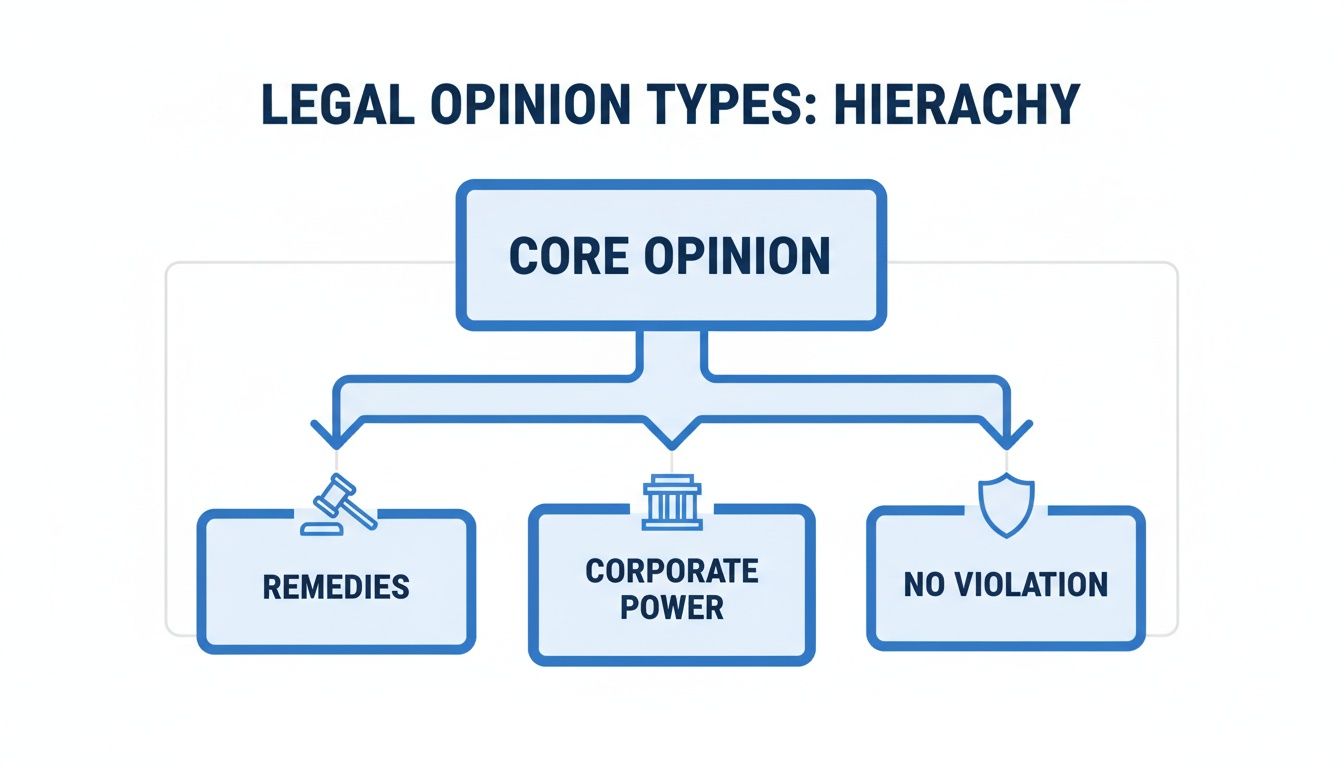
As you can see, a core opinion branches out into specific assurances. You have enforceability (remedies), corporate authority, and legal compliance (no violation), with each one addressing a different layer of risk in the transaction.
Core Components of an Attorney Opinion Letter
To help visualize how these pieces fit together, the table below breaks down the essential sections of a standard opinion letter and explains what each one accomplishes.
| Component | Purpose | Key Information Included |
|---|---|---|
| Opening | Establishes the context and scope of the opinion. | Date, addressee, transaction description, and role of counsel. |
| Documents Reviewed | Creates a transparent record of the due diligence basis. | A comprehensive list of all agreements, certificates, and corporate records examined. |
| Opinions | Delivers the core legal conclusions. | Numbered, declarative statements on topics like enforceability, corporate power, etc. |
| Assumptions | States facts taken as true without independent verification. | Genuineness of signatures, authenticity of documents, and legal status of other parties. |
| Qualifications | Limits the scope of the opinions with explicit carve-outs. | Exclusions for bankruptcy laws, equitable principles, and specific regulatory areas. |
| Reliance & Closing | Defines who can rely on the letter and under what terms. | A clear statement limiting reliance to the addressee and prohibiting unauthorized sharing. |
This structure ensures that every opinion is clear, well-supported, and appropriately limited—protecting both the recipient and the issuing law firm.
The Guardrails: Assumptions and Qualifications
Let's be clear: no legal opinion is absolute. The world is messy, full of unknown facts and gray areas in the law. That’s where assumptions and qualifications come in. They are the essential "guardrails" that define the opinion's boundaries and shield the law firm from liability for things outside its control.
Assumptions and qualifications aren't signs of a weak opinion; they are signs of a professionally drafted one. They define the precise legal ground on which the attorney is standing.
Common assumptions include things like taking for granted that all signatures are genuine and that the documents the client provided are authentic and complete. Qualifications, on the other hand, are explicit carve-outs from the opinion. For example, a remedies opinion will always be qualified by bankruptcy laws and broad principles of equity, which is just a way of saying that a court might refuse to enforce a contract under certain fairness-based circumstances. Getting these nuances right is a core legal skill, much like knowing how to write a legal memorandum requires mastering a specific set of structural rules.
Finally, the letter closes with reliance language. This part explicitly restates that only the addressee can rely on the opinion and that it can’t be shared or quoted without consent. It's the final lock on the document's scope and a critical risk management tool.
Best Practices for Drafting and Reviewing Opinion Letters
Crafting an attorney opinion letter is a high-stakes balancing act. It demands absolute precision to satisfy a client's needs for a transaction while carefully managing the immense liability the law firm is taking on. For the attorney, it’s all about providing clear, defensible assurance; for the recipient, it’s about knowing that assurance is rock-solid.
Think of the lawyer drafting the opinion as a bridge engineer. The client needs a bridge strong enough to carry the heavy traffic of a deal. But the engineer has to account for wind, weight limits, and material stress—the legal risks and exceptions—to make absolutely sure it doesn't collapse. Every single beam, bolt, and cable has to be perfect.
The entire process is built on a foundation of meticulous due diligence. Before a single word of the opinion is even written, the attorney must dig into every relevant fact and document. This isn't a quick scan; it's a deep dive into corporate records, contracts, and legal precedents to build an unshakable factual basis for every conclusion.
The Art of Precision Language
In an opinion letter, words aren't just words; they are finely tuned instruments of risk management. Any hint of vague or ambiguous language can create unintended promises and expose a firm to a malpractice claim. Every phrase has to be deliberate and surgically precise.
This is why you'll see experienced lawyers lean on standardized, time-tested language for common opinions. They aren't being lazy—they're using phrasing that has been picked apart by courts and legal scholars for decades. It's a known quantity of risk. Any deviation from these norms is a calculated move that requires intense scrutiny.
"The language of an opinion letter is its armor. Assumptions, qualifications, and exceptions are not weaknesses but carefully calibrated shields that define the opinion's exact scope and protect the drafter from liability for matters outside their control."
These "shields"—the exceptions and qualifications—are often the most heavily negotiated part of the letter. They draw a clear line in the sand, stating exactly what the opinion doesn't cover so the recipient understands its boundaries. For a broader look at drafting formal legal communications, you can find helpful insights in guides on other critical documents, like a lawyer retainer letter.
Key Areas for Scrutiny When Reviewing
If you're on the receiving end of an opinion letter, your job is to stress-test it. You need to be sure the assurances you're relying on are as strong as they seem.
Here are the critical points to zero in on:
- Check the Addressee: Is your company correctly named as the party entitled to rely on the letter? If it isn't, the letter gives you zero legal protection. It’s that simple.
- Analyze the Assumptions: Are the assumptions reasonable and based in reality? An opinion built on an outlandish assumption (like, "assuming the company has a billion dollars in an unverified bank account") is completely worthless.
- Scrutinize the Qualifications: Pay extremely close attention to the exceptions. A qualification that carves out a key risk in your deal—like the enforceability of a crucial clause in the main agreement—can render the entire opinion useless for your purposes.
- Verify the Documents List: Does the list of reviewed documents include everything you consider material? If a critical amendment or side letter is missing from the list, the opinion may not cover it.
Cost-Effectiveness and Evolving Uses
The precision that goes into these letters is also what makes them so valuable in different situations. For instance, attorney opinion letters are becoming a cost-effective alternative to traditional title insurance in some real estate deals. An opinion letter typically costs between $500 and $1,500, which can be a whole lot less than a standard title insurance premium.
In fact, data from Fannie Mae in 2022 showed that across 45 loans they purchased that were backed by these letters, consumers saved an average of $1,034 each. It's a practical application that underscores why mastering this process matters.
Whether you're the lawyer writing the opinion or the business leader relying on it, understanding these best practices is essential for ensuring every transaction is built on a solid legal foundation. For those looking to bring another layer of diligence to their work, tools that assist with comprehensive legal document review can dramatically improve accuracy and efficiency.
Your Questions About Attorney Opinion Letters, Answered
Attorney opinion letters can feel like a world of their own, filled with specific rules and language. If you're involved in a major transaction, you've likely come across them, and it's natural to have questions. Let's break down some of the most common ones to give you a clearer picture.
Who Can Actually Rely on an Attorney Opinion Letter?
This is a big one. Reliance on an opinion letter isn't a free-for-all; it's an exclusive club. The letter is written for a specific audience—a person, a bank, a company—and only they get to rely on what it says.
Think of the addressee line at the top of the letter as a velvet rope. If your name isn't on the list, you can't get in. This is a critical risk management tool for the law firm issuing the opinion. The letter will always include explicit language spelling out who can rely on its conclusions and, just as importantly, that no one else can. If another party, say a secondary investor, needs that same assurance, they have to be formally added, which often becomes a point of negotiation.
The addressee line is the gatekeeper of reliance. If you are not named, you are not protected by the opinion, and any attempt to rely on it would be at your own risk.
What's the Difference Between a "Clean" and a "Reasoned" Opinion?
Not all opinions are created equal. The language used signals the lawyer's level of certainty, and this is where the distinction between "clean" and "reasoned" opinions comes into play.
A clean opinion (you might also hear it called an "unqualified" opinion) is a straight shot. It delivers a direct, confident conclusion, something like, “The Loan Agreement is a valid and binding obligation of the Company.” This tells you the lawyer has reviewed everything and found no significant legal gray areas that would make them hesitate.
A reasoned opinion (or "qualified" opinion) is what you get when the law is murky, untested, or just plain complicated. Instead of a simple yes or no, the lawyer walks you through their legal analysis, weighs the different arguments, and offers a more cautious conclusion. The language might sound like, “It is our opinion that a court would likely hold…” You’ll see these often in complex tax matters or novel regulatory areas where a guaranteed outcome just isn't possible.
How Is AI Changing the Opinion Letter Process?
Artificial intelligence is becoming a serious asset in the legal field, and the opinion letter process is a perfect example of its impact. AI-powered legal tools are helping lawyers do the foundational work much, much faster.
Before a lawyer can issue an opinion, they have to conduct extensive due diligence—that means digging through mountains of contracts, corporate records, and case law. An AI assistant can tear through this review process in a fraction of the time a human could, scanning thousands of pages in minutes.
- Extract Key Terms: AI can instantly find and pull out critical dates, clauses, and financial obligations from dense agreements.
- Identify Conflicts: For a "No Violation" opinion, an AI can cross-reference a new deal with all of a company's existing contracts to flag potential breaches.
- Summarize Records: Instead of manually reading every page, a lawyer can use AI to get quick, accurate summaries of board minutes or corporate charters to verify a company's authority to act.
This frees up the legal team to focus on what really matters: the high-level analysis, strategic thinking, and professional judgment that the opinion ultimately rests on. The result is a more efficient process with less room for human error and, often, lower costs for the client.
Are Opinion Letters Required for Every Major Deal?
Not at all. There’s no universal rule that says you must have one. Whether an attorney opinion letter is necessary really depends on the type of transaction and how much risk the parties are willing to accept.
They are absolutely standard practice in most large commercial loan transactions. Lenders see them as a non-negotiable part of their due diligence. You're also seeing them pop up more in real estate deals as an alternative to traditional title insurance.
In the M&A world, however, their role has shrunk. Representation and Warranty Insurance (RWI) has largely taken over as the go-to tool for managing risk in those deals. Ultimately, the decision to ask for an opinion letter is a business one, made by the party who wants that extra layer of legal certainty after weighing the costs, benefits, and other options on the table.
Accelerate your legal work with the power of artificial intelligence. LegesGPT streamlines document review, legal research, and case analysis, giving you the insights you need in seconds. Start your free trial today at LegesGPT and experience a new level of efficiency.