
Corporate and in-house lawyers spend a disproportionate amount of time on transactional work that AI now handles faster and more consistently: M&A due diligence, contract review and lifecycle management, entity and regulatory compliance, and board and governance documents. A single M&A transaction can involve thousands of contracts, each requiring clause extraction, risk flagging, and cross-referencing against applicable statutes. Doing this manually is slow, expensive, and prone to oversight.
In this guide, we compare the 7 best AI tools for corporate lawyers in 2026, with a focus on in-house legal departments and transactional practice rather than litigation. We cover core capabilities, pricing, strengths, and which slice of corporate work each one fits best: M&A and deal execution, contract lifecycle, entity compliance, or board and governance matters.
Best AI tools for corporate lawyers: a brief comparison
- LegesGPT: Best overall for corporate lawyers: answers legal questions with verified sources, reviews contracts to flag risks and propose changes, and drafts deal documents across multiple jurisdictions in one affordable platform.
- Harvey AI: Best for BigLaw and enterprise legal departments: agentic AI workflows with custom-trained models, used by half of the AmLaw 100.
- Luminance: Best for M&A due diligence and cross-border deals: proprietary Legal-Grade AI with anomaly detection across large document sets and autonomous contract negotiation.
- Kira (Litera): Best for large-scale contract analysis: 1,400+ pre-trained smart fields refined over a decade, with 90%+ extraction accuracy.
- Spellbook: Best for transactional contract drafting in Word: deal-term benchmarking and playbook-based review purpose-built for corporate deal work.
- Definely: Best for document drafting accuracy and proofreading: automated cross-reference checks, definition tracking, and multi-level change impact analysis.
- Diligen: Best for customizable due diligence workflows: user-trainable ML engine with pre-built provision models for M&A and lease reviews.
| Tool name | Key strength | Pricing | Best for |
|---|---|---|---|
| LegesGPT | Verified-source answers, contract review, and drafting in one platform | From $19.99/mo; 3-day trial for $1 | Corporate lawyers, law firms of all sizes |
| Harvey AI | Agentic AI with 25,000+ custom workflows | Enterprise; custom (no public price) | BigLaw, Fortune 500 in-house teams |
| Luminance | Anomaly detection across large document sets | Custom; enterprise pricing | M&A due diligence, cross-border deals |
| Kira (Litera) | 1,400+ pre-trained provision smart fields | Quote-based (firm-level, five to six figures/yr est.) | Large-scale M&A contract analysis |
| Spellbook | Deal-term benchmarking with Word-native AI | Quote-based; 7-day free trial | Transactional and corporate deal lawyers |
| Definely | Automated proofreading and change impact analysis | Custom/demo-based pricing | Document drafting accuracy |
| Diligen | User-trainable ML for clause recognition | Tiered plans; custom enterprise quotes | High-volume due diligence reviews |
1. LegesGPT, best overall for corporate lawyers
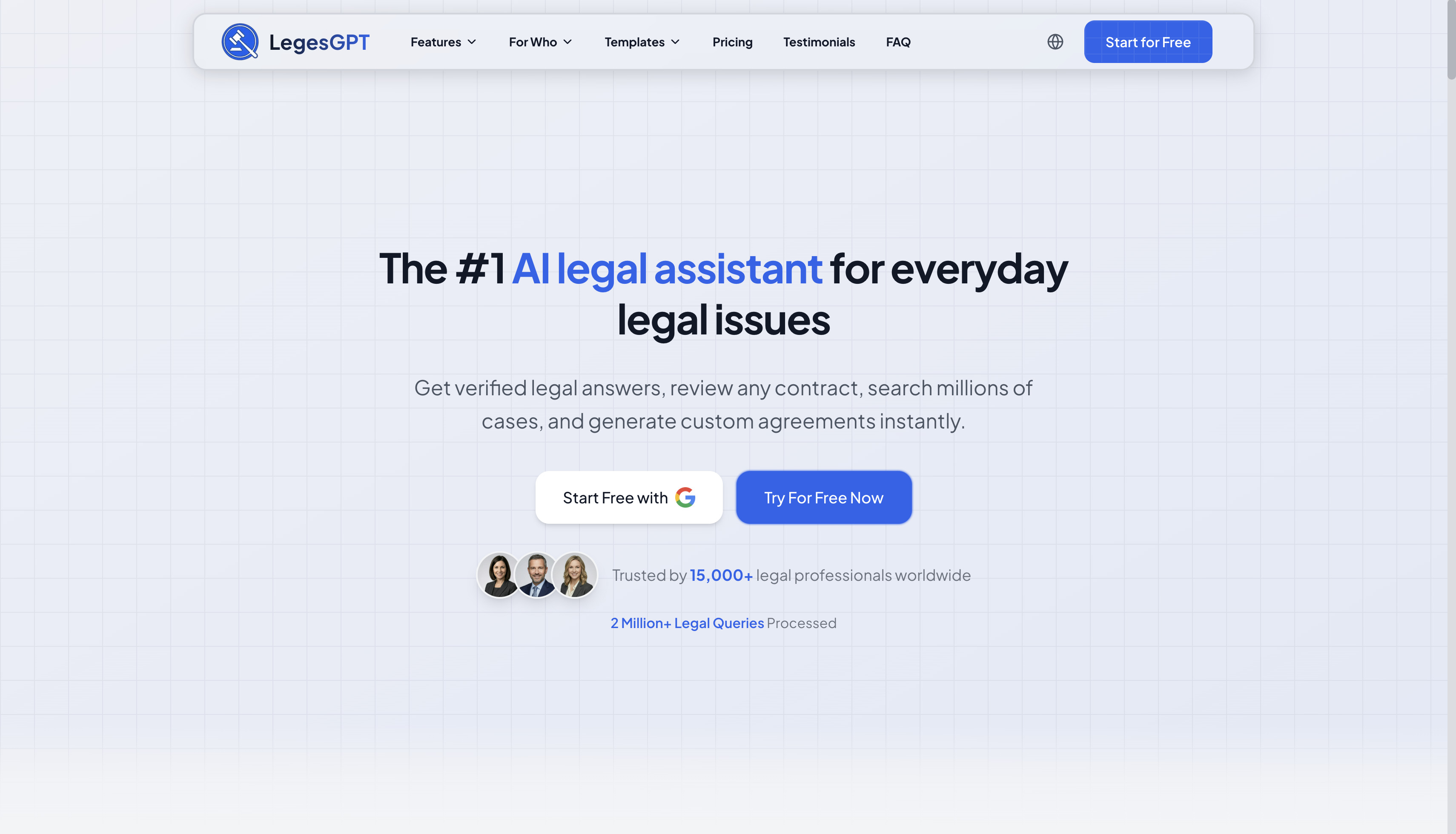
LegesGPT brings legal research, document review, and drafting into a single platform built for lawyers and law firms handling corporate work. Ask it a corporate-law question and it answers with verified sources you can click through; upload a shareholders' agreement and it flags the risks and proposes changes; describe a document and it drafts it, then lets you e-sign and send it. Unlike enterprise tools that require six-figure annual commitments and lengthy onboarding, LegesGPT is self-serve with plans starting at $19.99/month.
What makes it particularly useful for corporate lawyers is doing all of this in one place. You can review a contract, research the relevant corporate governance standards, and draft a follow-up document without switching tools, across 38+ jurisdictions. Deep Research mode handles complex multi-jurisdictional questions that require multi-step reasoning, which is common in cross-border corporate transactions.
Key features
- Answers corporate-law questions with verified sources and direct citations you can check
- Document review for contracts, corporate filings, and agreements (PDF, Word, PowerPoint, images): risk flagging, clause extraction, and proposed changes
- AI drafting of legal documents and contracts, plus e-signature to sign and send
- 38+ country jurisdiction coverage for cross-border corporate and M&A work
- Deep Research mode for complex scenarios requiring multi-step reasoning
- 100+ attorney-drafted legal document templates for common corporate document types
Best for
- Corporate lawyers handling contract review alongside statutory and case law research
- Law firms managing cross-border transactions that require multi-jurisdictional analysis
- In-house legal teams and small corporate practices that need capable AI without enterprise pricing
Pricing
- 3-day trial for $1 on all plans (no free usage tier)
- Basic at $19.99/month, Plus at $49.99/month (50 document reviews), Premium at $99.99/month (unlimited reviews + Deep Research and priority support)
- Annual billing saves around 30%
Pros
- All-in-one platform: research, document review, drafting, and e-signature in one subscription
- Verified sources and direct citations make outputs easy to check before you rely on them
- Covers 38+ countries, rare at this price point for cross-border corporate work
- Self-serve signup with no sales cycle, long-term contracts, or enterprise minimums
Cons
- Not a full contract lifecycle management platform (no obligation tracking or workflow routing)
- Document review requires the Plus plan ($49.99/month) or higher
- Credit-based system on the Plus plan caps reviews at 50/month
2. Harvey AI, best for BigLaw and enterprise legal departments
Harvey is the dominant AI platform in BigLaw, used by about half of the AmLaw 100 and many Fortune 500 in-house legal departments. Built on custom-trained models fine-tuned on vast amounts of legal data, Harvey differentiates itself with an agentic architecture that orchestrates multiple models together, using different LLMs depending on the task.
The Workflow Builder lets firms create custom multi-step processes that chain AI actions together, and clients have built 25,000+ custom workflows and agents to date. In May 2026 Harvey added Agent Builder and a library of 500+ prebuilt agents. Harvey Vault handles document analysis at scale (up to 10,000 documents per vault), and the Agentic Word integration brings planning and review directly into Microsoft Word. The platform now serves 1,500+ customers and more than 200,000 lawyers across 70 countries.
Key features
- Workflow Builder and Agent Builder for custom agentic processes with linked AI steps
- Harvey Vault for large-scale document analysis and data extraction (up to 10,000 documents)
- Agentic Word integration with deeper reasoning inside Microsoft Word
- 500+ prebuilt agents (added May 2026) plus client collaboration via guest accounts
- Multi-jurisdictional support across 60+ countries
Best for
- AmLaw 100 firms handling complex corporate transactions and M&A at scale
- Fortune 500 in-house legal departments with dedicated legal technology budgets
- Large legal teams that need customizable AI workflows across practice areas
Pricing
- Enterprise seat-based pricing (not publicly listed)
- Third-party estimates vary widely; treat any quoted figure with caution
- No free trial; pilot programs require user-count commitments
Pros
- 25,000+ custom workflows and agents created by firms, indicating deep customizability
- Enterprise-grade security: ISO 27001, encryption, and access controls
- Backed by over $1.2B in funding and an $11B valuation (March 2026), with ARR around $300M by mid-2026 and a further raise at a reported $15.5B valuation in the works as of August 2026
- Strong top-tier adoption (roughly 50% of the AmLaw 100)
Cons
- Pricing puts it out of reach for solo practitioners, small firms, and most mid-market teams
- 10,000-document cap per Vault can limit the largest litigation or M&A matters
- Steep learning curve to fully leverage the Workflow Builder
- Some users report workflow execution can feel disjointed with manual copy-pasting between steps
3. Luminance, best for M&A due diligence and cross-border deals
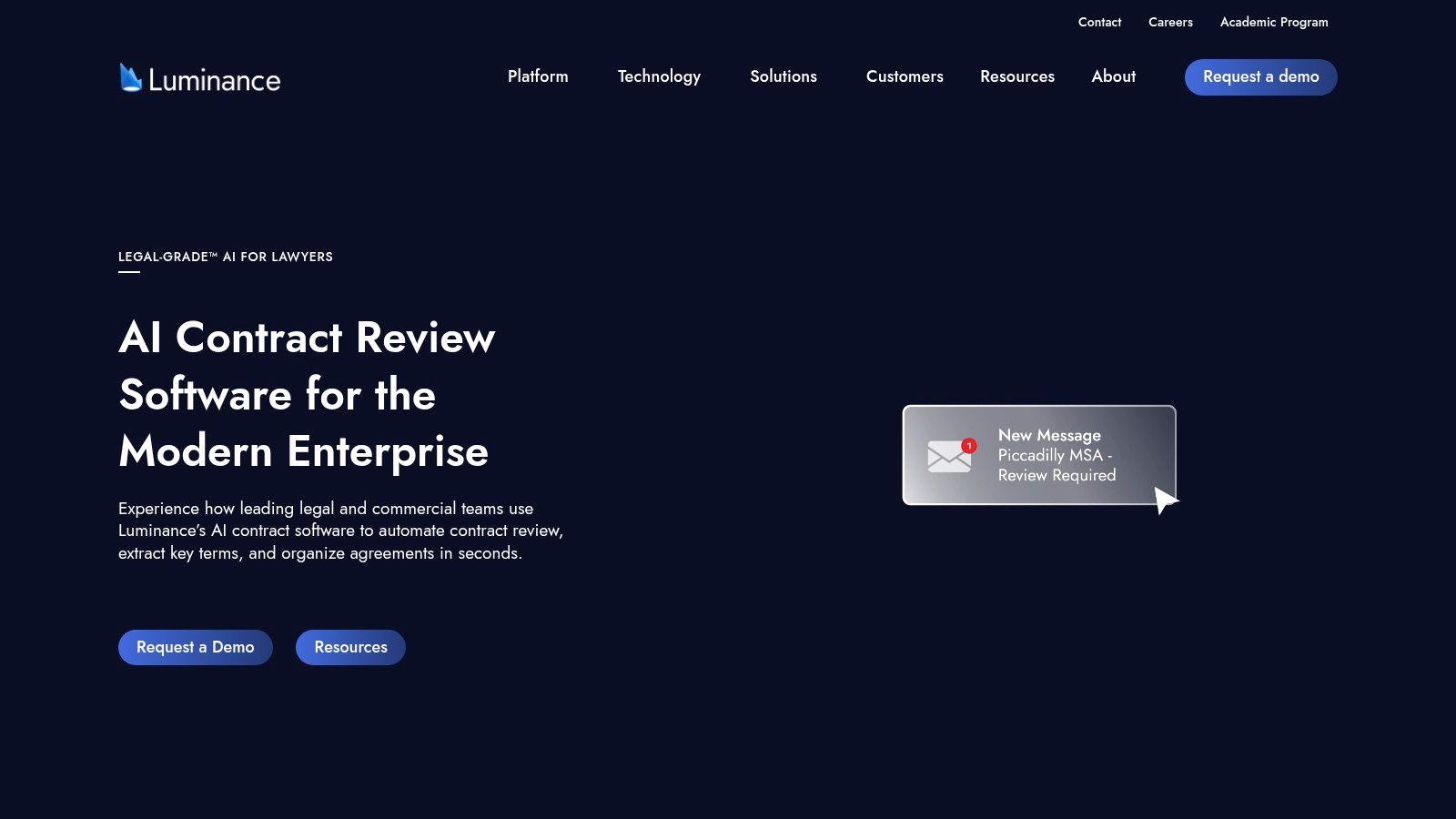
Luminance is purpose-built for the kind of large-scale document review that corporate M&A transactions demand. Its proprietary Legal-Grade AI, trained for over a decade on millions of verified legal documents, excels at anomaly detection and pattern recognition across deal rooms containing thousands of contracts.
The standout capability is autonomous negotiation (originally branded Autopilot), which handles routine contracts like NDAs from start to finish: Luminance reads the incoming contract, remediates risks against your playbook, and responds to the counterparty. A January 2026 platform update added "institutional memory" across negotiation, workflow orchestration, and contract intelligence. The platform serves 1,000+ organizations across 70+ countries, including clients like AMD, Hitachi, and Rolls-Royce, and raised a $75M Series C in February 2025 led by Point72.
Key features
- Luminance Diligence with instant insight across 1,000+ legal concepts for M&A, lease reviews, and compliance audits
- Autonomous negotiation of routine contracts (NDAs) from start to finish
- Traffic Light Analysis for AI-powered first-pass review with visual risk ratings
- Ask Lumi for negotiation suggestions and redrafting directly in Microsoft Word
- Integrations with Microsoft Word, Outlook, Salesforce, and virtual data rooms, plus LexisNexis legal content inside the drafting tool (April 2026 partnership)
Best for
- Corporate M&A teams running due diligence across hundreds or thousands of contracts
- In-house legal departments managing cross-border transactions requiring multi-jurisdictional review
- Organizations that want autonomous handling of routine NDA negotiations
Pricing
- Custom, quote-based pricing tailored to organization size and contract database volume
- Onboarding, training, and data uploading included in the upfront price
- Enterprise pricing; generally cost-prohibitive for solo practitioners or small firms
Pros
- Best-in-class anomaly detection across large document sets for due diligence
- Autonomous NDA negotiation is a genuine differentiator
- 1,000+ organizations across 70+ countries; strong enterprise track record
- No hidden fees; onboarding and training included in pricing
Cons
- Cannot generate contracts from scratch without pre-existing templates
- Primarily works with Microsoft Word; other formats must be converted
- Enterprise pricing makes it inaccessible for smaller firms and solo practitioners
4. Kira (Litera), best for large-scale contract analysis
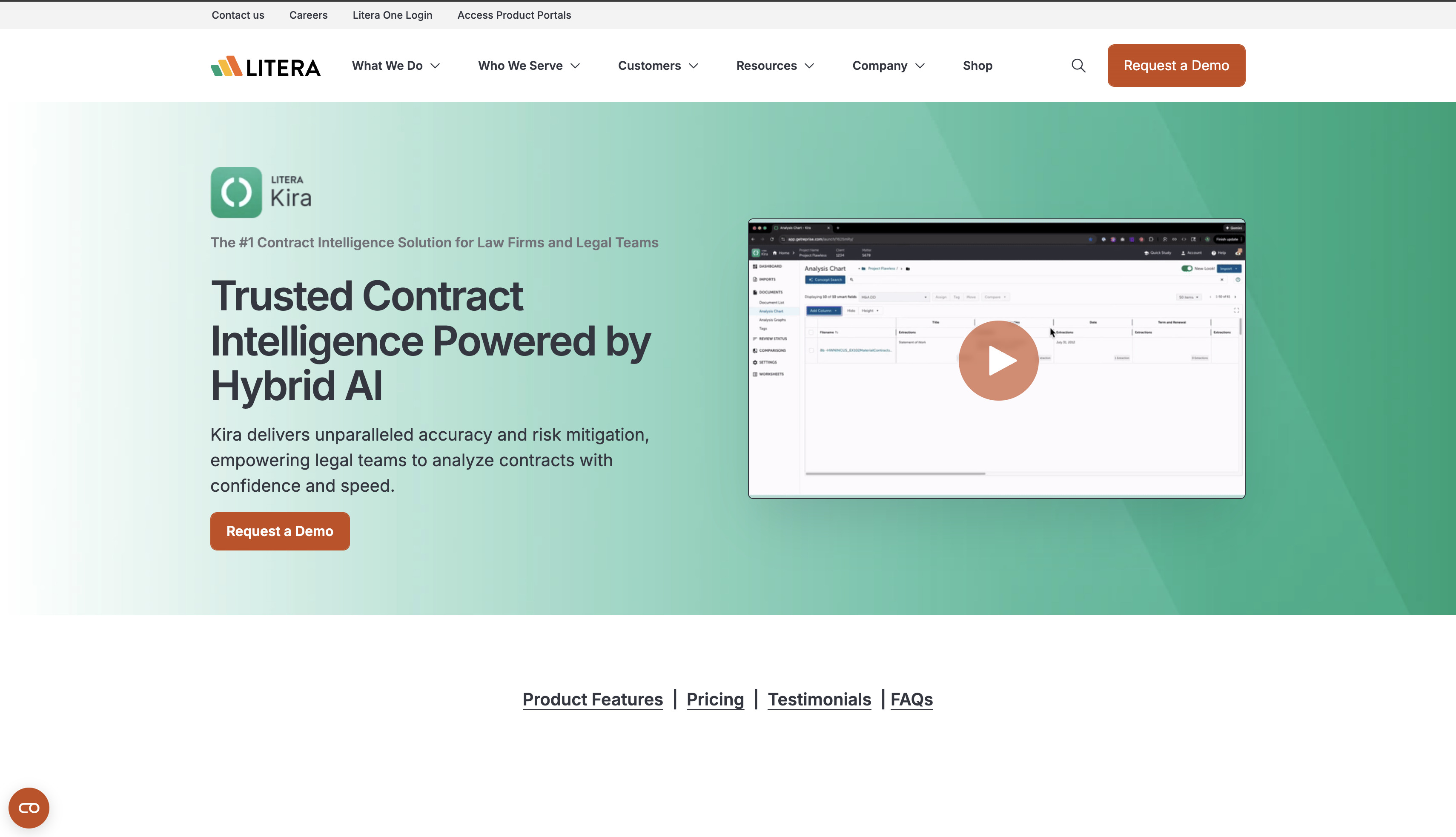
Kira is the gold standard for AI-powered contract analysis in M&A and transactional work. Its core strength is a library of 1,400+ pre-trained "smart fields" that identify contract provisions across 40+ substantive areas of law. These smart fields have been refined over a decade of AI innovation and 45,000+ lawyer hours of training, delivering 90%+ extraction accuracy consistently.
Used by roughly 70% of the top 50 global law firms, Kira is a default choice for large-scale due diligence. In July 2025, Litera expanded Kira under its "Litera AI+" framework (including the AI agent Lito), adding generative summarization and analysis alongside the core extraction engine at no additional cost to existing customers, with further hybrid gen-AI expansion in January 2026.
Key features
- 1,400+ pre-trained smart fields covering 40+ substantive areas of law
- GenAI capabilities under the Litera AI+ framework (added July 2025) for summarization and analysis
- Custom training to recognize new clause types specific to your deal requirements
- Multi-language support for smart fields across 40+ languages
- Collaborative worksheets for team-based contract review projects
Best for
- Large law firms handling high-volume M&A due diligence with thousands of contracts
- Corporate legal teams that need reliable, repeatable clause extraction across deal after deal
- Cross-border transactions requiring multi-language contract analysis
Pricing
- Quote-based; Litera does not publish standard pricing
- Commonly estimated in the five- to six-figure annual range for firms (third-party estimates, not official)
- Custom enterprise pricing for larger deployments
Pros
- Deepest pre-trained provision library in the market (1,400+ smart fields)
- 90%+ extraction accuracy backed by a decade of training and refinement
- Named a Tier 1 contract review platform by Legaltech Hub two years running
- GenAI features added at no additional cost to existing customers
Cons
- Firm-level pricing is prohibitive for small teams and solo practitioners
- Limited export options; lacks integration with some document automation platforms
- Interface and workflow structure could be more intuitive for new users
5. Spellbook, best for transactional contract drafting in Word
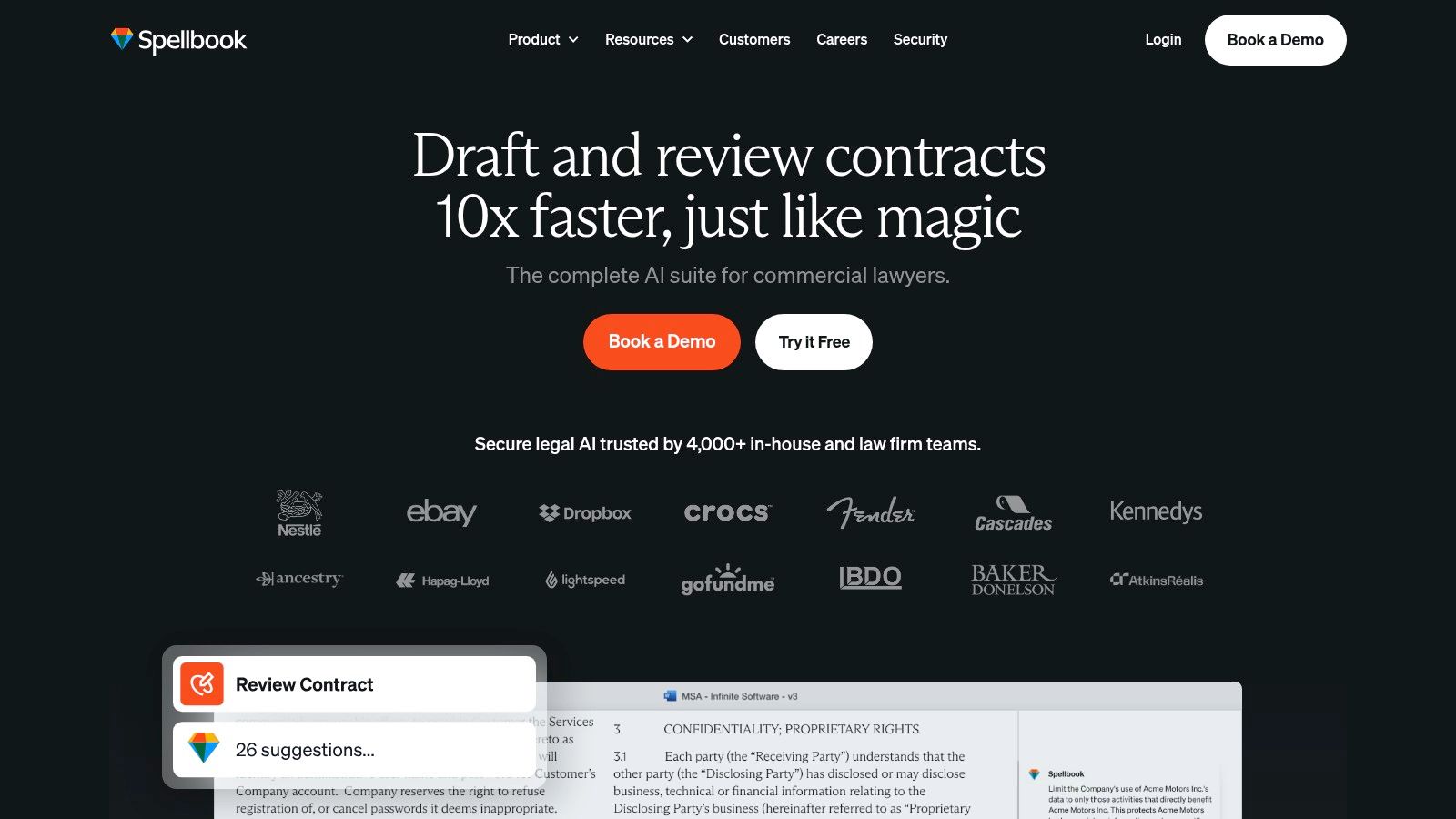
Spellbook is purpose-built for the daily workflow of transactional and corporate lawyers who live in Microsoft Word. It uses GPT-5 (and other frontier models, including Anthropic's Claude) to review contracts, suggest clause language, and flag risks directly within Word, with no platform switching required.
What sets Spellbook apart for corporate lawyers is its deal-term benchmarking. The Market Comparison feature (generally available January 2026) shows how your contract terms compare to market standards across common contract types during negotiations. Spellbook Library, launched in July 2025, lets the AI learn from your firm's precedent documents, and Spellbook Associate adds an agentic assistant for multi-document deal work. The company raised a $50M Series B in October 2025 led by Khosla Ventures, and maintains a zero data retention policy (SOC 2 Type II, GDPR, CCPA compliant).
Key features
- AI contract review, drafting, and clause suggestions natively inside Microsoft Word
- Market Comparison benchmarking your terms against market standards (GA January 2026)
- Spellbook Library that learns from your firm's precedent documents
- Spellbook Associate agent for multi-document M&A diligence (reps, warranties, covenants, indemnities)
- Zero data retention policy (SOC 2 Type II, GDPR, CCPA compliant)
Best for
- Transactional and corporate lawyers who draft and review contracts daily in Microsoft Word
- Deal lawyers who need market benchmarking data to support negotiation positions
- Mid-sized firms that want AI for corporate deal work without Harvey-level pricing
Pricing
- Quote-based per-license pricing by team size (no public list price as of 2026)
- 7-day free trial available
- Contact for team and enterprise pricing
Pros
- Deal-term benchmarking is a unique feature for corporate negotiation support
- Zero data retention policy provides genuine privacy assurance for sensitive deals
- Purpose-built for transactional law, not a general-purpose chatbot adapted for legal
- 7-day free trial allows testing with real deal documents
Cons
- Lives inside Microsoft Word (and Google Docs) as an add-in; no standalone platform or mobile app
- Focused on drafting and review only; no legal research database or case law included
- Pricing is quote-based, which makes budgeting harder for smaller teams
6. Definely, best for document drafting accuracy and proofreading
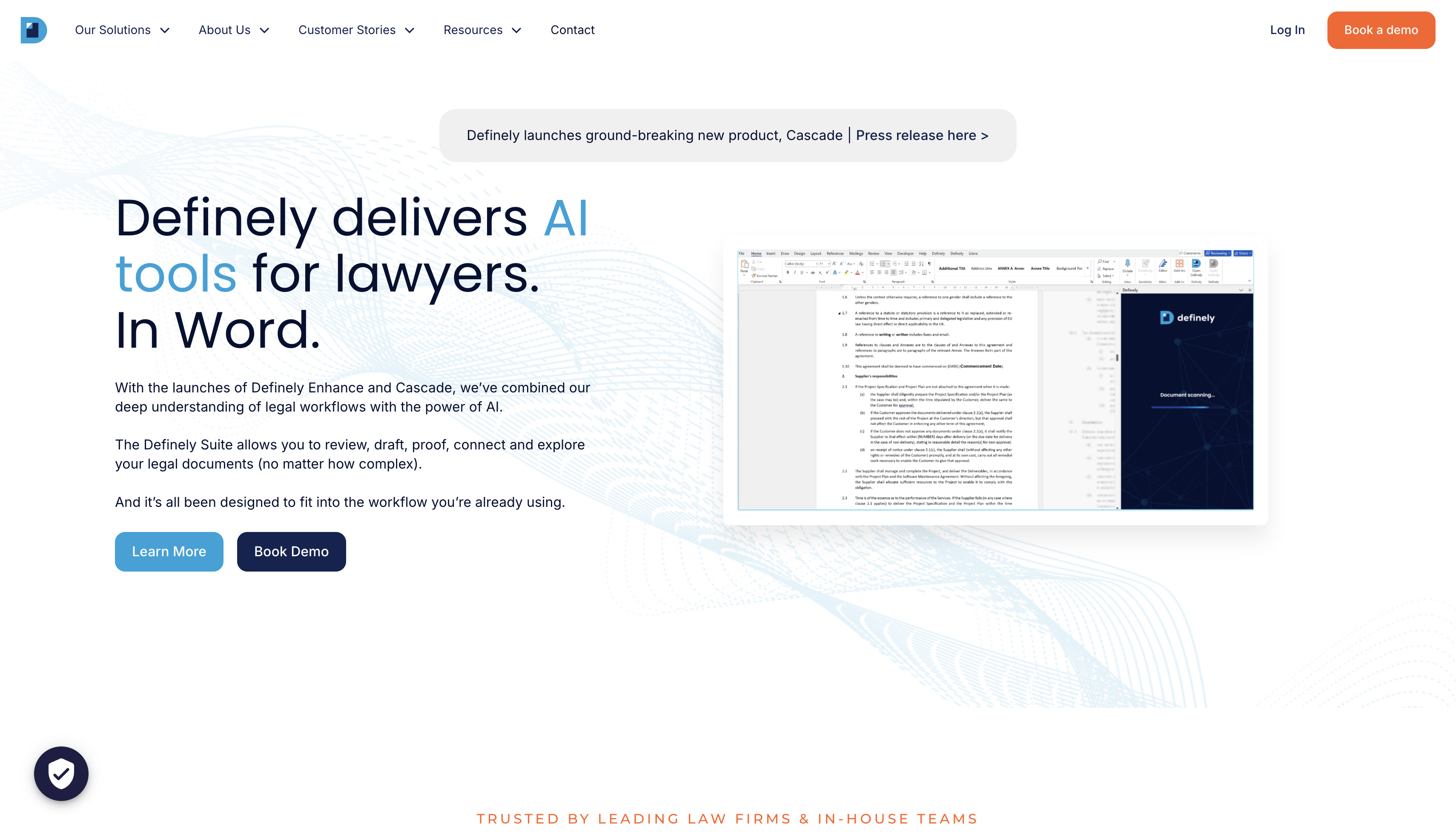
Definely specializes in the accuracy and quality of legal documents within Microsoft Word. For corporate lawyers producing complex agreements, disclosure schedules, and multi-party transaction documents, the proofreading engine automates hundreds of checks for defined terms, cross-references, punctuation, formatting, and stray drafting notes that would otherwise require manual review.
The Cascade feature, launched in August 2025, is particularly relevant for corporate transactional work. It reveals up to three levels of downstream impact from a single change in a contract, which is critical when modifying provisions in interconnected deal documents. Definely Enhance, the agentic AI layer, delivers a vendor-estimated 40-70% speed improvement in drafting workflows. Clients include Magic Circle and white-shoe firms (A&O Shearman, Slaughter and May, DLA Piper) and corporates (Barclays, Deloitte, KPMG, Samsung). Definely raised a $30M Series B in June 2025 led by Revaia.
Key features
- Automated proofreading for definitions, cross-references, punctuation, formatting, and drafting notes
- Cascade for multi-level change impact analysis (up to three levels of downstream effects)
- Definely Enhance agentic AI system for faster drafting workflows
- Definely Draft for editing defined terms and cross-references without navigating away from the current clause
- Native Microsoft Word integration with no platform switching
Best for
- Corporate lawyers producing complex multi-party agreements and disclosure schedules
- Law firms where document accuracy is critical (M&A closings, securities filings, board resolutions)
- Legal teams that want to eliminate manual proofreading of cross-references and defined terms
Pricing
- Custom, demo-based pricing by product suite and user count (no public free tier)
- Product suite spans Draft, Proof, Cascade, Enhance, and Vault
- Raised $30M Series B in June 2025 (~$40M total funding), indicating continued investment
Pros
- Saves approximately 45 minutes per lawyer per day on document accuracy checks
- Cascade feature is unique for understanding the ripple effects of contract changes
- Trusted by Magic Circle and white-shoe firms and major corporations
- Deep Microsoft Word integration with a focused, accuracy-first feature set
Cons
- Narrower scope than full CLM or research platforms (focused on drafting and proofreading)
- Limited post-execution capabilities (no obligation tracking or lifecycle management)
- Pricing is demo-based, with no public self-serve tier
7. Diligen, best for customizable due diligence workflows
Diligen takes a machine learning approach to contract analysis that prioritizes trainability. Beyond its library of 250+ pre-trained provision models covering M&A, lease reviews, tax, finance, and confidentiality, the platform lets users train the system (via its Prodigy training tool) to recognize completely new clause types. For corporate legal teams handling specialized or industry-specific due diligence, this adaptability is a meaningful advantage over tools with fixed provision libraries.
The platform generates contract summaries in Word or Excel format, which fits naturally into the due diligence reporting workflows that corporate lawyers already use. Filtering capabilities let you manage and sort contracts by parties, dates, provision types, and other criteria across large deal rooms. Note that Diligen has seen relatively little public product development in recent years compared to the better-funded tools on this list.
Key features
- 250+ pre-trained provision models across M&A, lease review, tax, finance, and confidentiality
- Prodigy custom training tool to teach the system new clause types specific to your deal or industry
- Auto-summarization generating contract summaries in Word or Excel
- Filtering by parties, dates, provision types, and other criteria
- Collaborative review for team-based due diligence projects
Best for
- Corporate legal teams running due diligence with industry-specific or unusual clause types
- Law firms that handle recurring deal types and want to build custom extraction models over time
- Mid-market teams looking for a trainable AI review tool without enterprise CLM overhead
Pricing
- Tiered plans with custom enterprise quotes (aggregators cite roughly $350-$1,600/month by tier)
- Enterprise pricing available on request
Pros
- Highly customizable: user-trainable ML engine adapts to any clause type or industry
- Cuts due diligence review time roughly in half, per company data
- Outputs summaries in Word and Excel, fitting existing reporting workflows
- Covers a broad range of practice areas (M&A, leases, tax, finance)
Cons
- Smaller pre-trained model library (250+) compared to Kira's 1,400+
- Little public product development or news in recent years
- Lower public profile and less transparent pricing than other tools on this list
How to choose the best AI tool for corporate law
1) What type of corporate work dominates your practice?
Different tools excel at different slices of corporate law, and in-house teams often need different things from deal counsel at a firm. Match the tool to your primary workflow.
- If you handle a mix of research, contract review, and advisory work across jurisdictions: LegesGPT covers all three in one platform at $19.99-$99.99/month
- If you primarily do M&A due diligence with large document sets: Luminance and Kira are purpose-built for high-volume deal rooms
- If you draft and negotiate contracts daily in Word: Spellbook and Definely work natively inside your existing environment
2) What is your firm's size and budget?
Pricing spans from $19.99/month to six figures annually. Be realistic about what your practice can sustain.
- Solo practitioners and small firms (under $100/month): LegesGPT ($19.99-$99.99/mo) is the most accessible option with research, review, and drafting
- Mid-sized firms: Spellbook (quote-based), Definely (demo-based), and Diligen offer solid value for focused use cases
- Large firms and enterprise: Harvey AI, Luminance, and Kira serve the enterprise tier with dedicated support and scale
3) Do you need a specialist tool or an all-in-one platform?
Some corporate practices benefit from a single tool that handles research, review, and drafting. Others need best-in-class point solutions for specific tasks.
- For an all-in-one approach: LegesGPT combines research, document review, and drafting. Harvey AI offers the broadest enterprise platform with customizable workflows
- For specialist M&A due diligence: Luminance (anomaly detection) and Kira (clause extraction) are the market leaders
- For drafting accuracy: Definely (proofreading) and Spellbook (clause suggestions and benchmarking) focus on what happens inside Microsoft Word
4) How important is multi-jurisdictional coverage?
Corporate transactions increasingly cross borders. Not all AI tools handle this well.
- For 38+ country coverage at an affordable price: LegesGPT covers the broadest range of jurisdictions for its price tier
- For enterprise-scale multi-jurisdictional support: Harvey AI (60+ countries), Luminance (70+ countries), and Kira (40+ languages) serve global firms
- For US- and UK-focused corporate work: Spellbook and Definely focus primarily on common law jurisdictions
Frequently Asked Questions
What are AI tools for corporate lawyers?
AI tools for corporate lawyers use natural language processing, machine learning, and large language models to automate tasks like contract analysis, legal research, due diligence review, and document drafting. They handle the time-consuming first pass on documents so lawyers can focus on strategy, judgment, and client advice. For in-house teams, that also extends to entity compliance filings, board resolutions and minutes, and contract lifecycle tracking.
Can AI replace corporate lawyers?
No. AI tools for corporate lawyers are designed to assist, not replace. They accelerate document review, flag risks, and surface relevant precedents, but a qualified attorney must still exercise legal judgment on deal strategy, negotiate key terms, and advise clients. The value is in speed and consistency, not autonomy.
Which AI tool is best for M&A due diligence?
For large-scale M&A due diligence, Luminance and Kira (Litera) are the established leaders. Luminance excels at anomaly detection across large deal rooms, while Kira offers the deepest pre-trained provision library (1,400+ smart fields) with 90%+ accuracy. For smaller M&A transactions where you also need legal research, LegesGPT combines document review with verified-source legal research in one tool.
Is there an affordable AI tool for solo corporate lawyers?
Yes. LegesGPT starts at $19.99/month, with document review available on the Plus plan at $49.99/month, and a 3-day trial for $1. It is accessible without enterprise sales cycles or minimum commitments, making it practical for solo practitioners and small corporate practices.
What is the difference between AI contract review and AI legal research?
AI contract review analyzes specific documents to extract terms, flag risks, and suggest edits. AI legal research searches case law, statutes, and legal articles to answer legal questions and find precedents. Most tools specialize in one or the other. LegesGPT is one of the few platforms that combines both capabilities in a single subscription.
How accurate are AI tools for corporate legal work?
Accuracy varies by tool, document type, and complexity. Kira reports 90%+ extraction accuracy on standard provisions. Most tools perform well on common commercial agreements (NDAs, share purchase agreements, employment contracts) but may struggle with highly bespoke or unusual provisions. The best approach is to test any tool with 3-5 real documents from your practice before committing.
Are AI tools safe for confidential corporate transactions?
Reputable tools offer enterprise-grade security certifications. Spellbook maintains a zero data retention policy (SOC 2 Type II). Harvey AI holds ISO 27001 certification. Luminance includes onboarding and training with no hidden data usage. Always verify a tool's data handling policy, encryption standards, and compliance certifications before uploading sensitive deal documents.
Which AI tool should I use if I need both contract review and legal research?
LegesGPT is the only platform on this list that combines AI contract review with verified-source legal research across 38+ countries in one subscription. If your workflow involves reviewing corporate agreements and then researching the applicable law, having both in one tool saves time and subscription costs compared to maintaining separate tools.