
For anyone who's spent time in the legal field, you know that much of the work has traditionally been measured in stacks of paper and the relentless ticking of the billable hour clock. What if you could tear through thousands of pages in mere minutes, not weeks? That’s not science fiction; it’s the reality that AI legal document review is bringing to the table, completely changing one of the most demanding parts of legal work.
The End of Manual Document Review
For years, the backbone of due diligence, e-discovery, and contract analysis was a brute-force manual review. Entire teams of paralegals and junior associates would slog through documents for hours on end. It was a process that was not only painfully slow and expensive but also dangerously susceptible to human error. Let's be honest, even the sharpest legal mind can miss a crucial detail after hours of staring at dense legalese.
This old-school approach was a major bottleneck. It held up case preparation, inflated client bills, and frankly, burned out good people. With the sheer volume of digital information exploding, the pressure has been on for a smarter, more efficient way to work.
Shifting from Exhaustion to Efficiency
Imagine trying to find a specific fact by manually flipping through every book in a massive library using only the card catalog. It's tedious, relies on a bit of luck, and takes forever. An AI legal document review platform is like having a super-powered search engine that doesn't just find the words you're looking for but understands their context and importance instantly.
This technology hits the main pain points of manual review head-on:
- High Labor Costs: It dramatically cuts down the number of billable hours needed just to get through the initial screening.
- Human Error: AI doesn’t get tired or distracted. It applies the same level of scrutiny to the first document as it does to the ten-thousandth.
- Client Demands: It allows firms to deliver insights and results much faster, which is exactly what clients expect in today's fast-paced world.
AI isn’t some far-off concept anymore; it's a practical, strategic tool that’s ready to use right now. It frees legal professionals from the drudgery of repetitive tasks so they can focus on what truly matters—building case strategy, negotiating deals, and advising clients.
A New Standard for Legal Work
Bringing AI into the document review process is about more than just speed. It’s about establishing a higher standard of care and gaining a real strategic edge. By automating that first, often grueling, pass, legal teams can begin their substantive work from a far more informed and organized starting point. They're no longer searching for a needle in a haystack; instead, they’re handed a pre-sorted stack of relevant documents with key terms extracted and potential risks already flagged.
This transition enables firms to take on bigger, more complex cases without needing to hire a proportionally larger team. Ultimately, adopting AI legal document review is a fundamental shift from a reactive, labor-intensive grind to a proactive, data-driven strategy. To see how this technology is applied, you can get more details on LegesGPT’s approach to AI-powered document review.
How AI Actually Reads and Understands Legal Language
To really get a feel for AI-powered document review, it helps to pop the hood and see what’s going on inside. It’s not some impenetrable "black box" doing magic. Instead, it’s a surprisingly logical process designed to first mimic, and then dramatically outperform, what a human reviewer can do. The whole thing is built on technology that teaches software how to make sense of human language.
At the heart of it all is Natural Language Processing (NLP). You can think of NLP as the engine that gives AI its reading comprehension skills. Just as a junior paralegal spends years poring over documents to learn key terms and concepts, NLP models are trained on massive datasets of legal texts. This teaches them to recognize the unique cadence, structure, and vocabulary of legal writing.
But just recognizing words isn't enough. The system has to get smarter over time. That’s where machine learning (ML) comes in. With every contract it analyzes, the AI sharpens its understanding, getting better and better at spotting patterns and flagging potential issues. It's a lot like a seasoned lawyer whose instincts and expertise grow with every single case they handle.
The Four Stages of AI Document Analysis
The journey from a raw document to a set of clear, actionable insights follows a well-defined four-stage workflow. This process is all about breaking down dense legal jargon into data points that a team can sort, filter, and act on. Each step builds on the one before it, adding a deeper layer of understanding.
The flowchart below shows this in action, comparing the old-school manual approach with a modern, AI-driven workflow.
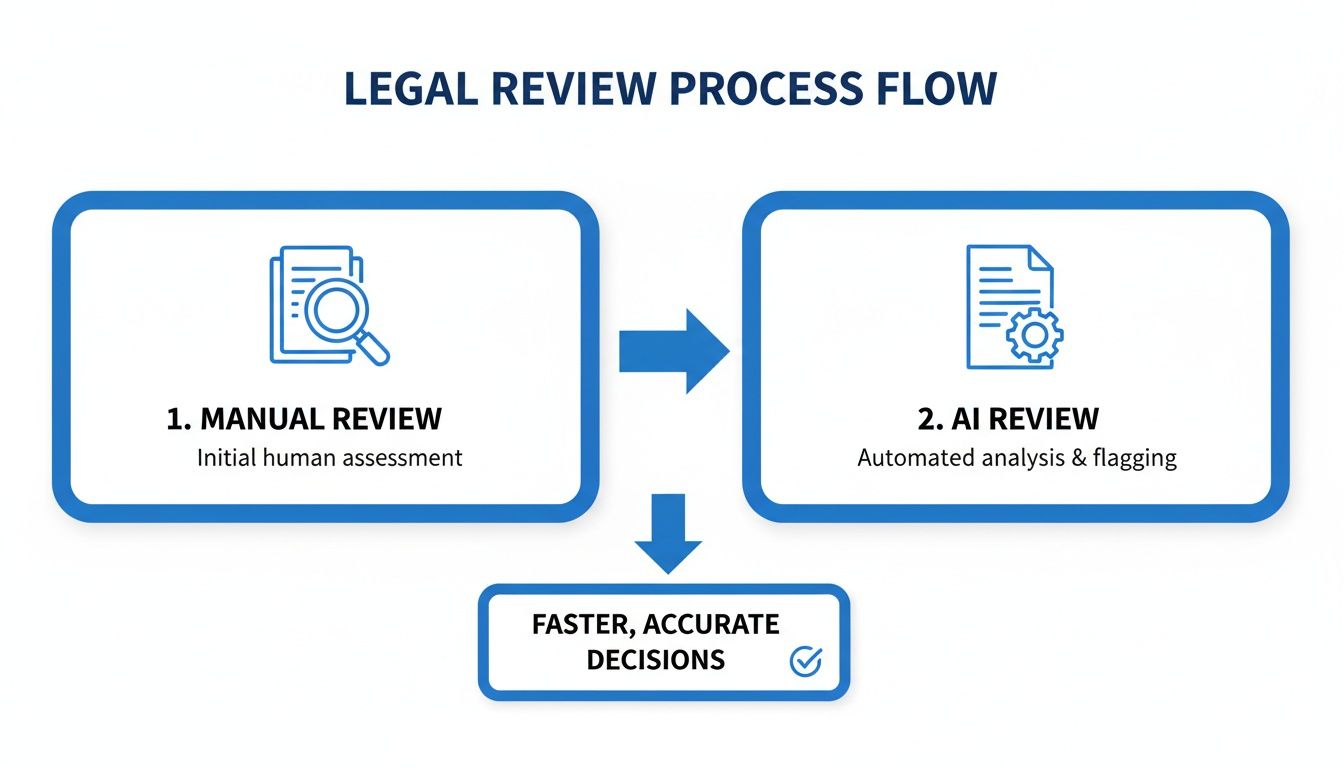
You can see right away how it moves the needle from a slow, labor-intensive grind to a far more efficient, tech-supported solution.
Let's walk through the individual stages that make this happen:
-
Ingestion: It all kicks off when you feed documents into the system. This could be anything from a single contract to thousands of files in different formats, like PDFs, Word docs, or even scanned images. Good platforms use Optical Character Recognition (OCR) to turn those scans into digital text the AI can actually read.
-
Data Extraction: With the documents loaded, the AI does its first pass. Think of it as a super-diligent clerk pulling out all the critical info: party names, effective dates, renewal terms, governing law, and key financial figures. This step alone turns a wall of text into a structured list of basic facts.
-
Clause Classification: Now, the system goes deeper than just plucking out data points. It starts analyzing entire sections, identifying and tagging common legal provisions. It neatly categorizes clauses like "Indemnification," "Confidentiality," "Limitation of Liability," or "Termination." This is invaluable for quickly comparing contracts or spotting when a standard clause is missing. If you want to go deeper, you can see how AI accelerates contract review in practice.
-
Risk Analysis: This final stage is where the real high-level work happens. The AI takes the clauses it found and compares them against your company's playbook, predefined legal standards, or common market practices. It immediately flags anything that’s non-standard, missing, or deviates into risky territory.
By following this systematic approach, the AI transforms a mountain of unstructured documents into a dashboard of clear, organized, and actionable intelligence. It doesn't just read the words; it interprets their legal weight and serves them up in a way that helps you make smarter decisions, faster.
When you break it down like this, it’s clear that AI document review isn't some kind of wizardry. It's a methodical application of smart technology, built to tackle the sheer volume and complexity of modern legal work and turn a powerful concept into a tangible, everyday asset for your team.
Human Expertise vs. AI-Powered Efficiency
The debate over AI legal document review isn't about replacing lawyers with algorithms. Not at all. It's about forging a powerful partnership where technology shoulders the exhausting, repetitive work, freeing up human experts for the strategic thinking that only they can provide. This model doesn't replace legal professionals; it supercharges them, making them faster, more accurate, and ultimately, more valuable.

Think about an experienced litigator staring down a mountain of data for an eDiscovery project. The old way involved a small army of associates manually sifting through terabytes of information. Today, that same litigator can deploy an AI tool to perform the first pass, flagging potentially relevant documents in a tiny fraction of the time. This lets them skip straight to the good part: building a winning case narrative.
Defining Roles in the Modern Legal Workflow
The secret to success lies in understanding who—or what—is best for each task. Human lawyers bring nuanced judgment, strategic creativity, and an ethical compass that no machine can ever replicate. They grasp context, understand a client’s ultimate goals, and navigate the subtle art of negotiation. Their value is in interpreting the law, not just processing data.
AI, on the other hand, is built for tasks demanding brutal scale, speed, and consistency. It can churn through millions of documents without a coffee break, pinpoint a specific clause across thousands of contracts with perfect recall, and tirelessly flag any deviation from a predefined standard. It’s the ultimate data-processing workhorse.
We're already seeing this dynamic play out with the rise of the artificial intelligence paralegal, a clear sign of how technology is augmenting legal talent. It lets professionals offload the routine work to focus on the high-value strategic counsel their clients are actually paying for.
The winning formula is simple: Let AI manage the high-volume, low-complexity work of initial review, empowering legal professionals to dedicate their time to analysis, client strategy, and negotiation.
This approach pays real dividends. One midsize litigation group, for instance, cut its contract review times by an incredible 60% by using AI assistants that could summarize key terms and flag missing clauses. As tools like this become commonplace, they are fundamentally improving how law firms operate.
A Side-by-Side Comparison
To really see how this partnership works, it helps to put their strengths side-by-side. The table below breaks down the core attributes of traditional human review versus an AI-assisted process, highlighting how perfectly they complement each other.
Human Review vs. AI Document Review: A Comparative Analysis
This table compares the key attributes of traditional manual document review by legal professionals against AI-powered review systems.
| Attribute | Human Review | AI Document Review |
|---|---|---|
| Speed | Limited by human reading and analysis speed; slow for large volumes. | Extremely fast; processes thousands of documents in minutes or hours. |
| Consistency | Susceptible to fatigue, distraction, and subjective interpretation. | Unwavering; applies the same criteria to every document, every time. |
| Cost | High, based on billable hours for multiple reviewers over long periods. | Lower operational cost; reduces billable hours for repetitive tasks. |
| Scalability | Difficult to scale quickly; requires adding more people. | Highly scalable; can handle massive increases in data with minimal delay. |
| Nuanced Judgment | High; excels at interpreting ambiguity, intent, and complex strategy. | Low; operates based on patterns and predefined rules, lacks true context. |
| Ethical Oversight | Essential; provides professional responsibility and ethical guidance. | None; requires human oversight to ensure compliance and ethical use. |
As the comparison makes clear, the goal isn't to pick a winner. The most effective legal teams are the ones that successfully blend both. By delegating the initial, data-heavy lifting to AI, they free up the time and mental space for human expertise to make its greatest impact.
The Big Wins: What AI Document Review Actually Delivers
Bringing an AI document review platform into your firm isn't just about getting things done faster. It's about fundamentally changing how you work, creating a ripple effect of strategic advantages that start with a massive leap in speed and accuracy.
We all know the grind of long review sessions. Fatigue sets in, and consistency can waver. An AI, on the other hand, gives the ten-thousandth document the same sharp focus as the first. This relentless consistency is key to catching those small but critical errors that can easily be missed by the human eye.
Pinpoint Accuracy and Rock-Solid Consistency
Manual document review is a high-wire act. One missed clause, one misinterpreted date, and the entire outcome of a case or a deal can shift. It's an immense pressure to put on any legal team.
AI operates differently. It applies a precise set of rules and algorithms to every single page, every single time. This creates a level of accuracy that's incredibly difficult for even the best human teams to match when dealing with massive volumes of documents. The AI's systematic approach ensures nothing gets overlooked because of a late night or a moment of distraction.
AI doesn't just lower the error rate; it sets a completely new standard for reliability. It’s a guarantee that the same rigorous analysis is applied consistently across thousands of documents, giving you a solid foundation to build your legal strategy on.
This precision is a game-changer for large-scale projects like eDiscovery or due diligence, where the sheer volume of material can feel overwhelming.
Real Cost Savings and Effortless Scalability
Let's talk about the bottom line, because this is where AI document review makes one of its most compelling arguments. The classic billable-hour model for manual review is expensive and, from a client's perspective, often unpredictable.
AI platforms slash the number of billable hours needed for that initial, often tedious, first-pass review. In fact, studies show that legal professionals using AI can save around 240 hours per year, time they can reinvest in more strategic, high-value work. This efficiency boost means firms can take on bigger cases and manage far more complex document sets without having to hire more people. Your operations become instantly more scalable.
The financial impact is clear:
- Lower Labor Costs: You're spending far fewer billable hours on repetitive, low-level review tasks.
- Predictable Pricing: This allows firms to offer clients more attractive and predictable pricing, like fixed fees.
- Greater Capacity: You gain the ability to handle more client work without a proportional increase in your overhead.
Smarter Risk Management and Tighter Compliance
AI is great at finding the "smoking gun" in a document set, but it's equally brilliant at identifying what's not there. You can train an AI legal review system on your firm's own playbook or on industry-standard best practices. It can then automatically flag non-standard clauses, risky language, or critical omissions that a human reviewer, under pressure, might not spot.
This kind of proactive risk detection is a massive advantage for compliance and negotiations. Imagine the system instantly highlighting an indemnification clause that deviates from your company's approved version, or flagging a contract that’s missing a required data privacy provision. By catching these issues early, legal teams can neutralize potential liabilities before they become real problems. You can explore more about the various AI tools for law firms that help with this.
This shifts document review from a purely reactive task to a strategic risk management function. It gives legal professionals a much clearer picture of potential exposures across their entire portfolio of documents. Ultimately, it’s a competitive edge that helps firms deliver faster, more thorough, and more cost-effective services that perfectly meet what modern clients expect.
Real-World Use Cases in Legal Practice
It's one thing to talk about technology in theory, but where does the rubber really meet the road? For AI legal document review, the proof is in how it solves real, everyday problems for legal professionals across every imaginable practice area. The applications are as diverse as the law itself, each showing how smart automation can deliver concrete, measurable results.
From high-stakes M&A deals to sprawling litigation, AI is quickly becoming a non-negotiable part of the modern legal toolkit. It takes on the grueling, data-heavy lifting, freeing up lawyers to do what they do best: focus on strategy, negotiate terms, and advise clients. These scenarios show just how powerful this technology is in practice.
Accelerating M&A Due Diligence
The due diligence process is the heart of any merger or acquisition. Traditionally, it was a brutal, manual slog. Teams of associates would spend months locked in a room, poring over thousands of contracts to find risks, liabilities, and tricky change-of-control clauses. The process was not just slow; it was incredibly expensive.
AI completely flips that script. A platform can now digest an entire virtual data room—often containing thousands of documents—and deliver a comprehensive first-pass review in a matter of days, not months. It can:
- Flag Non-Standard Clauses: Instantly spot any terms that deviate from market standards or the buyer’s pre-approved positions.
- Identify Key Liabilities: Unearth hidden risks buried in indemnity, liability, or warranty clauses that could derail a deal's valuation.
- Extract Critical Dates: Systematically pull all contract expiration, renewal, and termination notice dates to build a coherent timeline.
This gives the M&A team a massive head start. They can begin their strategic analysis almost immediately, armed with a clear, organized summary of potential deal-breakers.
By transforming due diligence from a manual marathon into an automated sprint, AI enables deal teams to focus their energy on negotiating terms and structuring the transaction, rather than getting lost in a sea of paperwork.
Revolutionizing Litigation and eDiscovery
When litigation kicks off, the eDiscovery phase can feel like searching for a needle in a continent-sized haystack. Lawyers often face millions of documents—emails, memos, reports—to find the handful of communications that actually matter. The cost and time involved can be staggering, frequently becoming a major point of contention in the case itself.
AI-powered eDiscovery tools, often called Technology Assisted Review (TAR), bring methodical order to this chaos. You can train the system on a small sample of relevant documents, and from there, it learns what to look for. It then accurately categorizes the rest of the massive dataset, intelligently prioritizing which documents need human eyes first.
This is a clear area of growth. AI is making serious inroads into legal work, with adoption in law firms accelerating as the tools prove their value. Recent research shows that 42% of legal professionals now use AI, a huge jump from just 26% the previous year. If you're deciding where to begin, compare the best AI tools for legal professionals before you commit. What’s more, 46% believe eDiscovery is where it will have the biggest impact. You can see a full analysis of these legal tech trends on NetDocuments.com.
Streamlining Corporate Contract Management
For in-house legal teams, the sheer volume of routine contracts like Non-Disclosure Agreements (NDAs) and vendor agreements can be a constant drain on resources. AI steps in to automate this entire workflow, boosting both speed and compliance.
An AI platform can take an incoming third-party NDA and check it against the company’s internal playbook in seconds. It instantly flags problematic clauses and can even suggest pre-approved alternative language. This simple shift frees up the corporate legal team to concentrate on more complex, high-value agreements, all while ensuring routine contracts are executed quickly and without unnecessary risk.
Navigating the Challenges and Ethical Duties
Bringing any powerful tool into a legal practice means we have to take a clear-eyed look at its limitations and our responsibilities. While AI legal document review can make us incredibly efficient, it’s not a simple plug-and-play fix. Success hinges on a thoughtful approach to potential hurdles and an unwavering commitment to our professional ethics.
One of the biggest risks you hear about is "AI hallucinations." This is when a generative AI model confidently spits out information that sounds plausible but is completely made up. In legal work, where every detail matters, trusting unverified AI output can lead to disaster—think flawed case strategies or even professional sanctions.
This reality highlights a rule that can't be bent: human oversight is essential. The best way to think of AI is as a highly capable assistant that does the heavy lifting, but the final call, the validation, must always come from a qualified legal professional. No matter how sophisticated the algorithm gets, it can't replicate the nuanced judgment and ethical accountability of a lawyer.
The Duty of Technological Competence
The duty of competence has been a cornerstone of the legal profession for ages, and now it includes being proficient with technology. As legal professionals, we have an ethical obligation to understand the benefits and risks of the tools we use. You can't just adopt an AI platform without having a solid grasp of how it works, what it can't do, and how it handles your clients' sensitive information.
This responsibility applies directly to choosing an AI legal document review platform. A huge part of your due diligence is digging into a provider's security and privacy protocols.
When you're evaluating a tool, you have to be sure it meets the highest standards for data protection. A failure here isn't just a technical slip-up; it's a potential breach of your duty of confidentiality.
You need to be ready to ask some tough questions about a platform’s security architecture. Vetting a tool properly isn't just a box to check—it’s a core part of using AI responsibly and a direct reflection of your professional duty.
Safeguarding Client Confidentiality
Data security isn't just a good idea; it's a fundamental ethical command. The moment you upload client documents to an AI platform, you're placing immense trust in that system to protect highly confidential information. That's why you absolutely must understand how your data is being guarded.
Zero in on platforms that provide robust security measures as part of their standard package:
- End-to-End Encryption: This is non-negotiable. It ensures your data is scrambled and secure both while it's being uploaded and while it's sitting on a server.
- Strict Access Controls: The platform should give you granular control over who on your team can see, change, or download specific documents. This is key to preventing unauthorized access.
- Data Residency and Compliance: You need to know where your data is physically stored and confirm the platform adheres to critical data protection laws like GDPR or CCPA.
By tackling these challenges head-on—from verifying every AI output to demanding top-tier security—legal teams can build a framework for using AI that is not only powerful but also ethically sound and professionally responsible.
Frequently Asked Questions
How Secure Is My Data with an AI Legal Document Review Tool?
This is often the first and most critical question. Reputable platforms are built on a foundation of security, using measures like end-to-end encryption and strict, role-based access controls. They also have to comply with major data protection regulations like GDPR and CCPA. When you're vetting a tool, dig into its security protocols and privacy policy. You need to be absolutely certain your firm's and your clients' confidential information is locked down tight against any unauthorized access.
Does Using AI Replace the Need for a Lawyer?
Absolutely not. Think of AI as an incredibly powerful paralegal, not a replacement for a seasoned attorney. It's fantastic at churning through massive amounts of data at a speed no human can match, but it lacks the capacity for professional judgment, strategic thinking, or understanding the subtle nuances of the law. The best approach is a partnership: AI does the heavy lifting on the initial pass, and lawyers provide the crucial oversight, deep analysis, and strategic counsel that clients pay for. For a deeper look at this collaborative model, check out this practical guide to AI legal document review. > Remember, AI is a tool to augment, not replace, legal expertise. The irreplaceable value of a lawyer lies in strategic thinking, ethical judgment, and client advocacy—skills that technology is designed to support, not supplant.
What Types of Documents Are Best Suited for AI Review?
AI really excels with high-volume, relatively standardized documents where it can learn to spot patterns in key clauses and data points. This makes it a perfect fit for things like: • Non-Disclosure Agreements (NDAs) • Commercial Leases • Service Agreements • Massive document sets in eDiscovery and due diligence projects While it can certainly tackle more complex, bespoke agreements, the need for expert human validation goes up as the document’s uniqueness increases.
How Do I Measure the ROI of an AI Document Review Platform?
Measuring the return on investment comes down to both hard numbers and less tangible—but equally important—benefits. On the quantitative side, you can track the direct reduction in billable hours spent on tedious review tasks and measure faster project turnaround times. Some studies have shown AI tools can save legal professionals nearly 240 hours per year. Qualitatively, you’ll see the value in significantly reduced risk from human error, greater consistency across all your work product, and the freedom to redirect your attorneys' time toward the high-value strategic work that truly moves the needle for clients and grows the firm. --- Ready to see how an AI legal assistant can transform your document review process? LegesGPT offers powerful tools to help you analyze contracts, identify risks, and streamline your research, all while prioritizing top-tier security for your confidential data. Discover how much time you can save by starting your free trial at https://www.legesgpt.com.