
A client says the job was supposed to include three rounds of revisions. You remember agreeing to revisions, but the contract only says the work will be delivered “as needed.” A supplier misses a deadline, then points to a clause that says delivery dates are “estimates only.” A founder signs a customer contract copied from an old deal and discovers the payment trigger depends on an exhibit nobody attached.
That's how contract problems usually start. Not with fraud or courtroom drama, but with ordinary business conversations that never made it into clear language.
A good contract doesn't just help when things go wrong. It helps the deal go right. It sets expectations, assigns responsibility, forces the parties to agree on timing and standards, and gives everyone a workable process for change. If you want to learn how to draft a contract, start there. The point isn't to sound legal. The point is to make the deal operable.
Modern drafting is less about ornate wording and more about clarity, structure, and disciplined process. That's especially true now that many teams use templates, automated workflows, and AI tools to produce first drafts quickly. Speed helps, but speed without controls just spreads mistakes faster.
Why a Well-Drafted Contract Is Your Best Business Tool
A deal often feels settled long before the paperwork is finished. Sales has shaken hands, operations is ready to start, and someone asks legal to "paper it up." That is the moment weak drafting causes the most damage, because a vague contract does not just create litigation risk. It creates billing disputes, delivery confusion, approval delays, and internal finger-pointing.
A well-drafted contract gives the business something more useful than formal enforceability. It gives the team a working set of instructions. The strongest agreements tell the people doing the job what must happen, when it must happen, how changes get approved, and which risks each side agreed to carry. That is what makes a contract a business tool rather than a document that gets opened only after a problem appears.
It turns agreement into execution
Good drafting converts a commercial understanding into terms people can use. If the contract does that well, the account manager, project lead, finance team, procurement contact, and outside counsel should all reach the same answer when they read it.
The document should resolve the practical questions that drive performance:
- Scope: What is being sold, delivered, built, licensed, or supported?
- Timing: What are the start dates, deadlines, dependencies, and consequences of delay?
- Money: When is payment earned, when can invoices be challenged, and what happens if payment is late?
- Change control: Who can approve extra work, revised specifications, extensions, or price changes?
If those points are blurry, the parties fill the gaps themselves. Usually they do it differently.
It helps the business run with fewer preventable disputes
Many founders and commercial teams treat contracts as a file for legal. In practice, the contract is often doing operations work, finance work, and relationship-management work at the same time. A services agreement can set the approval path for change orders. A supply agreement can define who bears shortage risk. A SaaS contract can tell support, security, and billing teams what they promised.
That is why clarity matters so much. The people closest to performance need to use the contract without translating it from legal dialect into business instructions.
Practical rule: If the team delivering the work cannot use the contract to manage scope, timing, and approvals, the draft is not finished.
I tell junior lawyers to test every draft against one hard question. Could a project manager run the relationship from this document on a bad day, with no memory of the negotiation? If the answer is no, the draft still has holes.
It gives you a better position before anyone mentions breach
A clear contract improves day-to-day decision-making after signature. If a customer asks for work outside the agreed scope, the contract should let the business point to a defined process for additional fees and revised deadlines. If a vendor misses a milestone, the contract should show whether that date was firm, what notice is required, and what remedies are available. If the parties want to revise the deal, the amendment mechanics should be easy to follow and hard to dispute.
This is also where process matters inside the business. Strong drafting is not only about writing a better clause. It is about creating a repeatable method for how sales, procurement, finance, operations, and legal produce contracts in the first place. Templates, playbooks, approval matrices, contract platforms, and AI assistants can help. Used carelessly, they copy old mistakes at speed. Used with discipline, they help teams produce cleaner first drafts, catch missing terms early, and keep the signed document aligned with how the business operates.
Strong contracts support trust because they reduce guesswork. They put the deal in a form people can perform, administer, and defend.
Laying the Groundwork Before You Write a Word
A sales lead promises custom reporting. Operations assumes monthly batches. Finance expects annual prepaid terms. Legal gets the request two hours before signature and is asked to “paper the deal.” That is how bad contracts start. The drafting problem usually sits upstream in an incomplete business handoff.
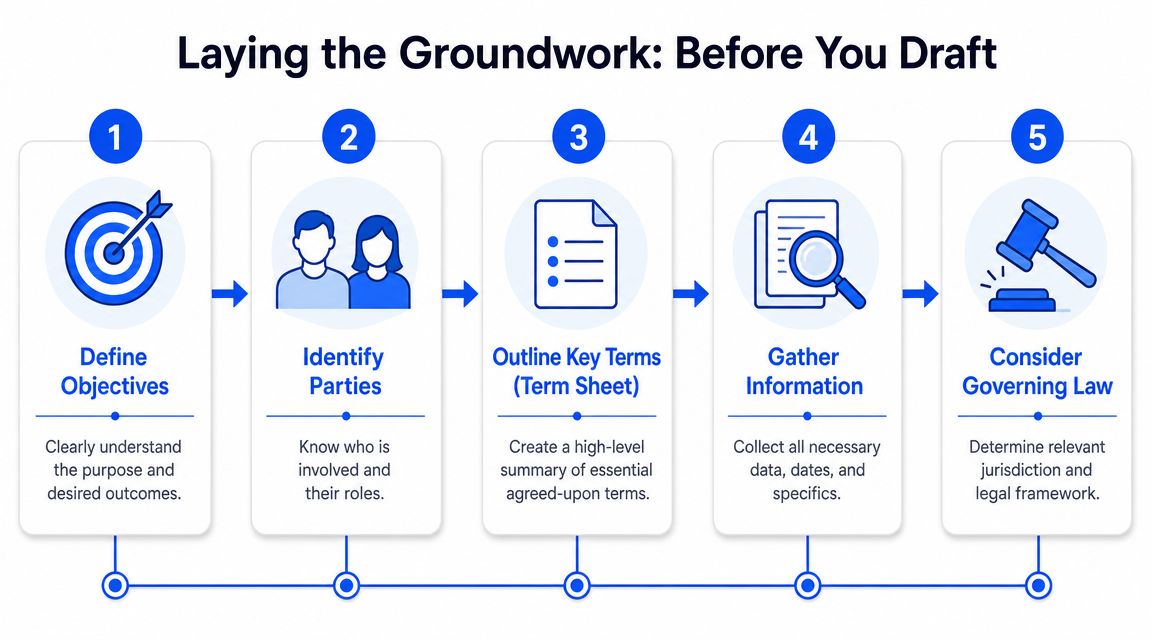
The fix is a term sheet first process. Get the commercial points into plain English before anyone starts writing clause language. A contract drafted from a vague email thread will inherit every ambiguity in that thread.
Start with the business objective
Ask what the agreement needs to do in actual practice. Not at signing. During performance.
That question changes the draft. A services agreement needs a workable scope, a method for accepting or rejecting work, a payment trigger, and a clear rule on ownership of deliverables. A supply agreement needs ordering mechanics, delivery terms, quality standards, shortage allocation, and replacement or refund rights. A SaaS agreement needs access rights, support terms, data handling, security expectations, and service levels that match the product the customer is buying.
I usually want three points on paper before drafting starts:
- Transaction type: Services, goods, software, license, consulting, referral, employment, or a hybrid deal.
- Business goal: Generate revenue, buy supply, protect confidential information, secure exclusivity, document a collaboration, or satisfy a compliance requirement.
- Likely failure point: Late delivery, nonpayment, defective output, ownership disputes, security incidents, scope creep, or a missed approval.
If the team cannot answer those three points cleanly, the draft is not ready.
Identify the parties correctly
This sounds clerical until a payment default or indemnity claim lands on the wrong entity.
Confirm the full legal name, entity type, registered address, and signer authority. Then confirm who is performing. A parent company may negotiate while an affiliate delivers the services. A brand name may appear on the website while a different entity invoices and holds the IP. If those roles matter, the contract should assign them clearly.
The party named in the contract should be the party carrying the obligation.
Build the term sheet in plain English
Good pre-draft work is disciplined, not fancy. Set out the client's position, the points already agreed, the points still open, and the operational facts the document needs to reflect. Clear drafting starts there.
A useful term sheet should answer:
- What is being exchanged
- What each party has to do
- When performance starts, ends, and can change
- How pricing, invoices, and payment timing work
- What assumptions the deal depends on
- What approvals, dependencies, or third-party inputs are required
- What happens if the scope changes
This is also the right stage to pull examples from prior deals. A library of contract clause examples for common business terms can help the team spot missing issues early, but examples are only reference points. They do not replace deal analysis.
AI tools can help organize inputs, compare drafts to fallback positions, and flag missing definitions or schedules. They are less reliable when the business terms are still fuzzy. If the source material is confused, the draft will be confused faster.
Gather the operational details before drafting clauses
A surprising amount of contract trouble comes from blanks, assumptions, and missing attachments. Someone writes “per the SOW,” but no one has approved the SOW. Someone adds acceptance testing language, but the product team has no test protocol. Someone refers to renewal notice periods, but sales is still offering side emails that contradict the form.
Collect the details that usually break deals in practice:
- Dates and milestones: Effective date, launch date, delivery dates, renewal windows, notice periods.
- Commercial mechanics: Fees, taxes, expenses, currency, invoice timing, payment triggers, credits, refunds.
- Attachments: Statement of work, pricing schedule, service levels, technical specifications, security exhibit, notice forms.
- Decision rights: Who approves changes, who accepts deliverables, who can issue purchase orders, who can sign amendments.
- Internal approvals: Finance sign-off, security review, procurement review, insurance requirements, export or privacy checks.
Business teams often need a repeatable intake process, not just a better template. If sales, procurement, finance, operations, and legal all supply information in different formats, the same drafting errors will keep showing up.
Choose governing law deliberately
Governing law and dispute venue affect interpretation, litigation cost, settlement pressure, and sometimes the practical value of a remedy. They deserve more thought than a late-stage boilerplate skim.
For a routine, low-value agreement, consistency may matter more than theoretical advantage. Using one preferred state law and one preferred forum can reduce review time and simplify internal playbooks. For a cross-border deal, a regulated transaction, or a contract with real enforcement risk, the choice deserves closer analysis. The right answer depends on where the parties operate, where assets sit, what claims are most likely, and how much friction the business can tolerate if the relationship breaks down.
Good drafting starts before the first clause. Get the deal structure, party roles, approvals, and operating facts straight first, and the document becomes easier to draft, easier to negotiate, and much easier to manage after signature.
Building the Skeleton Essential Contract Clauses
A contract usually breaks where the parties assumed they were aligned. The sales lead says the deliverable was obvious. Operations says the customer changed the scope twice. Finance says the invoice was not payable yet. The draft should prevent that fight before it starts.
Build the agreement in layers. Start with the clauses that describe the exchange of value. Add the clauses that measure performance and control change. Then add the clauses that allocate loss, manage exit, and keep the document administrable across legal, procurement, finance, and the business team using it after signature.
Put the commercial engine first
The first pages should answer the questions the people doing the work will ask on day one:
- What, exactly, is being provided?
- What is excluded?
- When is performance due?
- What triggers payment?
- Who decides whether work is accepted?
- How does the scope change?
If those answers are vague, the rest of the contract becomes cleanup. A polished liability cap will not rescue a statement of work that never defined the deliverables.
I usually push technical detail into schedules and keep the body of the agreement focused on operative rules. That is not just a drafting preference. It makes negotiation cleaner, gives business teams a repeatable structure to fill in, and reduces the chance that someone edits a technical requirement in one place and forgets the cross-reference in another. If your team writes contracts at scale, this structure also works better with templates, clause libraries, and AI-assisted drafting because the model has clearer inputs and fewer opportunities to blend legal terms with operational detail.
Those early clauses carry more weight than many drafters realize:
- Scope and deliverables define the bargain and set the boundary for scope creep.
- Pricing and payment mechanics determine when money is due, what can be billed, and what happens if an invoice is disputed.
- Performance standards set the benchmark for compliance.
- Milestones and acceptance determine whether completion is objective or open to argument.
- Change control decides whether extra work becomes a priced amendment or an unpaid expectation.
For teams that need drafting benchmarks, this collection of contract clause examples is useful for comparing how common provisions are structured.
Essential clauses in a business contract
| Clause Category | Example Clauses | What the clause is doing |
|---|---|---|
| Commercial terms | Scope, deliverables, pricing, payment terms, milestones | States the actual business deal |
| Performance rules | Service levels, acceptance, change orders, dependencies | Sets the test for performance and the process for adjustments |
| Risk allocation | Confidentiality, indemnity, limitation of liability, force majeure | Assigns responsibility when a problem causes loss |
| Exit rights | Term, renewal, termination for cause, termination for convenience | Controls how the relationship ends and what follows |
| Legal mechanics | Notices, dispute resolution, amendment, assignment | Makes the contract workable in administration and enforcement |
| Document integrity | Definitions, exhibits, order of precedence, entire agreement | Prevents internal conflict and reliance on side conversations |
Risk clauses do different jobs
New drafters often group indemnity, liability limits, confidentiality, and termination into one mental bucket called legal terms. That approach misses the point. Each clause answers a separate business question, and each one should be negotiated against a specific risk.
Indemnity addresses who bears the cost of a defined third-party claim.
Limitation of liability sets the financial exposure each side keeps, and often carves out claims that stay uncapped.
Confidentiality defines what must be protected, how it can be used, and which exceptions apply.
Termination sets the conditions for exit and the obligations that survive it.
The right wording depends on what can go wrong in the deal you have, not the precedent sitting in the shared drive. A vendor handling personal data should not use the same indemnity structure as a creative agency producing ad copy. A supply agreement with long lead times needs different termination mechanics than a month-to-month services arrangement. Good drafting reflects the likely failure mode.
This is also where commercial judgment matters. A customer may ask for broad indemnity language because it sounds protective. If the supplier cannot insure that risk or price it sensibly, the clause may create more negotiation heat than practical protection. The stronger answer is often a narrower indemnity tied to controllable risks, paired with clear specs, acceptance criteria, and a realistic liability cap. If you want sharper input on defining technical requirements before they spill into legal disputes, learn the art of specification writing.
Boilerplate decides real outcomes
Boilerplate is recurring language, not disposable language.
Notice clauses decide whether a default notice was effective. Amendment clauses decide whether a project manager changed the deal by email. Assignment clauses matter in restructurings, financings, and asset sales. Order-of-precedence clauses decide whether the master agreement, statement of work, or purchase order controls when they conflict.
I have seen more than one dispute turn on a clause the business team barely read because it looked standard.
Use the body of the agreement to establish the governing rules. Use schedules and exhibits for formulas, implementation plans, service metrics, product descriptions, and other detail that may need updating. Then make the hierarchy explicit. If the contract does not say which document wins in a conflict, the parties will argue about it later, usually when money is already at stake.
Drafting With Clarity and Avoiding Ambiguity
The fight usually starts with a sentence that looked harmless in redlines.
A contract says the vendor will provide support "as needed" and respond "promptly" to "critical" issues. Six months later, the customer expects weekend work, a one-hour response time, and fixes for every bug affecting one user. The vendor thought it agreed to business-hours support for systemwide outages. Both sides point to the same clause. Both think the text favors them. That is what unclear drafting does in practice.
Clarity is risk control. A clause should tell the people doing the work what to do, when to do it, and what happens if they do not. If the business team cannot apply the language without calling legal, the draft is not finished.
Plain language carries more weight
Contracts read better, and hold up better, when they use ordinary English and direct verbs. Legal-sounding filler often masks uncertainty instead of resolving it. Phrases like "heretofore," "party of the first part," and "and/or" usually signal copied language that no one cleaned up.
Compare these two versions:
- Weak: “Consultant shall, from time to time and as requested by Company, provide such services as may be reasonably necessary in connection with the Project.”
- Better: “Consultant will provide the services listed in Exhibit A. Consultant will perform additional services only if the parties approve a written change order.”
The second version allocates scope, approval authority, and change control. That is real drafting work.
Define terms with discipline
Defined terms should reduce repetition or pin down a concept that must stay consistent across the agreement. They should not turn simple words into capitalized obstacles.
Use definitions for items such as acceptance criteria, service levels, deliverables, pricing mechanics, or a specific category of confidential information. Skip them for words that already have a clear meaning in context. A contract overloaded with definitions becomes harder to review, harder to negotiate, and easier to misread.
This is also where contract drafting overlaps with operational drafting. Teams often write a vague statement of work, then try to solve the vagueness with legal language. That rarely works. If the commercial input is fuzzy, the contract will stay fuzzy. For teams working across scopes, technical exhibits, and legal terms, it helps to learn the art of specification writing. The same discipline applies. Define the requirement before you argue about the remedy.
Words that deserve suspicion
Ambiguity often hides in familiar words because everyone assumes they mean the same thing. They do not.
- “Promptly” invites argument. State a deadline or response window.
- “Material” needs context. Tie it to a threshold, business impact, or stated standard.
- “Commercially reasonable efforts” can be acceptable, but many deals work better with a short list of required actions.
- “As necessary” leaves the decision-maker unclear. Identify who decides necessity and on what basis.
- “Including” should make clear whether the list is illustrative or complete.
One practical test works well. Read the clause as the counterparty, then as the operations lead who must perform it, then as the judge who knows nothing about the deal history. If those readers could reach different answers, revise the text.
Structure prevents drafting mistakes
Good structure does more than improve readability. It reduces execution errors inside a business team.
Use headings that describe the clause's function. Keep cross-references accurate. Put one operative rule in each sentence where possible. If a clause mixes conditions, exceptions, timing, and remedies, separate them into subsections so each point stands on its own. That makes review faster for legal, procurement, finance, and the people who will administer the agreement.
This matters even more in companies that draft at volume. If sales, procurement, legal, and operations all touch contract templates, the drafting process needs repeatable rules. Approved definitions, clause libraries, template notes, and AI-assisted first drafts can save time, but only if the team applies them with discipline. AI can produce usable language quickly. It can also produce polished ambiguity quickly. Someone still has to ask whether the words match the deal, the workflow, and the risk the business is prepared to carry.
Identifying Common Pitfalls and Red Flags
The contract looks clean. The signatures are in place. Finance books the revenue or procurement onboards the vendor. Six weeks later, the business team learns that the document does not answer a basic operational question: who approves a change, what counts as acceptance, or when payment is due. That is how avoidable disputes start.
Most contract failures are process failures disguised as drafting issues. The words matter, but so does the system behind them. If sales writes the intake notes, legal drafts from an old form, operations never reviews the workflow, and nobody checks the final hierarchy of documents, the contract can be internally consistent and still fail in practice.
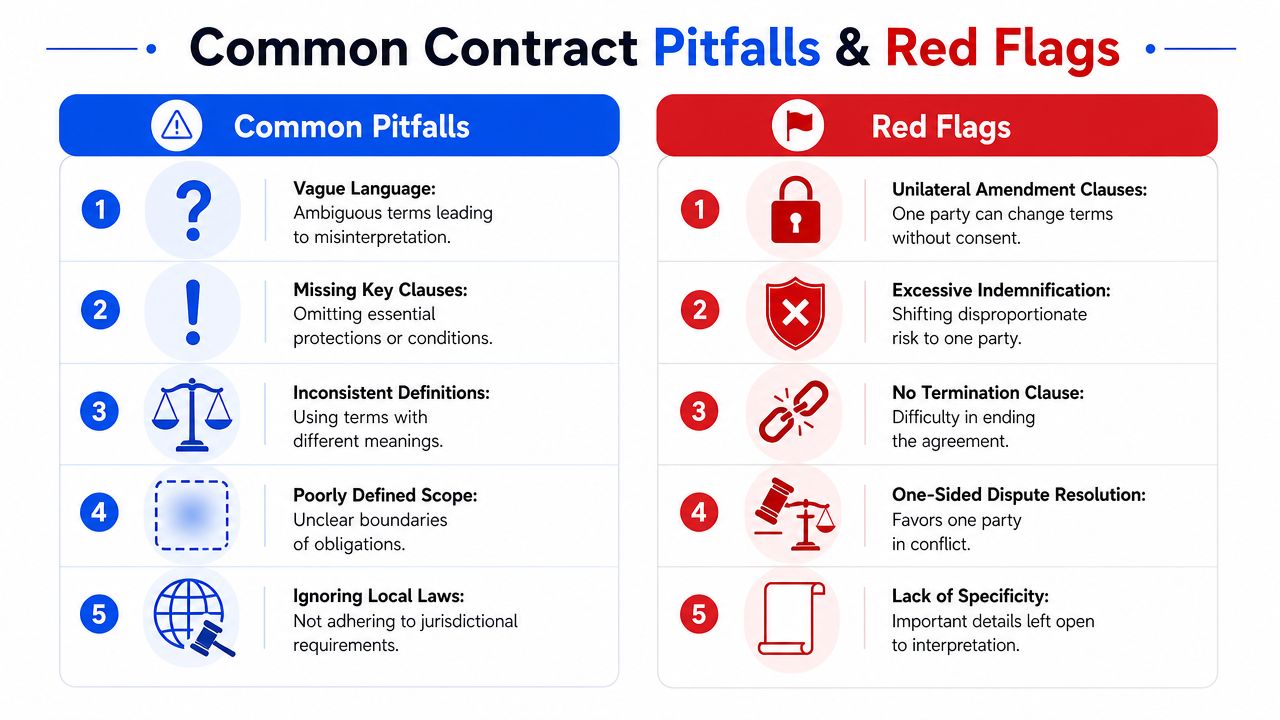
Small gaps that become expensive
A consulting agreement requires a “final report by the end of the quarter.” The client expects delivery by close of business on the last business day. The consultant sends it later that evening. If the clause does not state the date, time zone, delivery method, and whether acceptance is part of completion, both sides can claim they read it reasonably.
A sales contract says payment is due “upon completion.” That phrase means nothing until the contract ties it to a measurable event. Shipment, installation, testing, user acceptance, and signoff are different milestones with different cash-flow consequences.
A vendor form allows one party to change service terms by posting updates on a website. In a negotiated commercial agreement, that should stop the review. If one side can change material terms without a signed amendment or a defined notice-and-objection process, the pricing and risk allocation are unstable from the start.
The precedent problem
Reusing an older template saves time only if someone checks whether the old assumptions still fit the deal. I see the same errors repeatedly. Defined terms carried over from another transaction. Exhibits that do not match the body of the agreement. Liability language written for a low-value pilot pasted into a multi-year implementation.
Cross-border deals are where this gets exposed fastest. Notice provisions may assume delivery methods that are not used locally. Tax language may ignore withholding issues. A hardware template reused for software or services may attach warranty and acceptance concepts that do not belong there.
This is one reason teams should treat templates as controlled documents, not shared folklore.
Red flags worth slowing down for
- One-sided termination rights: One party can walk away for convenience, while the other must keep performing or absorb stranded costs.
- Undefined acceptance mechanics: The contract allows rejection of work but does not say who tests, against what criteria, within what period.
- Loose change control: Scope expands through email threads or meetings, with no signed approval tied to price, timing, or responsibility.
- Conflicting document order: The order form says one thing, the master agreement says another, and the statement of work states something different.
- Missing post-termination provisions: Confidentiality, accrued payment rights, audit access, IP protections, and dispute clauses may not survive when they should.
- Operational terms buried in PDFs: If key obligations sit inside scanned attachments, the team reviewing or automating the contract may miss them. Good PDF parsing for AI matters when contract data has to move into approval, billing, and compliance systems.
Use a red-flag review that matches how the business works
A useful review pass asks three practical questions.
Can the business team perform this clause without calling legal for translation? Can finance tell when to invoice or withhold payment? Can someone new to the account find the controlling rule without reading five overlapping documents?
If the answer is no, the clause is not ready.
For higher-volume teams, this review should be repeatable. Keep a short issue list for fallback positions, approval thresholds, clause ownership, and document priority. Use technology to support that process, not replace judgment. A good AI contract review software guide can help teams spot mismatched definitions, risky edits, and missing terms faster, but someone still has to decide whether the paper reflects the actual commercial deal.
Contracts create risk when assumptions stay in people's heads instead of on the page.
Leveraging AI and Contract Review Platforms
Drafting has changed. The first draft no longer has to start from a blank page, and routine reviews no longer have to depend entirely on manual comparison. That's useful because contract operations are still weak in many organizations. Only 11% of businesses rate their contract management as very effective, and the same set of contract-management statistics reports that 46% of in-house lawyers using generative AI use it to draft contract templates while 21% use it to review contracts, according to Juro's contract management statistics.
Those figures match what many legal teams already feel. The bottleneck isn't just writing words. It's getting from request to usable draft without losing consistency.
What AI does well
AI tools are good at pattern recognition and first-pass organization. In contract work, that usually means:
- Generating starting drafts from a known template and a set of deal points
- Comparing versions to spot changed definitions, dates, or risk clauses
- Summarizing long contracts so a reviewer can triage quickly
- Flagging internal inconsistencies such as mismatched terms, missing exhibits, or broken references
A tool like LegesGPT's AI contract review software can support those review workflows by helping users analyze uploaded agreements, identify issues, and ask targeted questions about the draft. That's useful for speed, but also for consistency if the team already knows what it wants the contract to say.
Where human judgment still controls
AI cannot decide your business risk tolerance. It can't know whether a customer relationship justifies softer remedies, whether a supplier deserves exclusivity, or whether an indemnity carve-out is commercially acceptable in context. Those choices depend on bargaining power, industry practice, and your client's goals.
That's why responsible use looks like this:
- Start from approved language when possible
- Feed the tool a clean term sheet or issue list
- Verify every proposed clause against the actual deal
- Review security and confidentiality before uploading documents
- Escalate unusual provisions to a lawyer or senior reviewer
If your workflow involves extracting information from messy source files before review, it also helps to understand PDF parsing for AI. A contract review system is only as good as the text it can reliably read.
A quick product walkthrough makes the workflow easier to picture:
AI works best inside a controlled drafting system
Gain doesn't come from asking a chatbot to “write a contract.” It comes from combining approved templates, clear intake information, review rules, and a final human check. AI accelerates the middle of the process. It shouldn't replace the beginning or the end.
That matters even more for template maintenance. A fast draft built from an outdated form just gives you an outdated contract sooner.
The Final Polish Negotiation and Quality Control
A contract is still fragile at the redline stage. Deals often degrade there. Someone edits one clause and forgets the definition it relies on. A business lead accepts a commercial concession by email, but no one updates the payment mechanics. A team member sends “final_final_v7” to the counterparty and negotiates from the wrong version.
That's why quality control needs an actual workflow, not a vague promise to “give it one last look.”
Negotiate from a controlled document
Redlines are useful only if everyone is working from the same base text. Centralized version control matters more than is often realized. A clean process usually means one source-of-truth draft, one responsible owner, and a rule that substantive changes must appear in tracked edits or an agreed issue list.
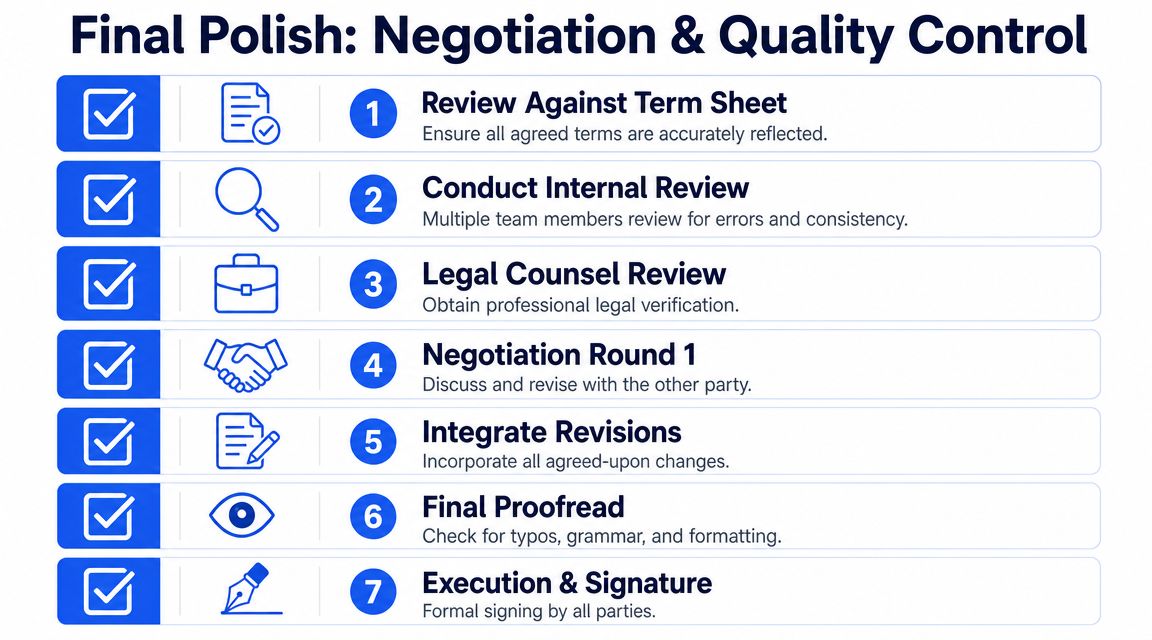
A practical closing workflow often looks like this:
- Check against the term sheet: Confirm the negotiated draft still reflects the deal.
- Resolve open issues in writing: Don't leave commercial points buried in email chains.
- Update cross-references and exhibits: Late edits often break section numbering and attachments.
- Confirm signature authority: The right legal entity and the right signatory still need verification.
If you want a reusable close-out process, this contract review checklist is the kind of tool that helps teams avoid preventable misses.
Let non-lawyers draft, but only inside guardrails
One overlooked business challenge is enabling non-lawyers to draft safely at scale. Neutral guidance increasingly points to pre-approved templates, centralized version control, training on escalation rules, and clear legal review thresholds because the bigger operational risk is often who is allowed to change what and when, as discussed in this practical guide to contract drafting governance.
That means self-service drafting can work, but only with boundaries:
- Approved templates only: Sales, procurement, HR, and operations should start from controlled forms.
- Locked provisions: Some clauses shouldn't be editable without legal approval.
- Escalation rules: Indemnity changes, liability caps, data terms, exclusivity, and unusual governing law provisions should trigger review.
- Template maintenance: Someone must own updates when policy, process, or law changes.
For teams that need to extract key terms and route contracts consistently, tools built around DigiParser for document parsing can also support intake and review processes, especially where high document volume makes manual sorting unreliable.
The final pass before signature
The last review should be mechanical and unforgiving. By this point, you're not debating strategy. You're catching mistakes.
Use a short execution checklist:
- Party details are correct, including legal names and addresses.
- Dates match across the signature block, term clause, and schedules.
- Defined terms are defined and used consistently.
- Cross-references point to the right sections.
- Exhibits and schedules are attached, labeled correctly, and referenced accurately.
- Negotiated changes made in email or calls appear in the final draft.
- Signature blocks match the signing structure, including affiliates if needed.
Final check: Read the contract once from the perspective of the person performing it, and once from the perspective of the person enforcing it.
That last discipline catches more than typos. It catches operational nonsense.
If you want help turning rough drafts, uploaded agreements, and negotiation markups into a cleaner review workflow, LegesGPT - AI Legal Assistant is one option to consider. It can help analyze contracts, surface risks, extract key terms, and answer questions about uploaded legal documents, which is useful when you need a faster first pass before legal judgment and final approval.