

When you're hit with a DUI charge, one of the first questions that flashes through your mind is, "How much is this going to cost me?" Let's be direct: the average cost for a DUI lawyer runs anywhere from $1,500 to $5,000 for a standard first-time misdemeanor. For more complicated cases, like repeat offenses or felonies, that number can easily climb to $15,000 or more.
It's tempting to see that as just another expense. But it’s better to think of it as a critical investment in protecting your future.
The Real Price of a DUI Defense: An Honest Overview
Trying to make sense of DUI attorney fees can feel like navigating a maze, but it really comes down to one thing: you're paying for an expert to guide you through a very complex legal system. The upfront cost of a good lawyer is meant to head off much bigger, longer-lasting problems down the road.
A conviction isn't just a one-time event. It can lead to years of sky-high insurance premiums, massive court fines, and even the loss of your job. When you add all that up, the initial legal fees often look small in comparison.
Hiring a seasoned DUI attorney is a lot like hiring a professional guide to get you through treacherous terrain. Sure, you could try to go it alone, but the guide knows every hidden pitfall, every shortcut, and every danger you might face. Their experience dramatically improves your odds of getting through it safely. That’s what a DUI lawyer does—they challenge the evidence, negotiate with prosecutors, and fight to protect your rights, which can lead to reduced charges or, in some cases, a full dismissal.
A Snapshot of Potential Costs
To give you a clearer picture, here’s a quick breakdown of what you can generally expect. Of course, every case is different, so the only way to get a firm number is to have a direct consultation with an attorney.
The table below offers a general overview to help you set some financial expectations as you start looking for the right legal help.
Estimated DUI Attorney Fee Ranges at a Glance
This table provides a quick summary of typical cost ranges for DUI legal representation based on the severity of the charge.
| Offense Type | Typical Fee Range | Key Considerations |
|---|---|---|
| First-Time Misdemeanor | $1,500 – $5,000 | This usually covers standard court appearances and negotiating a plea bargain. |
| Repeat Misdemeanor | $3,500 – $10,000 | Prior convictions mean the defense strategy has to be much more complex and aggressive. |
| Felony DUI | $5,000 – $15,000+ | These are serious cases, often involving injury, death, or multiple prior offenses. |
As you can see, the numbers vary quite a bit. Ultimately, the fee you pay is for specialized knowledge that can make a world of difference in how your case turns out.
For a broader perspective on how legal costs work across different areas of law, you might find our complete guide to legal fees helpful.
How DUI Lawyers Bill for Their Time
Trying to make sense of a legal bill can feel as stressful as the charges themselves. When it comes to DUI attorney fees, lawyers generally use a couple of standard ways to bill you. Getting a handle on these is the first step to confidently hiring the right person for your defense.
The two models you'll run into most often are the flat fee and the hourly rate. Each has its own pros and cons, and one might be a better fit for your case than the other. It’s a bit like hiring a contractor: sometimes you want a single, fixed price for the whole project, and other times, paying by the hour just makes more sense.
The Predictability of a Flat Fee
A flat fee is exactly what it sounds like: one single price for a defined set of legal services. For a DUI, this fee typically covers all the work done before a trial—things like showing up to court for you, hammering out a deal with the prosecutor, and handling all the necessary paperwork.
The biggest plus here is clarity. You know the total DUI lawyer cost from day one. There are no surprise bills, which makes budgeting for your defense a whole lot easier. This approach is most common for straightforward cases, like a standard first-offense misdemeanor, where an experienced lawyer can accurately predict how much work will be involved.
But here's the catch: you have to be crystal clear on what that flat fee actually covers. Most lawyers will have a second, separate flat fee if your case ends up going to trial, because a trial is a massive commitment of time and resources that's tough to predict from the start.
The Flexibility of an Hourly Rate
The other route is paying your attorney by the hour. With this setup, you're charged for the actual time the lawyer and their team spend on your case. This can include everything from phone calls and emails to drafting legal motions and time spent in the courtroom.
Hourly billing can be a great deal if your case is relatively simple and gets resolved quickly. If there’s a clear shot at getting the charges dismissed or a very straightforward plea bargain, you could pay less than you would with a flat fee. The lawyer will almost always ask for a retainer upfront, which is basically a down payment they draw from as they log hours.
What is a Retainer? A retainer isn't the final cost—it's an advance payment held in a special trust account. Your lawyer deducts their hourly fees from this fund as they work. If that money runs out, you'll need to "replenish the retainer" to keep them on your case.
The downside to hourly billing is the uncertainty. A case that gets complicated with unexpected legal battles or long, drawn-out negotiations can get expensive fast, making your final DUI attorney fees a moving target.
Other Billing Considerations
Beyond these two main structures, a few other factors can pop up in a fee agreement. It’s smart to keep an eye out for these when you're interviewing lawyers.
- Tiered Fees: This is a popular hybrid model. An attorney might charge one flat fee for all pre-trial work, and then a second, much larger flat fee kicks in only if you decide to take the case to trial.
- Additional Expenses: The lawyer's fee is for their time and expertise. It almost never includes "out-of-pocket" costs like court filing fees, hiring an expert witness to challenge the breathalyzer, or paying for a private investigator. Always ask for a list of these potential extras.
- Transparency in Billing: A good lawyer will be upfront about their billing. To keep things precise and fair, many firms now rely on professional time tracking software for lawyers to create a detailed log of every minute they spend working for you.
At the end of the day, the right billing structure really depends on the specifics of your situation. A flat fee gives you peace of mind, while an hourly rate can offer more flexibility. Knowing how both work puts you in a much better position to talk with potential attorneys and choose the arrangement that makes the most sense for you.
The Key Factors Driving Your Legal Costs
When you start calling around for a DUI lawyer, the price quotes can feel like they're all over the map. One attorney might quote $2,500, while the next one says it’ll be closer to $10,000. That huge gap isn't random—it's a direct reflection of your specific situation. Understanding what goes into the final DUI lawyer cost helps you see why there's no such thing as a one-size-fits-all price tag.
Think of it like hiring a contractor. Painting a single room is a pretty straightforward job with a predictable cost. But a full kitchen gut and remodel? That's a whole different beast with custom work, complex plumbing, and a price tag to match. Your DUI case works the same way. The complexity and what’s at stake are the biggest drivers of the final bill.
Several key variables are at play here, and each one adds layers of work, time, and specialized expertise to your defense. From the charge itself to the lawyer’s own credentials, these elements all factor into what it will take to build a solid legal strategy.
The Severity of the Charges
The single biggest factor dictating your DUI attorney fees is how serious the charge is. A standard, first-offense misdemeanor DUI with a blood alcohol concentration (BAC) just over the limit is like that simple room-painting project. It's a serious matter, no doubt, but the legal road ahead is usually more predictable.
On the other hand, a felony DUI changes everything. This could be a DUI that caused an accident with serious injuries, a case involving a child in the car, or your third or fourth offense. The stakes are dramatically higher—we're talking about the potential for significant prison time—and that demands a much more intensive and aggressive defense from day one.
This diagram shows the two main ways attorneys bill for their time.
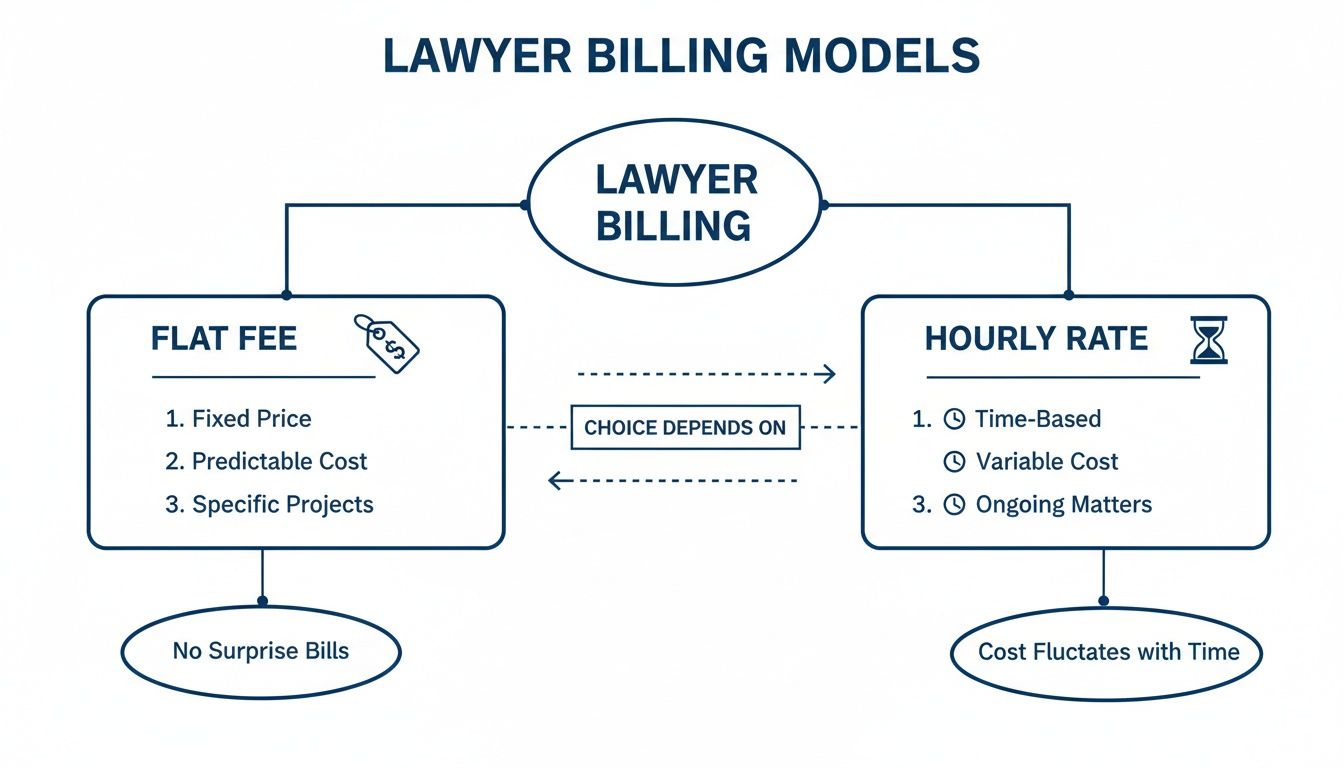
As you can see, a flat fee gives you cost certainty for a predictable case, while an hourly rate makes more sense when the scope of work is unknown.
The Complexity of Your Case
Beyond the charge on the ticket, the unique facts of your arrest play a massive role in the cost. A "simple" case might just involve a standard traffic stop and a breathalyzer test. A complex one, though, can have all sorts of wrinkles that require a lot more work from your lawyer.
Just look at a few things that can make a case more complicated:
- Challenging the Evidence: Was the traffic stop even legal? Was the breathalyzer machine calibrated and maintained properly? Questioning the prosecution's evidence means filing motions, researching case law, and arguing your points in front of a judge.
- Accident Reconstruction: If your case involves a crash, your attorney may need to bring in an expert to analyze the scene and prove what really happened.
- Expert Witnesses: That high BAC reading might not be as solid as it seems. A toxicologist could testify about problems with the blood draw or the testing lab's procedures.
Each of these steps requires more time and resources, which naturally increases the overall cost.
This table shows how different elements of a case can push the price up or down.
How Different Factors Impact DUI Attorney Fees
| Influencing Factor | Impact on Cost | Reasoning |
|---|---|---|
| First-Time Misdemeanor | Lower | The legal process is more standardized with fewer court appearances and less complex defense strategies. |
| Felony Charge (e.g., with injury) | Significantly Higher | The stakes are much higher (prison time), requiring extensive investigation, more court filings, and possibly a jury trial. |
| Challenging Evidence | Higher | Filing motions to suppress evidence or challenging lab results requires significant legal research, writing, and court time. |
| Hiring Expert Witnesses | Higher | Experts like toxicologists or accident reconstructionists charge their own professional fees, which are added to the case costs. |
| Going to Trial | Significantly Higher | A trial is the most labor-intensive part of a case, involving jury selection, witness preparation, and days spent in court. |
| Negotiating a Plea Deal | Lower | Reaching a resolution without a trial is far less time-consuming for the attorney, reducing the total hours needed. |
Ultimately, a more complex case demands a more robust—and therefore more expensive—defense strategy.
The Attorney’s Experience and Reputation
Finally, who you hire matters. An attorney with 20 years of experience, a stellar reputation with local judges and prosecutors, and a long list of wins in tough DUI cases is going to charge more. And for good reason. You’re paying for their deep knowledge, their courtroom instincts, and the respect they command.
A seasoned DUI specialist may charge more upfront, but their expertise could lead to a dismissed case or reduced charges, saving you thousands in fines, increased insurance, and other long-term penalties.
It can be tempting to just go with the cheapest lawyer you can find, but that can be a massive mistake. An inexperienced attorney might miss a crucial defense angle that a true specialist would spot immediately. That's why it's better to view the DUI lawyer cost as an investment in your future. The right attorney delivers value that goes way beyond their fee.
Why an Attorney Fee Is an Investment, Not Just a Cost
When you start looking at quotes for a DUI defense, it's easy to get sticker shock. The numbers can feel overwhelming, and it’s natural to view the DUI lawyer cost as just another massive expense you can't afford. But that perspective misses the bigger picture.
Hiring a skilled attorney isn't just a cost; it’s a strategic investment to protect yourself from a cascade of devastating and long-lasting financial consequences.
Think of a DUI conviction like a slow, expensive leak that quietly drains your bank account for years. The initial attorney fee is what you pay a master plumber to fix the problem at its source—before it floods your entire house. Paying that expert upfront is the key to avoiding far greater repair bills, structural damage, and ongoing headaches down the line.
The truth is, the attorney's fee is often just a fraction of the total financial fallout. It’s the visible tip of the iceberg, while a massive, hidden chunk of expenses lurks just beneath the surface.
The Hidden Financial Drain of a Conviction
A DUI conviction sets off a relentless series of mandatory expenses that can follow you for a decade or more. These aren't just one-time fines; they are ongoing financial burdens that add up to a staggering total. A conviction is the gift that keeps on taking long after you’ve served your sentence.
Here are just a few of the downstream costs a good attorney works to help you avoid:
- Skyrocketing Insurance Premiums: Once you're labeled a "high-risk driver," your auto insurance rates can triple or even quadruple overnight. This isn't a temporary spike. You could be paying these inflated rates for five to seven years, costing you thousands of extra dollars.
- Court Fines and Surcharges: The fine the judge hands down is just the beginning. States and counties pile on numerous additional fees, assessments, and surcharges that can easily double the base penalty.
- Mandatory Education Programs: Courts almost always require you to attend and pay for alcohol education classes or substance abuse treatment programs. These can cost hundreds or even thousands of dollars out of your own pocket.
- License Reinstatement Fees: Getting your driver's license back after a suspension isn't free. You'll have to pay significant fees to the DMV, and in some states, you may need to file for special high-risk insurance (an SR-22), adding yet another recurring cost.
When you tally everything up, the numbers are truly eye-opening. A single DUI conviction can easily result in total expenses exceeding $30,000 when you factor in fines, increased insurance premiums, lost income, and legal representation. Court-ordered fines alone typically range from $1,600 to $4,000 or more, and elevated car insurance expenses can reach approximately $3,500 over time. You can learn more about the complete financial impact from comprehensive DUI statistics.
Calculating the Return on Your Investment
This is where the true value of excellent legal representation comes into sharp focus. When you hire a top-tier attorney, you aren’t just paying for someone to show up in court. You are investing in their skill to dismantle the prosecution's case, negotiate from a position of strength, and secure a far better outcome.
An effective attorney may be able to get the charges reduced to a lesser offense, like reckless driving, or even achieve a full dismissal. That outcome doesn't just save you from jail time; it prevents the entire avalanche of long-term financial penalties from ever starting.
Let’s look at two scenarios. In one, you try to save money by forgoing experienced counsel and end up with a DUI conviction, triggering $20,000 in fines, insurance hikes, and other costs over the next five years. In the other scenario, you invest $5,000 in a skilled attorney who gets the charge reduced, saving you from nearly all of those downstream costs.
Suddenly, that initial fee doesn't look like an expense anymore. It's a proactive financial decision—spending money now to protect yourself from losing much, much more later.
How to Keep Your Legal Fees in Check
Let's be honest: the cost of a DUI defense can be as intimidating as the charge itself. But you're not powerless here. With a smart approach, you can navigate the financial side of things without breaking the bank. It really boils down to being proactive, asking the right questions, and knowing your options inside and out before you hire anyone.
Think of your initial consultations as job interviews—where you're the one doing the hiring. This mindset helps you compare not just the bottom-line DUI lawyer cost, but the actual value and transparency each lawyer brings to the table. The goal is to walk away with a crystal-clear picture of the financial road ahead, leaving no room for nasty surprises later.
Must-Ask Questions for Any Potential Attorney
That first meeting is your chance to get all the financial details on the table. It's not just a handshake and a hello; it's a critical fact-finding mission. Arm yourself with these questions to make sure you're making a fully informed choice.
Here’s a practical checklist to run through with every lawyer you meet:
- Fee Model: "For a case like mine, do you typically work on a flat fee or charge by the hour?"
- Flat Fee Scope: "If it’s a flat fee, what exactly does that cover? Does it include filing motions, plea negotiations, and the DMV hearing?"
- Trial Costs: "What happens if this goes to trial? Is that a separate flat fee, or do you switch to an hourly rate?"
- Extra Costs: "What other expenses should I budget for that are not included in your fee? I'm thinking of things like expert witnesses, investigators, or court filing fees."
- Payment Schedule: "What are your payment terms? Do you require the full amount upfront, or can we set up a payment plan?"
- Retainer Policy: "If there's a retainer, is any part of it refundable if we resolve the case faster than expected?"
- Communication Billing: "How do you bill for communication? Am I going to see a charge for every quick phone call or email?"
Getting straight answers to these questions is the only way to do a true apples-to-apples comparison and avoid getting blindsided by hidden costs.
Negotiating Payment Plans and Other Arrangements
Most DUI lawyers get it. Not everyone has thousands of dollars just sitting in a bank account, ready to go. That's why many firms are willing to offer payment plans, breaking down the total fee into a series of more manageable monthly installments.
Don't ever be afraid to bring up your financial situation. A good attorney wants to help you and would much rather set up a realistic payment schedule than turn you away. Open and honest conversation about your budget is your best tool.
These plans can be a lifesaver, easing the immediate financial burden so you can hire the experienced lawyer you need right away. Just make sure you get the details in writing: the payment schedule, exact due dates, and whether there are any late fees or interest.
What About a Public Defender?
If hiring a private attorney just isn't financially possible, you might qualify for a public defender. These are state-funded lawyers the court appoints to represent people who can't afford legal counsel. You’ll have to prove financial hardship by providing details about your income, assets, and debts.
Public defenders are often very capable and hardworking lawyers, but the reality is they are usually juggling an enormous number of cases. This can severely limit the time and individual attention they can give to your defense. A private attorney, on the other hand, has the caseload flexibility and resources to dig much deeper. They often use every tool at their disposal—from private investigators to an AI legal research assistant—to build the strongest case possible, an advantage that can make a real difference in the outcome.
Frequently Asked Questions
Is a More Expensive DUI Lawyer Always a Better Choice?
Not always. It's easy to assume that a bigger price tag equals better results, and while a top-tier attorney with a long history of DUI wins will rightfully charge more, cost alone isn't the whole story. The "best" lawyer for your case is someone who lives and breathes DUI defense right there in your local court system. You want an attorney with a proven track record on cases similar to yours, who you can actually talk to and understand. Pay attention to their specific experience, how well they know the local DAs and judges, and how comfortable you feel with them. A sharp, well-respected local attorney can often run circles around a high-priced lawyer from another county.
If My Case Gets Dismissed, Do I Still Have to Pay?
Yes, absolutely. The fee agreement you sign is for the work your lawyer does, and getting a case dismissed is the ultimate goal—the grand slam of DUI defense. It's that very outcome that saves you from a conviction, massive fines, a suspended license, and skyrocketing insurance rates. Think of it this way: you're paying for the skill it takes to find the fatal flaw in the prosecution's case. Whether it's proving an illegal traffic stop, dismantling a faulty breathalyzer result, or filing a brilliant motion to suppress evidence, that's the hard work that leads to a dismissal. > You're paying for the attorney's time, knowledge, and strategy to secure a win. A dismissal isn't a reason to skip the bill; it's the direct result of the expert work you hired them to do.
Are Retainer Fees Refundable if My Case Wraps Up Quickly?
This is a big one, and the answer is always in the fine print of your fee agreement. Some retainers are essentially a flat fee for the case, and the contract will state it's "earned upon receipt." This means it’s non-refundable, no matter how fast things move. Other times, a retainer acts more like a deposit. The lawyer bills their hourly rate against that initial payment, and if there's any money left over when the case closes, it comes back to you. You have to get clarity on this before you sign anything. Don't be shy about asking your lawyer to explain exactly how they handle the retainer.
Will I Pay More if My DUI Case Goes to Trial?
Almost certainly, yes. Taking a case to trial is a whole different ballgame, and the DUI attorney fees will reflect that. Most DUI lawyers have a tiered fee structure. One flat fee will cover all the pre-trial work—that includes things like court appearances, negotiations with the prosecutor, and filing motions. But if a plea deal can't be reached and you decide to go to trial, a separate, much larger fee kicks in. A trial is a massive commitment of time and resources. We're talking about jury selection, preparing witnesses, presenting evidence, and spending days, sometimes weeks, in a courtroom. Always ask a potential lawyer to break down their costs for both the pre-trial phase and a full-blown trial. Before you even hire a lawyer, it can be helpful to get a sense of initial costs; learning about typical lawyer consultation fees is a good place to start. --- At LegesGPT, we know that facing a legal issue means you need clear, reliable information. Our AI-powered platform is built to help you perform legal research, analyze documents, and get straightforward answers to your questions. See how LegesGPT can help you by visiting https://www.legesgpt.com.