
Before you ever think about setting foot in a courtroom, you need to understand the power of a well-written demand letter. This isn't just about asking for money or a resolution; it's your opening move in a strategic game. It sets the tone, establishes your seriousness, and creates a paper trail. Using a high-quality demand letter attorney sample gives you the professional edge you need to settle things, often without ever filing a lawsuit.
Why a Strong Demand Letter Should Always Be Your First Move

It’s a common mistake to think of a demand letter as just an angry threat or a procedural box to check. The reality? It’s a critical tool meant to kickstart a conversation and push for a quick, out-of-court resolution. Think of it as a formal, documented warning shot. It lays out your side of the story clearly and gives the other party a chance to make things right before lawyers get more involved.
This one document can do a lot of heavy lifting. It makes the other person take your claim seriously, transforming a casual disagreement into a problem with real legal weight. I've seen it time and time again—for many people, receiving a formal demand is the wake-up call that moves them from ignoring an issue to actually trying to solve it.
The Strategic Edge of a Well-Crafted Letter
A demand letter does more than just state what happened. It’s about building the foundation for your entire case. Whether you're dealing with a client who won't pay or a partner who broke a contract, a professional letter gives you a massive strategic advantage.
Here's what makes it so powerful:
- It Creates an Official Record: This letter is proof you tried to resolve the dispute reasonably before taking things to the next level. Judges appreciate seeing that you made a good-faith effort.
- It Forces You to Clarify Your Case: Writing everything down makes you organize your evidence, timeline, and arguments. That clarity is gold, whether you're heading into negotiations or preparing for court.
- It Shows You Mean Business: A letter structured like one an attorney would send signals that you're serious about protecting your rights. That alone can often get you a much faster, more cooperative response.
A thoughtfully constructed demand letter resolves a surprising number of conflicts all by itself. It presents the facts, outlines the legal claim, and offers a clear way out, making it easier for the other side to simply comply rather than pick a fight.
Let's be real: hiring a lawyer is expensive. The average cost for an attorney to write and send a demand letter is $305, and that price can easily balloon with complex cases. This isn't just a minor hurdle; it's a major barrier. In fact, surveys reveal that 62% of small businesses don't even bother chasing debts with formal demands because of the cost, often writing off anything under $10,000. You can explore the full breakdown of these demand letter expenses to see the numbers for yourself.
This is precisely why learning to use a reliable demand letter attorney sample is such a game-changer. It puts the power back in your hands without the hefty price tag.
The Anatomy of a Demand Letter That Gets Results
A truly effective demand letter isn't just a list of complaints—it's a carefully constructed legal document. Every single piece of it, from the date at the top to your signature at the bottom, serves a very specific, strategic purpose. Getting this structure right is the difference between being taken seriously and being ignored.
Think of it less like an angry letter and more like a miniature version of a legal argument. The whole point is to lay out your case so logically and factually that the other side sees the wisdom in settling the matter with you now, rather than facing a bigger fight later. This means stripping out the emotion and focusing on a calm, systematic presentation of the facts.
Getting the Foundation Right: Your Heading and Parties
The very top of your letter immediately sets a professional, no-nonsense tone. It needs to clearly state who is involved and what this is all about. This isn't just a formality; it ensures your letter gets to the right person and is treated with the seriousness it deserves.
Make sure your contact information or letterhead includes:
- Your full name and address
- The date you're sending the letter
- The recipient's full name and address, sent via a trackable service like Certified Mail
Right below that, you need a strong subject line. Something like "RE: Demand for Payment for Unpaid Invoice #12345" or "RE: Breach of Contract Dated January 15, 2024" is perfect. It cuts straight to the point and prevents anyone from claiming they didn't know what the letter was about.
Building Your Case: The Fact-Based Narrative
This is where you tell the story. The goal here is to create a chronological, fact-based timeline of events. You have to leave emotional language and personal opinions out of it completely. Stick to what happened, when it happened, and what was agreed upon.
For example, don't write, "You completely ignored my repeated attempts to get paid." It sounds weak and emotional.
Instead, state the facts: "We issued Invoice #12345 on April 1, 2024, with net-30 payment terms. Follow-up emails were sent on May 5 and May 15, 2024, to which we received no response." The second version is objective, provable, and carries far more weight.
The most persuasive demand letters read like a simple, factual report. They guide the reader from the initial agreement to the current dispute without drama, making your conclusion—that you are owed something—feel inevitable and logical.
Next, you have to connect these facts to the legal reason for your claim. This is where looking at a solid demand letter attorney sample can be a huge help. You don't need to write a legal brief, but you do need to explain why you're entitled to a remedy. This could be as simple as pointing to a specific clause in your contract that was violated or referencing the basic legal duty to pay for services you provided.
Making Your Demand Crystal Clear
After you've laid out the facts, you have to state exactly what you want. This is no time for ambiguity. Your demand must be specific, measurable, and leave zero doubt about what it will take to make this problem go away.
Don't just say, "I demand compensation." Be precise.
- For an unpaid bill: "We demand payment of the outstanding balance of $5,450.00."
- For a contract breach: "We demand you cure the breach by delivering the outstanding goods as specified in section 4(b) of our agreement."
- For property damage: "We demand payment of $2,100.00 to cover the cost of repairs, as detailed in the attached estimate."
Finally, a demand letter must have a deadline. This creates urgency and prevents the other party from just putting your letter in a drawer. A timeframe of 14 to 30 days is pretty standard. Wrap it up by clearly stating the consequences of inaction, such as, "If we do not receive a satisfactory response by [Date], we will be forced to pursue all available legal remedies."
Breaking your letter down into these essential parts transforms it from a simple complaint into a powerful tool. The table below summarizes these key components.
Key Components of an Effective Demand Letter
| Component | Purpose | Sample Phrasing Example |
|---|---|---|
| Clear Subject Line | Immediately informs the recipient of the letter's purpose and severity. | "RE: Formal Demand for Payment Regarding Invoice #78910" |
| Factual Background | Establishes a clear, emotion-free timeline of events that led to the dispute. | "On March 1, 2024, we entered into an agreement for services..." |
| Legal Basis for Claim | Cites the specific contract clause or legal principle that was violated. | "Your failure to deliver constitutes a breach of Section 3 of our signed contract." |
| Specific Demand | States exactly what you want in clear, quantifiable terms to resolve the issue. | "We demand immediate payment of the full outstanding amount of $4,250.00." |
| Firm Deadline | Creates urgency and sets a clear timeframe for the recipient to respond. | "Please remit payment no later than October 30, 2024, to avoid further action." |
By methodically addressing each of these components, you build a logical and compelling case that is much more likely to get the results you're looking for.
Real-World Demand Letter Samples for Common Disputes

Knowing the theory is great, but putting it into practice is what gets results. This is where we shift from discussing concepts to working with battle-tested templates for the kinds of disputes you’re most likely to encounter. My goal here isn't to just hand you a fill-in-the-blank document. I want to give you a complete demand letter attorney sample and explain the strategic thinking behind every clause.
We'll walk through five common scenarios, and I’ll provide commentary on why certain phrases are chosen, what you need to emphasize, and how to adapt the language to fit your specific situation. This way, you can use these samples with confidence, knowing your letter is not just properly formatted but also logically and legally sound.
Sample for Breach of Contract
Contract disputes are a fact of life in business. But a well-crafted demand letter — or, when the contract gives the other side a chance to fix the problem first, a notice to cure — can often stop them from spiraling into expensive litigation. The trick is to be direct, stick to the facts, and keep the focus squarely on the contract itself.
Here’s how you build it:
-
Pinpoint the Contract: Start by clearly identifying the agreement. Don't make them guess. Include the date it was signed and what it was for.
- Sample Language: "This letter concerns the Service Agreement entered into on May 1, 2024, between [Your Name/Company] and [Other Party's Name/Company] for the provision of web design services."
-
State the Breach: Get right to the point. Identify the exact clause or obligation they failed to meet. If you can, quote the specific language from the contract—this adds a ton of weight to your claim.
- Sample Language: "Per Section 3(a) of the Agreement, final project delivery was due by July 15, 2024. As of the date of this letter, this obligation has not been met."
-
Show You Did Your Part: Briefly explain that you held up your end of the deal. This cuts off any potential argument that you were the one at fault.
- Sample Language: "We have fulfilled all our obligations under the Agreement, including the timely payment of the initial deposit of $2,500 on May 5, 2024."
-
Demand a Fix (the "Cure"): Clearly state what you need them to do and by when. This is the heart of your demand.
- Sample Language: "We hereby demand that you deliver the completed project, as specified in the Agreement, within 15 business days of the date of this letter. Failure to do so will leave us no choice but to pursue legal remedies to recover damages incurred by this delay."
Pro Tip: Before you demand a remedy, double-check the contract. Does it already spell out what happens in a breach, like specifying liquidated damages? If it does, reference that clause directly. It shows you've done your homework and are serious.
Poor contract management is a silent killer of profits. Businesses lose, on average, 9.2% of their annual revenue because of things like unresolved breaches. A solid demand letter is your first and best defense, and it successfully resolves 60-70% of disputes before a lawsuit even gets filed. It's one of the most powerful, cost-effective tools you have.
Sample for Unpaid Invoices
Chasing down payments is one of the most frustrating parts of running a business. A formal demand letter takes your request out of the "friendly reminder" category and makes it clear you're serious. The tone here should be firm, professional, and all about the numbers.
Be sure to include these key elements:
- Invoice Details: Right at the top, list the invoice number, date, and original due date.
- Itemized Balance: Break down the amount. Show the original invoice total, any payments they've made, and the current outstanding balance. If your contract allows for late fees, calculate and add them as a separate line item.
- Payment Instructions: Make it easy for them to pay you. Provide clear instructions for an online portal, mailing a check, or whatever method you prefer.
- A Firm Deadline: Set a final, non-negotiable date for payment.
Here’s a quick example:
"This letter is a formal demand for payment of Invoice #6789, issued on June 1, 2024, for the amount of $1,800.00. The payment was due on July 1, 2024, and remains outstanding. Pursuant to our service agreement, a late fee of 1.5% per month has been applied, bringing the total amount due to $1,827.00. We demand immediate payment of the full amount within 10 calendar days."
Sample for Personal Injury Claims
When it comes to personal injury, demand letters are much more detailed. You have to quantify not just the financial costs but the human cost, too. The goal is to paint a vivid picture for the insurance adjuster of how the accident truly impacted your life.
Your letter needs a comprehensive structure:
- Accident Summary: A short, factual account of what happened, establishing why the other party was at fault.
- Liability Explanation: Briefly state why their insured is legally responsible (e.g., they ran a red light, violating traffic laws).
- Detailed Injury List: List every single injury a doctor diagnosed, from major fractures to things like whiplash and chronic headaches.
- Medical Treatment Summary: Tell the story of your recovery—the ER visit, specialists, physical therapy, medications.
- Economic Damages (Special Damages): This is where you list every penny you've lost.
- Medical Bills (include past and projected future costs)
- Lost Wages (backed up by a letter from your employer)
- Out-of-pocket expenses (like prescriptions or rides to appointments)
- Non-Economic Damages (General Damages): This is the tough part: articulating your pain and suffering. Describe the physical pain, the emotional distress, and how your daily life has changed (e.g., you can no longer pick up your kids or enjoy your hobbies).
- Total Demand: End with a clear, final settlement amount that covers everything.
Seeing how these pieces fit together is crucial. Looking at some good personal injury demand letter example templates can really help clarify how to build your own case.
Sample for Return of Security Deposit
Disputes over security deposits are incredibly common. Your demand letter needs to be direct and, most importantly, reference your specific state or local laws. These statutes are your best friend because they often set strict rules for landlords.
Your letter absolutely must include:
- Property Address and Lease Dates: Clearly identify the unit and when you lived there.
- Deposit Amount: State the exact dollar amount of the security deposit you paid.
- Move-Out Date: Note the date you officially vacated and handed over the keys.
- Legal Reference: This is key. Cite the specific state law that governs how long a landlord has to return a deposit (e.g., "In accordance with California Civil Code § 1950.5...").
- Demand for Full Return: State clearly that you expect the full deposit back by a specific date. If the landlord has already sent a partial refund with deductions, you can use this letter to dispute any charges you believe are unreasonable.
For more templates and specific examples you can adapt, check out our deep dive on creating and customizing demand letters.
Sample for Debt Collection
When you're trying to collect a personal debt, like a loan you gave a friend, the tone can be a little less formal but still needs to be crystal clear. This letter is your documentation, proving you made a formal attempt to collect before heading to small claims court.
Structure it like this:
- Reference the Original Loan: "This letter is in regard to the personal loan of $2,000 I provided to you on February 10, 2024."
- Outline Repayment Terms: "As we agreed, repayment was to be made in full by June 1, 2024. I have attached a copy of our written agreement for your reference."
- State the Current Status: "To date, no payment has been received."
- Make a Final Demand: "I demand payment of the full $2,000 within 14 days of this letter. Please send a check or money order to the address listed above."
- State Your Next Step: "If I do not receive payment by this deadline, I will pursue the matter in small claims court without further notice."
Refining Your Draft for Maximum Legal Impact
Once you’ve got a first draft hammered out from a solid template, it's time to sharpen it into a document that truly commands respect. This is where the real work begins—transforming a decent draft into a powerful legal instrument. The secret isn't about stuffing it with convoluted legal jargon; it's about making every single word count.
Your goal is to be firm, factual, and completely professional. The tone should be objective, almost clinical, laying out the facts of the dispute without a hint of anger or personal attacks. Why? Because emotional language gives the other side an easy out. It lets them dismiss your letter as an angry rant instead of the serious legal notice it is.
Striking the Right Tone
Nailing a neutral, business-like tone is non-negotiable. It signals that you're in control, approaching this logically, and prepared to take the next step. Think of yourself as a narrator presenting evidence, not an accuser pointing fingers.
- Avoid: "You completely ignored your responsibilities and it's caused me a huge headache."
- Instead, use: "Your failure to adhere to the terms outlined in Section 4 of our agreement constitutes a material breach of contract."
See the difference? The second version removes the emotion and points directly to the legal foundation of your claim. It's much harder to argue with facts and contractual obligations. Your letter should feel like the inevitable, logical conclusion of the events you’ve described.
An effective demand letter is built on a foundation of facts, not feelings. The more objective and evidence-based your letter is, the more seriously the recipient will take your demand and the prospect of potential legal action.
Strengthening Your Claim with Specifics
Vague claims are weak claims. Simple as that. To give your letter real teeth, you have to anchor every argument in concrete, undeniable details. This means citing the exact source of the obligation the other party failed to meet.
Get specific by:
- Quoting Contract Clauses: Refer to the exact section of the agreement that was violated. For instance, "As per Section 7(b), payment was due within 30 days of invoice receipt."
- Citing Relevant Laws: If a statute backs you up, use it. In a security deposit dispute, you might write, "Under [State] Civil Code §[Number], a landlord is required to return a security deposit within 21 days."
This level of detail does more than just state your case; it shows you’ve done your homework. It subtly shifts the dynamic from a simple disagreement to a clear legal problem they must address.
The financial incentive for getting this right is massive. In fact, well-crafted demand letters have been shown to drastically cut litigation costs. One study found that strategic pre-litigation demands caused average claim payouts to drop from $68,368 to $18,594. The associated legal fees also plummeted from $47,252 to $12,023 per claim. You can review the full findings on pre-litigation strategy to see the full impact. Manually drafting these detailed documents can take lawyers hours, and any error can weaken a case.
Final Polish and Professional Delivery
The finishing touches can make or break your letter’s impact. Proofread it meticulously. Then proofread it again. Typos and grammatical errors scream amateur and can undermine your credibility. Make sure the formatting is clean and professional, with clear paragraphs that are easy to scan.
Beyond the legal arguments, a crucial part of this process involves ensuring compliance and ethics in your law boutique. This means steering clear of threats, misrepresentations, or any language that could be construed as harassment.
Finally, think about delivery. Don’t just drop it in the mail. Send it via a method that gives you proof of delivery, like Certified Mail with a return receipt requested. This creates an official paper trail and prevents the classic "I never got it" defense. For something this important, a second pair of eyes is invaluable. Consider using a professional document review service to catch any potential weaknesses before it goes out the door.
What Happens After You Send Your Demand Letter?
Hitting "send" on that demand letter can feel like a huge weight off your shoulders. It’s a major step, for sure. But it’s not the finish line—it’s the start of the next phase. The waiting game that follows can be incredibly frustrating, but if you know what to expect, you can stay in control and plan your next move.
The other party's response, or their silence, will tell you everything you need to know about the path ahead. In my experience, it almost always boils down to one of three things: they’re ready to talk, they flat-out deny everything, or you get radio silence. Each scenario requires a completely different game plan.
Decoding the Three Most Common Responses
How the recipient reacts is your first real clue as to how painful this is going to be. A quick, professional reply—even if it's not a full-throated "you're right!"—is a good sign. It means they're taking you seriously. On the flip side, getting ignored usually means you'll need to turn up the heat.
Here’s a breakdown of how to handle each situation:
- They're Open to Negotiation. This is what you were hoping for. If they reply and seem willing to find a middle ground, your job is to open a productive dialogue. Just be ready to negotiate. Their first offer is almost never their best one; it's a starting point.
- They Deny Everything. Don't lose heart if you get a letter back that stonewalls you and denies all responsibility. A firm denial is often just a negotiating tactic meant to see if you'll back down. Take a hard look at your evidence again and consider sending a counter-response that calmly dismantles their arguments and restates your legal position.
- You Hear Nothing But Crickets. If your deadline comes and goes without a peep, it's time for one final follow-up. This letter should be short and to the point. Reference your original demand, restate your seriousness, and give them a new, much shorter deadline—think 7 to 10 days—to respond before you're forced to pursue legal action.
This decision tree gives you a great visual for how to calibrate your tone for the best possible outcome.
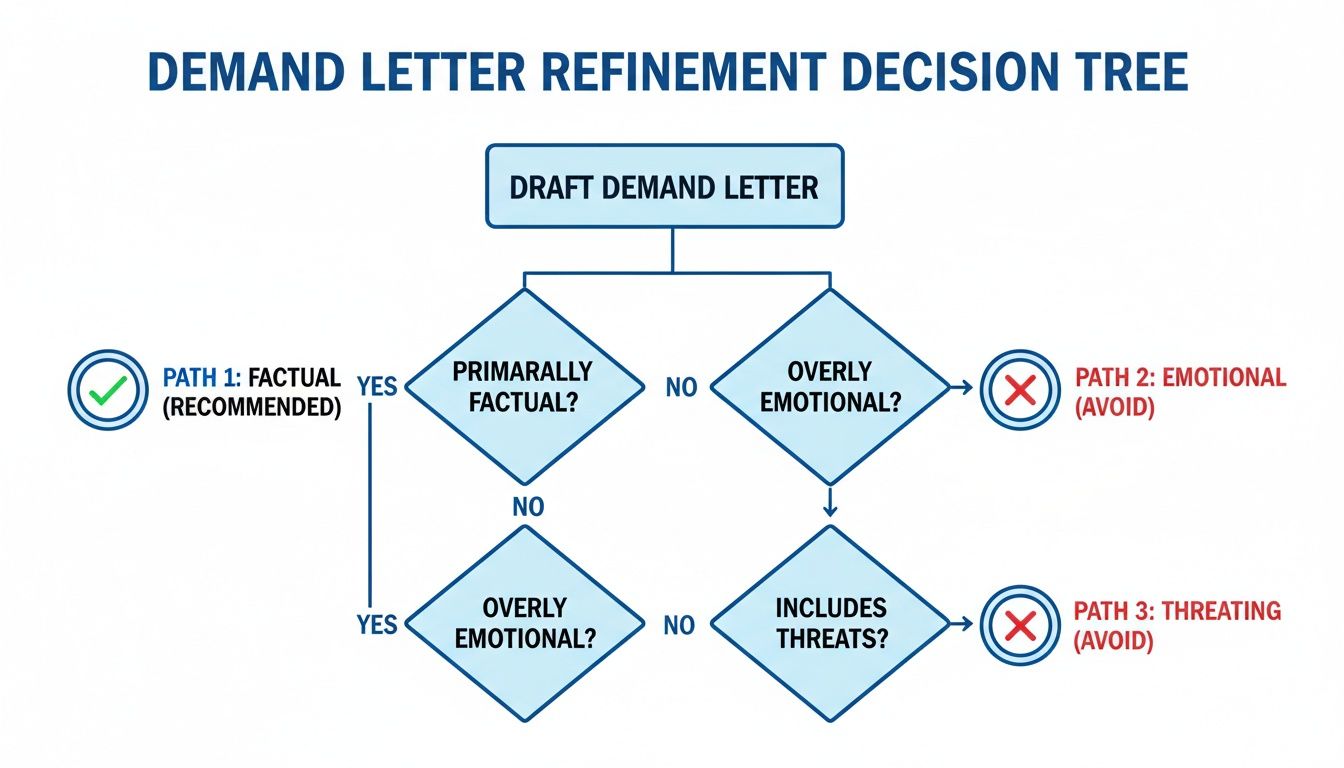
As you can see, sticking to the facts is the only route that builds a credible, professional demand. Letting emotions or threats creep in just gives the other side ammunition to dismiss you.
Knowing When It's Time to Escalate
So, what if your follow-up letter gets ignored too? Or what if they're just stringing you along with no real intention of settling? This is the moment you have to seriously consider escalating. The threat of a lawsuit has to become a reality. For many smaller disputes, filing a claim in small claims court is the next logical step.
Before you march down to the courthouse, get your ducks in a row. Make sure every piece of documentation is flawlessly organized. You'll need clean copies of your demand letter, the certified mail receipt proving they got it, and all the evidence you gathered for your original claim.
Keeping track of legal timelines is also absolutely critical here. A simple mistake can get your case thrown out. You can use a legal deadline calculator to stay on top of any important dates and filing windows.
A key takeaway here: The demand letter wasn't just about asking for money. It was about creating a paper trail showing you tried to resolve this reasonably. If you do end up in front of a judge, this documentation is powerful proof that you acted in good faith before resorting to litigation. Judges really appreciate that.
Finally, you need to know when to bring in a professional. If the dispute involves a lot of money, a tricky legal argument, or a personal injury, it’s time to consult with an actual attorney. A failed demand letter is the perfect trigger. They can give you an honest assessment of your case and handle the complexities of a formal lawsuit.
Your Top Questions About Demand Letters, Answered
Even with a great template in hand, you’re bound to have questions when you sit down to write. Drafting a document with potential legal weight can feel intimidating. That's perfectly normal.
Let’s walk through some of the most common questions I hear from people in your exact situation. My goal is to give you direct, practical answers based on years of experience, so you can move forward with confidence.
Is a Demand Letter Actually Legally Binding?
In a word, no. A demand letter isn't a court order or a legally binding judgment. Think of it more as an official, professional warning shot.
Its real power comes into play later if you do end up in court. The letter serves as concrete proof that you made a good-faith effort to resolve the dispute reasonably before escalating to a lawsuit. Judges appreciate seeing this. It demonstrates you weren't "litigation-happy" and gave the other side a fair chance to make things right. It signals you're serious and often gets the other party to the negotiating table just to avoid the hassle of a lawsuit.
Can I Really Write This Myself Without a Lawyer?
For many straightforward situations, absolutely. If you're chasing an unpaid invoice or dealing with a very clear breach of contract, a high-quality demand letter attorney sample can give you an excellent framework to build from. The trick is to stick strictly to the facts and keep your tone business-like.
That said, it’s vital to recognize when you're out of your depth. If the legal arguments are complex, a lot of money is at stake, or you’re dealing with a significant personal injury, it’s time to call in a professional. Many attorneys will draft the letter for a flat fee or review the one you’ve written, which can be a very smart, relatively small investment for peace of mind.
A huge mistake I see people make is threatening to sue when they have no intention of doing so. If you make a threat you can't or won't back up, you lose all credibility instantly. Only state consequences you are fully prepared to see through.
What Are the Biggest Mistakes to Avoid?
Almost every damaging error I've seen in a demand letter has been self-inflicted and easily avoidable. These mistakes can immediately weaken an otherwise strong claim.
Be on the lookout for these common traps:
- Getting Emotional: Venting your anger or frustration makes you look unprofessional and undermines your argument. Stick to the objective facts of what happened.
- Being Vague: Don't just ask for "compensation." Be specific. State precisely what you want, like "$5,250.00 by October 31st."
- Forgetting a Deadline: A letter without a firm date for a response lacks urgency. It’s easy for the recipient to set it aside and forget about it.
- Making Threats or Insults: This never helps. It can escalate the conflict and, in some cases, could even be viewed as harassment. Professionalism is your most powerful tool.
Does Sending a Letter Guarantee I'll Get Paid?
Unfortunately, nothing is guaranteed. But I can tell you from experience that a well-crafted demand letter dramatically increases your odds of getting a resolution without ever setting foot in a courtroom.
Why? Because a professional, well-reasoned letter shows you’re serious, organized, and aware of your rights. Faced with a clear claim and the implied threat of legal action, many people and businesses will simply choose to settle. It often makes paying you the path of least resistance compared to the time, cost, and stress of a lawsuit.
Stop wrestling with legal documents and get the answers you need in seconds. LegesGPT offers an AI-powered legal assistant that can help you review contracts, understand complex legal language, and build stronger arguments faster. Start your 3-day trial and see how much time you can save at https://www.legesgpt.com.