

In Illinois, a divorce often costs about $10,000 to $15,000, but the spread is wide. An uncontested case may land closer to $3,000 to $7,000, while a contested case commonly rises into the $10,000 to $15,000 range and can go far higher when conflict, children, property disputes, or expert work enter the picture.
That gap is what unsettles many individuals. They aren't just asking for one number. They're trying to figure out whether their case is likely to stay near the lower end or slide into a much more expensive fight.
The most useful way to think about the cost of divorce in Illinois is not as one price tag, but as a cost stack. Some costs are fixed and unavoidable. Some depend on how much attorney work your case needs. Others appear only when a case escalates into custody disputes, valuations, discovery battles, or trial preparation. If you understand those layers early, you can budget more realistically and make better decisions before legal fees start compounding.
Understanding the Financial Reality of a Divorce in Illinois
A common Illinois divorce starts with a mistaken assumption. Someone checks the county filing fee, sees a few hundred dollars, and builds a budget around that number. Then the first attorney meeting shifts the conversation, because the filing fee only opens the case. It does not settle parenting disputes, trace income, draft a marital settlement agreement, divide retirement assets, or prepare for hearings when negotiations break down.
That is why broad averages have limited value by themselves. A divorce is better understood as a cost stack. The first layer is predictable court-entry expense. The second layer is attorney time, which expands or contracts based on the work your case requires. The third layer appears when conflict or complexity pulls in experts, emergency motions, extensive discovery, or trial preparation.
For planning purposes, that framework matters more than any single statewide average.
Why the range is so wide
Two spouses can file in the same courthouse and end up with very different total costs.
If both sides exchange information promptly, agree on the children, and stay focused on settlement, fees usually stay concentrated in drafting, review, and a few court appearances. If one side contests parenting time, disputes income, delays financial disclosure, or pushes every issue toward hearing, attorney hours rise fast. Add a business, unusual assets, or allegations that require outside professionals, and the budget changes again.
The filing fee is the cover charge. The final cost comes from how much work the case generates after it enters the system.
Practical rule: In most Illinois divorces, conflict drives cost more than the initial court fee.
The cost stack clients should use
This is the model I want clients to use at the start of a case:
- Fixed costs: Filing fees, appearance fees, service fees, and similar court-entry charges.
- Variable costs: Attorney meetings, drafting, email review, negotiations, routine motions, financial document analysis, and court appearances.
- Escalation costs: Guardian ad Litem involvement, custody evaluations, business valuation, forensic accounting, vocational experts, and trial preparation.
That structure helps you ask the right questions early, before fees start accumulating.
- Do you already agree on the major terms? Early agreement can keep the case in the lower layers of the stack.
- Are children involved, and is parenting contested? Parenting disputes often increase both urgency and expense.
- Is there a house, retirement account, business interest, deferred compensation, or other hard-to-value property? Even cooperative cases cost more when the assets are complicated.
- Is either spouse likely to fight over process, not just outcome? Discovery disputes, repeated continuances, and unnecessary motions can consume a budget quickly.
Clients usually benefit from treating divorce costs as a risk-management problem, not just a legal bill. The more accurately you identify which layer your case is likely to reach, the better your financial planning will be.
The Baseline Costs Court Filing Fees and Service Charges
Before attorney fees enter the picture, every divorce starts with court-entry expenses. These are the easiest costs to understand because they are the least flexible. You don't negotiate them with your spouse, and your lawyer doesn't control them.
Illinois reporting shows a relatively narrow court-entry band of about $250 to $388 for the initial filing fee, plus about $181 to $251 for a respondent appearance fee in some counties, according to this Illinois divorce cost guide. That's the base layer of the stack. It matters, but it usually isn't what makes divorce financially overwhelming.

What these baseline charges usually include
- Filing fee: The amount paid to open the divorce case with the circuit court.
- Appearance fee: A fee that may apply when the responding spouse formally appears in the case.
- Service of process: The cost of formally delivering the petition if waiver and acceptance aren't used.
- Administrative extras: Copies, certifications, and procedural items that can show up in smaller amounts.
Why people overestimate or underestimate these fees
Some people overestimate them because they assume “court costs” include everything. They don't. Others underestimate them because they look only at the filing line item and forget that the responding spouse may pay a separate fee, and service may be needed if the case doesn't start cooperatively.
A practical budget should treat court charges as the opening expense, not the full forecast.
The filing fee is the cover charge. The real cost comes from how much work the case generates after it enters the system.
What works at this stage
If your spouse is cooperative, simple administrative choices can keep the fixed layer from spreading into avoidable variable costs.
- Use waiver options when appropriate: If the other side will accept service, you may avoid the delay and cost of formal service.
- File complete paperwork: Missing information creates corrections, follow-up calls, and more attorney time.
- Confirm county-specific requirements early: Fee schedules and procedures vary by county, even when the legal issues are similar.
The court fees are usually the most predictable part of the cost of divorce in Illinois. That predictability is useful. It gives you a starting number. Just don't confuse that starting number with the total.
The Biggest Variable Illinois Divorce Attorney Fees
After the filing fee is paid, the cost stack changes. The fixed layer gives way to the variable layer, and attorney time becomes the main driver of your total bill.
In Illinois, hourly rates vary widely by lawyer, county, and case difficulty. The range matters less than the billing structure underneath it. Every email, draft, call, document review, negotiation session, and court appearance draws from the same source: lawyer time. If the case stays focused, fees stay more predictable. If the case sprawls, fees rise fast.

What you are paying for
Many clients come in assuming the bill is driven mainly by court dates. In practice, a large share of fees is generated outside the courtroom, often before the first substantial hearing is ever held.
- Document drafting: Petitions, financial affidavits, parenting plans, settlement agreements, motions, and proposed orders.
- Document review: Tax returns, bank records, retirement statements, business records, loan documents, and communications from the other side.
- Client communication: Calls, emails, strategy meetings, and follow-up requests for missing information.
- Negotiation: Attorney-to-attorney conferences, revisions, settlement drafting, and issue-specific bargaining.
- Hearing preparation: Organizing exhibits, witness prep, legal research, and time spent waiting at court.
That is why two divorces with the same legal issues can have very different price tags. One client sends a complete, organized packet and makes decisions promptly. Another sends partial records over three weeks, changes positions repeatedly, and wants a long response to every upsetting text. The second case costs more, even if the law is no different.
Retainers and hourly billing
Most Illinois divorce lawyers charge a retainer and bill against it by the hour. The retainer is an advance deposit, not a flat total for the case. As work is completed, time is billed against that deposit. If the matter resolves early, the total cost may stay controlled. If conflict expands, the retainer can run out and need to be replenished.
For a practical overview of billing models, retainers, and common fee pressure points, see this guide on how much a divorce lawyer costs.
A good way to evaluate counsel is to ask not only for the hourly rate, but also how the office manages communication, document collection, staffing, and settlement work. A lower hourly rate can still produce a higher total bill if the file is handled inefficiently. A higher rate can be the cheaper choice if the lawyer is focused, organized, and able to narrow disputes early.
What drives attorney fees up fastest
In my experience, the biggest cost increases usually come from behavior, not from some unusual legal doctrine.
- Using your lawyer as a running emotional outlet: Emotional support matters, but lawyer time is expensive. Therapy, coaching, or trusted personal support is often a better place for processing anger and grief.
- Sending records in pieces: Five emails with missing attachments create more billable review time than one labeled and complete set.
- Turning every disagreement into a legal issue: If every irritation becomes a drafting project or a motion threat, the file becomes expensive quickly.
- Waiting until the deadline is close: Last-minute work leads to rushed review, repeated calls, and avoidable preparation time.
- Ignoring the financial questions that matter most: Time spent fighting over low-value items can swallow the money needed to resolve support, parenting, or property issues that carry real long-term consequences.
The practical lever is efficiency. Organized clients usually spend less because their lawyer can work in larger, cleaner blocks of time.
Here's a useful primer before the video below. Pay attention to how process choices affect billing just as much as hourly rates do.
What works
The clients who control this layer of the cost stack best tend to do three things consistently.
- They prepare before sending. Financial records are complete, labeled, and grouped by category.
- They separate principle from price. They know which issues affect the outcome and which ones only increase fees.
- They answer quickly and clearly. Prompt decisions reduce duplicate work, repeated follow-up, and hearing pressure.
Attorney fees are the largest variable because they reflect the volume of work the case creates. That gives you more control than many people expect. Manage the workload, and you often manage the cost.
Contested vs Uncontested How Conflict Multiplies Costs
The line between an uncontested and contested divorce is not technical jargon. It's a budget line.
An uncontested divorce means the spouses can reach agreement on all major issues. A contested divorce means one or more core issues remain disputed. That dispute might involve parenting, support, the house, retirement accounts, debt allocation, or the value of a business. Once disagreement hardens, the case usually needs more drafting, more negotiation, more hearings, and often more third-party involvement.
Illinois-focused reporting suggests a straightforward divorce averages around $13,800, while divorces involving children average about $20,700 and property-division cases about $19,400. The same reporting notes that complex or contested matters can reach $40,000+, according to this Illinois divorce cost analysis.
Divorce Path Comparison in Illinois
| Factor | Uncontested Divorce | Contested Divorce |
|---|---|---|
| Agreement level | Spouses agree on all major terms | One or more major issues remain disputed |
| Typical cost profile | Often near the lower end of the Illinois range | Often rises into the higher range and may become far more expensive |
| Attorney workload | Drafting, review, and settlement completion | Motions, hearings, discovery, negotiation rounds, and possible trial prep |
| Timeline pressure | Usually more manageable | Often longer and less predictable |
| Stress pattern | Administrative and decision-focused | Adversarial and reactive |
| Risk of expert involvement | Lower | Much higher |
For readers comparing process options in other states, an uncontested divorce in North Carolina is not Illinois law, but it shows the same structural point. Agreement usually costs less than litigation.
The issues that flip a case into the expensive category
Children are one of the biggest cost multipliers. Parenting schedules, decision-making authority, relocation concerns, and allegations about a child's best interests all generate work that doesn't exist in a simple paperwork divorce.
Property disputes do the same thing. A couple may agree they're divorcing but still fight over who keeps the house, how to handle retirement assets, what debt is marital, or whether a closely held business is worth what one spouse claims.
A case becomes expensive when the parties stop negotiating positions and start proving them.
What clients often miss
Many contested divorces do not begin with dramatic conflict. They become contested because one unresolved issue sits too long, temporary arrangements break down, or one spouse assumes the other will eventually give in. By the time counsel is preparing motions, gathering records, and setting hearings, the lower-cost path is already harder to recover.
That doesn't mean you should agree to an unfair settlement just to save money. It means you should identify early which issues matter enough to fight over and which ones are costing more to dispute than they're worth.
The Escalation Costs Expert Witnesses and Third Parties
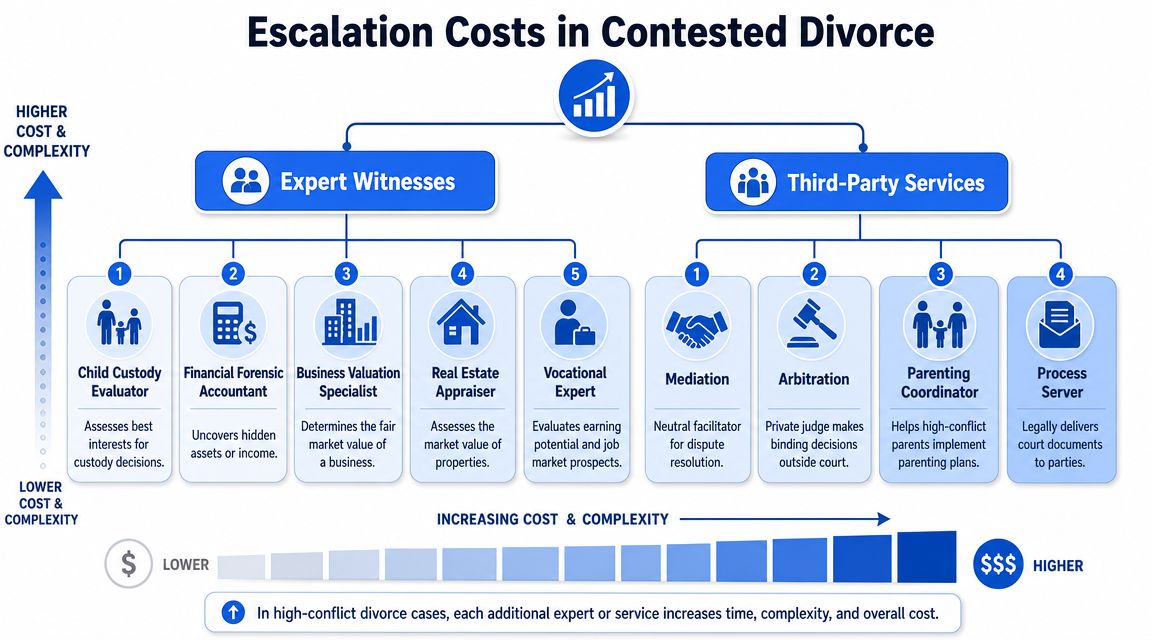
Some cases don't stay within court fees plus attorney time. They trigger a third layer of the cost stack: escalation costs. At this stage, divorce becomes significantly more expensive, because outside professionals enter the case and each professional adds both direct fees and additional attorney work.
Illinois-focused reporting models divorce expenses as fixed, variable, and escalation costs. It places reported averages around $11,300 to $14,000, notes that divorces involving children can average about $20,700, and reports mediation at $100 to $400 per hour or $1,500 to $7,500 total, according to this Illinois divorce cost breakdown from Sterling Lawyers.
Who gets pulled into these cases
When clients hear “expert fees,” they often think only of trial witnesses. In practice, several professionals can become part of the case long before trial.
- Guardian ad Litem or child-focused evaluator: Used when parenting disputes require investigation and recommendations tied to the child's best interests.
- Forensic accountant: Brought in when one spouse suspects hidden income, unusual transfers, or unreliable business records.
- Business valuation specialist: Needed when one or both spouses own a closely held business and value is disputed.
- Real estate appraiser: Useful when the parties disagree about the value of a home or investment property.
- Vocational expert: Sometimes involved when earning capacity, employability, or support-related work issues are contested.
- Parenting coordinator or mediator: Used to improve communication or resolve disputes outside a full court fight.
Why escalation costs grow so quickly
Third parties do not replace attorney work. They usually create more of it.
The lawyer has to identify the issue, retain the expert, gather materials, prepare the client, review the report, respond to the other side's expert, negotiate around the findings, and sometimes present the expert in hearings or trial. That's why a single valuation or custody dispute can push a case well beyond its original budget.
Cost warning: The moment your case requires proof from outsiders instead of agreement between spouses, expenses tend to accelerate fast.
Mediation as a pressure valve
Mediation is different from escalation costs in one important way. It can be a controlled spending tool rather than a conflict multiplier. When used early and seriously, it often helps parties narrow disputes before formal discovery and expert work take over.
That benefit shows up in the pricing structure. Mediation is usually billed as a defined professional service, not open-ended litigation activity. It is still an expense, but it can be a much more efficient one if both sides arrive prepared to solve actual problems.
Proven Strategies to Reduce Your Illinois Divorce Costs
Lowering divorce costs does not mean doing less legal work than your case requires. It means using the right level of process for the right level of conflict.
The best savings usually come from issue control, not bargain shopping. A highly skilled lawyer handling a narrow, organized matter can cost less overall than a cheaper lawyer managing a disorganized fight that keeps expanding. That's the frame clients should keep in mind.

The strategies that usually help
- Mediation early, not late: Mediation works best before both sides have spent heavily on motions and expert positioning. If the marriage can be unwound through structured compromise, that route often preserves more money for both households.
- Limited-scope representation: Some clients don't need full-service litigation from day one. They may need a lawyer to review a settlement draft, appear at a specific hearing, or handle one disputed issue. Used carefully, that can reduce spend without giving up legal advice where it matters.
- Organized document production: Deliver tax returns, statements, pay records, debt records, and asset lists in a clean package. That lowers review time and reduces repeated follow-up.
- Fewer emotional skirmishes: Don't pay your lawyer to litigate household irritations that have no meaningful legal value.
- Realistic settlement positions: Anchoring on extreme demands often increases fees without improving the outcome.
The strategies that only work in the right case
A fully DIY divorce can make sense for a very simple matter where there is genuine agreement, no serious property dispute, and no child-related conflict. But many people misclassify their case as simple. If there is uncertainty about support, retirement division, parenting rights, or asset disclosure, “saving money” by avoiding legal review can become expensive later.
For a broader consumer-oriented overview of process choices and spending trade-offs, weigh the broader cost of a divorce before deciding how much to spend.
A practical cost-control checklist
Before you hire counsel or commit to a litigation strategy, ask yourself:
- What are the three issues that matter? If you can't name them, everything will become a billing event.
- What documents can I gather before the first major meeting? Preparation lowers legal spend.
- Can temporary problems be solved by agreement? Temporary orders often create permanent fee momentum.
- Is this dispute about value or principle? Principle is expensive.
- Would a neutral mediator help us break the logjam? In many Illinois cases, yes.
The cheapest issue in divorce is the one the parties resolve before it becomes a discovery fight.
Clients often assume cost reduction means compromise at any price. It doesn't. Good cost control means choosing where to spend on legal effort and where not to.
Building Your Financial Plan for Divorce
A workable divorce budget starts with the cost stack. First come the fixed court costs. Then come the variable attorney fees that rise or fall with the amount of legal work required. Finally, there are escalation costs, which appear when disputes over children, property, income, or credibility require outside professionals and heavier litigation.
If you remember only one thing, remember this: conflict is usually the biggest cost driver. Not the filing fee. Not the petition itself. Conflict.
That gives you some control, even in a difficult situation. You may not control your spouse's behavior, but you can control your preparation, your responsiveness, your document organization, your willingness to mediate, and your judgment about which issues are worth paying to fight over. In the cost of divorce in Illinois, those decisions often matter more than people expect.
A smart plan is not just “set aside money for a lawyer.” It's deciding, as early as possible, whether your case can stay in the fixed-and-variable layers or whether it is drifting toward escalation.
If you're sorting through divorce costs, fee structures, court procedure, or settlement language and want faster, better-organized legal answers, LegesGPT is worth a look. It helps lawyers, legal teams, and individuals research issues, review documents, and get citation-backed guidance without wasting hours digging through scattered sources.
Frequently Asked Questions
How much does a divorce cost in Illinois?
Most Illinois divorces land somewhere around $10,000 to $15,000, but the spread is wide. An uncontested case where both spouses agree can come in closer to $3,000 to $7,000, while a contested case commonly reaches the $10,000 to $15,000 range and climbs well beyond it once custody disputes, property fights or expert witnesses are involved.
Why do divorce costs vary so much?
Because conflict drives cost. Two couples filing in the same courthouse can pay very different amounts depending on whether they exchange financial information promptly, agree on arrangements for children, and stay focused on settlement. Every contested motion, delayed disclosure and additional hearing adds attorney time.
What is the difference between a contested and uncontested divorce cost?
An uncontested divorce, where the couple agrees on the major terms, concentrates cost in drafting, review and a small number of court appearances. A contested divorce adds discovery, negotiation, motions and potentially trial, and each of those stages multiplies attorney hours, which is the largest component of the bill.
What are the court filing fees in Illinois?
Filing and appearance fees are set by county and typically run to a few hundred dollars, plus service charges. A common mistake is budgeting from that number alone. Filing fees only open the case, and attorney time is what actually determines the total.
How can I reduce the cost of my divorce?
Agree on what you can before involving lawyers, provide financial documents quickly and completely, use mediation where the disputes are genuinely negotiable, and keep communication with your attorney focused. Cost control in divorce is mostly about reducing the number of things that have to be fought over.
Is mediation cheaper than litigation?
Usually, and often substantially. Mediation replaces adversarial motion practice with structured negotiation, which takes far fewer billed hours. It works best where both parties are willing to disclose honestly and negotiate, and it is less suitable where there is a serious imbalance of power or information.
Who pays the legal fees in an Illinois divorce?
Each spouse generally pays their own attorney, but Illinois courts can order one spouse to contribute to the other's fees where there is a significant disparity in resources. That is a decision for the court on the facts of the case rather than something either side can assume.