
Legal AI tools have moved from novelty to necessity. Clio's Legal Trends Report found that 79% of legal professionals now use AI in some capacity, up from 19% only a year earlier. For lawyers billing by the hour, every hour AI saves translates directly into capacity, margin, and competitive edge.
This is the umbrella guide to legal AI tools for lawyers, organized by category (research, document review, contract drafting, practice management, and vertical tools) so you can pick the category before the product. Within each category we compare the 7 best tools in 2026: what each does best, who it is built for, real 2026 pricing, and honest pros and cons. We end with a decision framework so you can pick the right fit for your practice in under 10 minutes.
TL;DR: For most lawyers, LegesGPT is the best legal AI tool in 2026: verified-citation research, document review, and drafting in one subscription from $19.99/month with a 3-day $1 trial. Harvey AI wins for BigLaw, Lexis+ AI for citation accuracy, CoCounsel for litigation research, Spellbook for contracts in Word, Clio Manage AI for firm operations, and EvenUp for personal injury practices.
Best legal AI tools for lawyers: a brief overview
- LegesGPT: Best overall. Covers research, document review, and drafting in one $19.99/month subscription with verified citations.
- Harvey AI: Best for BigLaw and enterprise legal teams. The most powerful platform on the market at roughly $1,000+ per seat per month with a 20-seat minimum.
- Lexis+ AI (Protege): Most accurate research. A 17% error rate in Stanford testing versus 34% for Westlaw's AI.
- CoCounsel Legal: Best for litigation research. Agentic Deep Research built on Westlaw and Practical Law.
- Spellbook: Best for contract work in Word. 10M+ contracts analyzed through a native Microsoft Word add-in.
- Clio Manage AI: Best for firm operations. AI built into the most widely used practice management platform.
- EvenUp: Best for personal injury practices. Demand letters 69% more likely to hit policy limits.
| Tool | Best for | Starting price | Free trial | Jurisdictions |
|---|---|---|---|---|
| LegesGPT | All-in-one for solo and small practices | $19.99/mo | 3-day, $1 | 38+ countries |
| Harvey AI | BigLaw, enterprise legal | ~$1,000/seat/mo | No | 60 countries |
| Lexis+ AI (Protege) | Citation-verified research | Custom (Lexis add-on) | Demo | US + select intl |
| CoCounsel Legal | Litigation research | From $225/user/mo | Demo | Primarily US |
| Spellbook | Contract drafting in Word | ~$179/user/mo | Demo | Primarily US/UK |
| Clio Manage AI | Small/mid firm operations | $49–149/user/mo + AI add-on | 7-day | US, Canada, UK, AU |
| EvenUp | Personal injury practices | Per-case (custom) | Demo | US only |
What are legal AI tools?
Legal AI tools are software platforms that use artificial intelligence, typically large language models trained or fine-tuned on legal content, to automate or accelerate tasks lawyers traditionally do by hand. The core categories:
- Legal research AI: natural-language case law and statutory search with citation verification (Lexis+ AI, CoCounsel, LegesGPT).
- Document review AI: clause extraction, risk flagging, and Q&A on uploaded PDFs and contracts (LegesGPT, Spellbook, Harvey).
- Contract drafting AI: generates first drafts, suggests next clauses, and benchmarks language (Spellbook, LegesGPT, Harvey); see how to generate contracts and legal documents with AI for the workflow.
- Practice management AI: automates billing, scheduling, deadline tracking, and intake (Clio Manage AI).
- Vertical legal AI: purpose-built for a single practice area like personal injury (EvenUp).
Start by identifying which category eats most of your week; the rankings below are organized around these categories so you choose the category first and the product second. The best modern tools combine several categories, and a few cover most of them in a single subscription.
How we ranked these tools
Every tool on this list was screened against the same three criteria:
- Built for legal work: legal-specific grounding with real citations and legal workflows, not a general chatbot with a legal label.
- Proven with practicing lawyers: an established customer base using the tool on real matters, not pre-launch demos.
- Claims we could verify: capabilities confirmed through documentation, product access, or hands-on testing rather than marketing copy.
We then weighted price against real-world output for the tool's target user. An enterprise platform only earns its ranking if it delivers clearly more than a $19.99/month subscription for the lawyer actually using it. For solo lawyers and small practices, LegesGPT wins that math decisively; enterprise platforms have to justify their procurement cycles and per-seat quotes with depth a smaller tool cannot match.
1. LegesGPT, best overall legal AI tool for lawyers
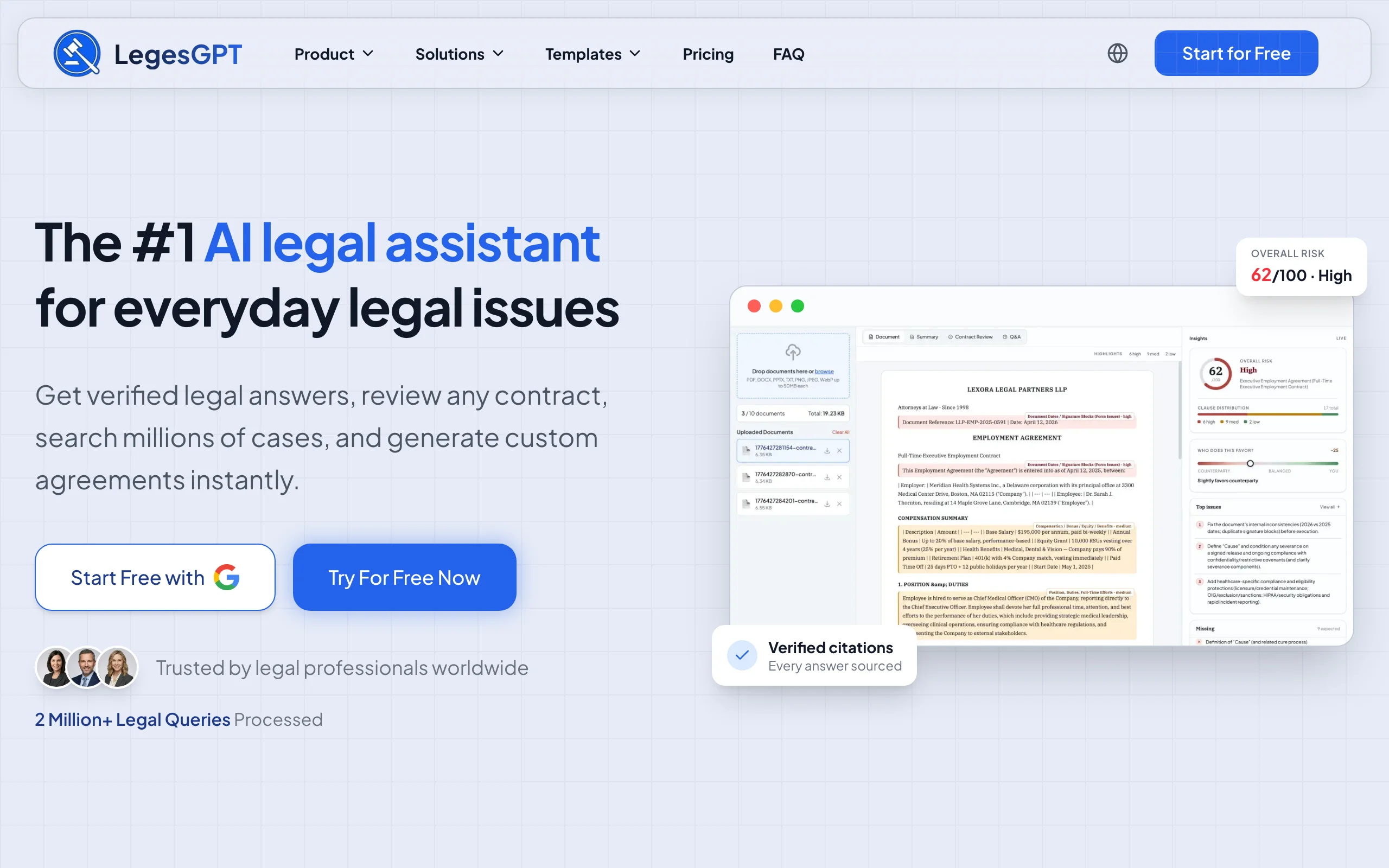
For most working lawyers, LegesGPT delivers the highest value per dollar on this list. It replaces the classic three-tool stack (a research database, a document reviewer, and a drafting assistant) with one subscription. Ask a legal question in plain English and the answer comes back with verified citations linking straight to the source, or run case law research across statutes and precedents without leaving the tab.
Document work covers the formats lawyers actually receive. Upload PDF, DOCX, PPTX, TXT, or even a photographed page, and the review engine flags risks, extracts key terms and deadlines, proposes changes, and writes a plain-language summary; a chat panel lets you interrogate the document clause by clause. Drafting works in the other direction: describe the agreement you need and the AI legal document generator builds it clause by clause, lets you add a signature, and exports a ready-to-send PDF or an editable DOCX. Premium adds a Deep Research mode with live web search for fast-moving legal questions.
There is no sales cycle, no seat minimum, and no annual contract. You sign up, start a 3-day trial for $1, and are running real matters through it within minutes. For a solo lawyer or 5-attorney practice, LegesGPT typically replaces $300–500/month of research and contract-tool spend for around $100/month total.
Key features
- Verified citations with direct source links on every research answer
- Case law and statute search in plain English
- AI document review of PDF, DOCX, PPTX, TXT, and image files: risk flags, key-term extraction, proposed changes, and summaries
- Chat with any uploaded document to drill into specific clauses
- Clause-by-clause contract and document drafting from a plain-English brief
- Add a signature and export ready-to-send PDF or editable DOCX
- 100+ free legal templates, plus a free AI contract generator, deadline and support calculators, and a citation generator
- Deep Research mode with real-time web search for recent legal developments
Best for
- Solo practitioners and 2–50 attorney practices that want research, review, and drafting in one place
- Lawyers handling international or multi-jurisdictional matters
- In-house counsel and legal ops teams wanting enterprise capability without enterprise pricing
Pricing
- Basic, $19.99/mo: unlimited AI queries, case law and statute search, citation verification
- Plus, $49.99/mo: Basic + document upload, 50 document reviews/month
- Premium, $99.99/mo: Plus + unlimited document review, Deep Research, web search
- 3-day trial for $1; annual billing saves 30% (see LegesGPT pricing)
Pros
- All-in-one: research + review + drafting + e-signature export under one subscription
- Verified citations sharply reduce hallucination risk versus general-purpose chatbots
- 11–50× cheaper than CoCounsel ($225/mo) or Harvey AI ($1,000+/mo)
- Self-serve signup with instant trial, no demo required
Cons
- Smaller raw case law database than Westlaw or LexisNexis for deep historical research
- Web-only: no Word add-in or public API
- Unlimited document review and Deep Research only on the Premium tier
2. Harvey AI, best for BigLaw and enterprise legal teams
Harvey is a professional-grade generative AI platform that routes work across OpenAI, Anthropic, and Google models with domain-specific legal fine-tuning. It functions as a comprehensive AI partner across research, contract analysis, drafting, litigation support, and workflow automation.
Harvey is the most capitalized legal AI startup: an $11B valuation after its March 2026 round, an estimated $350M ARR by mid-2026 (Sacra), and used by 200,000+ lawyers at 2,400+ organizations including A&O Shearman, Latham & Watkins, and O'Melveny. If you are at a large firm with budget to match, Harvey delivers serious firepower.

Key features
- AI fine-tuned for complex legal, regulatory, and tax questions with citations
- Harvey Vault: secure repository for bulk analysis of up to 10,000 documents
- Contract analysis with risk identification and key term extraction
- Deposition preparation with AI-generated outlines and questions
- Litigation support: case timelines, strategy assistance, document review up to 80× faster (Harvey internal benchmarks)
- Enterprise integrations with Microsoft 365 and LexisNexis
Best for
- AmLaw 100 / 200 and large international law firms
- Enterprise in-house teams at multinationals
- Teams handling high-volume litigation or complex transactional work
Pricing
- Custom enterprise pricing only
- Estimated $1,000–1,200 per lawyer per month
- Reported 20-seat minimum (~$288,000/year entry point)
- No free trial, no self-serve plan
Pros
- The most powerful general-purpose legal AI on the market today
- Enterprise security (ISO 27001, encryption, granular access controls)
- Legal-specific fine-tuning across practice areas
- Deep partnerships with Microsoft and LexisNexis
Cons
- Prohibitively expensive for solo, small, and most mid-size practices
- No free trial, no self-serve, and months-long onboarding
- Vault's 10,000-document cap is limiting in mass tort or massive M&A
- Like all LLM-based tools, requires attorney verification of outputs
3. Lexis+ AI (Protege), best for citation-verified research
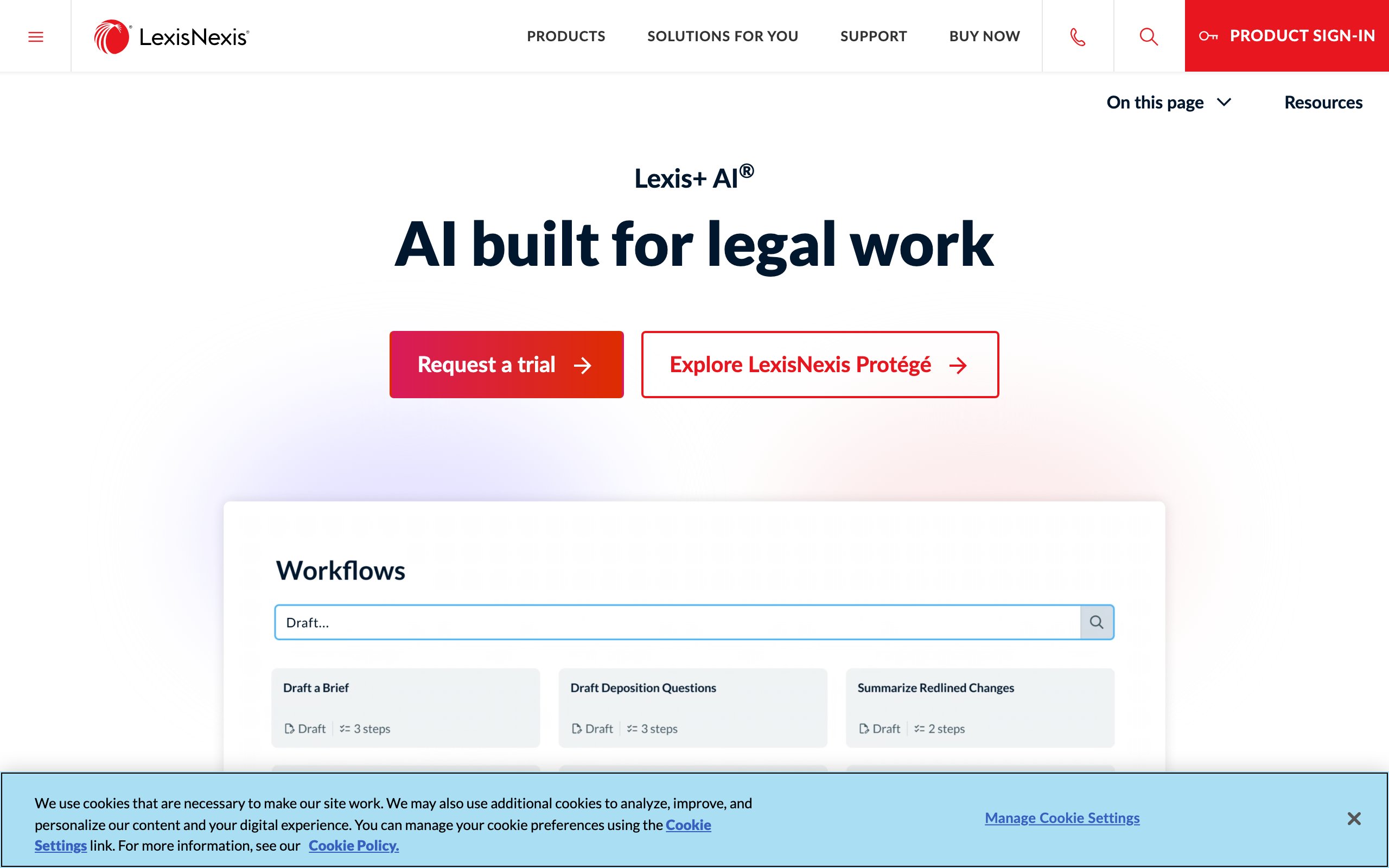
Lexis+ AI (renamed Lexis+ with Protégé in February 2026) is LexisNexis's AI research and drafting platform built around Protégé, a personalized AI assistant that handles conversational search, document analysis, and legal drafting. Every answer is grounded in LexisNexis's proprietary content and validated in real time by Shepard's Citations.
A 2024 Stanford study (and a 2025 follow-up) found Lexis+ AI's research had a 17% error rate, compared to 34% for Westlaw's AI-Assisted Research. That accuracy edge matters when your research has to hold up in court. Protege adds hundreds of pre-built AI workflows plus a no-code workflow builder.
Key features
- Conversational legal research grounded in LexisNexis content
- Real-time Shepard's Citations validation on AI-generated answers
- Protege AI: drafts motions, complaints, and memos; analyzes documents up to 300 pages
- Protégé General AI: secure access to multiple LLMs (GPT-5.1, Claude Sonnet 4.5, Gemini 3 Pro) inside the platform, with a Best Fit mode that picks the model per task
- Hundreds of pre-built AI workflows + no-code workflow builder
- DMS integration with iManage, SharePoint, NetDocuments, Google Drive
Best for
- Practices of all sizes already using LexisNexis
- Litigation and transactional teams needing citation-verified AI answers
- Lawyers for whom defensible research is non-negotiable
Pricing
- Custom pricing as an add-on to an existing Lexis+ subscription
- Sales contact required (no public price)
- Forrester reports 344% three-year ROI for typical firms
Pros
- Lowest error rate among major legal AI research tools (Stanford-validated)
- Answers grounded in proprietary authoritative content, not open-web data
- Strong privacy: documents auto-purged after each session
- No-code workflow builder for non-technical users
Cons
- No public pricing; requires a sales conversation
- Best value only when paired with an existing Lexis+ subscription
- Multi-year LexisNexis contracts common
- No native integration with practice management (Clio, PracticePanther, etc.)
4. CoCounsel Legal, best for litigation research
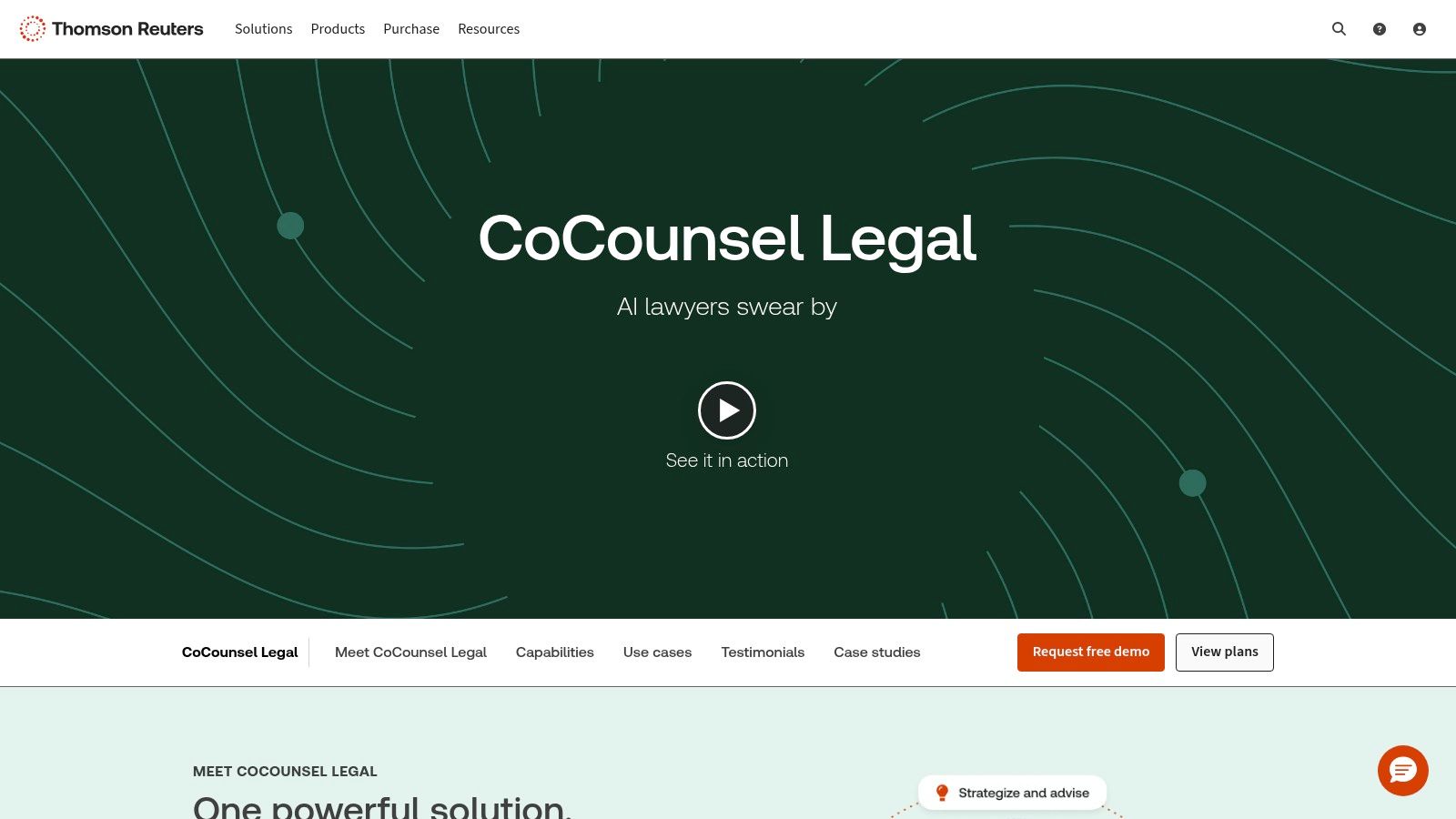
CoCounsel Legal is Thomson Reuters' flagship AI platform, relaunched in August 2025 as the spiritual successor to Casetext's original CoCounsel (Casetext was shut down in April 2025). It combines legal research, workflow automation, document analysis, and AI assistance built on OpenAI models trained on Westlaw + Practical Law content.
The standout is Deep Research: an agentic AI that builds multi-step research plans, explains its reasoning, and returns cited reports. For litigation lawyers who burn hours on case law and document review, CoCounsel meaningfully compresses that work.
Key features
- Deep Research: agentic multi-step AI with explained reasoning and cited reports
- Document review: summarizes depositions, extracts contract terms, builds case timelines
- Deposition prep with AI outlines and questions
- Contract analysis with risk identification
- Database Search across firm knowledge bases and client repositories
- Clio integration for practice management workflows
Best for
- Litigation attorneys handling case law research and document-heavy matters
- Lawyers already on Westlaw who want AI on top of their subscription
- Mid-size to large practices with budget for Westlaw Precision bundling
Pricing
- CoCounsel Core (document-focused): from $225/user/mo
- Westlaw Precision with CoCounsel (full research + AI): ~$428/mo for a single attorney
- Volume discounts for teams
Pros
- Deep Research is a genuinely novel agentic capability
- Grounded in Westlaw + Practical Law, authoritative sources
- Citations on every AI answer
- Good Clio integration
Cons
- CoCounsel Core alone does NOT search case law; you need a Westlaw Precision subscription
- Stanford research: 34% error rate (2× higher than Lexis+ AI)
- Expensive when bundled with full Westlaw
- Deep Research has a real learning curve
5. Spellbook, best for contract drafting and review in Word
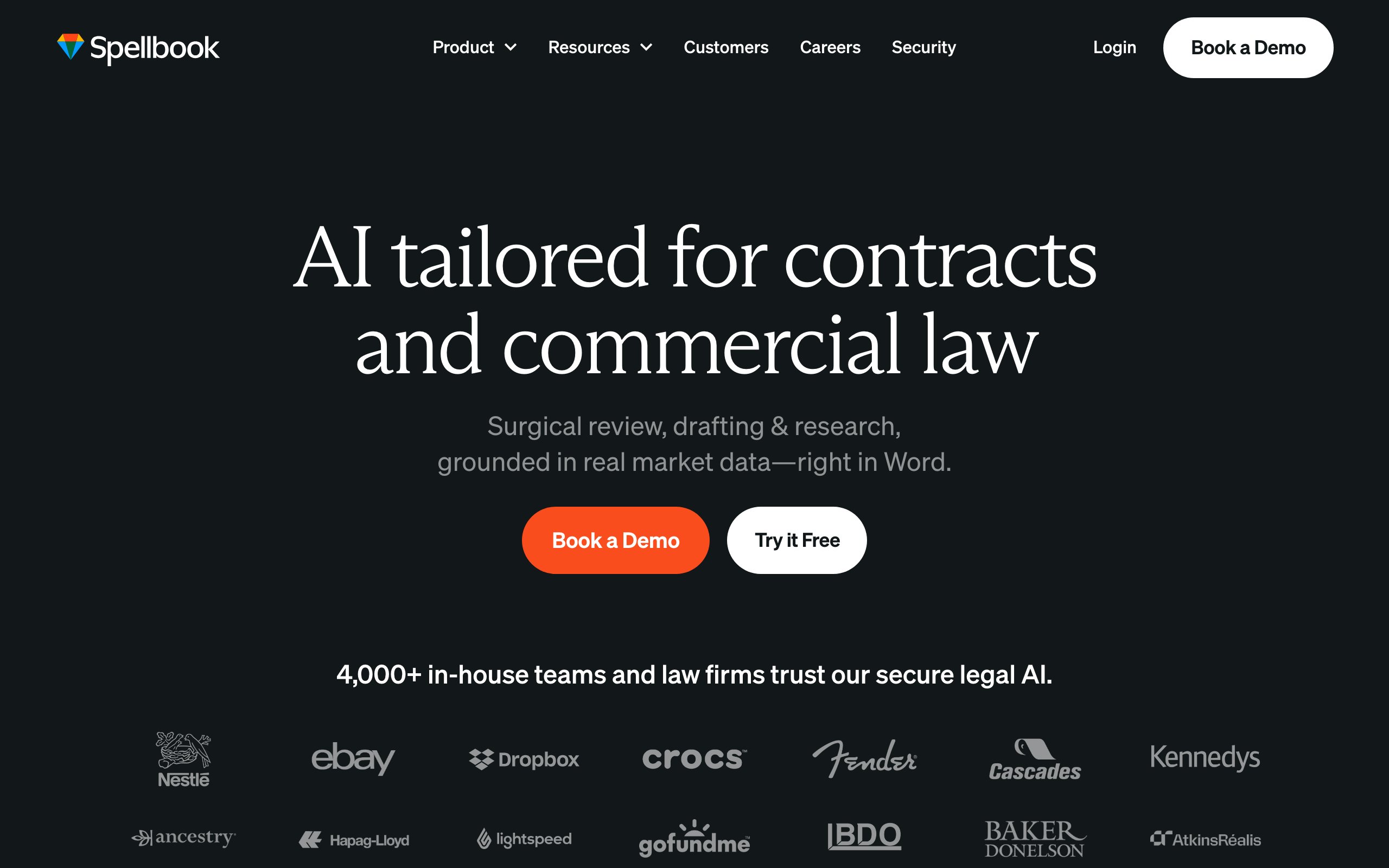
Spellbook is a purpose-built AI for transactional lawyers that lives inside Microsoft Word as an add-in. It uses leading LLMs from OpenAI and other providers to draft, review, redline, and analyze contracts directly in the lawyer's existing workflow, with no platform switching and no copy-paste.
Over 4,000 legal teams in 80+ countries use Spellbook, with 10M+ contracts analyzed since launch. For lawyers whose day revolves around contracts, Spellbook fits the workflow you already have instead of forcing you to change it.
Key features
- AI contract review with redlined output and risk flagging
- Clause library with boilerplate + AI-generated clause drafting
- Benchmarking against industry standards and compliance databases
- Question feature: ask about specific clauses or compare clauses across contracts
- Deep Microsoft Word integration with minimal training
Best for
- Transactional lawyers handling high contract volume (M&A, real estate, corporate)
- In-house teams reviewing vendor and client agreements daily
- Teams that want contract AI without leaving Word
Pricing
- Custom pricing; third-party reporting puts it around $179/user/mo
- Demo required; no self-serve trial
Pros
- Best-in-class Word integration; almost no learning curve
- 10M+ contracts in the training base
- Strong privacy: Zero Data Retention, SOC 2 Type II, GDPR, CCPA compliant
Cons
- Not a full Contract Lifecycle Management (CLM) tool
- Can struggle with heavily customized or non-standard agreements
- No public pricing or self-serve signup
- Contract-only: no litigation, research, or practice management
6. Clio Manage AI, best for small-to-mid-size practice operations
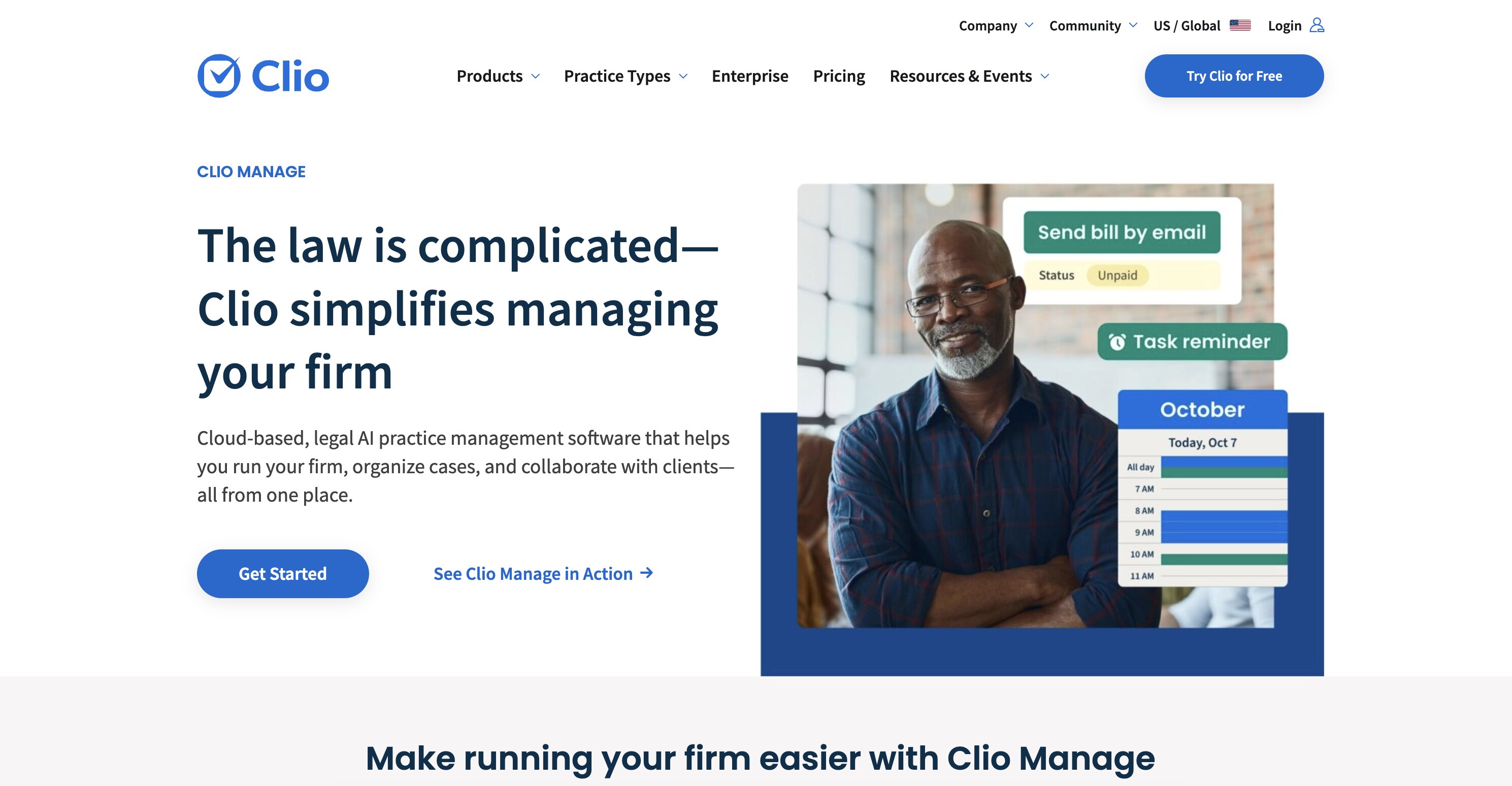
Clio Manage AI is the AI layer inside Clio Manage, the legal industry's most widely used cloud practice management platform. Rather than a separate tool, AI is embedded into the workflows lawyers already use: scheduling, billing, intake, and case management.
Over 150,000 legal professionals in 130+ countries use Clio. The AI features automate deadline extraction from court documents, generate billing drafts, and create performance reports. Every AI action surfaces original context and requires lawyer approval before anything goes out.
Key features
- Automated deadline extraction from court documents
- Document Analyzer with summaries, issue spotting, and clause identification
- Billing automation with accuracy checks and end-of-month workflows
- AI reports from natural-language queries on firm metrics
- Built-in review checkpoints on every AI action
- 150+ integrations with other legal tools
Best for
- Solo and small-to-mid-size practices automating admin and billing
- Teams already on Clio Manage adding AI
- Lawyers losing hours to scheduling, billing, and document organization
Pricing
- Clio Manage: $49–149/user/mo (billed annually)
- Manage AI: per-user add-on on top of the base
- Most teams pay $89–149/user/mo total
Pros
- AI inside the practice management platform, not a separate tool to learn
- Review checkpoints give lawyers full control
- Strong security: no data used to train external LLMs
Cons
- AI is a paid add-on on top of the base subscription
- Focused on practice management, not a replacement for dedicated research or contract AI
- Less powerful for heavy document analysis vs Harvey or CoCounsel
7. EvenUp, best for personal injury practices
EvenUp is a vertical AI platform built exclusively for personal injury law. Its Piai (Personal Injury AI) automates demand letters, medical chronologies, complaints, and other PI case documents while managing the full case lifecycle.
2,000+ firms use EvenUp, including 20% of the top 100 US PI firms. The platform processes 10,000 cases/week and has helped resolve 200,000+ cases worth $10B+ in damages. EvenUp raised a $150M Series E at a $2B+ valuation in October 2025.
Key features
- AI Drafts Suite: demands, complaints, medical summaries, negotiation sheets, interrogatory responses
- Medical Chronologies (MedChrons) with automatic chronological organization
- Smart Workflows manage case lifecycle, flag treatment gaps, identify missing docs
- Medical Bill Summary with 95% accuracy (vs GPT-4's 80%)
- Case Companion centralizes all materials
Best for
- Personal injury practices of any size
- PI attorneys spending hours on demands and medical record review
- Plaintiff lawyers aiming to lift settlement values and shorten timelines
Pricing
- Per-case pricing (introduced May 2025)
- One predictable cost per case, full platform access
- Custom; contact sales
Pros
- Demands 69% more likely to hit policy limits (99% confidence interval)
- Users report tripling drafting output and cutting timelines by a month
- Purpose-built PI models, not repurposed general AI
- Human expert review layer yields 99% output accuracy
Cons
- PI only, with zero applicability elsewhere
- No transparent pricing
- Significant human-in-the-loop behind the AI branding
- Vertical solution cannot be reused across practice areas
Benefits of using legal AI tools
The most recent industry surveys put numbers on the upside:
- 74% of hourly billable tasks could be automated or streamlined with AI (Clio 2025 Legal Trends Report)
- 69% of wide AI adopters report a positive impact on revenue, versus 36% of legal professionals overall (Clio 2025 Legal Trends Report)
- 5 hours saved per week per professional over the next year, worth roughly $19,000 a year each (Thomson Reuters Future of Professionals Report 2025)
Solo and small-practice lawyers report the biggest relative gains because the alternative, full Westlaw or LexisNexis seats, was often unaffordable.
Risks and best practices
Legal AI is powerful, not infallible. The main risks:
- Hallucinated citations: LLMs can fabricate plausible-looking case citations. Always verify before filing.
- Confidentiality: read each vendor's data-handling terms; prefer providers that do not train on client data (LegesGPT, Lexis+ AI, Spellbook, Harvey all confirm this).
- Jurisdictional gaps: many tools cover only US law. Confirm coverage before using internationally.
- Ethics and disclosure: check your jurisdiction's bar association guidance on AI use, billing, and client disclosure.
Best practice: treat AI output as the work of a fast but junior associate. Review every citation, every clause, every conclusion before it leaves your office.
How to choose the best legal AI tool for your practice
1) What type of legal work do you do most?
Your dominant workflow should drive the choice.
- Research-heavy / litigation: LegesGPT, Lexis+ AI, or CoCounsel. For a side-by-side comparison of dedicated research platforms, see our guide to the best legal research tools for lawyers.
- Transactional / contracts: Spellbook (Word) or LegesGPT (browser). Corporate and in-house teams can compare picks in our roundup of AI tools for corporate lawyers.
- Practice management & admin: Clio Manage AI. For a wider view of the legal stack beyond AI, see our roundup of the best legal tech tools for lawyers and law firms.
- Personal injury exclusively: EvenUp.
- All-in-one across categories: LegesGPT covers research + review + drafting in one subscription.
If you are evaluating platforms for a whole firm rather than your own practice, our dedicated guide to the best AI tools for law firms compares firm-wide options by use case.
2) What's your budget?
Pricing varies by a factor of 50× across this list.
| Practice size | Realistic monthly spend | Recommended tool |
|---|---|---|
| Solo / 1–5 lawyers | $20–100/user | LegesGPT |
| Small (5–20 lawyers) | $100–250/user | LegesGPT, Clio AI, or CoCounsel Core |
| Mid-size (20–100 lawyers) | $225–500/user | CoCounsel + Westlaw, or Lexis+ AI |
| BigLaw / enterprise | $800–1,200+/user | Harvey AI |
Do not over-buy. A 4-attorney practice rarely needs a platform priced for 400-attorney firms; diminishing returns kick in fast.
3) Do you need international jurisdiction coverage?
Most legal AI tools are US-centric. If you work cross-border:
- 38+ countries: LegesGPT
- 60 countries: Harvey AI (enterprise pricing)
- US-focused: Lexis+ AI, CoCounsel, Spellbook, Clio, EvenUp
4) Standalone platform or AI inside what you already use?
- Standalone: LegesGPT, Harvey AI, EvenUp
- Layered on existing tools: Lexis+ AI (LexisNexis), CoCounsel (Westlaw), Spellbook (Microsoft Word), Clio Manage AI (Clio)
If you already pay for Westlaw or LexisNexis, adding their AI tier may deliver the best incremental value. If you want a clean stack without legacy lock-in, LegesGPT is the most flexible.
5) How important is citation accuracy?
For court-bound research, the Stanford-measured error rates are the cleanest signal we have:
- Lexis+ AI: ~17% error
- Westlaw AI (CoCounsel): ~34% error
- LegesGPT and others: not yet third-party benchmarked at scale; verify citations manually for high-stakes filings
Treat every AI output as a strong first draft. Verify before filing.
Frequently Asked Questions
What are the best legal AI tools for lawyers in 2026?
The top 7 are LegesGPT (best overall, $19.99/mo), Harvey AI (best for BigLaw), Lexis+ AI with Protege (best citation accuracy), CoCounsel Legal (best for litigation research), Spellbook (best for contracts in Word), Clio Manage AI (best for practice operations), and EvenUp (best for personal injury). The right one depends on practice size, budget, and primary workflow.
Are legal AI tools accurate enough for professional use?
Accuracy varies. Stanford research measured Lexis+ AI at a 17% error rate and Westlaw AI at 34%. No tool is 100% reliable, so treat AI output as a first draft requiring attorney verification. Tools grounded in authoritative legal databases with verified citations are far more reliable than general-purpose chatbots.
Can legal AI tools handle research across multiple countries?
Most are US-centric. LegesGPT covers 38+ countries and Harvey AI operates in around 60. If you work cross-border, verify jurisdiction coverage before committing to a subscription.
What is the cheapest legal AI tool for solo lawyers?
LegesGPT at $19.99/month is the lowest-cost full-featured option, with a 3-day trial for $1. Most other tools on this list start around $179/month or require enterprise quotes.
Is it safe to use AI for legal work?
When used responsibly, yes, but never as a finished product. Verify citations, check for hallucinations, review AI-drafted documents before filing or sending to clients, and follow your jurisdiction's bar ethics rules on AI use.
What is the difference between Harvey AI and LegesGPT?
Harvey AI targets BigLaw at roughly $1,000+ per seat per month with a reported 20-seat minimum. LegesGPT targets solo and small practices at $19.99/month. Both handle AI research and document analysis, but LegesGPT adds clause-by-clause drafting with signature-ready export and free tools, while Harvey leads on enterprise depth like Vault and custom integrations.
Will legal AI tools replace lawyers?
No. They replace specific tasks, not lawyers. AI handles first-draft research, document review, and routine drafting faster than humans, while strategy, judgment, client counseling, advocacy, and ethical decisions remain human work. The likely path through 2030 is that lawyers using AI replace lawyers who do not.
Can I use ChatGPT or Claude for legal work instead of a specialized tool?
You can for general drafting, summarization, and brainstorming, but not for citation-grounded research, since general LLMs hallucinate case law at high rates. For anything that will be filed, signed, or relied on, use a legal-specific tool with verified citations such as LegesGPT, Lexis+ AI, or CoCounsel.
Do I need to disclose AI use to clients or the court?
Increasingly, yes. Several US federal judges now require disclosure of AI-assisted filings, and bar opinions in New York, California, Florida, and elsewhere are tightening. Check your local rules. As a default, disclose AI assistance in filings and discuss your AI workflow with clients during engagement.
If I mainly need affordable, all-in-one legal AI, what should I use?
LegesGPT. It combines verified-citation research, case law and statute search, document review with risk flags, clause-by-clause drafting with signature-ready export, and free legal tools in one platform starting at $19.99/month, with a 3-day trial for $1.