

Supio has become one of the best-known AI platforms for plaintiff law. It reads medical records, builds chronologies, drafts demands, and now runs agentic workflows across a whole personal injury caseload. But it is sold on custom, volume-based quotes, it is built only for plaintiff practice, and it assumes you want a firm-wide platform rather than a single tool. If any of that is a poor fit, you are not stuck.
This guide compares the best Supio alternatives for plaintiff and personal injury firms. For each option you get what it actually does, key features, pricing, and the kind of firm it suits, followed by a decision framework. We start with LegesGPT, a self-serve Supio alternative for the drafting, research, and document review work that fills an injury lawyer's day, from $19.99/month.
What Supio does, and why firms look for a Supio alternative
Supio is an AI platform purpose-built for plaintiff law firms handling personal injury and mass torts. Its core jobs are medical chronologies, demand letters, case economics (bills and liens), litigation drafting, and cross-case analysis. In May 2026 it launched Supio Agent, which plans and executes work across cases and the firm, plus Supio Intake for 24/7 lead conversations. It also integrates with case management systems and, through an expanded Thomson Reuters partnership, gives users a route into Westlaw Advantage.
It is a serious product. Firms still shop for a Supio alternative for practical reasons:
- Quote-only pricing. Supio says it offers "firm-friendly pricing by case based on volume" and asks you to contact sales. There is no public price list and no self-serve trial, which makes it hard to budget or to test before you commit.
- Platform scope. Supio is designed to sit across intake, records, and case management. A three-attorney shop that only needs faster demands, or better research and drafting, may be paying for a firm-wide system it will not fully use.
- Plaintiff-only focus. If your firm also handles contracts, employment, business disputes, or estate work, a plaintiff-only platform covers only part of your matters.
- Onboarding and procurement. A platform that connects to your case management, records, and inbox takes a sales cycle and setup. Some firms simply want a tool they can open today.
The right replacement depends on which of those problems you are trying to solve. Some alternatives below compete with Supio head-on for medical chronologies and demands; others cover different ground at a much lower price. For a wider look at every AI category an injury practice can use, see our roundup of the best AI tools for personal injury lawyers. This article stays focused on replacing Supio.
One AI assistant for demands, research, and review
Ask legal questions, search case law, review contracts, and draft documents in one place — every answer backed by citations you can verify.
Try the AI legal assistantBest Supio alternatives: a brief overview
- LegesGPT: Best overall for small plaintiff firms: drafts demand letters and litigation documents, reviews files and flags risks, and answers legal questions with verified citations, all in one self-serve plan.
- EvenUp: Best for high-volume demand letter production, with verdict and settlement data behind every demand.
- Eve: Best for firms that want a full plaintiff "operating system" covering intake, audits, and firm analytics.
- CaseMark: Best for pay-per-summary deposition summaries and cited medical chronologies.
- Filevine: Best for firms that want AI built into their case management system.
- Casefleet: Best for litigators who want fact and chronology building in software they control, at a published per-user price.
- CoCounsel (Thomson Reuters): Best for Westlaw subscribers who want research-grounded litigation support.
| Tool | Best for | Starting price | Free trial | Platform |
|---|---|---|---|---|
| LegesGPT | Small firms: drafting, research, review | From $19.99/mo | 3-day, $1 | Web |
| EvenUp | High-volume demand letters | Custom (quote-only) | Demo only | Web |
| Eve | All-in-one plaintiff platform | Custom (quote-only) | Demo only | Web |
| CaseMark | Depo summaries & med chronologies | $100/user/mo (Pro) | Free trial with $5 credit | Web |
| Filevine | AI inside case management | Custom (quote-only) | Free LOIS Explore tier | Web + Word |
| Casefleet | Fact chronologies you control | $30/user/mo | 14-day, no card | Web |
| CoCounsel | Westlaw-grounded research | Custom (usually with Westlaw) | Sales-arranged trial | Web + integrations |
1. LegesGPT, best overall Supio alternative for small plaintiff firms
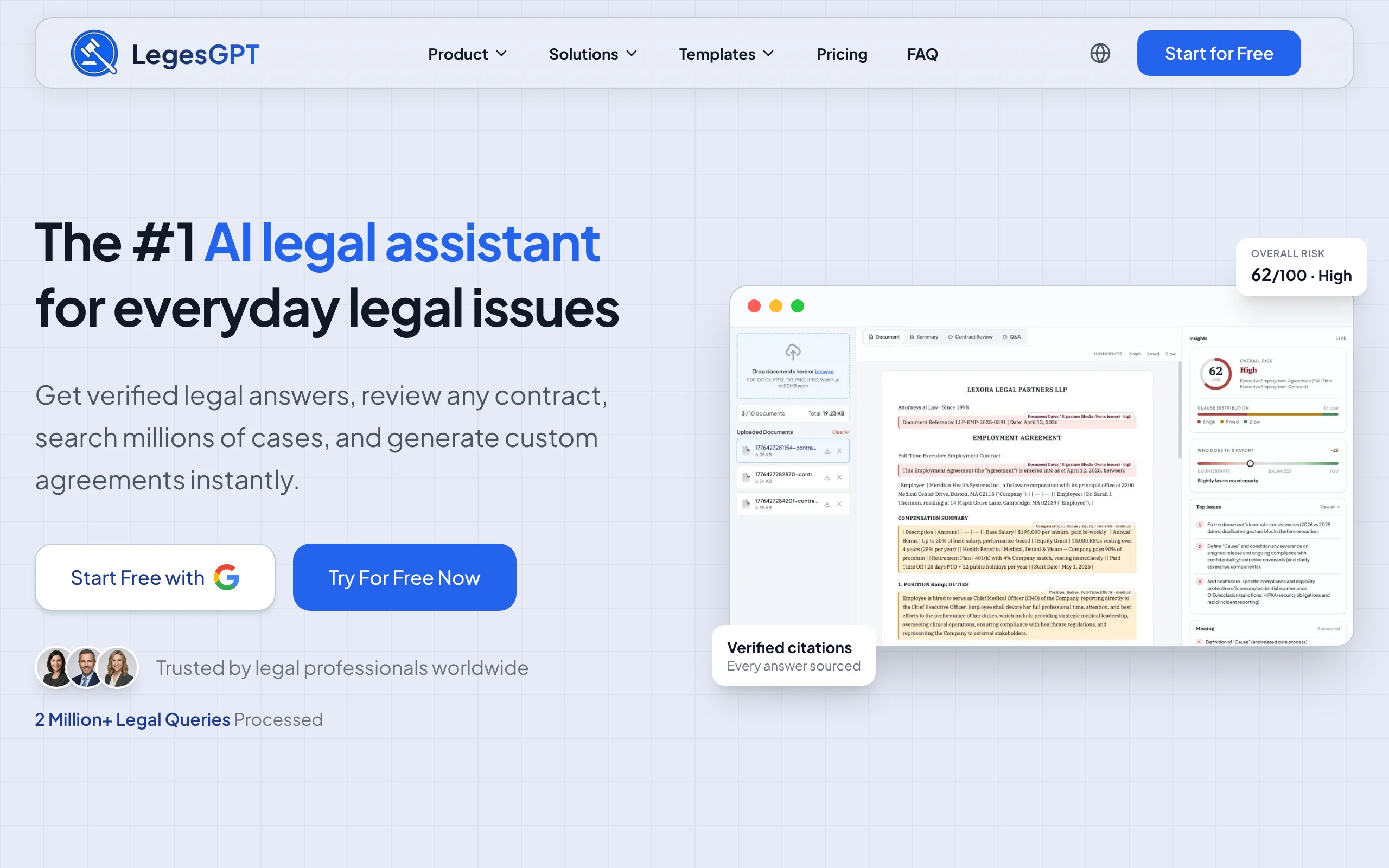
LegesGPT takes a different route from Supio. Instead of a case-level platform wired into your records system, it is a legal AI assistant you open in the browser and point at the task in front of you. Ask it to draft a demand letter from your facts, check a statute of limitations question with sources you can click through, or upload a defense settlement release and have it flag the risky terms and propose edits. When a document is final, you can send it for e-signature from the same place.
For a small injury practice, that covers much of the writing and research that sits around medical records: demands, letters of representation, discovery requests, motions, fee agreements, and client correspondence. It does not replace a medical chronology engine, and it is honest about that (see the cons).
Key features
- An AI legal document generator for demand letters, complaints, discovery, and correspondence, plus 100+ templates
- Document review for PDF, DOCX, and image files that identifies risks, flags problematic clauses in releases and settlement agreements, and proposes changes
- Legal questions answered with verified citations and direct source links, so you can check the authority before relying on it
- AI case law search across case law and statutes, with a Deep Research mode for multi-step questions
- Built-in e-signature to sign and send retainer agreements and other finished documents
- Free tools, including a personal injury settlement calculator
Best for
- Solo plaintiff attorneys and 2 to 20 lawyer injury firms that need drafting and research help without a platform contract
- Firms that handle personal injury alongside other practice areas
- Paralegals and case managers who draft demands, letters, and discovery every day
Pricing
- Basic, $19.99/month: unlimited AI queries, case law and statute search, citation verification
- Plus, $49.99/month: adds document upload and 50 document reviews per month
- Premium, $99.99/month: adds unlimited document review, Deep Research, and web search
- 3-day trial for $1, and annual billing saves 30%
Pros
- Published, self-serve pricing: you can start today and cancel without a sales process
- Covers drafting, research, review, and signing, not just the pre-litigation file
- Works for every practice area your firm handles, not only plaintiff matters
- Verified citations make legal research output fast to check
Cons
- No dedicated medical chronology, medical bill extraction, or lien tracking like Supio, EvenUp, or Eve
- Web-only, with no case management integration, public API, or mobile app, so you move documents in and out by upload
If you want to see what a finished demand looks like before you draft one, our demand letter sample walks through the structure.
Review settlement releases before your client signs
Upload a contract and LegesGPT flags risky clauses, surfaces obligations and deadlines, and answers questions with citations you can verify.
Try AI document review2. EvenUp, best for high-volume demand letter production
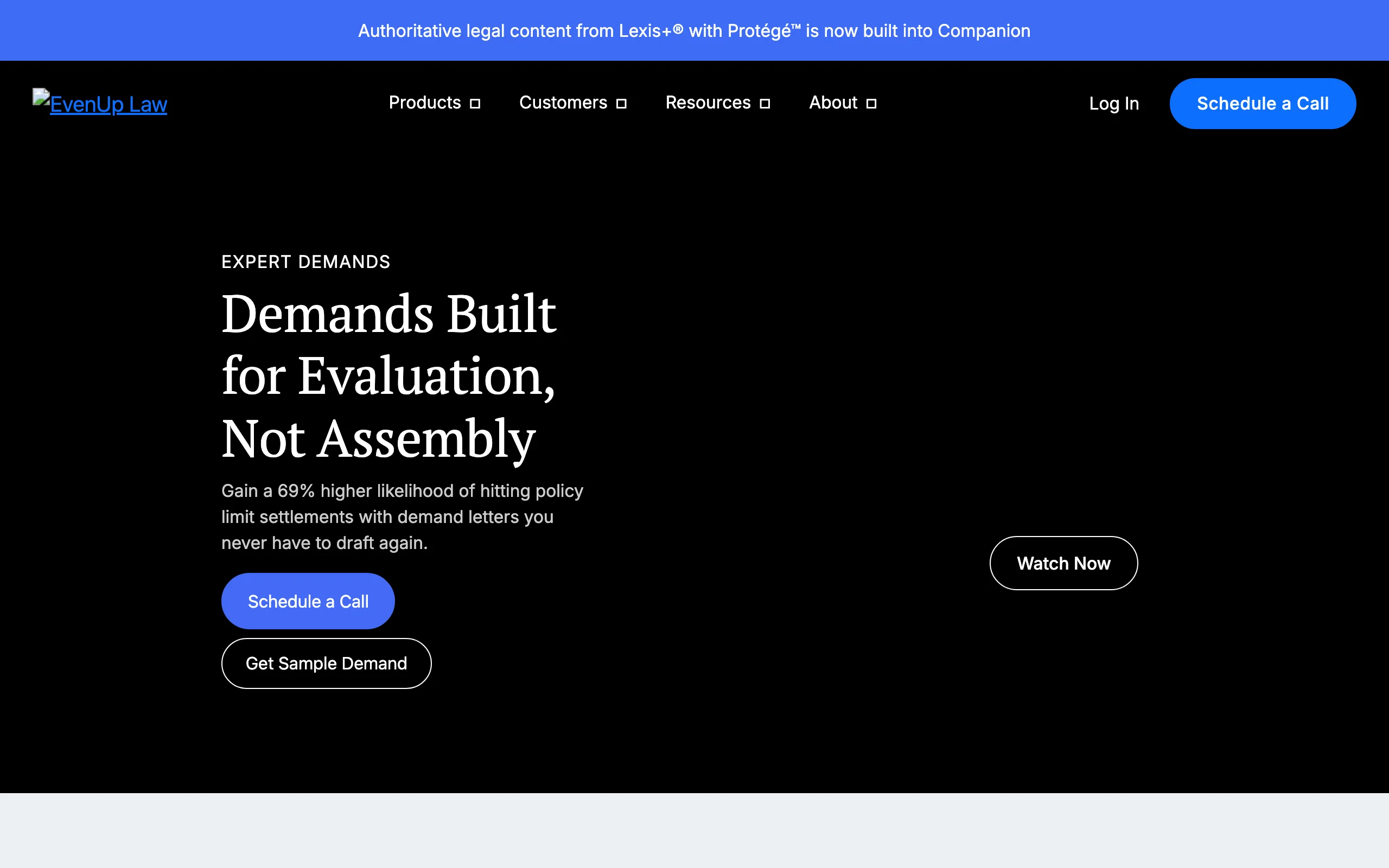
EvenUp is the most direct Supio competitor on demands. It started as a demand letter service and has grown into a pre-litigation and litigation platform for personal injury firms, reporting more than 2,000 PI firm customers. Its pitch is valuation: demands are built on a dataset of 250,000+ verdicts and settlements, and EvenUp claims a 69% higher likelihood of hitting policy limits. Recent additions include intake, treatment tracking, negotiation support, discovery, trial prep, MedChrons, and an AI assistant called Companion.
Key features
- Demand letters drafted with AI plus in-house legal and medical expertise
- Verdict and settlement analytics to support the damages number
- MedChrons medical chronologies and treatment tracking
- Negotiation, discovery, and trial-prep modules
- Integrations with existing case management platforms
Best for
- Personal injury firms sending dozens of demands a month
- Firms that want valuation data behind every demand
Pricing
- Not published; EvenUp quotes by case volume and firm size after a sales call
- Third-party reviews report per-demand fees starting around $300 and rising with record volume (confirm with the vendor)
- Demo-based evaluation, no self-serve trial
Pros
- Deep specialization in PI demands and settlement valuation
- Hybrid AI plus human review for demand quality
Cons
- Opaque, usage-driven pricing that is hard to forecast
- Plaintiff-only scope, like Supio, so it will not help with the rest of your practice
3. Eve, best all-in-one plaintiff operating system
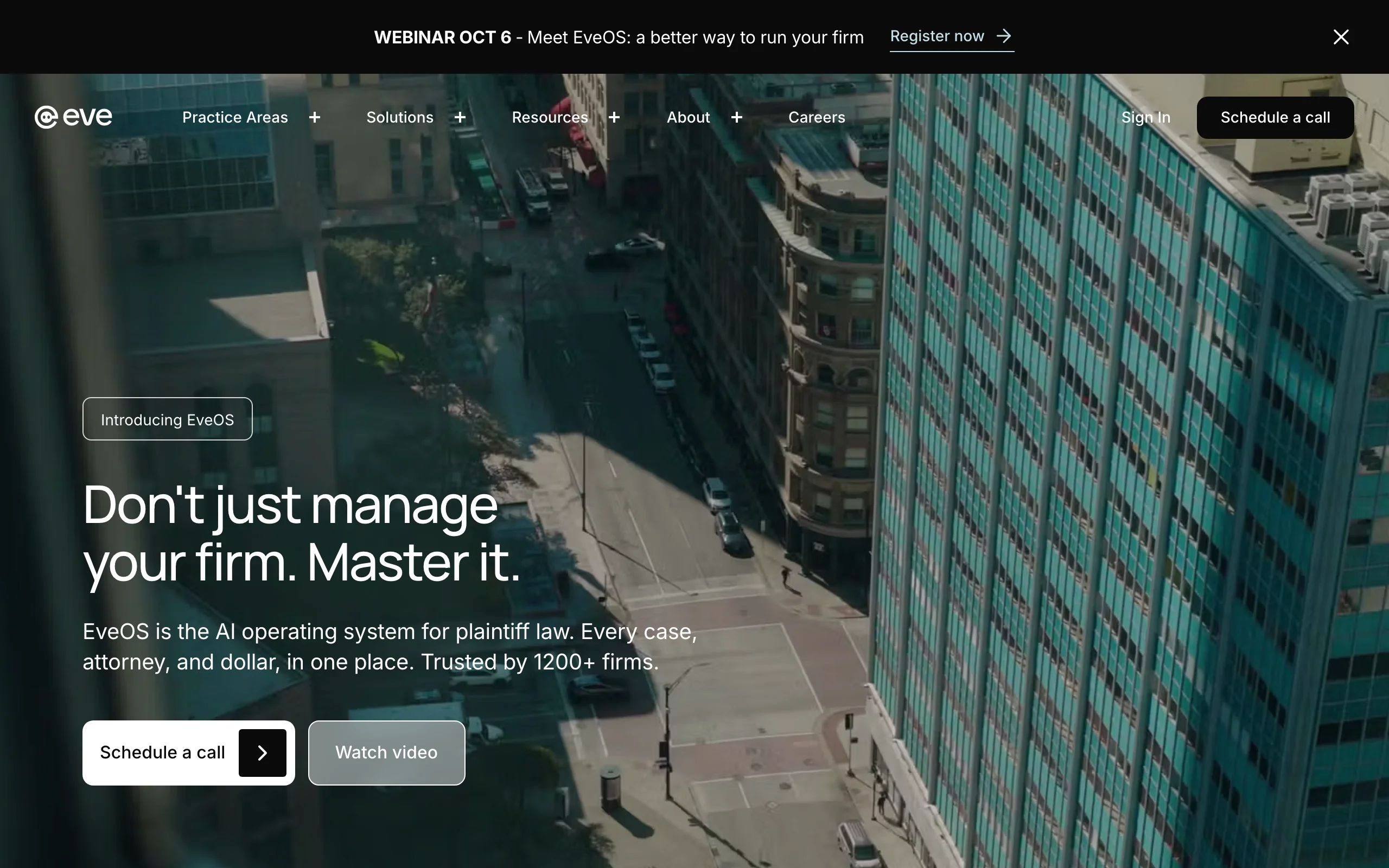
Eve positions EveOS as "the AI operating system for plaintiff law" and says it is trusted by 1,200+ firms. Where Supio is strongest in case-file intelligence, Eve leans into running the firm: 24/7 intake that qualifies leads and signs clients, a nightly Auditor that reviews cases for missed injuries and treatment gaps, an Analyst for firm financials, and Agents that draft demands, discovery, and motions. It serves personal injury, employment, medical malpractice, workers' compensation, and SSDI practices.
Key features
- AI intake that answers, qualifies, and signs new clients around the clock
- Medical chronologies from records and bills
- Drafting agents for demand letters, discovery, and motions
- Nightly case audits that surface next actions and missed issues
- Firm analytics in plain English
Best for
- Growing plaintiff firms that want intake, case work, and analytics on one platform
- Firms practicing across several plaintiff areas, not only PI
Pricing
- Not published; quote after a scheduled call
- Demo-based evaluation, no self-serve trial
Pros
- Broadest plaintiff-side feature set in this list
- Covers several plaintiff practice areas beyond personal injury
Cons
- Swapping Supio for Eve is swapping one platform commitment for another
- Custom pricing makes side-by-side cost comparison difficult
4. CaseMark, best for pay-per-summary chronologies and deposition summaries
CaseMark turns case materials into cited work product. You upload a deposition, a medical record set, or a trial transcript, choose a workflow, and get a formatted summary that cites back to the source page. It covers page-line and narrative deposition summaries, medical chronologies, medical record analysis, proceeding recaps, and more, with a workspace for chat, research, and drafting against your matter files. It is a good fit when you want the chronology output without a firm-wide platform.

Key features
- Deposition summaries in several formats, including page-line and narrative
- Medical chronologies and medical record summaries with source citations
- Hundreds of legal workflows and agent skills for transcripts, records, and pleadings
- Workspace for chat, research, and drafting against matter files
Best for
- Litigators who need deposition and medical record summaries on demand
- Firms that prefer paying for output rather than a platform contract
Pricing
- Workspace Pro: $100/user/month, including a $100 monthly AI usage allowance
- Teams: custom pricing for 2 to 10 users; Enterprise: from $200/user/month with a BAA
- Free trial with a $5 one-time usage credit
Pros
- Transparent entry pricing and a way to try it without sales
- Output is cited to the page, which speeds attorney review
Cons
- Summary and chronology focused; it will not run your demand pipeline or intake
- Usage-based costs rise with record volume
5. Filevine, best for AI inside your case management system
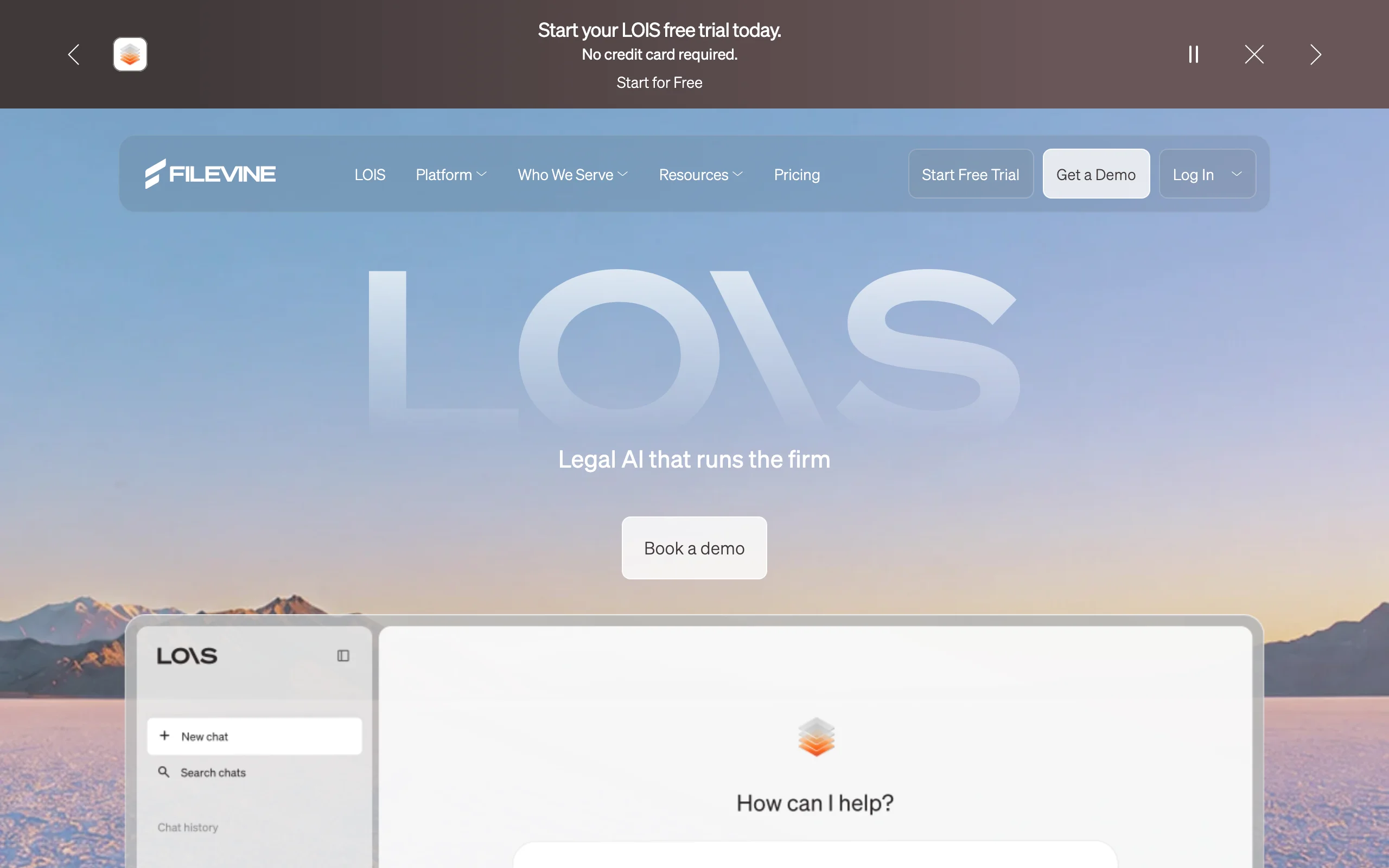
Filevine is a case management platform used heavily by personal injury firms, and its AI layer, LOIS, is built into it. That means AI works on data already in your matters: medical chronologies (MedChron), demand generation, AI Fields that fill case data automatically, document assembly, and a LOIS legal research tool. It also offers LOIS for Word for drafting. If you are replacing Supio and your case management system at the same time, Filevine consolidates both.
Key features
- Full case management for PI and many other practice areas
- MedChron medical chronologies and AI-assisted demand drafting
- AI Fields that populate case data from documents
- LOIS legal research and LOIS for Word drafting
- Document assembly and workflow automation
Best for
- Firms that want case management and AI in one system
- Mid-size PI firms standardizing workflows across many matters
Pricing
- Custom quotes built around the modules you select; no public price list
- A free LOIS Explore tier (no credit card) lets you test document Q&A, drafting, and research in a sandbox without live case data
Pros
- AI works directly on your case data, with no separate upload step
- Serves many practice areas beyond plaintiff PI
Cons
- Full value requires adopting Filevine as your case management system
- Packages are custom-built, so AI costs are hard to compare before a quote
6. Casefleet, best for fact chronologies in software you control
Casefleet is litigation case management built around facts, evidence, and chronologies. Its own comparison page frames the difference with Supio clearly: Casefleet is "software, not a service," so your team builds the chronology in a workspace, with every fact linked to its source document, instead of waiting on a vendor queue. The Advanced AI plan adds document summarization, automated fact extraction, and the Casey AI assistant.
Key features
- Fact chronologies with every fact linked to source evidence
- AI document summarization and automated fact extraction
- Casey AI assistant for natural-language search across case documents
- Document review, transcripts, and team collaboration
- Works for any civil litigation, not only PI
Best for
- Litigators who want to build and own the case chronology themselves
- Firms handling PI alongside other civil litigation
Pricing
- Starter: $30/user/month; Advanced AI: $140/user/month
- Enterprise: custom, for 20+ users
- 14-day free trial, no credit card, limited to 10 documents per case
Pros
- Published per-user pricing and a real self-serve trial
- Your team controls the chronology and the review
Cons
- No done-for-you demand letters or human-verified chronologies
- Your team does more of the work than with a service model
7. CoCounsel (Thomson Reuters), best for Westlaw-grounded research
CoCounsel is Thomson Reuters' AI assistant for legal work, and it is relevant here for a specific reason: Supio's own partnership with Thomson Reuters routes users to Westlaw Advantage for research. If research, motion practice, and litigation drafting are the parts of the Supio workflow you value most, going straight to CoCounsel gives you document review, drafting, deposition preparation, and research grounded in Westlaw content.
Key features
- Legal research grounded in Westlaw content
- Document review and summarization
- Drafting and deposition preparation tools
- Integrations with Microsoft 365 and common document management systems
Best for
- Firms already paying for Westlaw
- Litigation-heavy plaintiff practices that prioritize research and motions
Pricing
- Usually bundled with Westlaw on annual contracts; the standalone CoCounsel Essentials tier lacks Westlaw research
- Third-party estimates range from roughly $100 to over $600 per user per month depending on plan and research coverage (confirm with Thomson Reuters)
- Trials are arranged through sales, not self-serve
Pros
- Research backed by a major legal database
- Strong fit for motion practice and trial preparation
Cons
- No PI-specific demand or medical chronology workflow
- Cost climbs quickly once the Westlaw subscription is included
How to choose the best Supio alternative for your firm
Start by naming the specific reason you are leaving Supio. The answer changes the shortlist.
1) Is the problem price and procurement, or capability?
- If you want published prices and to start today: LegesGPT (from $19.99/month, 3-day $1 trial), Casefleet ($30/user/month, 14-day trial), or CaseMark ($100/user/month Pro).
- If you like Supio's capabilities but want a different vendor: EvenUp or Eve are the closest like-for-like replacements, and both quote custom pricing.
2) Which part of the workflow matters most?
- Demand letters at volume: EvenUp, or Eve's drafting agents. For a smaller caseload, LegesGPT drafts demands from your facts for a flat monthly price, and you can sanity-check numbers with the free settlement calculator.
- Medical chronologies: CaseMark (pay per use), Filevine MedChron, EvenUp MedChrons, or Eve. LegesGPT does not build medical chronologies.
- Research, motions, and litigation drafting: LegesGPT for AI legal research with verified citations at a small-firm price, or CoCounsel if you already pay for Westlaw.
- Owning the fact chronology: Casefleet.
3) Do you want a platform or a tool?
- A platform that runs intake, cases, and analytics: Eve, or Filevine if you also want to change case management systems.
- A tool you use when you need it, alongside your existing case management: LegesGPT, CaseMark, or Casefleet.
4) Is all of your work plaintiff PI?
- Plaintiff-only practice: any of the specialists can fit.
- Mixed practice (PI plus contracts, employment, business, or estate matters): LegesGPT, Filevine, and Casefleet serve work outside plaintiff law, so you are not paying for a second tool.
Many small firms end up combining two options: a pay-per-use chronology tool such as CaseMark for record-heavy files, and LegesGPT for the everyday drafting, research, and review. That pairing often costs less per month than a single platform quote. Whatever you shortlist, run two or three closed files through each tool, compare the demand, chronology, or research output against what your team actually produced, and only then sign. If litigation management is your broader concern, our guide to the best litigation software covers that category.
Give your whole firm a research edge
Accelerate case research, document review, and drafting across your firm — LegesGPT backs every answer with citations your attorneys can verify.
Try LegesGPT for your firmFrequently Asked Questions
What is the best Supio alternative?
It depends on why you are leaving. For small plaintiff firms that want published pricing and help with drafting, research, and document review, LegesGPT is the best all-around Supio alternative, from $19.99 per month with a 3-day $1 trial. For a like-for-like replacement focused on demands and medical chronologies, EvenUp and Eve are the closest competitors, both on custom quotes.
What is the best AI alternative to Supio for a small personal injury firm?
Small firms usually get the most value from self-serve tools with published prices. LegesGPT covers demand letters, litigation drafting, legal research with verified citations, and settlement release review for a flat monthly fee, and CaseMark adds pay-as-you-go medical chronologies and deposition summaries when a file is record-heavy.
How much does Supio cost?
Supio does not publish prices. It describes its model as firm-friendly pricing by case based on volume and asks firms to contact sales for a quote, so there is no public price list or self-serve trial to compare against.
Which Supio alternatives build medical chronologies?
EvenUp (MedChrons), Eve, CaseMark, and Filevine (MedChron) all generate medical chronologies from records. Casefleet lets your team build fact chronologies linked to source documents. LegesGPT does not build medical chronologies; it focuses on drafting, research, and document review.
Is there a Supio alternative with a free trial?
Yes. Casefleet offers a 14-day free trial without a credit card, CaseMark has a free trial with a small usage credit, Filevine has a free LOIS Explore tier, and LegesGPT offers a 3-day trial for $1. EvenUp and Eve are evaluated through sales demos.
Can AI write a personal injury demand letter?
Yes. AI tools can draft a complete demand letter from your facts, treatment summary, and damages, and specialist services like EvenUp add verdict data to support the number. An attorney should still verify every fact, medical detail, and figure before the demand goes to the insurer.
Is it safe to upload medical records to an AI tool?
Medical records contain protected health information, so check each vendor's security and compliance commitments, such as HIPAA support, a business associate agreement, and whether client data is used to train models, before uploading. Plaintiff-specific platforms usually advertise these controls; confirm them in writing for any tool you adopt.
If I mainly need help drafting and researching for my injury cases, what should I use?
LegesGPT is built for that. It drafts demands, letters, and litigation documents, answers legal questions with verified citations, reviews releases and agreements to flag risks and propose changes, and lets you e-sign, all in one browser app from $19.99 per month with a 3-day $1 trial.