

A personal injury file is mostly paper: 1,500 pages of medical records, a stack of bills, a police report, a policy declarations page, and an adjuster who will read none of it closely. The work that moves a case (a clean chronology, a demand that ties every dollar to a record, a release with no surprises) is also the work that eats paralegal hours.
AI tools for personal injury lawyers now handle much of that load. They build medical chronologies in minutes, draft demand letters from case facts, flag risky terms in releases and settlement agreements, and answer liability and damages questions with sources you can check.
This guide compares the 9 best AI tools for personal injury lawyers in 2026, from AI software built for plaintiff law firms (EvenUp, Supio, Eve) to case management systems with AI built in. For each one you get pricing, key features, honest pros and cons, and a decision framework to match the tool to your caseload.
Best AI tools for personal injury lawyers: a brief overview
All-in-one legal AI
- LegesGPT: Best overall for solo and small PI firms: drafts demand letters and firm documents, reviews releases and policies for risk, researches negligence and damages law with verified citations, and sends documents for e-signature, from $19.99/mo.
PI-specific platforms
- EvenUp: Best for outsourced, professionally reviewed demand packages: AI drafts plus an in-house review team, priced per case.
- Supio: Best for high-volume and mass tort plaintiff firms: an agentic platform that works across medical records, demands, discovery, and deposition prep.
- Eve: Best for automating the full plaintiff workflow from intake call to complaint: 24/7 intake, demands in your firm's style, discovery responses, and a nightly case auditor.
- CaseMark: Best for pay-as-you-go medical chronologies: no seat contract, priced per summary and per page.
Case management with AI built in
- Filevine: Best for PI firms that want AI inside their case management system: MedChron, DemandsAI, and Depo CoPilot on the same matter record.
- SmartAdvocate: Best for plaintiff firms that need a server-based deployment option: PI case management with built-in AI summaries, chronologies, and demands.
- Clio: Best for small general practices adding PI matters: familiar practice management plus a personal injury add-on for medical records, liens, and settlements.
General-purpose AI
- Claude: Best budget option for plain-language client communication and long-document reading, as long as you keep it away from citations.
| Tool | Best for | Starting price | Free trial | Platforms |
|---|---|---|---|---|
| LegesGPT | All-in-one for solo and small PI firms | From $19.99/mo | 3-day, $1 | Web |
| EvenUp | Professionally reviewed demand packages | Case-based (custom) | Demo only | Web |
| Supio | High-volume and mass tort firms | Custom | Demo only | Web |
| Eve | End-to-end plaintiff workflow automation | Custom | Demo only | Web |
| CaseMark | Pay-as-you-go medical chronologies | $25/summary + $0.05/page | Free, $5 credit | Web |
| Filevine | AI inside PI case management | Custom | Demo only | Web |
| SmartAdvocate | Cloud or server-based PI case management | Custom | Demo only | Web, mobile |
| Clio | General practices adding PI matters | From $49/user/mo | Free trial | Web, mobile |
| Claude | Client letters and long-document reading | Free; Pro $20/mo | Free tier | Web, desktop, mobile |
1. LegesGPT, best overall for solo and small personal injury firms
LegesGPT is built around the four things a small PI practice does every week: drafting, reviewing, researching, and getting signatures. Describe the incident, injuries, treatment, and specials, and it drafts a first-pass demand letter you can edit into your firm's voice. The same legal document generator handles contingency fee agreements, letters of representation, preservation letters, and lien correspondence, starting from 100+ attorney-drafted templates rather than a blank page.
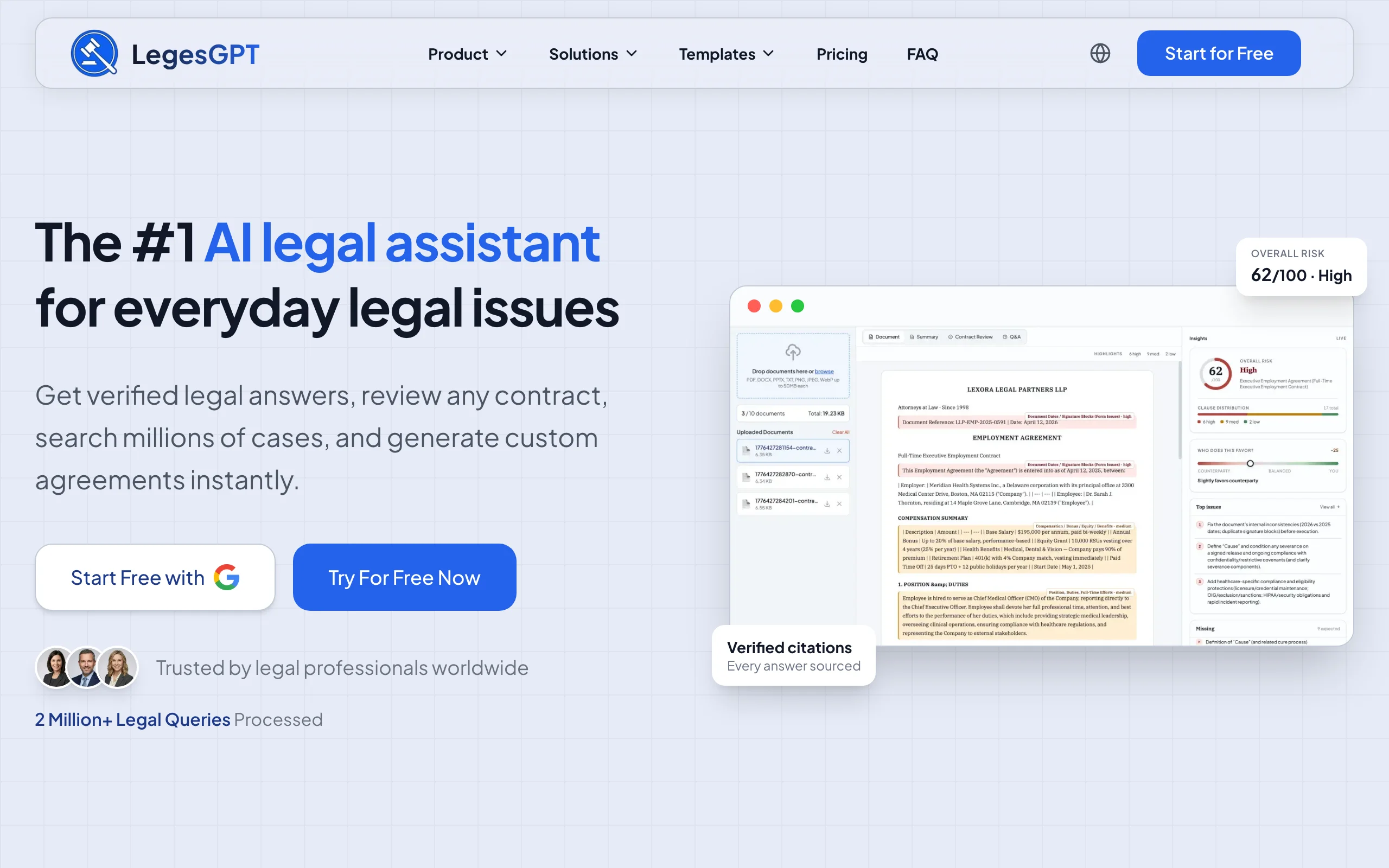
Review is where it saves the most risk. Upload a settlement release, a policy, or a medical-provider agreement and it flags problem terms (an overbroad release of unknown claims, a confidentiality clause that binds your client, a lien waiver that does not match the negotiated reduction), proposes changes, and summarizes the document in plain language. For liability and damages questions (comparative fault rules, damages caps, notice deadlines for claims against a city), you get answers with verified citations and source links, or you can run an AI case law search for comparable verdicts and appellate law directly. When the paperwork is final, e-signature sends it to the client without a separate tool.
Key features:
- AI drafting of demand letters, fee agreements, preservation letters, and lien correspondence
- Document review that flags risky terms in releases, policies, and settlement agreements and proposes fixes
- Legal research with verified citations on negligence, damages, and procedural questions
- Built-in e-signature for retainers, authorizations, and settlement documents
- Deep Research mode for multi-step questions (e.g. dram shop liability plus comparative fault)
- Accepts PDF, DOCX, PPTX, TXT, and images, including scanned records
Best for:
- Solo PI attorneys and 2-20 attorney plaintiff firms that want drafting, review, research, and signing in one subscription
- Firms that write their own demands and want a faster first draft, not an outsourced service
Pricing:
- Basic: $19.99/mo (unlimited queries, case law and statute search, verified citations)
- Plus: $49.99/mo (adds document upload and 50 document reviews/month)
- Premium: $99.99/mo (unlimited document reviews, Deep Research, web search)
- 3-day trial for $1; annual billing saves 30%
Pros:
- Flat monthly price with no per-case fees, so cost does not scale with your caseload
- Verified citations make it safe to use for the research side of a demand, where general chatbots invent cases
- Self-serve signup and a $1 trial; no demo call, seat minimum, or annual contract
Cons:
- Not a medical chronology engine: it does not auto-sort a 2,000-page record set by provider the way CaseMark or MedChron does
- Web-only, with no case management integration, Word add-in, mobile app, or API
Review releases and settlement agreements before your client signs
Upload a contract and LegesGPT flags risky clauses, surfaces obligations and deadlines, and answers questions with citations you can verify.
Try AI document review2. EvenUp, best for professionally reviewed demand packages
EvenUp is the best-known name in AI demand letters for personal injury, and it says more than 2,000 firms use it. Its core product turns medical records and case files into a demand package, with two tracks: Express Demands, drafted by AI in minutes for your team to finish, and Expert Demands, delivered finalized in 1-5 days after EvenUp's legal staff review them.
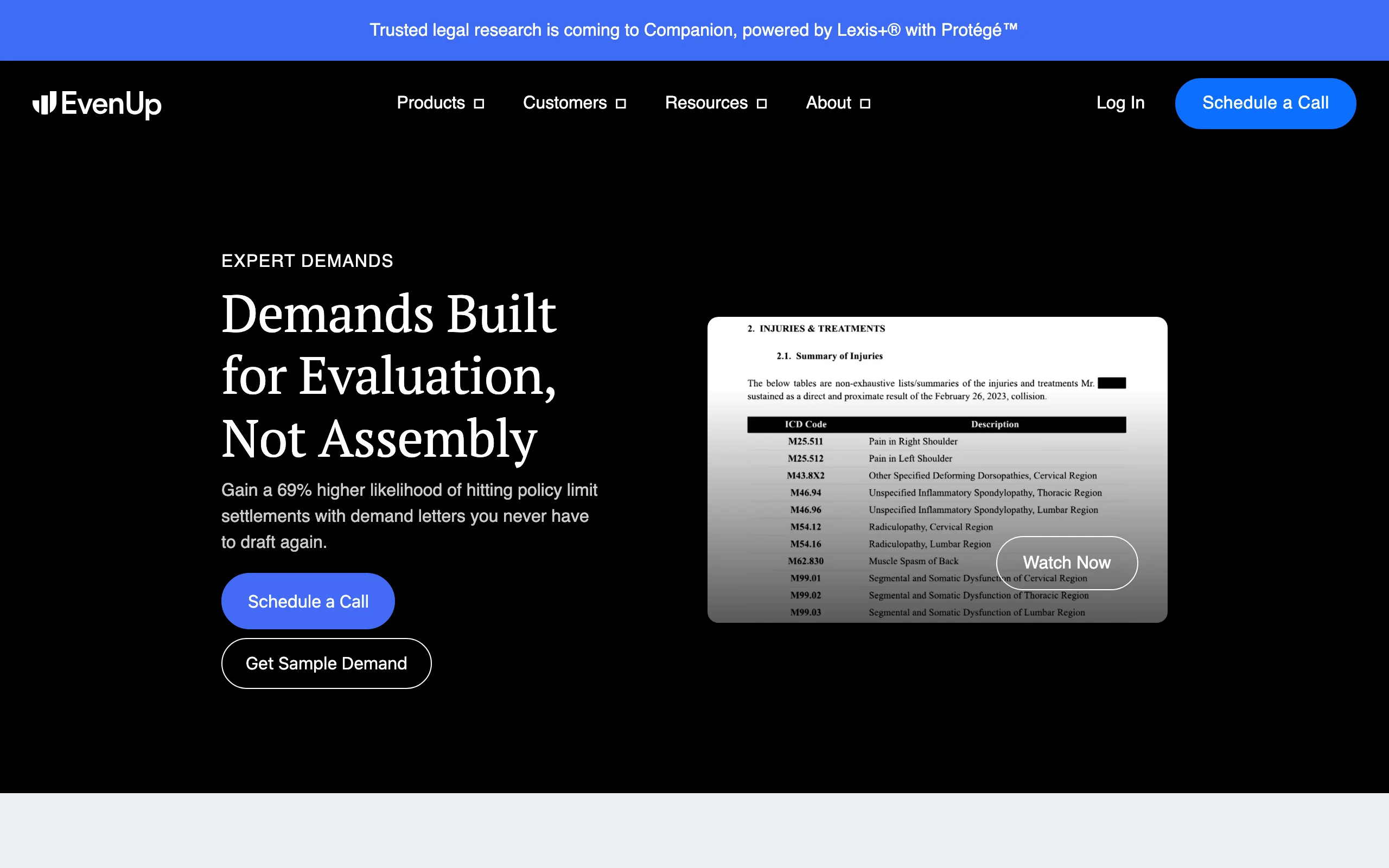
It has since grown well past demands into a pre-litigation platform: medical chronologies (MedChrons), treatment management, negotiation support, a settlement repository, discovery and trial tools, and case management integrations that pull case details in automatically. The trade-off is cost structure: pricing is case-based and quoted by sales, so it fits firms with steady demand volume more than a solo with a handful of files.
Key features:
- Express Demands (AI drafts in minutes) or Expert Demands with professional review (1-5 days)
- MedChrons for medical chronologies, with ICD codes and damages narratives captured
- Settlement repository and negotiation support for valuation
- Case management integrations that auto-populate case files
- Pre-litigation, discovery, and trial modules
Best for:
- PI firms that want a finished demand package without adding drafting staff
- Growing practices sending demands every week
Pricing:
- Case-based pricing; no public rates, quotes via sales
- No self-serve trial
Pros:
- Human review option removes the "who checks the AI" problem for busy teams
- Deep PI focus across the pre-litigation lifecycle
Cons:
- Per-case pricing grows with volume and is not published
- Built for plaintiff PI only; no help with the rest of your firm's legal work
3. Supio, best for high-volume and mass tort plaintiff firms
Supio is an AI platform built only for plaintiff law and mass torts, and its 2026 release, Supio Agent, is pitched as an end-to-end agentic system from first call to case resolution. It handles case-level work (medical chronologies, demand letters, case ledgers, litigation drafting, deposition prep, interrogatory responses, missing-records flags) and firm-level work (cross-case pattern recognition, mass tort discovery, dashboards, and performance benchmarking).
The firm-level layer is what separates it from a demand-letter tool. If you run hundreds of files, Supio can surface treatment gaps and undiagnosed injuries across the docket, not just inside one case. That power is priced accordingly: Supio sells through demos and publishes no rates.
Key features:
- Supio Agent for chronologies, demands, litigation drafting, and deposition prep
- Missing-records flagging and treatment-gap detection
- Mass tort discovery and cross-case pattern recognition
- Firm dashboards, task prioritization, and benchmarking
- Integrations with case management, document management, and Westlaw
Best for:
- Plaintiff firms with large PI dockets or mass tort inventories
- Firms that want analytics across cases, not just faster drafting
Pricing:
- Custom pricing; demo required
- No public trial
Pros:
- Covers pre-litigation and litigation work in one PI-native system
- Firm-wide analytics that single-case tools do not offer
Cons:
- Enterprise sales process and opaque pricing
- More platform than a solo or two-attorney firm is likely to use
4. Eve, best for automating the plaintiff workflow from intake to complaint
Eve describes itself as an AI operating system for plaintiff firms, and it reports use by more than 1,200 firms. Where EvenUp starts at the demand, Eve starts at the phone: its intake agent answers calls 24/7, scores leads, and gets the fee agreement signed. From there it builds medical chronologies, drafts demand letters in your firm's style and formatting, drafts complaints and good-faith letters, and propounds and responds to discovery.
Eve's AI Auditor reviews cases nightly for overlooked injuries, missed deadlines, and factual gaps, and its Analyst that answers questions about firm performance (revenue, margins, settlement pacing) in plain English. It also includes case law research for verifying facts and citing sources.
Key features:
- 24/7 AI intake with lead scoring and signed fee agreements
- Demand letters in your firm's style, plus complaints and good-faith letters
- Discovery drafting and responses with objections
- Nightly AI Auditor for overlooked injuries and missed deadlines
- Firm analytics in plain English
Best for:
- Plaintiff firms that want intake, drafting, and discovery automated in one system
- Litigation-heavy PI practices that file often
Pricing:
- Custom pricing; demo required
- No public trial
Pros:
- Covers the front of the funnel (intake) that most PI tools skip
- Strong on litigation drafting (complaints, discovery), not just pre-suit demands
Cons:
- No published pricing
- A full operating system is a bigger change-management project than a single tool
5. CaseMark, best for pay-as-you-go medical chronologies
CaseMark is a general legal AI workspace with a strong medical-records product, and its pricing model is the draw for PI firms that do not want a seat contract. Medical Summaries are pay as you go: $25 per summary plus $0.05 per source page, so a 2,000-page record set costs $125.
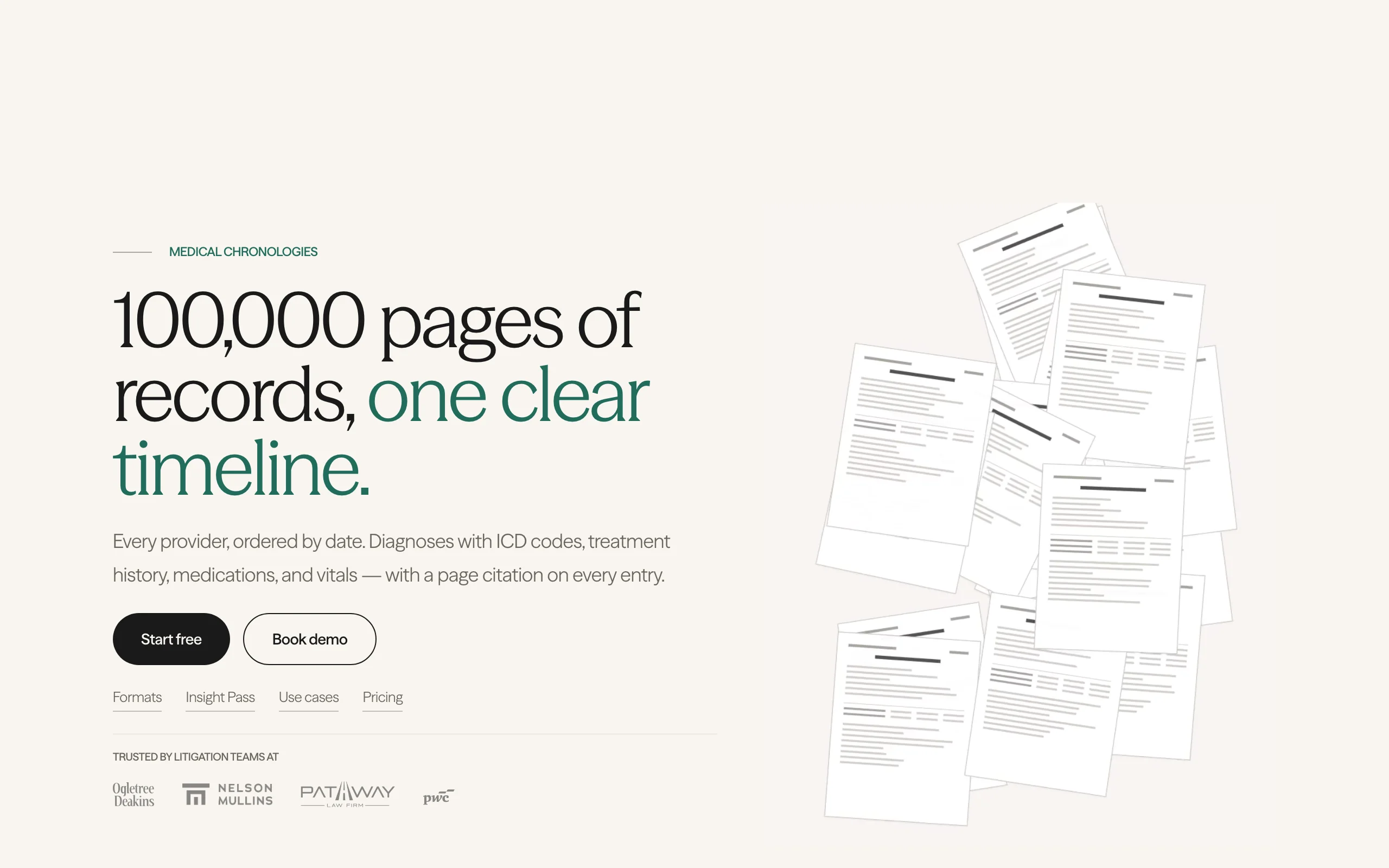
You choose among three outputs: an injury-focused Medical Analysis that filters unrelated history, a Comprehensive Medical Chronology covering every encounter, and a Treatment Summary Chronology focused on clinical decisions. Each entry cites the source page, and CaseMark says record sets over 100,000 pages process in about 30 minutes. Beyond records, the Workspace plan adds document analysis, AI chat, and a large library of legal agent skills.
Key features:
- Three chronology formats, with diagnoses, ICD codes, treatments, and medications
- Source-page citations on every entry
- Discrepancy and gap flagging across providers
- Workspace for document analysis and AI chat
- Optional Insight Pass add-on per summary
Best for:
- PI and med-mal firms that order chronologies case by case
- Firms replacing an outsourced nurse-review vendor
Pricing:
- Medical Summaries: $25 per summary + $0.05 per source page (Insight Pass +$25/summary)
- Workspace Pro: $100/user/mo, including $100 of monthly usage
- Free trial for one user with a $5 usage credit, no card required
Pros:
- Transparent, usage-based pricing you can budget per file
- Source-linked chronologies make attorney verification fast
Cons:
- No human-reviewed demand service or case management layer; outputs feed your own workflow
- Costs rise with very large record sets and add-ons
6. Filevine, best for AI inside your PI case management system
Filevine is one of the most common case management platforms in plaintiff practice, and its AI lives on the same matter record as your contacts, deadlines, and documents. MedChron classifies and organizes uploaded medical records, builds hyperlinked chronologies grouped by provider, facility, or date, and shows timelines that expose gaps and delays. DemandsAI drafts demand letters from case data, and Depo CoPilot streams a live deposition transcript with real-time question suggestions and inconsistency flags.
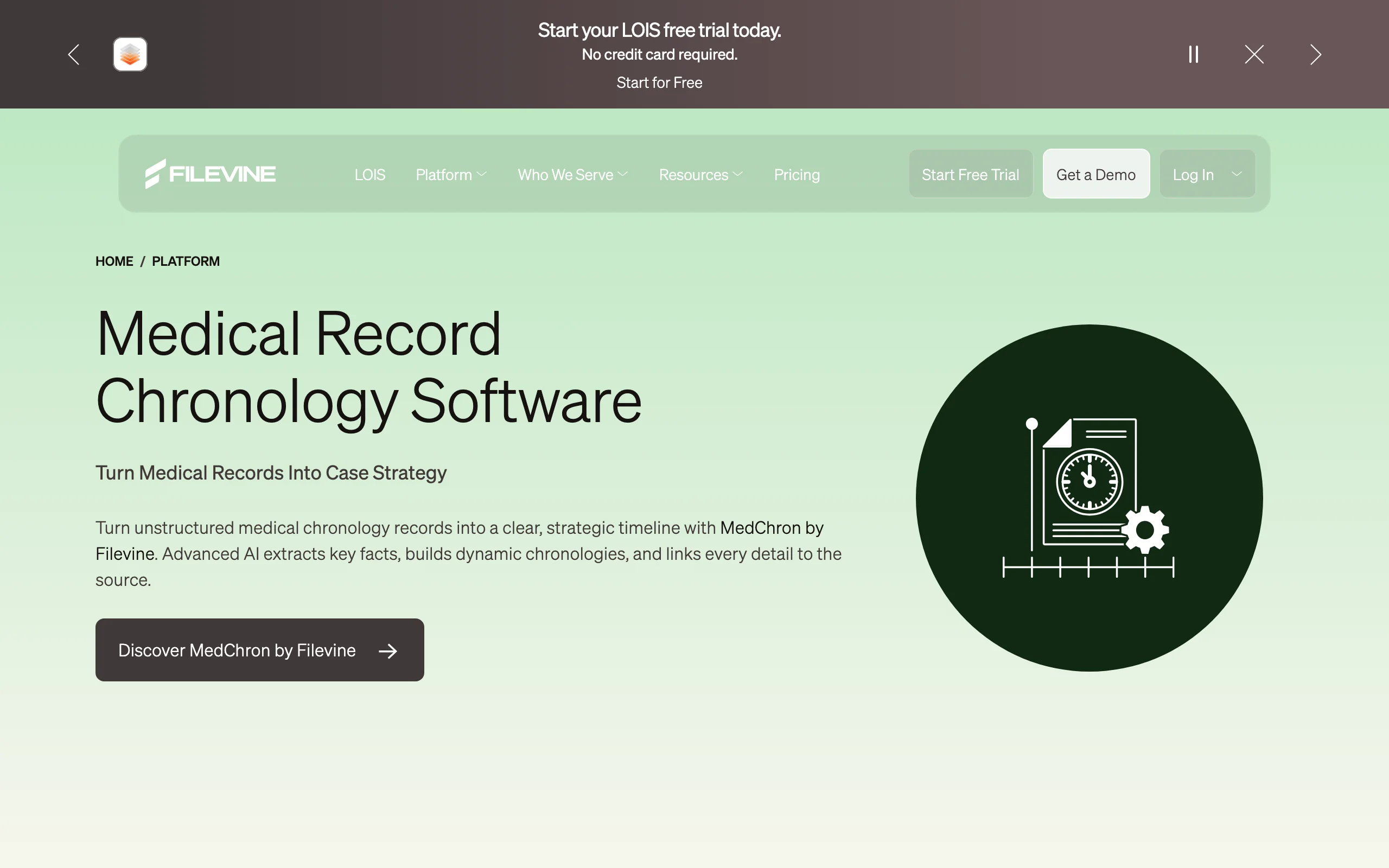
The advantage is no copy-paste: records, chronology, and demand stay in one system. The catch is that you are buying a case management platform, with quote-based pricing and implementation work, not a standalone AI tool.
Key features:
- MedChron: automatic record classification and source-linked chronologies
- DemandsAI: demand letters drafted from case data
- Depo CoPilot: real-time deposition support
- LOIS for AI drafting and research inside the platform
- Full PI case management (deadlines, contacts, documents, collaboration)
Best for:
- Mid-size PI firms already on Filevine or ready to switch case management
- Firms that want records, chronologies, and demands on one matter record
Pricing:
- Custom, quote-based pricing; AI pricing not published
- Demo on request
Pros:
- AI output lands directly in the case file your team already uses
- Live deposition support, not just prep
Cons:
- Switching case management systems is a major project
- Pricing is not published, so total cost is hard to compare
7. SmartAdvocate, best for plaintiff firms that need a server-based option
SmartAdvocate is case management built for plaintiff and PI firms, with statute of limitations tracking, medical lien management, multi-carrier insurance tracking, and automatic disbursement sheets. Its AI layer, SmartIntelligence, summarizes cases, medical records, motions, and depositions, runs multi-document summaries and AI case chat, and automates demand letters and medical chronologies.
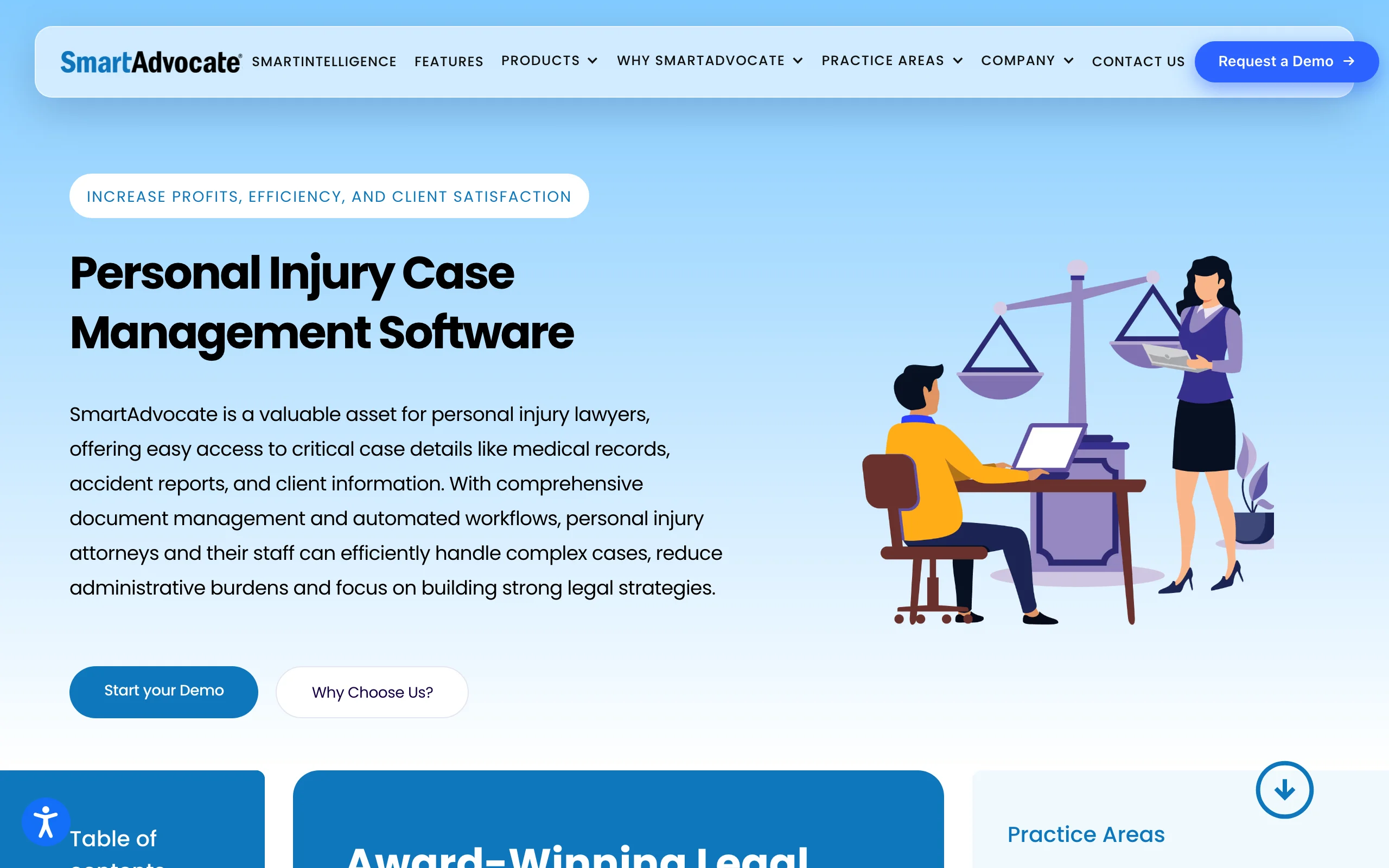
What sets it apart is deployment: you can run it in SmartAdvocate's cloud or on a server located wherever you choose, both accessed through the browser. For firms with strict data-location requirements, that option matters. AI Case Assembly also turns incoming case materials into an organized case file with extracted data and summaries.
Key features:
- SmartIntelligence summaries of records, motions, and depositions
- Automated demand letters and medical chronologies
- AI Case Assembly from incoming case materials
- Statute of limitations tracking and lien management
- Cloud or server-based deployment
Best for:
- Established plaintiff firms that want PI-native case management
- Firms with data-residency or on-premise requirements
Pricing:
- Custom pricing; demo required
Pros:
- PI-specific workflows (liens, multi-carrier tracking, disbursements) out of the box
- Rare server-based deployment option
Cons:
- Another full case management migration if you are on a different system
- No public pricing
8. Clio, best for small general practices adding PI matters
Clio is the most widely used practice management platform for small firms, and for PI work it offers a dedicated add-on: medical records and bills organized by provider with follow-up reminders, a settlement calculator for running negotiation scenarios, lien and damages tracking, HIPAA compliance, and settlement statements you can send for e-signature. Manage AI (formerly Clio Duo) handles billing drafts and matter administration, and Clio Work adds an AI workspace for case analysis and research.
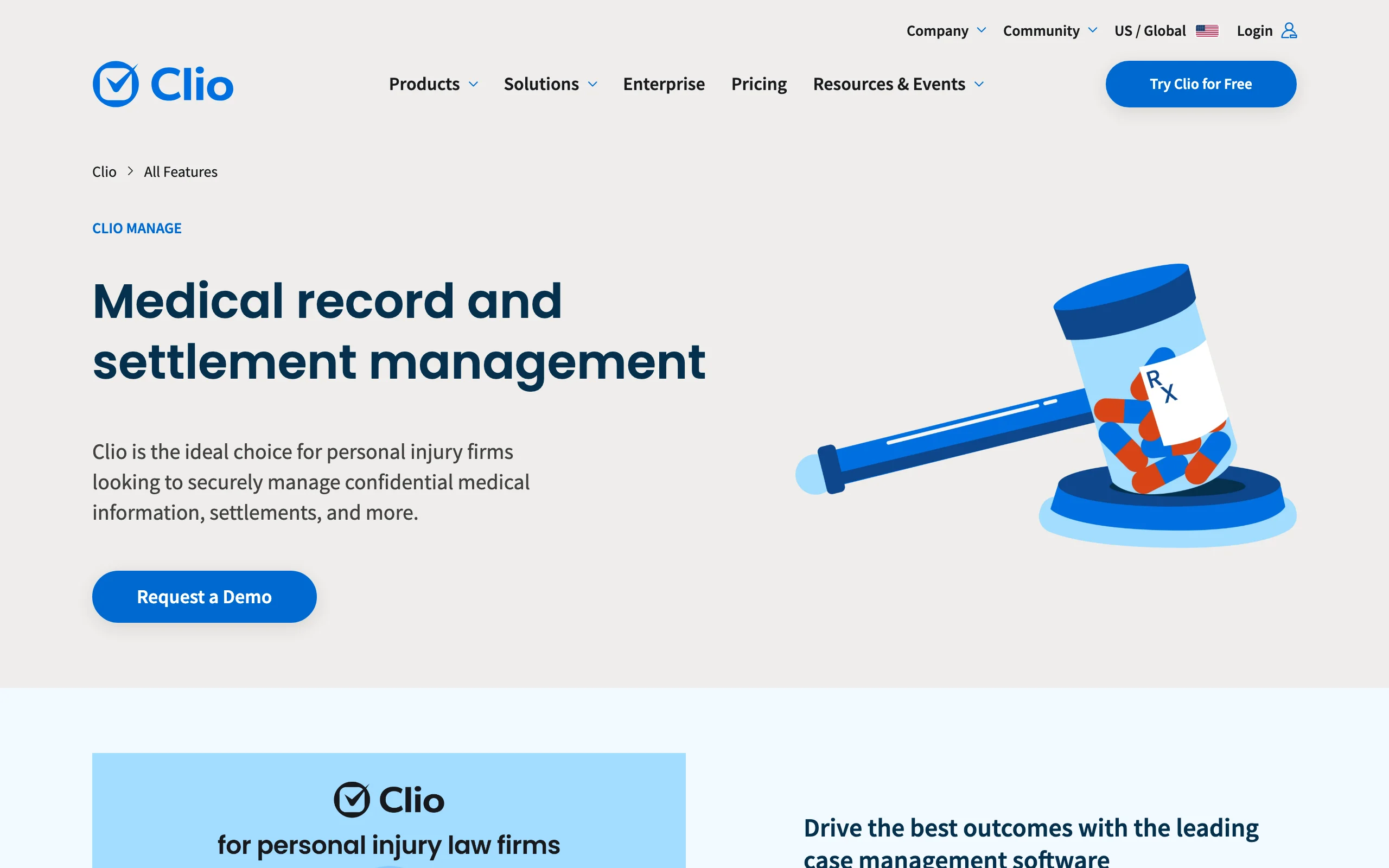
Clio is the right choice when PI is one of several practice areas and you want billing, trust accounting, and PI tracking in one place. It is lighter on PI-specific AI than Filevine or SmartAdvocate: there is no built-in demand generator or medical chronology engine.
Key features:
- Medical records and bills organized by provider
- Settlement calculator with liens, fees, and net-to-client
- Manage AI for billing and matter administration
- Clio Work AI workspace for analysis and research
- Legal billing, trust accounting, and 300+ integrations
Best for:
- General practices and small firms with a growing PI caseload
- Firms that want mainstream practice management first, PI features second
Pricing:
- Plans start at $49/user/mo (Starter); higher tiers quoted via sales
- Personal injury features are a paid add-on, priced by sales
- Free trial available
Pros:
- Mature billing, trust accounting, and integrations ecosystem
- PI add-on can be purchased per user
Cons:
- No dedicated demand generator or medical chronology engine
- Full pricing now sits behind a sales form
9. Claude, best budget option for client communication
Claude, from Anthropic, is a general-purpose AI that PI lawyers use for the writing nobody bills for: explaining a lien reduction to a client in plain English, turning a deposition transcript into a two-page summary, or tightening the narrative section of a demand you already drafted. It reads very long documents in one conversation, which suits PI files.
It has no legal database and does not verify citations, so it should never be the source for case law in a demand or brief. Before uploading medical records, check that your plan's data-handling terms fit your HIPAA and confidentiality obligations.
Key features:
- Long-document reading and summarization
- Plain-language rewriting for client letters
- Projects to keep one matter's documents and chats together
- Web, desktop, and mobile apps
Best for:
- Solos who want a cheap writing assistant alongside a legal-specific tool
- Client communication and internal summaries
Pricing:
- Free tier
- Pro: $20/mo (about $17/mo billed annually)
- Team and Enterprise plans for firms
Pros:
- Lowest-cost way to speed up client communication
- Handles long transcripts and records in one pass
Cons:
- No verified legal research; citations must come from elsewhere
- You must confirm its data terms fit your HIPAA and confidentiality duties before uploading records
How to choose the best AI tool for your personal injury practice
AI software for plaintiff attorneys is not one category: the PI tools in this list solve different bottlenecks. Start with the one that costs your firm the most hours or the most settlement value, then add from there.
1) Do you want a service or a tool?
- If you want finished demand packages without hiring: EvenUp's Expert Demands are the closest thing to outsourcing with AI speed.
- If your team writes its own demands: LegesGPT drafts a strong first pass for a flat monthly fee; add a chronology tool like CaseMark when record sets get large. An AI paralegal approach keeps the judgment in-house while removing the blank-page time.
2) Where is your biggest bottleneck?
- Medical records: CaseMark for pay-per-file chronologies; Filevine MedChron if you want them inside case management.
- Intake and lead conversion: Eve, whose intake agent answers, qualifies, and signs clients 24/7.
- Litigation (complaints, discovery, depositions): Eve or Supio for drafting; Filevine Depo CoPilot for depositions.
- Releases, policies, and research: LegesGPT, which reviews documents for risk and backs liability and damages questions with AI legal research you can cite.
3) What does your caseload look like?
- Solo or 2-5 attorneys, under ~50 open files: LegesGPT ($19.99-$99.99/mo) plus CaseMark per file keeps AI spend under a few hundred dollars a month. Use the free personal injury settlement calculator for quick valuation ranges before you draft.
- Mid-size firm with steady demand volume: EvenUp or Filevine, depending on whether you want a service or a platform.
- High-volume or mass tort: Supio or Eve, where firm-wide analytics justify enterprise pricing.
4) Are you changing case management?
- Staying on Clio: add the PI module and layer LegesGPT or CaseMark for drafting and chronologies.
- Ready to switch: compare Filevine and SmartAdvocate side by side, and ask about server-based deployment if data location matters.
Whatever you shortlist, test it on three closed files where you already know the outcome. Compare the AI chronology against your nurse reviewer's, and the AI demand against the one that actually settled. For a refresher on what a strong demand includes, see our demand letter attorney sample.
One AI subscription for drafting, review, research, and e-signature
Accelerate case research, document review, and drafting across your firm — LegesGPT backs every answer with citations your attorneys can verify.
Try LegesGPT for your firmFrequently Asked Questions
What are the best AI tools for personal injury lawyers?
The strongest 2026 options are LegesGPT for all-in-one drafting, document review, verified-citation research, and e-signature; EvenUp for professionally reviewed demand packages; Supio for high-volume and mass tort firms; Eve for intake-to-complaint automation; CaseMark for pay-as-you-go medical chronologies; Filevine and SmartAdvocate for case management with AI built in; Clio for general practices adding PI matters; and Claude for low-cost client communication. The right pick depends on whether your bottleneck is demands, medical records, intake, or litigation.
Can AI write a personal injury demand letter?
Yes. EvenUp, Eve, Supio, and Filevine DemandsAI generate demand letters from medical records and case data, and LegesGPT drafts a first-pass demand from the facts, injuries, and specials you provide. An attorney still needs to verify every figure against the records, confirm the liability narrative, and set the demand amount before it goes to the adjuster.
What is the best AI legal assistant for plaintiff firms on a budget?
For a solo or small plaintiff firm, LegesGPT at $19.99 to $99.99 a month covers drafting, document review, legal research with verified citations, and e-signature without per-case fees. Pair it with CaseMark's pay-as-you-go medical summaries, priced at $25 per summary plus $0.05 per page, when you need a chronology for a large record set.
Can AI build a medical chronology from medical records?
Yes. CaseMark, Filevine MedChron, EvenUp, Supio, Eve, and SmartAdvocate all generate medical chronologies, and CaseMark, Filevine, and Supio link entries back to the source pages. Source links matter most, because they let a paralegal or attorney verify each entry quickly instead of re-reading the full record set.
Is it safe to upload medical records to an AI tool?
It can be, if the vendor's security and data-handling terms fit your HIPAA and confidentiality obligations. PI-specific platforms such as Supio and Filevine publicly cite HIPAA compliance, while consumer chatbots vary by plan. Confirm that client data is not used for model training, check whether a business associate agreement is available, and follow your firm's policy before uploading anything.
How much do AI tools for personal injury lawyers cost?
Pricing splits into three models. Flat subscriptions such as LegesGPT ($19.99 to $99.99 a month) and Claude Pro ($20 a month) cost the same no matter how many cases you run. Usage pricing such as CaseMark scales per file. Case-based or custom enterprise pricing from EvenUp, Supio, Eve, Filevine, and SmartAdvocate is quoted by sales and usually suits firms with steady case volume.
Will AI replace personal injury paralegals?
No, but it changes what they spend time on. AI removes the mechanical work of sorting records, drafting first-pass demands, and summarizing depositions, so paralegals shift toward client communication, records retrieval follow-up, lien negotiation, and quality control of AI output, which is where their judgment adds the most value.
Can general AI chatbots like ChatGPT or Claude handle personal injury research?
They are useful for writing and summarizing but risky for research, because they do not verify citations and can invent case law. Use a legal-specific tool with verified citations for comparative fault rules, damages caps, and statutes of limitation, and keep general chatbots for client letters and internal summaries.
If I mainly need to draft demands and review settlement documents, what should I use?
LegesGPT is the most direct fit: it drafts demand letters and fee agreements, reviews releases and settlement agreements for risky terms with proposed changes, researches the law with verified citations, and sends documents for e-signature. The Plus plan at $49.99 a month includes 50 document reviews, and the $1 three-day trial lets you test it on a closed file first.