
Spellbook made AI contract work feel native by living right inside Microsoft Word, where transactional lawyers already draft and redline. But it is built around one workflow, contracts in Word, and sells on custom quotes that many solo practitioners and small firms find hard to access. If you want broader legal AI, simpler pricing, or a tool you can try today without a sales call, you have options.
This guide compares the best Spellbook alternatives for lawyers and in-house teams. For each tool you get what it does, key features, pricing, and who it fits, plus a decision framework to match the right one to your practice. We start with LegesGPT, an all-in-one alternative that handles drafting, review, research, and signing in one self-serve subscription from $19.99/month.
Why look for a Spellbook alternative?
Spellbook is a capable contract drafting and review assistant, and for Word-centric transactional teams it does its job well. Lawyers still look elsewhere for a few practical reasons:
- Quote-only pricing. Spellbook no longer publishes prices; cost is set by team size and quoted per license, which makes it hard to budget without a sales conversation.
- Word-only, contract-only scope. Spellbook lives inside Microsoft Word and focuses on contracts. If you also need case law research, litigation drafting, or a browser-based workflow, you are buying a second tool.
- Add-in dependency. It requires installing and maintaining a Word add-in, which is friction for teams that work in browsers, Google Docs, or locked-down IT environments.
If any of those describe your situation, the tools below cover the same contract work and often more.
Best Spellbook alternatives: a brief overview
- LegesGPT: Best overall for solo and small firms: drafting, document review, legal research, and e-signature in one affordable, self-serve plan.
- Harvey AI: Best for BigLaw and enterprise legal teams that need agentic workflows and deep document analysis at scale.
- CoCounsel (Thomson Reuters): Best for firms already invested in Westlaw that want research-grounded drafting.
- Luminance: Best for high-volume due diligence and enterprise-grade contract analysis.
- LawGeex: Best for in-house teams automating first-pass contract approval against a playbook.
- Ironclad: Best for end-to-end contract lifecycle management, not just drafting and review.
- Lexis+ AI: Best for research-led drafting inside the LexisNexis ecosystem.
| Tool | Best for | Starting price | Free trial | Platform |
|---|---|---|---|---|
| LegesGPT | All-in-one for solo & small firms | From $19.99/mo | 3-day trial | Browser app |
| Harvey AI | BigLaw & enterprise teams | Custom (enterprise) | Demo only | Web + integrations |
| CoCounsel | Firms already on Westlaw | ~$225/user/mo (bundled) | Demo only | Web + integrations |
| Luminance | High-volume due diligence | Custom ($100k+/yr) | Demo only | Web + Word |
| LawGeex | In-house approval workflows | Custom (enterprise) | Demo only | Web integrations |
| Ironclad | Contract lifecycle management | Custom (~$20k+/yr) | Demo only | Web platform |
| Lexis+ AI | Research-led drafting | Custom (quote-only) | Demo only | Web + integrations |
1. LegesGPT, best overall for solo and small firms
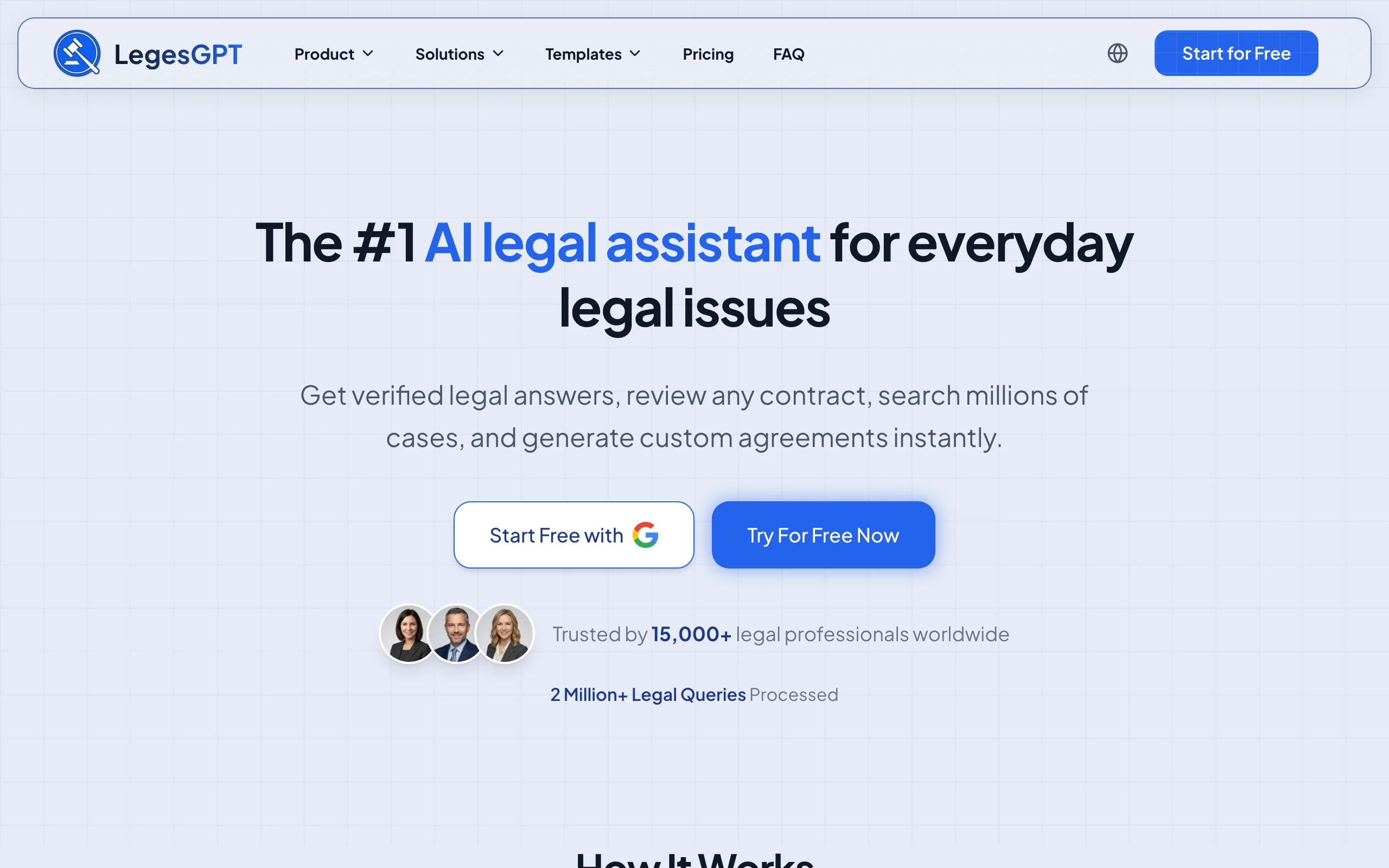
LegesGPT is an all-in-one legal AI assistant that covers the full contract workflow, then keeps going. Where Spellbook stops at drafting and review inside Word, LegesGPT drafts contracts and documents, reviews uploaded files to flag risky clauses and propose changes, answers legal questions with verified citations, and lets you e-sign and send, all in one browser app and one subscription. There is no add-in to install and no sales call to start.
Key features
- AI drafting of contracts and legal documents, plus 100+ attorney-drafted templates
- AI document review for PDF, DOCX, PPTX, TXT, and images: flags problematic clauses, proposes edits, and gives plain-language summaries
- Legal questions answered with verified citations and clickable source links
- Case law and statute search, with Deep Research mode for multi-step questions
- Built-in e-signature to sign and send finished documents
- Free tools including a contract generator, citation generator, and deadline calculators
Best for
- Solo practitioners and 2 to 50 attorney firms that want one tool instead of three
- In-house counsel and legal ops teams that need contract work plus research
- Paralegals and individuals handling their own contracts and documents
Pricing
- Basic, $19.99/month: unlimited AI queries, case law and statute search, citation verification
- Plus, $49.99/month: adds document and image upload plus 50 document reviews/month
- Premium, $99.99/month: adds unlimited document review, Deep Research, and web search
- 3-day trial (with a $1 activation fee) and roughly 30% off annual billing
Pros
- Covers drafting, review, research, and signing in one low-cost plan, not just contracts in Word
- Verified citations with source links make answers fast to check
- Self-serve signup with no add-in, no seat minimums, and a 3-day trial
- A fraction of the cost of enterprise legal AI platforms
Cons
- Newer brand with a smaller footprint than Westlaw or LexisNexis
- Web-only, with no native mobile app, public API, or Microsoft Word add-in
If your main reason for leaving Spellbook is price or scope, LegesGPT is the most direct upgrade.
2. Harvey AI, best for BigLaw and enterprise legal teams
Harvey AI is the enterprise standard for purpose-built legal AI. It handles research, drafting, and large-scale document analysis with agentic workflows tuned for AmLaw firms and corporate legal departments. For contract work specifically, its Vault and Contract Intelligence features analyze large document sets that exceed what a Word add-in is designed for.
Key features
- Agentic workflows for multi-step legal tasks
- Vault for large-scale document review and due diligence
- Drafting and research grounded in firm knowledge
- Enterprise integrations and security controls
Best for
- BigLaw firms and large in-house legal departments
- Teams running high-stakes M&A, litigation, and due diligence at scale
Pricing
- Custom, quote-only enterprise pricing with no public rates
- No self-serve trial; evaluation is through a sales demo
- Third-party estimates run into the hundreds or thousands per user per month, often with seat minimums (confirm with the vendor)
Pros
- Deep capability for complex, large-volume legal work
- Strong enterprise security and integration story
Cons
- Out of reach for most solos and small firms on price and procurement
- No way to test it on your own matters without a sales process
For a closer look at value alternatives at the top end, see our roundup of the best Harvey AI alternatives.
3. CoCounsel (Thomson Reuters), best for firms already on Westlaw
CoCounsel is Thomson Reuters' legal AI assistant, now bundled with Westlaw. It shines when drafting and review need to be grounded in authoritative research, since it draws on the Westlaw corpus. For firms already paying for Westlaw, adding CoCounsel keeps research and AI drafting in one ecosystem.
Key features
- Document review, summarization, and contract analysis
- Legal research grounded in Westlaw content
- Drafting and deposition preparation tools
- Tight integration with the Thomson Reuters stack
Best for
- Firms already subscribed to Westlaw
- Litigation and research-heavy practices that also draft contracts
Pricing
- Bundled with Westlaw; reported pricing starts around $225/user/month and climbs to $639/user/month for higher Westlaw tiers
- Not sold as a standalone product; pricing depends on your Westlaw plan
- Demo-based evaluation, no self-serve trial
Pros
- Research-grounded answers from a trusted legal database
- Strong fit if you already live in Westlaw
Cons
- Tied to a Westlaw subscription, which raises the real cost
- Heavier and pricier than a focused contract tool for pure drafting
If your priority is research, compare options in our guide to the best legal research tools for lawyers.
4. Luminance, best for high-volume due diligence
Luminance uses legal-grade AI for contract analysis, review, and automation at enterprise scale. It is built for high-volume transactional work, like private equity due diligence and large-scale document review, where thousands of contracts need to be analyzed and benchmarked quickly.
Key features
- Automated contract analysis across large document sets
- Anomaly detection and clause benchmarking
- Negotiation and review automation
- Works across the web and within Word
Best for
- BigLaw and Big Four teams doing high-volume deal work
- Private equity due diligence and large review projects
Pricing
- Custom, quote-only; no self-serve tier
- Mid-size deployments are commonly five to six figures annually, often $100,000+/year
- Modules are priced separately, with implementation fees on top
Pros
- Excellent at scale for due diligence and bulk analysis
- Mature, enterprise-grade platform
Cons
- Enterprise pricing and onboarding that solos and small firms cannot justify
- Overkill if you mainly draft and review a handful of contracts a week
5. LawGeex, best for in-house approval workflows
LawGeex automates first-pass contract review for in-house legal teams. Instead of helping a lawyer draft, it reviews incoming contracts against your playbook, redlines them, and approves standard agreements automatically, freeing counsel to focus on the exceptions. It is workflow software more than a drafting copilot.
Key features
- Automated contract review against a configured playbook
- Auto-approval of standard, low-risk agreements
- Redlining and clause-level recommendations
- Integrations with common business systems
Best for
- In-house legal departments with high contract volume
- Legal ops teams standardizing approval workflows
Pricing
- Custom enterprise pricing based on volume and user count
- Demo-based evaluation, no public pricing or self-serve trial
Pros
- Removes routine first-pass review from counsel's plate
- Strong fit for repeatable, playbook-driven approvals
Cons
- Not a drafting tool; narrower than Spellbook for creating documents
- Custom pricing and setup aimed at larger legal departments
6. Ironclad, best for contract lifecycle management
Ironclad is a contract lifecycle management (CLM) platform with an AI layer. Its scope is broader than Spellbook's: it manages contracts from creation through negotiation, signing, storage, and renewal, with AI Assist adding clause extraction, risk flagging, and analysis. Choose it when the problem is managing contracts end to end, not just drafting them.
Key features
- Full contract lifecycle management: create, negotiate, sign, store, renew
- AI Assist for clause extraction, risk flagging, and analysis
- Workflow automation and approval routing
- Repository and analytics for signed contracts
Best for
- In-house legal and operations teams managing large contract volumes
- Companies that need a system of record, not just a drafting aid
Pricing
- Custom, quote-only; reported annual contracts commonly range from about $20,000 to $250,000+
- AI and analytics modules typically add 15 to 40% to the base platform cost
- Demo-based evaluation, no self-serve trial
Pros
- Manages the entire contract lifecycle in one platform
- Strong workflow automation and reporting
Cons
- A CLM investment, not a lightweight drafting tool
- Pricing and implementation scaled for mid-market and enterprise buyers
7. Lexis+ AI, best for research-led drafting
Lexis+ AI, with the Protégé assistant, is LexisNexis' legal AI for research, drafting, and analysis. Like CoCounsel, its strength is grounding output in a major legal database, with recent updates adding litigation drafting and brief analysis. For firms in the LexisNexis ecosystem, it brings AI drafting alongside trusted research.
Key features
- Conversational AI search across LexisNexis content
- Document drafting, including transactional and litigation documents
- Contract analysis and the Protégé multi-step assistant
- Citation and brief analysis tools
Best for
- Firms already on LexisNexis
- Research-heavy practices that also draft and analyze documents
Pricing
- Quote-only; third-party estimates range from roughly $128 to $494/user/month depending on plan and coverage
- Demo-based evaluation, no public self-serve trial
Pros
- Research-grounded drafting from a trusted database
- Expanding drafting and litigation features
Cons
- Quote-only pricing that skews higher than focused contract tools
- Best value only if you already use LexisNexis
How to choose the best Spellbook alternative for your practice
The right tool depends on your scope, your budget, and where you already work. Use these questions to narrow it down.
1) Do you need only contracts, or research and drafting too?
- If you want one tool for drafting, review, research, and signing: LegesGPT covers the whole workflow in one plan.
- If you only automate contract approvals against a playbook: LawGeex is purpose-built for that.
- If you need full contract lifecycle management with a system of record: Ironclad.
2) How big is your team and budget?
- Solo to 50 attorneys who want predictable, self-serve pricing: LegesGPT from $19.99/month, with a 3-day trial.
- Enterprise legal departments with procurement and budget for custom contracts: Harvey AI, Luminance, or Ironclad.
3) Are you already in a research ecosystem?
- Already on Westlaw: CoCounsel keeps research and drafting together.
- Already on LexisNexis: Lexis+ AI does the same in that stack.
- No existing research subscription and you do not want to buy into one: LegesGPT is standalone with its own research, review, and drafting.
4) How do you want to work?
- If leaving the browser to install a Word add-in is friction: LegesGPT runs entirely in the browser with no setup.
- If your team drafts almost exclusively in Microsoft Word: a Word-native tool may still suit you, though most alternatives here offer browser workflows.
Whatever you shortlist, test it on your own documents first. Run three to five real contracts through each tool, check the citations and redlines, and compare the price-to-value math before committing. For drafting-specific options, our roundup of the best AI contract drafting tools goes deeper on that category.
Frequently Asked Questions
What is the best alternative to Spellbook?
For solo practitioners, small firms, and budget-conscious in-house teams, LegesGPT is the best all-around alternative. It drafts contracts, reviews documents and proposes fixes, answers questions with verified citations, and lets you e-sign, all in one self-serve plan from $19.99/month with a 3-day trial. Larger enterprises with dedicated procurement may prefer Harvey AI or Luminance.
Why do lawyers look for a Spellbook alternative?
Spellbook is Word-only and contract-focused, and it sells on custom quotes rather than published prices. Lawyers who also need legal research, litigation drafting, or a browser-based workflow, or who want transparent self-serve pricing, often look for a tool with broader scope or a simpler buying process.
Is there a cheaper alternative to Spellbook?
LegesGPT starts at $19.99/month and tops out at $99.99/month, with a 3-day trial and roughly 30% off annual billing. Because Spellbook quotes pricing by team size and does not publish rates, the most reliable way to compare cost is to get a quote from each vendor. Always confirm current pricing directly.
Do I need Microsoft Word to use a Spellbook alternative?
No. Spellbook runs as a Word add-in, but most alternatives work in the browser. LegesGPT, for example, is a browser app with no add-in to install, so you can draft, review, and sign without depending on Word or local IT setup.
Can these tools review contracts as well as draft them?
Yes. LegesGPT, Luminance, LawGeex, Ironclad, and Lexis+ AI all review contracts, flag risky clauses, and suggest changes, with different emphases. LegesGPT pairs review with drafting, research, and e-signature in one plan, while LawGeex focuses on automated first-pass approval and Luminance on high-volume analysis.
Are AI contract tools accurate enough to rely on?
AI tools speed up drafting and review, but they do not remove the lawyer's duty to verify. Tools that link to sources, like LegesGPT's verified citations, make checking faster, but you should still review every redline and citation before relying on it. Treat AI output as a strong first draft, not final advice.
I mainly need one affordable tool that drafts, reviews, and researches. What should I use?
LegesGPT is built for exactly that. It drafts contracts and documents, reviews uploaded files and proposes fixes, answers legal questions with verified citations, and lets you e-sign, in one self-serve subscription from $19.99/month with a 3-day trial, so you can test it on your own matters before committing.