

Harvey AI proved that purpose-built legal AI can draft, research, and analyze documents at a level general chatbots cannot match. The catch is who gets to use it. Harvey raised $200 million at an $11 billion valuation in March 2026, but it still sells through custom enterprise contracts, usually with seat minimums and no self-serve trial, which puts it out of reach for most solo practitioners, small firms, and budget-conscious in-house teams.
The good news: the market is full of capable Harvey AI alternatives, and several are built for the law firms Harvey overlooks. This guide compares the 9 best Harvey AI alternatives, covering what each tool does, who it fits, and what it costs, so you can pick the one that matches your practice and budget. We start with LegesGPT, the all-in-one pick for solo and small firms, then work through research platforms, contract tools, and litigation software.
Best Harvey AI alternatives: a quick overview
For solo and small firms that want one affordable tool:
- LegesGPT: Best overall. Research, document review, drafting, and e-signature in one self-serve plan from $19.99/month.
- Paxton AI: Best standalone research-and-drafting assistant for an individual practitioner who wants strong citation handling.
- NexLaw: Best for small litigation teams that need research, drafting, and trial-prep tooling at a flat per-seat rate.
For firms anchored to an existing ecosystem:
- CoCounsel (Thomson Reuters): Best if your firm already runs Westlaw and wants AI inside that stack.
- Lexis+ AI: Best for deep primary-law research backed by the LexisNexis database.
- Clio Duo: Best if your firm already lives in Clio practice management.
For specialist and enterprise workflows:
- Vincent AI (vLex): Best for multi-jurisdiction and 50-state comparative research.
- Spellbook: Best for transactional lawyers who draft and redline contracts inside Microsoft Word.
- Luminance: Best for enterprise contract review, negotiation, and due diligence at scale.
| Tool | Best for | Starting price | Free trial | Platform |
|---|---|---|---|---|
| LegesGPT | All-in-one for solo & small firms | From $19.99/mo | 3-day trial | Browser app |
| CoCounsel | Westlaw-ecosystem firms | ~$225/user/mo (reported) | No trial (online quote up to 10 attorneys) | Web + Westlaw |
| Lexis+ AI | Deep primary-law research | Quote-only (reported ~$128-494/user/mo) | Demo only | Web + Lexis |
| Vincent AI (vLex) | Multi-jurisdiction research | Quote-based (reported from ~$65-69/mo) | Free trial | Browser app |
| Spellbook | Contract drafting in Word | Custom (quote-only) | 7-day trial | Word add-in |
| Paxton AI | Standalone research + drafting | From $499/user/mo ($2,999/yr) | 7-day trial | Web |
| Luminance | Enterprise contract review | Custom (quote-only) | Demo only | Web + Word |
| Clio Duo (Manage AI) | Firms already on Clio | Quote-based add-on (reported ~$39-59/user/mo) | Demo / Clio trial | Inside Clio |
| NexLaw | Litigation teams | From $2,999/yr | Free trial / demo | Web |
1. LegesGPT, best overall for solo and small firms
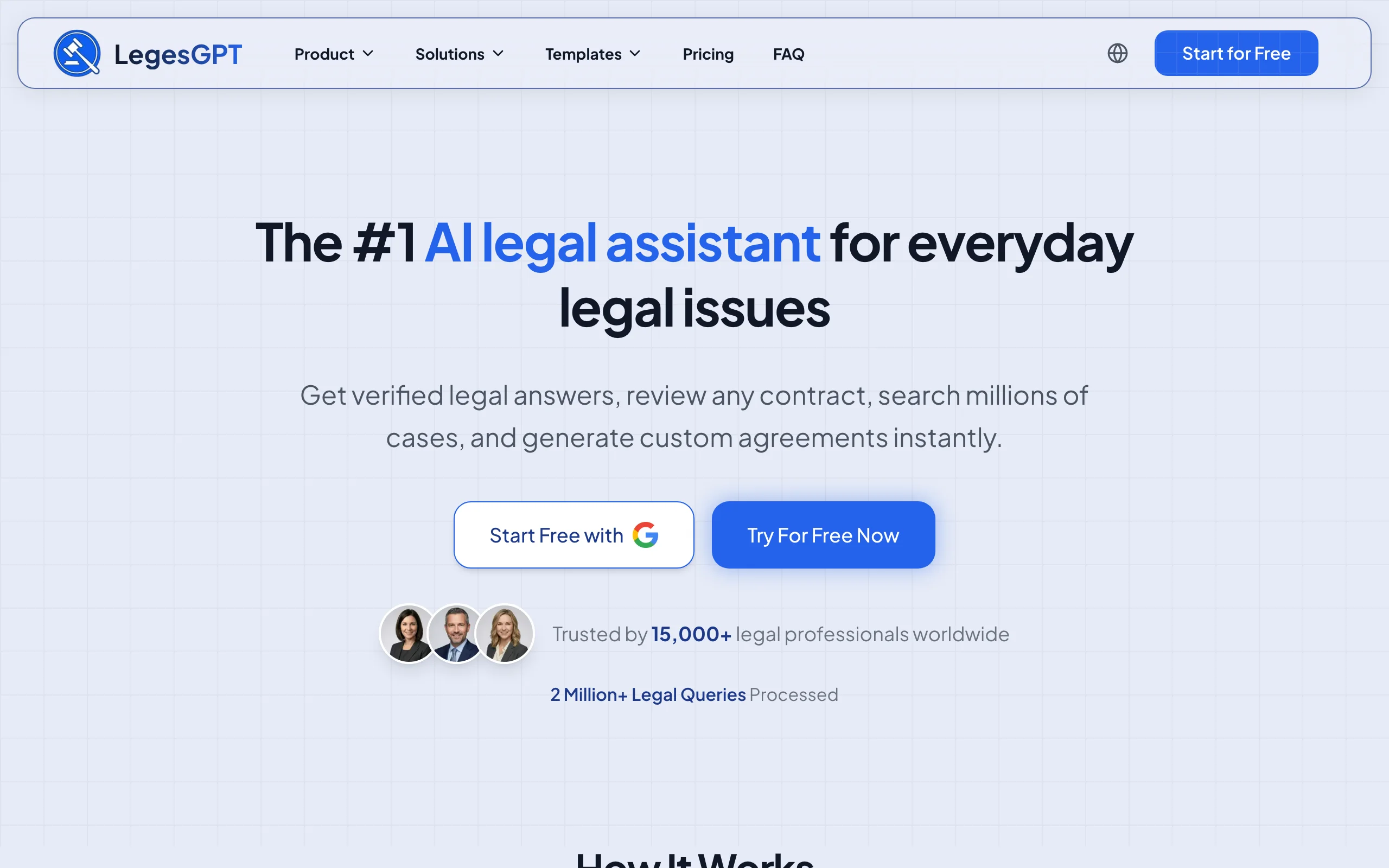
LegesGPT is an all-in-one legal AI assistant built for the lawyers Harvey overlooks. Instead of buying a research tool, a separate contract tool, and a signing tool, you run the whole workflow, from a research question to a signed document, on a single plan. You sign up, start a trial, and work the same day. No seat minimums, no sales calls.
Key features
- Answers legal questions with verified citations and clickable source links, so checking authority is fast
- Searches case law and statutes across multiple jurisdictions
- Reviews documents (PDF, DOCX, PPTX, TXT, and images) to flag risky clauses and propose changes, via AI document review
- Drafts contracts and legal documents with AI, then lets you e-sign and send them
- Runs Deep Research mode and web search for multi-step questions and recent developments
- Includes free legal tools: a contract generator, citation generator, and support, alimony, and deadline calculators
Best for
- Solo practitioners and 2 to 50 attorney firms that want one tool instead of three subscriptions
- In-house counsel and legal ops teams that cannot justify enterprise seat minimums
- Paralegals and law students who need cited answers without a sales cycle
Pricing
- Basic, $19.99/month: unlimited AI queries, case law and statute search, citation verification
- Plus, $49.99/month: adds document and image upload plus 50 document reviews/month
- Premium, $99.99/month: adds unlimited document review, Deep Research, and web search
- 3-day trial (with a $1 activation fee) and roughly 30% off annual billing
Pros
- All-in-one workflow (research, review, drafting, and signing) in a single low-cost plan
- Verified citations with source links reduce hallucination risk and speed up checking authority
- Self-serve with no seat minimums, so you can test it on your own documents before committing
- A fraction of the cost of Harvey or other enterprise legal AI tools
Cons
- Newer brand with a smaller footprint than Westlaw or LexisNexis
- Web-only, with no native mobile app, public API, or Microsoft Word add-in
Firms can see how the workflow fits a practice on the AI for law firms page.
2. CoCounsel (Thomson Reuters), best for firms in the Westlaw ecosystem
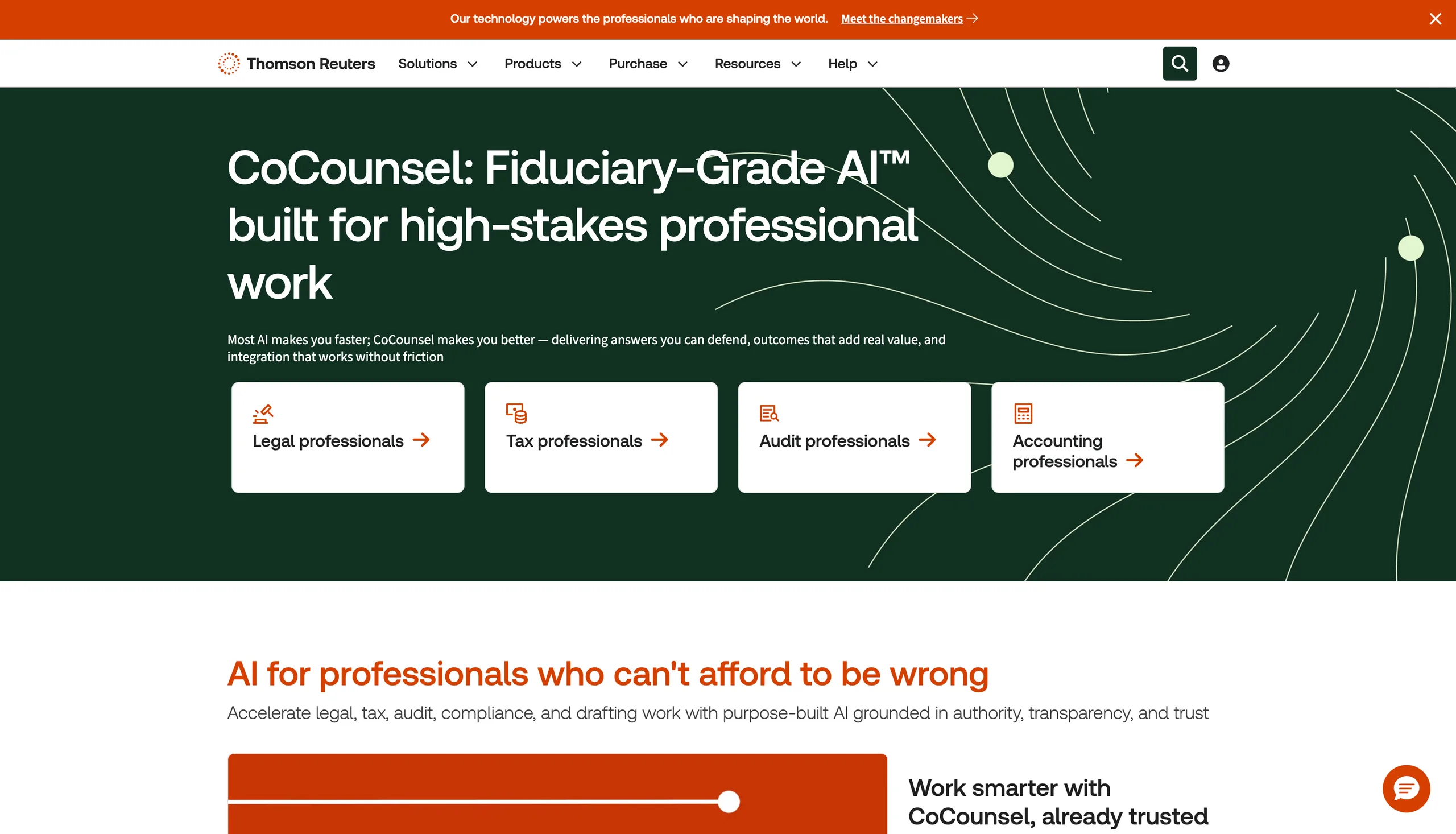
CoCounsel (originally Casetext, now owned by Thomson Reuters) is an AI legal assistant that plugs directly into Westlaw. For firms already paying for Westlaw, it is the most natural place to add AI: research, document review, and deposition prep run against authority you already trust.
Key features
- AI legal research grounded in Westlaw primary law
- Document review and summarization across large sets
- Deposition preparation and timeline building
- Contract analysis and clause extraction
Best for
- Mid-size and large firms already subscribed to Westlaw
- Litigation teams that want AI layered on a trusted research platform
Pricing
- Firms with up to 10 attorneys can price CoCounsel through Thomson Reuters' online configurator; larger firms go through sales, and there is no free trial. Third-party sources report roughly $225/user/month entry pricing on an annual contract, with Westlaw-bundled plans running higher. Confirm current pricing with Thomson Reuters.
Pros
- Backed by Thomson Reuters with deep Westlaw integration
- Strong document review and deposition tooling
Cons
- Best value is tied to an existing (expensive) Westlaw subscription
- Annual contracts and no free trial; online pricing is limited to firms of up to 10 attorneys
If you are weighing the original product, see our Casetext alternative breakdown.
3. Lexis+ AI, best for deep primary-law research
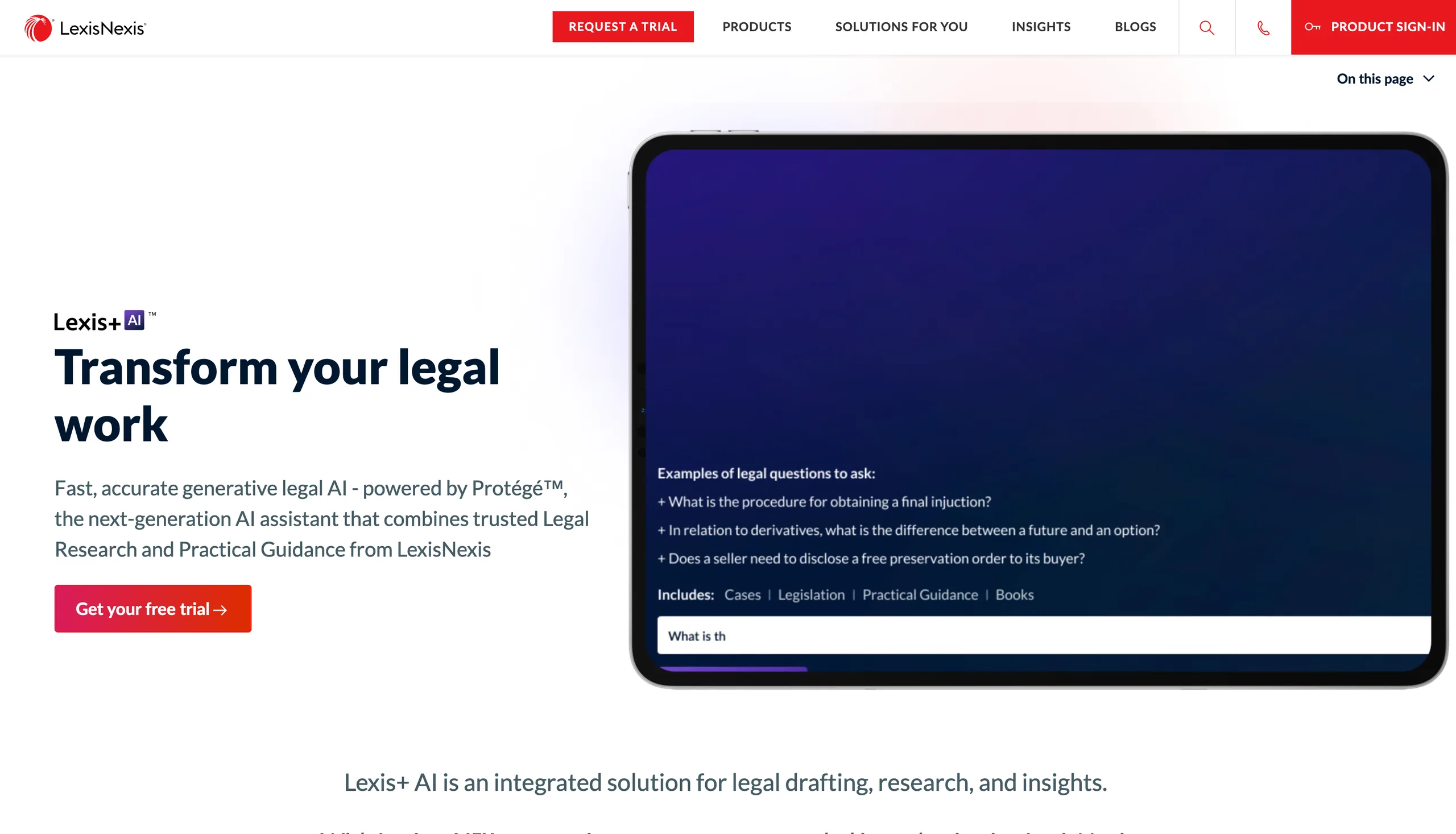
Lexis+ AI, now folded into the Lexis+ with Protégé platform that LexisNexis rolled out in 2026, brings conversational and agentic AI to the LexisNexis platform. It answers research questions, drafts documents, analyzes contracts, and runs litigation tools like Brief Analyzer, all grounded in the Lexis database that large firms have relied on for decades.
Key features
- Conversational legal research over LexisNexis primary law
- AI drafting and document analysis
- Brief Analyzer for litigation
- Linked citations back to Lexis sources
Best for
- Firms that need the breadth of the LexisNexis primary-law database
- Research-heavy practices that already license Lexis
Pricing
- Quote-only. Third-party estimates put it around $128 to $494/user/month depending on plan and coverage. Confirm directly with LexisNexis.
Pros
- Massive, established primary-law database
- Research, drafting, and litigation tools in one platform
Cons
- Expensive and quote-only, with complex packaging
- Best value assumes you are buying into the Lexis ecosystem
For a cost-focused comparison, see our best legal research tools guide.
4. Vincent AI (vLex), best for multi-jurisdiction research
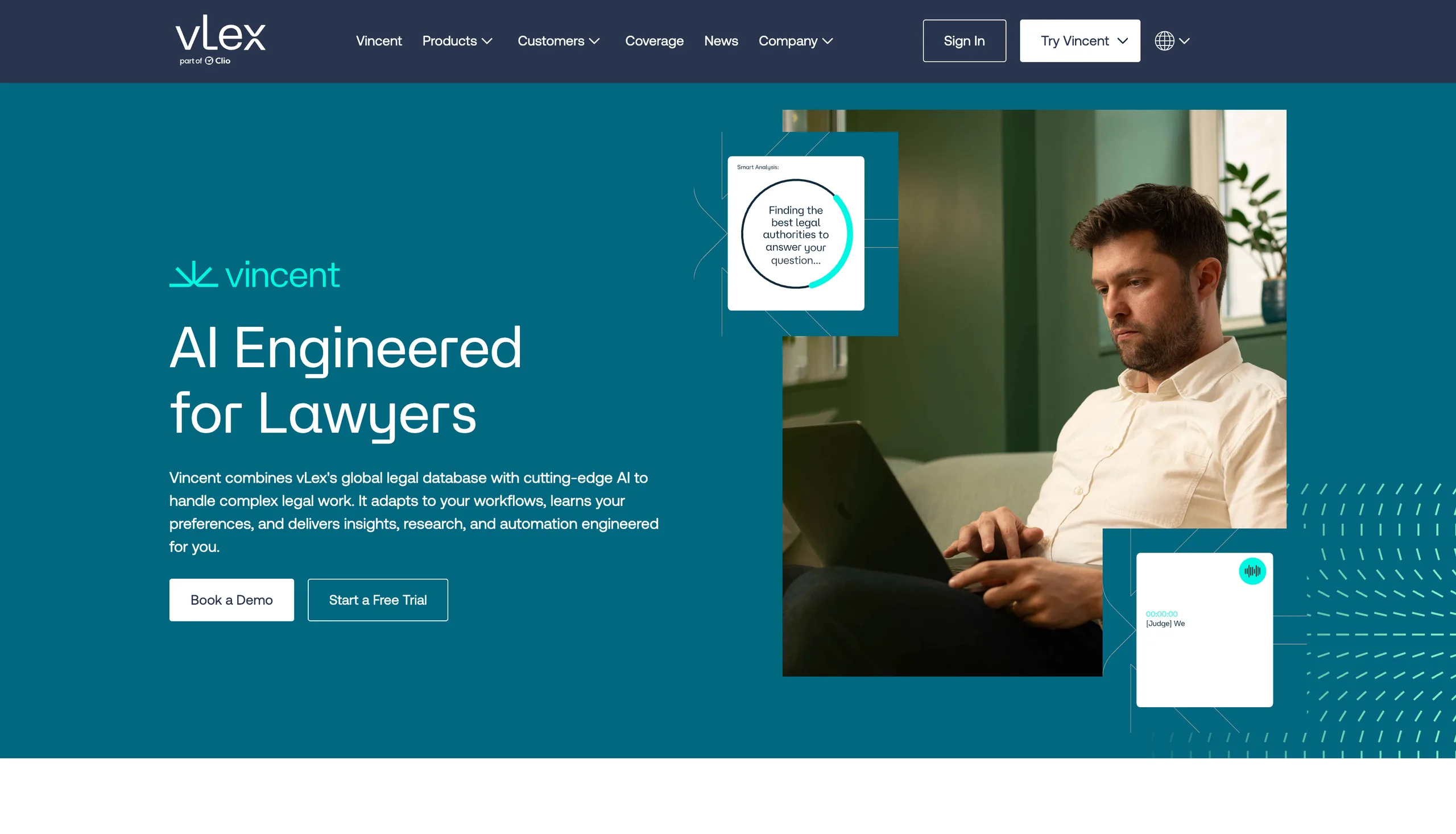
Vincent AI, from vLex (now part of Clio, which also sells it as Clio Work), is a legal research assistant built on a global database covering primary law across 100+ countries. It stands out for comparative work: a single query can generate a 50-state survey, and answers come with full citations you can trace back to the underlying authority.
Key features
- Global legal research across 100+ countries
- 50-state survey and other prebuilt comparative workflows
- Answers with full citations and visible reasoning
- Vincent Studio for building custom no-code workflows
Best for
- Firms doing cross-border or multi-state comparative research
- Practices that want research without Westlaw or Lexis lock-in
Pricing
- Largely quote-based; third-party reports put self-serve entry pricing at roughly $65 to $69/user/month, with firm plans considerably higher, and Clio Work pricing is demo-only. A free trial is available. Confirm current pricing with vLex or Clio.
Pros
- Strong international and 50-state comparative coverage
- Citation-grounded answers with transparent sourcing
Cons
- Research-focused, not an all-in-one drafting-and-signing suite
- Headline pricing is not clearly published
5. Spellbook, best for contract drafting in Microsoft Word
Spellbook is a contract AI that lives inside Microsoft Word. For transactional lawyers, it drafts clauses, redlines agreements, flags missing or risky terms, and benchmarks language without leaving the document. If your day is contracts and your tool is Word, it fits the existing workflow cleanly. If it doesn't — your team works in Google Docs, or the quote-only pricing is a dealbreaker — the closest Spellbook alternatives cover the same drafting and redlining ground.
Key features
- Drafting, review, and redlining inside Microsoft Word
- Clause suggestions and benchmarking against market standards
- Compare, Ask, and Search across your contracts
- Built for in-house teams and transactional practices
Best for
- Transactional and in-house lawyers who draft in Word all day
- Contract-heavy practices across M&A, procurement, IP, and real estate
Pricing
- Custom, quote-only pricing determined by team size, with a 7-day free trial. Spellbook raised prices in late 2025, and third-party estimates now range from roughly $179 to $350+/user/month (with a minimum commitment on enterprise plans), but confirm with Spellbook.
Pros
- Tight Microsoft Word integration with no workflow change
- Focused, mature contract-drafting feature set
Cons
- Word-only and contract-focused, not a research or litigation tool
- No public tier pricing
See our best AI contract drafting tools guide for a contract-tool comparison.
6. Paxton AI, best for a standalone research-and-drafting assistant
Paxton AI is an all-in-one AI legal assistant for research, drafting, and document analysis. It is browser-based and standalone, so it does not require a Westlaw or Lexis subscription, and it leans heavily on citation accuracy and source verification for research work.
Key features
- AI legal research with citation verification
- Document drafting and file analysis
- Contract review and summarization
- Standalone, no third-party database subscription required
Best for
- Individual practitioners who want one standalone assistant
- Research-focused lawyers who prioritize citation accuracy
Pricing
- Individual plan at $499/user/month, or $2,999/user/year. Enterprise pricing is custom. A 7-day free trial is available. Confirm current pricing with Paxton.
Pros
- Strong citation handling and source verification
- Self-serve with a free trial and no required database subscription
Cons
- Per-user pricing is high for solos compared with LegesGPT
- Narrower workflow than an all-in-one suite with e-signature
7. Luminance, best for enterprise contract review and due diligence
Luminance is legal-grade AI for contract analysis, review, and automation at scale. It works on the web and inside Word, and is built for high-volume contract operations: due diligence, negotiation support, and bulk review across large document sets.
Key features
- High-volume contract analysis and review
- Negotiation and redlining support
- Due diligence across large document sets
- Works on the web and within Microsoft Word
Best for
- Large in-house teams and firms with heavy contract volume
- Enterprise due diligence and M&A workstreams
Pricing
- Custom, quote-only. Third-party sources report mid-size deployments often run into five or six figures annually, with separate module pricing and implementation fees. Confirm with Luminance.
Pros
- Powerful at enterprise contract scale
- Mature analysis and negotiation tooling
Cons
- Enterprise pricing and procurement, not solo-friendly
- Contract-focused, not a general research or drafting assistant
8. Clio Duo, best for firms already running Clio
Clio Duo (now branded Manage AI) is the AI layer built into Clio practice management, powered by Vincent AI and the Clio library. It lets you query your own matter data in plain English: summarize a matter, draft a follow-up email, or analyze an uploaded document, all without leaving Clio.
Key features
- Natural-language queries over your Clio matter data
- Drafting of emails, letters, and memos from case data
- Document Analyzer for summaries, issue spotting, and clause identification
- Built into the Clio practice-management workflow
Best for
- Firms already running Clio Manage for case management
- Teams that want AI tied to their existing matter data
Pricing
- Quote-based add-on to the Essentials, Advanced, and Expand plans (not EasyStart); third-party reports put it around $39 to $59/user/month. Clio Manage itself starts at $49/user/month for EasyStart, with higher tiers quoted by sales. Confirm current pricing with Clio.
Pros
- No new tool to learn if you already use Clio
- Grounded in your own firm and matter data
Cons
- Requires a Clio subscription; not standalone
- Tied to practice-management data rather than a broad research database
9. NexLaw, best for litigation teams
NexLaw is a litigation-focused AI platform covering the full litigation lifecycle: citation-verified deep research, document drafting, deposition and evidence analysis, and courtroom-ready chronologies. It offers flat per-seat pricing with no minimum team size, which makes it accessible to small and mid-sized litigation firms.
Key features
- Citation-backed legal deep research (NeXa)
- Drafting for memos, motions, and briefs
- Evidence analysis and fact-to-evidence chronologies (ChronoVault)
- Trial prep and deposition summarization
Best for
- Small to mid-sized litigation teams and trial lawyers
- Litigators who need research plus chronology and trial-prep tooling
Pricing
- Essential plan from $2,999/year (solo and boutique litigation firms); Professional from $3,999/year. A 5-day complimentary trial and demo are available, with no minimum seat count. Confirm current pricing with NexLaw.
Pros
- Purpose-built for the litigation lifecycle
- Flat per-seat pricing with no seat minimum
Cons
- Litigation-only; not a general contract or transactional tool
- Pricing is annual rather than low monthly entry
How to choose the best Harvey AI alternative for your firm
The right Harvey alternative depends on your workflow, your budget, and what you already own. Work through these questions.
1) Do you want one tool or a specialist?
- If you want research, review, drafting, and e-signature in one affordable plan: LegesGPT.
- If you only draft and redline contracts in Word: Spellbook (or Luminance at enterprise scale).
- If you are a litigator who needs trial prep and chronologies: NexLaw.
2) Are you locked into an existing platform?
- Already on Westlaw: CoCounsel keeps AI inside that stack.
- Already on LexisNexis: Lexis+ AI.
- Already on Clio practice management: Clio Duo.
- No ecosystem and you want independence: LegesGPT, Paxton AI, or Vincent AI.
3) What is your budget and buying process?
- Self-serve, low monthly cost, instant trial: LegesGPT (from $19.99/month) is the most accessible.
- Comfortable with per-user pricing in the hundreds: Paxton AI, CoCounsel, or Lexis+ AI.
- Enterprise budget and procurement: Luminance or the enterprise platforms.
4) How important is multi-jurisdiction coverage?
- Cross-border or 50-state comparative research: Vincent AI is built for it.
- Day-to-day U.S. research, review, and drafting: LegesGPT covers the common workflow at a fraction of the price.
Whatever you shortlist, test it on your own work before committing. A practical approach: run three to five of your real research questions and check the citations against the source links; upload a contract you know well and see whether the risk flags match your judgment; and draft a document you write often, then compare the output to your usual first draft. LegesGPT's 3-day trial is built for exactly this, and for most firms the price-to-value math against an enterprise contract is hard to beat. For a broader look at the category, see our roundup of AI tools built for practicing lawyers.
FAQ
What is the best alternative to Harvey AI?
For solo practitioners, small firms, and budget-conscious in-house teams, LegesGPT is the best all-in-one alternative. It delivers research with verified citations, document review, AI drafting, and e-signature in one self-serve subscription starting at $19.99/month, without the enterprise pricing or sales cycle Harvey requires. Larger firms anchored to Westlaw or Lexis may prefer CoCounsel or Lexis+ AI.
Why do lawyers look for a Harvey AI alternative?
Harvey is built for BigLaw and enterprise legal teams. It uses quote-only enterprise pricing, typically carries seat minimums, and has no self-serve signup. Solo attorneys, small firms, and in-house teams often cannot access it or justify the cost, so they look for a tool they can try and buy directly.
How much does Harvey AI cost compared to these alternatives?
Harvey does not publish prices and sells through 12-month enterprise contracts; third-party estimates put it in the hundreds to over $1,000 per user per month, with reported seat minimums of roughly 20 to 50 and annual commitments that commonly start around $50,000. By contrast, LegesGPT starts at $19.99/month, Vincent AI is reported from around $65 to $69/month, and Clio's Manage AI (formerly Clio Duo) is a quote-based add-on reported at roughly $39 to $59/user/month. Always confirm current pricing with each vendor.
Is there a free Harvey AI alternative?
No mainstream legal AI tool is permanently free, but several offer trials: LegesGPT has a 3-day trial, Spellbook and Paxton AI offer 7-day trials, Vincent AI offers a free trial, and NexLaw offers a 5-day trial. General chatbots like ChatGPT are free but are not grounded in verified legal sources, so they are not a safe substitute for a purpose-built legal AI tool.
Which Harvey alternative is best for a small law firm?
LegesGPT is the most small-firm friendly: it is self-serve, starts at $19.99/month, and covers research, review, drafting, and e-signature in one plan with no seat minimums. NexLaw suits small litigation teams, and Clio Duo fits firms already running Clio. The enterprise platforms (Luminance, and to a degree CoCounsel and Lexis+ AI) are generally a poorer fit for small firms on cost.
Do I need Westlaw or LexisNexis to use a Harvey alternative?
No. LegesGPT, Paxton AI, and Vincent AI are standalone and do not require an existing Westlaw or Lexis subscription. CoCounsel and Lexis+ AI, by contrast, deliver their best value when layered on those platforms, so factor the underlying subscription into the cost.
Are these AI legal tools accurate enough to rely on?
The better tools reduce hallucination risk by grounding answers in real case law and statutes and linking to sources you can verify. No AI tool removes the lawyer's duty to check authority, so treat every output as a first draft and verify citations before filing or advising, regardless of which tool you choose.
I mainly need one affordable tool that does research, review, and drafting. What should I use?
LegesGPT is built for exactly that. It answers legal questions with verified citations, searches case law and statutes, reviews documents and proposes fixes, drafts contracts, and lets you e-sign, all in one self-serve subscription starting at $19.99/month with a 3-day trial, so you can test it on your own matters before committing.