
Your contracts already contain the answers your business keeps asking: what did we agree to, what are we owed, and where are we exposed. Contract intelligence software uses AI to pull those answers out, extracting key terms, flagging risks, tracking obligations, and letting you ask questions in plain language instead of rereading PDFs.
The catch is that most contract intelligence platforms are built for enterprises, with custom pricing, sales cycles, and six-figure implementations. That leaves smaller legal and ops teams wondering what they can actually buy.
This guide compares the 8 best contract intelligence software platforms in 2026, from a $19.99/month option you can start using today to enterprise suites that analyze repositories with 100,000+ agreements. You'll get pricing, strengths, honest trade-offs, and a framework for choosing.
Best contract intelligence software: a brief overview
- LegesGPT: Best per-document contract intelligence for lean teams: upload any contract, ask questions, extract terms, and flag risks from $19.99/month with a $1 trial.
- Workday Contract Intelligence: Best for enterprises running Workday: an AI analytics layer (built on Evisort) that plugs into Workday, Box, SharePoint, and Salesforce.
- Luminance: Best for agent-driven work across a whole contract portfolio, with the Lumi assistant answering cited questions from first draft to repository insight.
- LinkSquares: Best CLM-plus-intelligence for mid-market in-house teams that want key terms, obligations, and risk surfaced across every agreement.
- Icertis: Best for global enterprises in regulated industries that need contract intelligence woven into SAP, Microsoft, and Salesforce ecosystems.
- Sirion: Best for supplier contracts and obligation tracking at scale, where the money is in enforcing what was actually negotiated.
- Kira (Litera): Best for M&A due diligence at law firms, with a decade of trained extraction models and data-room integrations.
- Zuva Analyze: Best pay-as-you-go extraction for defined projects: $10 per document with 1,400+ pre-built AI fields and no subscription.
| Tool | Best for | Starting price | Free trial | Platforms |
|---|---|---|---|---|
| LegesGPT | Per-document intelligence on a budget | From $19.99/mo | 3-day, $1 | Web |
| Workday Contract Intelligence | Enterprises running Workday | Custom (enterprise) | Demo only | Web |
| Luminance | Portfolio-wide AI agents | Custom (enterprise) | Demo only | Web |
| LinkSquares | Mid-market CLM + insights | Custom | Demo only | Web + Word add-in |
| Icertis | Regulated global enterprises | Custom (enterprise) | Demo only | Web |
| Sirion | Supplier and obligation management | Custom (enterprise) | Demo only | Web |
| Kira (Litera) | M&A due diligence at law firms | Custom | Demo only | Web |
| Zuva Analyze | Pay-as-you-go extraction projects | $10/document ($5K min) | 5 documents free | Web |
1. LegesGPT, best per-document contract intelligence for lean legal teams
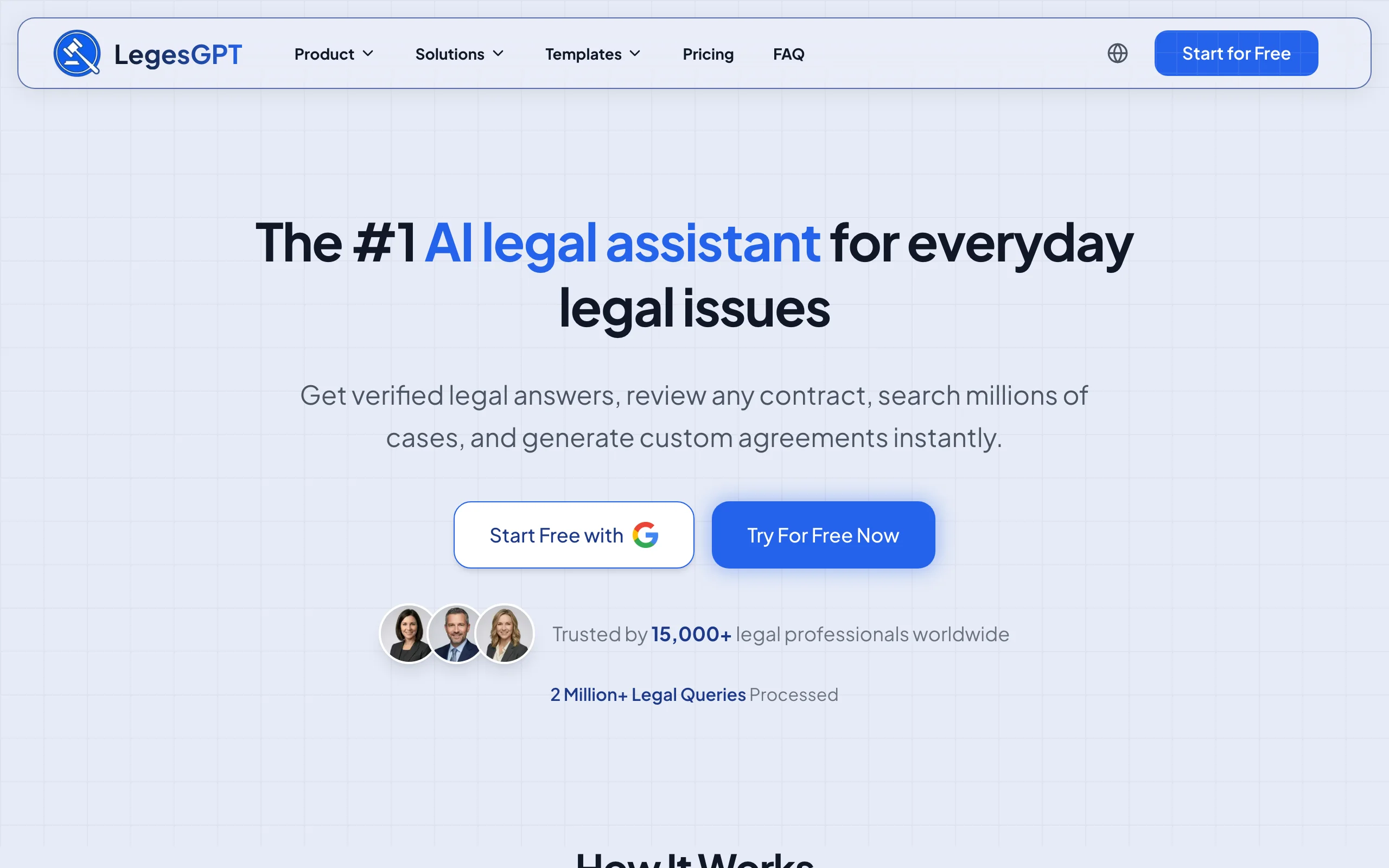
LegesGPT approaches contract intelligence from the document up rather than the repository down. Upload a contract (PDF, DOCX, PPTX, TXT, or even images) and the AI extracts key terms, flags risky and non-standard clauses, proposes concrete changes, and answers your questions about the document in plain language. It pairs that with an AI legal assistant that answers legal questions with verified citations, so when a clause raises a question ("is this non-compete enforceable here?"), you can ask a legal question and get a sourced answer in the same subscription.
That makes it the realistic pick for in-house teams of one to five people, ops leads, and founders who need contract insight now, not after a six-month enterprise rollout. There are no seat minimums, no sales calls, and a working trial for $1.
Key features:
- Upload contracts and interrogate them: extract parties, dates, payment terms, termination rights, and obligations on demand
- Risk flagging with proposed fixes, so you can review contracts with AI and act on the output instead of just reading it
- Plain-language summaries of dense agreements for stakeholders outside legal
- Deep Research mode for multi-step questions that span a contract and the law behind it
- AI drafting plus e-signature, so fixing a flagged clause and re-executing happens in one place
- Web search integration to check recent legal developments against contract language
Best for:
- In-house counsel and legal ops at startups and SMBs analyzing contracts one at a time
- Founders, HR, and procurement leads who sign vendor and employment agreements without a legal department
- Solo GCs who need research, document intelligence, drafting, and signing in one tool
Pricing:
- Basic: $19.99/month for unlimited AI queries, case law and statute search, and citation verification
- Plus: $49.99/month adds document upload and 50 document reviews per month; Premium at $99.99/month is unlimited, with Deep Research and web search (see plans and pricing)
- 3-day trial for $1; roughly 30% off with annual billing
Pros:
- A fraction of the cost of every enterprise platform on this list, with transparent self-serve pricing
- Answers about a contract come with the legal context behind them, not just extracted fields
- Zero implementation: upload a contract and get intelligence in minutes
Cons:
- No repository-wide analytics: it will not build dashboards across 10,000 legacy agreements the way Workday or Icertis will
- Web-only, with no API or Microsoft Word add-in for embedding into existing pipelines
Review any contract in seconds
Upload a contract and LegesGPT flags risky clauses, surfaces obligations and deadlines, and answers questions with citations you can verify.
Try AI document review2. Workday Contract Intelligence, best for enterprises running Workday
Workday Contract Intelligence is the AI analytics layer Workday built from its 2024 acquisition of Evisort, one of the original contract intelligence pioneers. Its pitch is "stop reading contracts, start driving outcomes": it ingests agreements with OCR, structures them with AI, and lets business users query the whole repository through an "Ask AI" interface.
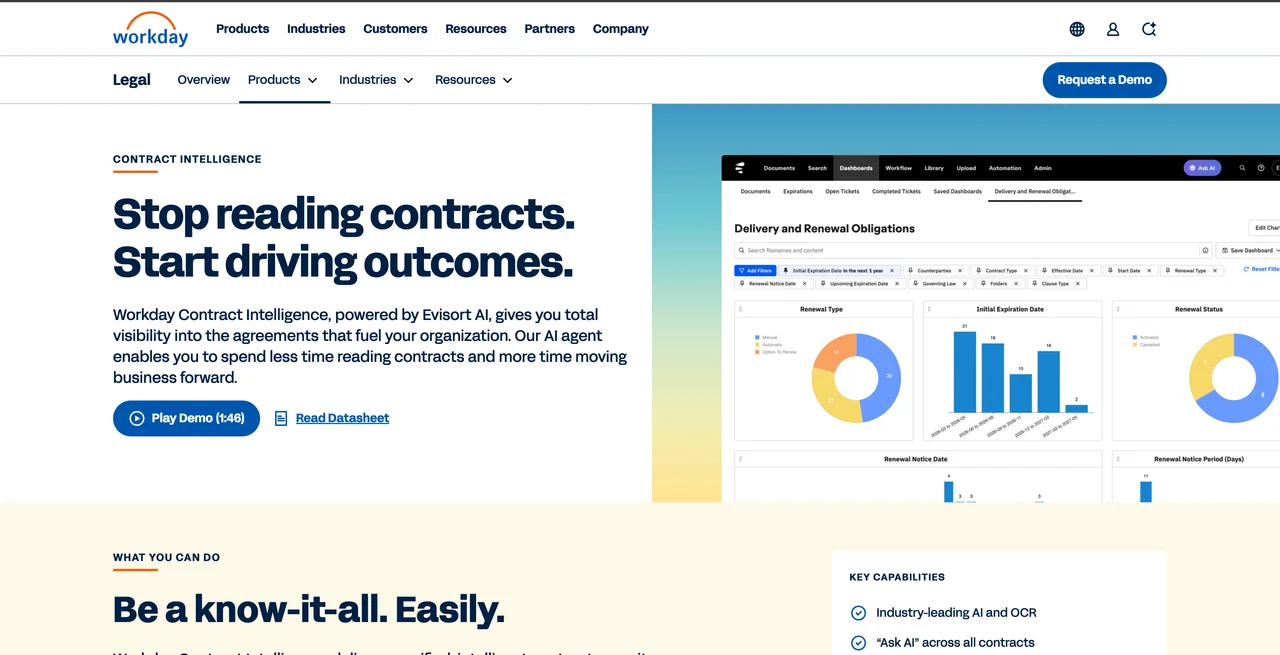
The differentiator is plumbing. It syncs with repositories you already have (Box, SharePoint, Salesforce) and pushes structured contract data into other enterprise systems via API, which matters when contract terms need to reach finance and procurement workflows.
Key features:
- Ask AI natural-language queries across the contract repository
- Custom AI models to track company-specific terms and clauses
- OCR ingestion and automatic syncing from Box, SharePoint, and Salesforce
- Customizable dashboards for terms, obligations, and renewals
- API delivery of structured contract data to downstream systems
Best for:
- Enterprises already on Workday HCM or Financials that can bundle it into an existing agreement
- Legal and procurement teams that need contract data flowing into other systems, not sitting in a silo
Pricing:
- Custom, quote-based; no public pricing (contact sales)
- Sold separately from the full Workday CLM suite, so you can buy the intelligence layer alone
Pros:
- Evisort's mature extraction AI backed by Workday's enterprise infrastructure
- Strong repository integrations reduce the "migrate everything first" tax
Cons:
- Pricing requires a sales conversation, and standalone buyers reportedly get less attractive terms than Workday customers
- Overkill if you need insight on individual contracts rather than a repository
3. Luminance, best for agent-driven work across the whole contract portfolio
Luminance started in due diligence and has evolved into an AI platform that runs agents across the entire contract lifecycle: drafting, negotiation, compliance, and investigation. Its conversational assistant, Lumi, is available throughout and answers questions with citations, whether you are on a first pass of a single agreement or querying obligations across the full portfolio.
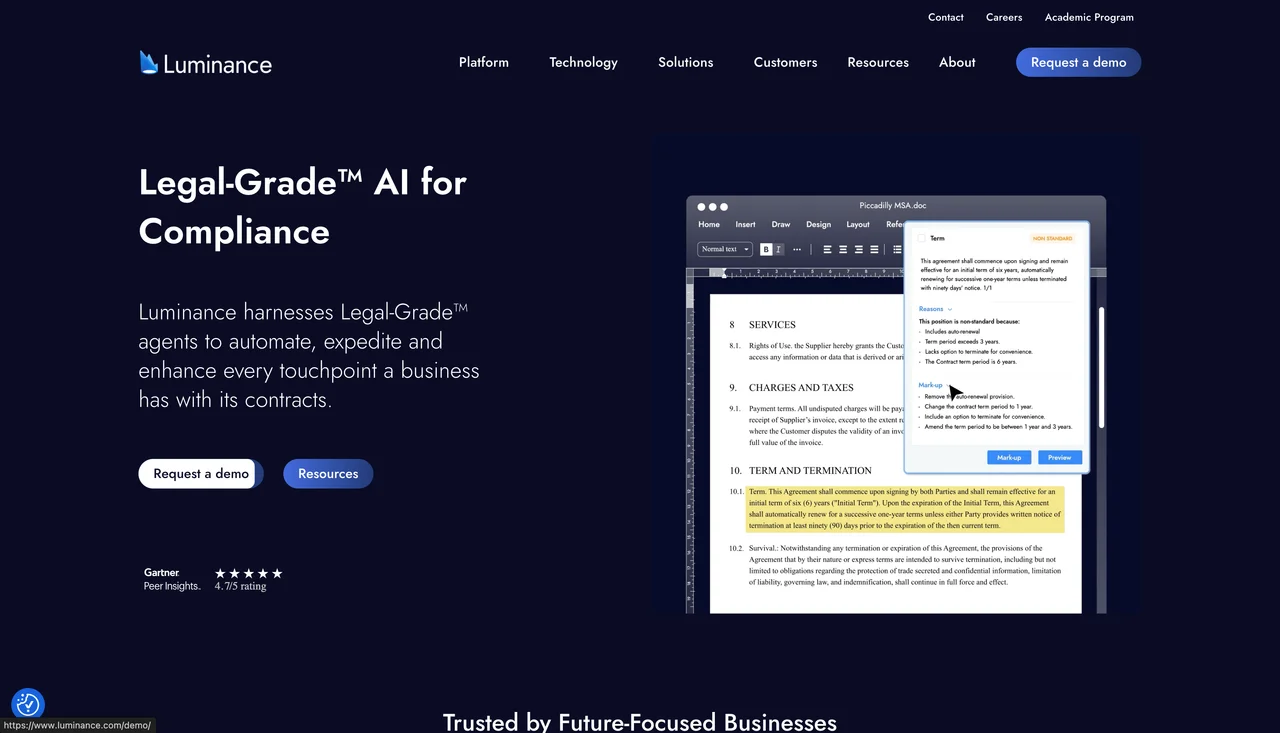
What sets it apart is continuity of context. The same AI layer follows a contract from negotiation into the repository, so portfolio-level questions benefit from what the system learned during the deal.
Key features:
- Lumi conversational assistant with cited answers across contracts, amendments, and obligations
- AI agents that trigger next steps automatically based on contract status
- Portfolio-wide querying of the enterprise contract estate
- Unified AI layer connecting negotiation, workflow, and repository intelligence
Best for:
- Legal departments that want AI agents doing work across the lifecycle, not just extracting data
- Organizations with large, messy contract estates that need answered questions, not just search
Pricing:
- Custom, quote-based; no public pricing (demo required)
- Deployments typically scale with team size and contract volume
Pros:
- One of the most complete visions of AI-native contract work on the market
- Cited answers reduce the trust problem that plagues generative AI in legal
Cons:
- Enterprise pricing and deployment put it out of reach for small teams
- Breadth means evaluation takes real effort; scoping which agents you need is a project in itself
4. LinkSquares, best CLM-plus-intelligence for mid-market in-house teams
LinkSquares is the pragmatic mid-market choice: a full contract lifecycle platform with its LinkAI engine underneath, built to surface key terms, obligations, and risk across every agreement you have. Post-signature intelligence is where it made its name, reading executed contracts and turning them into searchable, reportable data.
It also covers pre-signature work, with an AI legal assistant for drafting and redlining that includes a Microsoft Word add-in, plus playbooks and clause libraries to standardize how the team papers deals.
Key features:
- LinkAI extraction of key terms, obligations, and risk across the repository
- Analytics and reporting on contract data for the business
- AI assistant for drafting and redlining, including a Word add-in
- Automated approvals, tasks, and routing
- Playbooks, templates, and clause libraries; API for integrations
Best for:
- Mid-market in-house teams (roughly 2 to 20 legal professionals) consolidating CLM and intelligence in one vendor
- Teams that live in Microsoft Word and want AI where they already work
Pricing:
- Custom, quote-based, driven by contract volume, users, and modules; no public price points
- Third-party procurement data suggests mid-market deals commonly land in the tens of thousands per year; treat that as a reported estimate
Pros:
- Strong post-signature intelligence without Fortune 500 pricing
- Modular: start with insights, add workflow later
Cons:
- No free trial or self-serve tier; you cannot test it without a sales process
- Costs climb as modules, seats, and integrations stack up
5. Icertis, best for global enterprises in regulated industries
Icertis Contract Intelligence (ICI) is the heavyweight of this list, built for large enterprises managing tens of thousands of contracts across jurisdictions and regulatory regimes. Its model is "agents execute, humans govern": AI agents draft, redline, track obligations, and surface risk, while the platform keeps auditability and control at the center.
The Vera Copilot handles natural-language search and execution, and deep integrations with SAP, Microsoft, Salesforce, and Workday put contract data inside the systems where enterprise work actually happens.
Key features:
- Vera Copilot for natural-language search, summaries, and actions
- Obligation tracking and fulfillment monitoring across the repository
- Agent-driven drafting, redlining, and playbook enforcement
- Enterprise integrations: SAP, Microsoft, Salesforce, Workday
- Agent interoperability with external AI ecosystems, including Claude and ChatGPT
Best for:
- Fortune 500 and large global companies in regulated industries (pharma, financial services, manufacturing)
- Organizations where contract obligations carry compliance and audit consequences
Pricing:
- Custom, quote-based; no public pricing
- Third-party reporting places typical enterprise subscriptions in the six figures annually; implementations run months, not weeks
Pros:
- Genuine enterprise depth: governance, audit trails, and industry-specific configurations
- Contract data reaches ERP and CRM systems instead of staying in legal
Cons:
- Not a realistic option for small or mid-sized teams on cost or complexity
- Long implementation timelines before you see value
6. Sirion, best for supplier contracts and obligation tracking at scale
Sirion built its reputation on the post-signature problem most platforms underweight: making sure the other side delivers what the contract says. Its agentic CLM combines AI extraction and conversational contract search with obligation and supplier performance management, which is why it resonates with procurement-heavy enterprises. Sirion reports managing over 7 million contracts on the platform, in more than 100 languages.
For contract intelligence specifically, that means the system does not stop at "what does clause 12 say"; it connects the clause to the service levels, credits, and invoices it governs.
Key features:
- AI extraction and conversational search across the contract estate
- Obligation management tied to supplier performance and service levels
- Agentic workflows for creating, storing, and managing contracts
- Multi-language coverage for global supplier bases
Best for:
- Enterprises with large supplier and outsourcing portfolios where leakage is measured in millions
- Procurement and legal teams that need enforcement, not just visibility
Pricing:
- Custom, quote-based; no public pricing, with intelligence and management modules priced separately
- Minimum commitments reportedly start high, reflecting its enterprise positioning
Pros:
- Best-in-class link between contract terms and real-world supplier performance
- Strong fit for complex, multi-year services agreements
Cons:
- Enterprise-only economics; smaller teams rarely clear the minimum commitment
- Buyer-side, supplier-facing focus fits some use cases better than sales contracts
7. Kira by Litera, best for M&A due diligence at law firms
Kira, now part of Litera, is the tool many lawyers picture when they hear machine learning for contracts. Trained on legal documents for over a decade, it extracts provisions with models Litera says reach 90%+ accuracy, and its Generative Smart Fields let reviewers ask natural-language questions across thousands of documents without building training sets. Litera says 70% of the top 50 global law firms use it.
Its home turf is high-volume, high-stakes review: due diligence in M&A, finance, real estate, and restructuring, where a team needs every change-of-control clause across a data room by Friday.
Key features:
- Generative Smart Fields: natural-language extraction with no labeled training data
- Concept Search across every document in a project
- Chat with cited, contextual answers; Smart Summaries for reporting
- Bulk import, deduplication, and HighQ and Intralinks data-room integrations
- Exports to Word, Excel, and PDF for deliverables
Best for:
- Law firm transactional teams running diligence at data-room scale
- Corporate development teams reviewing target-company contract sets
Pricing:
- Custom, quote-based; no public pricing (demo required)
- Most attractive economics reportedly come bundled with broader Litera commitments
Pros:
- Deep, battle-tested extraction accuracy on transactional documents
- Project workflow (dedupe, assign, review, export) built for deal teams
Cons:
- Priced and packaged for firms and deal work, not everyday in-house questions
- Standalone deployments reportedly cost more per unit than Litera bundles
8. Zuva Analyze, best pay-as-you-go contract data extraction
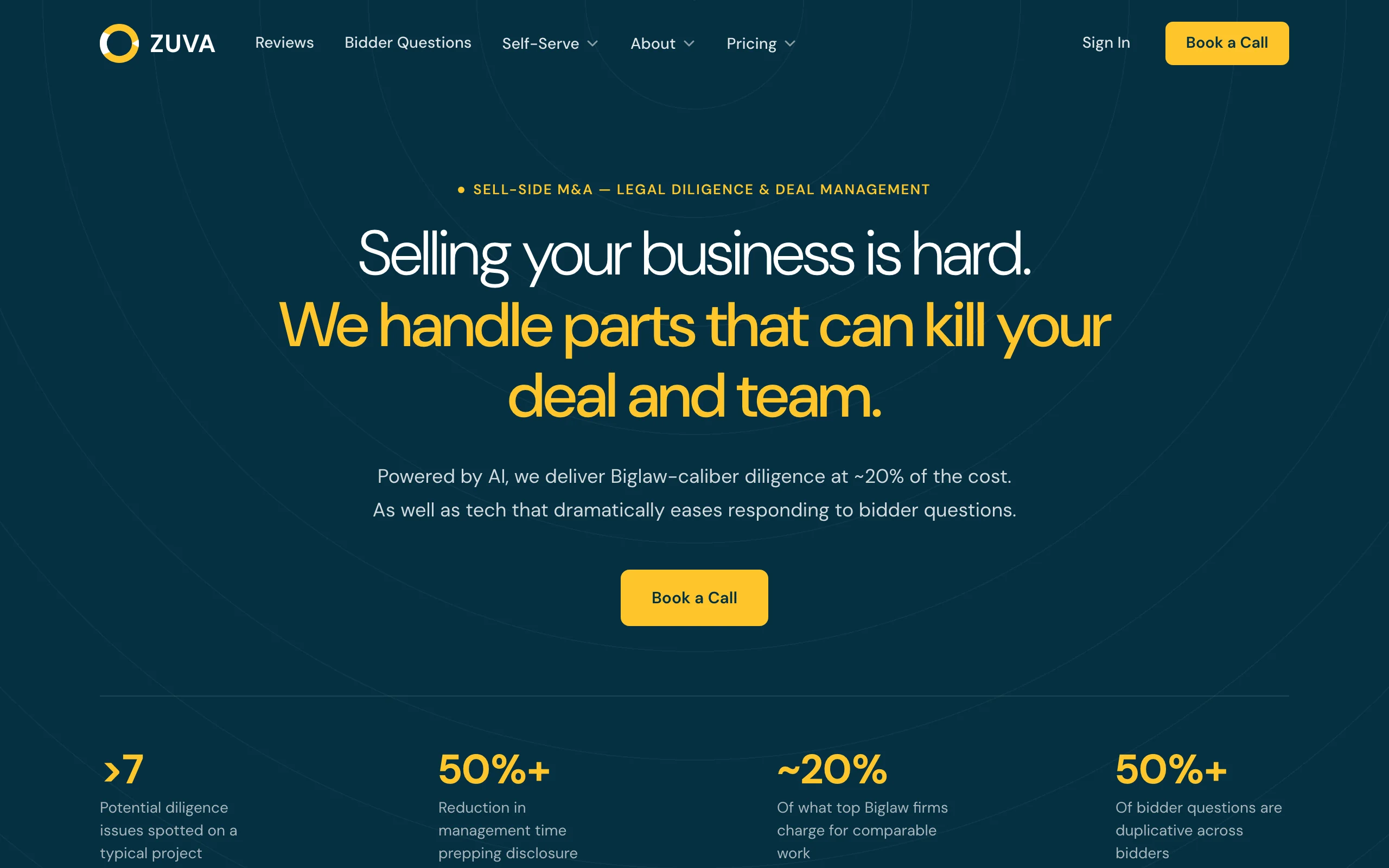
Zuva spun out of Kira Systems and turned its extraction technology into a self-serve product. Zuva Analyze charges $10 per document, pay as you go, with 1,400+ pre-built AI fields and automatic classification across 225+ document types. Upload documents, run a pre-built or custom workflow, and export structured results to Excel or Word.
The company now leads with fixed-fee M&A diligence services, but Analyze remains the rare contract intelligence tool with published, usage-based pricing, which makes it ideal for defined projects with a known document count.
Key features:
- 1,400+ pre-built AI extraction fields; 225+ document types auto-classified
- Custom workflows to tailor extraction to a specific project
- Exports to Excel, Word, or in-app review
- SOC 2 Type II certified; API available for embedding extraction
Best for:
- One-off projects: entity restructuring, compliance sweeps, migrating a legacy repository into a CLM
- Teams that want to test AI extraction on 5 free documents before spending anything
Pricing:
- Pay-as-you-go at $10 per document, with a $5,000 minimum commitment
- Free trial on 5 documents, no credit card; custom enterprise volume pricing
Pros:
- Transparent published pricing in a category that hides it
- Extraction pedigree inherited from Kira's decade of legal ML
Cons:
- The $5,000 minimum makes it a project tool, not a casual one
- Extraction-focused: you get structured data out, but drafting, negotiation, and legal Q&A live elsewhere
How to choose the best contract intelligence software for your team
Four questions separate these platforms faster than any feature grid.
1) One contract at a time, or the whole repository?
- If your real workflow is "a contract lands on my desk and I need to understand and de-risk it": LegesGPT gives you extraction, risk flags, summaries, and legal answers per document for $19.99 to $99.99 a month.
- If the job is "tell me what is inside our 20,000 executed agreements": that is repository-scale territory, and Workday Contract Intelligence, Luminance, Icertis, or LinkSquares are built for it.
- If it is a defined batch (a diligence set, a migration): Kira for firm-led deals, Zuva Analyze for self-serve extraction at $10 per document.
2) What is your budget and sales-cycle tolerance?
- Self-serve today: LegesGPT ($1 trial) and Zuva Analyze (5 free documents) are the only two you can try this afternoon.
- Mid-market procurement: LinkSquares deals reportedly land in the tens of thousands per year.
- Enterprise procurement: Workday, Luminance, Icertis, and Sirion involve custom quotes, security reviews, and implementations measured in months. Run the math: a $100,000 platform needs to save far more attorney hours than a $1,200-a-year one before it wins on value.
3) Where does the intelligence need to live?
- Inside business systems (ERP, CRM, HR): Icertis and Workday Contract Intelligence push contract data into SAP, Salesforce, and Workday workflows.
- Inside Microsoft Word: LinkSquares ships a Word add-in for drafting and redlining.
- Inside supplier management: Sirion ties clauses to obligations and service levels.
- In a browser with no IT involvement: LegesGPT runs entirely on the web, which is a constraint if you need an API and a gift if you need zero setup.
4) Who will actually use it?
Enterprise platforms assume trained legal ops users and admins. If the real users are one GC, a paralegal, and a procurement lead, pick something they will open without training. Whichever direction you lean, test before you commit: run 3 to 5 of your own contracts (an NDA, an MSA, your gnarliest vendor agreement) through any tool on a trial and judge the output against what your team would have caught. Small teams comparing options should also look at our guide to the best AI software for in-house legal teams, and for a deeper look at document-level tooling, see our roundup of the best contract analysis software. Lawyers evaluating a broader stack can start with these AI tools for lawyers.
All of LegesGPT for $1
Verified-citation answers, case law search, document review, AI drafting, and e-signature in one subscription. 3-day trial for $1, cancel anytime.
Start the $1 trialFrequently Asked Questions
What is contract intelligence software?
Contract intelligence software uses AI to turn signed agreements into usable data. It extracts key terms, dates, and obligations, flags risks, and lets you ask questions about a contract or an entire repository in plain language, instead of relying on someone rereading the documents.
How is contract intelligence different from contract management software?
Contract management (CLM) software runs the process: drafting, approvals, signatures, renewals, and storage. Contract intelligence is the insight layer that reads what those contracts actually say. Some platforms, like LinkSquares and Icertis, bundle both; pure intelligence tools like Zuva plug into whatever storage you already use.
Do I need enterprise software for contract intelligence?
Only if you need repository-scale analytics across thousands of agreements. If your real need is understanding the contracts in front of you, a self-serve tool covers it. LegesGPT extracts terms, flags risks, and answers questions about any uploaded contract from $19.99/mo, with no sales cycle or implementation project.
What is the cheapest contract intelligence software?
Among tools with published pricing, LegesGPT is the cheapest subscription at $19.99/mo with a 3-day $1 trial, and Zuva Analyze is the cheapest per-use option at roughly $10 per document. Nearly every other platform in this category sells custom enterprise contracts that typically run five figures annually.
Can contract intelligence software track obligations and renewal dates?
Yes, that is one of its core jobs. Platforms like Sirion and LinkSquares specialize in extracting obligations and deadlines and turning them into alerts and dashboards, so renewals stop expiring unnoticed and negotiated terms actually get enforced.
How accurate is AI contract data extraction?
Mature platforms are accurate enough to replace the first human pass; Kira, for example, has a decade of trained extraction models behind it. No vendor claims perfection, so treat extractions on high-stakes agreements as a fast draft that a qualified person verifies before decisions rely on it.
Is it safe to upload contracts to contract intelligence software?
Established vendors encrypt data in transit and at rest and state that customer documents are not used to train shared models. Before uploading, read the vendor's security page and data-processing terms, and confirm your confidentiality obligations and company policy allow third-party processing.
If I mainly need to understand and extract terms from individual contracts, what should I use?
Start with LegesGPT. Upload a contract, ask questions in plain English, extract the key terms, and get risks flagged with proposed fixes, all from $19.99/mo with a 3-day $1 trial. If you later outgrow per-document work and need portfolio dashboards, you will know exactly which enterprise features to demand.