
Ask a general counsel what changed over the last three years and the answer is rarely one tool. It is the shape of the job. Legal departments spent decades positioned as a cost center: necessary, respected, and permanently behind on volume. That framing is breaking down, and AI is the main reason.
The numbers show how fast. In an October 2025 survey by the Association of Corporate Counsel (ACC) and Everlaw, 52% of in-house counsel said they actively use generative AI in their practice, up from 23% in 2024. AI for in-house legal teams has crossed from experiment to infrastructure in roughly two budget cycles.
This guide is about how the work itself is changing, not which product to buy. (If you want a tool roundup, see our guide to the best AI software for in-house legal teams.) It covers five areas where the before-and-after is concrete, what the shift means for team structure and skills, the guardrails that keep it defensible, and a 90-day roadmap sized for a lean department.
The contract lifecycle: from bottleneck to self-service
Before AI, the contract process ran on scarcity. Every NDA, vendor agreement, and renewal crossed a lawyer's desk because there was no other way to control risk. First-pass review took days. The playbook, where one existed, lived in a senior lawyer's head. Sales teams learned to start deals early because legal was a known delay.
The work now splits into three layers.
Drafting. AI produces first drafts of routine agreements from your templates and preferred positions. The lawyer's job starts at "edit", not at a blank page, which changes the economics of every routine document the department touches.
Review. AI contract review reads an incoming agreement against your standard positions and flags the deviations: an uncapped indemnity, a missing limitation of liability, an auto-renewal buried in the boilerplate. A lawyer reviews the flagged issues instead of reading every clause of every contract at the same depth.
Self-service. This is the structural change. Business teams generate standard NDAs and routine agreements themselves, inside guardrails legal defines, and only exceptions escalate to a lawyer. Gartner expects that by 2029 roughly half of contract reviews will be delegated to self-service systems, with only about one in ten escalating to a human reviewer.
The role shift is easy to state and hard to overstate: legal stops processing every contract and starts designing the playbook, then handles what falls outside it.
Legal intake and triage: the end of the shared inbox
The old intake system was a shared mailbox, a few Slack DMs, and whoever got cornered in a hallway. Nobody could say how many requests arrived last month or what they were about. Senior lawyers spent expensive hours routing questions a template could have answered. Business teams either waited or quietly went around legal, which is worse.
AI-driven intake gives the department a front door. Requests get classified on arrival. Repeatable questions ("can I sign this standard form?", "what does our data policy allow here?") get answered from your own policies, with the source attached. Everything else routes to the right lawyer with context already gathered. Gartner expects 60% of legal departments to use AI-driven intake systems by 2029.
The underrated benefit is data. For the first time, you can see what the business actually asks: which teams generate the most requests, which questions recur, what deserves a template or a training session instead of a hundred one-off answers. Those numbers also happen to be exactly what you need for the next budget conversation.
Research and regulatory monitoring
The old version of a research question was hours in a database, or a call to outside counsel that turned a two-paragraph answer into a four-figure invoice. Regulatory monitoring meant newsletters, alerts, and luck. Operating in several jurisdictions multiplied all of it.
Now a first answer arrives in minutes. Doing legal research with AI means asking the question in plain language and getting a cited answer you then verify, rather than assembling one from scratch. This is where in-house teams report the clearest gains: 91% of legal professionals in the ACC/Everlaw survey cite efficiency as the most tangible benefit of generative AI, particularly in drafting and legal research.
Monitoring changes in kind, not just speed. Instead of a lawyer skimming updates for the two jurisdictions they know best, AI-assisted monitoring can track changes across every market you operate in and summarize what actually applies to your business.
One rule survives the transition intact: verification. An AI research answer is a starting point, and a lawyer confirms every citation against the primary source before anyone relies on it. Tools that link directly to the underlying case or statute make that check fast. Tools that cite nothing should not be anywhere near a legal department. More on this in the guardrails section below.
Outside counsel spend: the line item that finally moves
For decades the outsourcing math was fixed. Internal capacity could not flex, so anything voluminous or specialized went out the door at firm rates, and the annual conversation about outside counsel spend ended the way it always ended.
Expectations have shifted sharply. In the ACC/Everlaw survey, 64% of in-house teams said they expect to rely less on outside counsel because of generative AI, and 50% expect lower outside counsel costs.
Be honest about the current reality, though: total spend is not collapsing. Thomson Reuters' 2026 State of the Corporate Law Department report found 36% of general counsel still expect to increase outside counsel spend over the next year, against 20% planning a decrease. What changes first is the mix. The routine middle of the market moves in-house: first drafts, first-pass contract review, research memos, first-cut due diligence summaries. External firms keep the genuinely specialized work: litigation strategy, regulator-facing matters, bet-the-company deals.
There is a second-order saving too. A team that arrives at outside counsel with an AI-prepared summary of the documents, the issues, and the questions buys fewer firm hours than one that hands over a banker's box and waits.
Handle legal volume without the outside-counsel bill
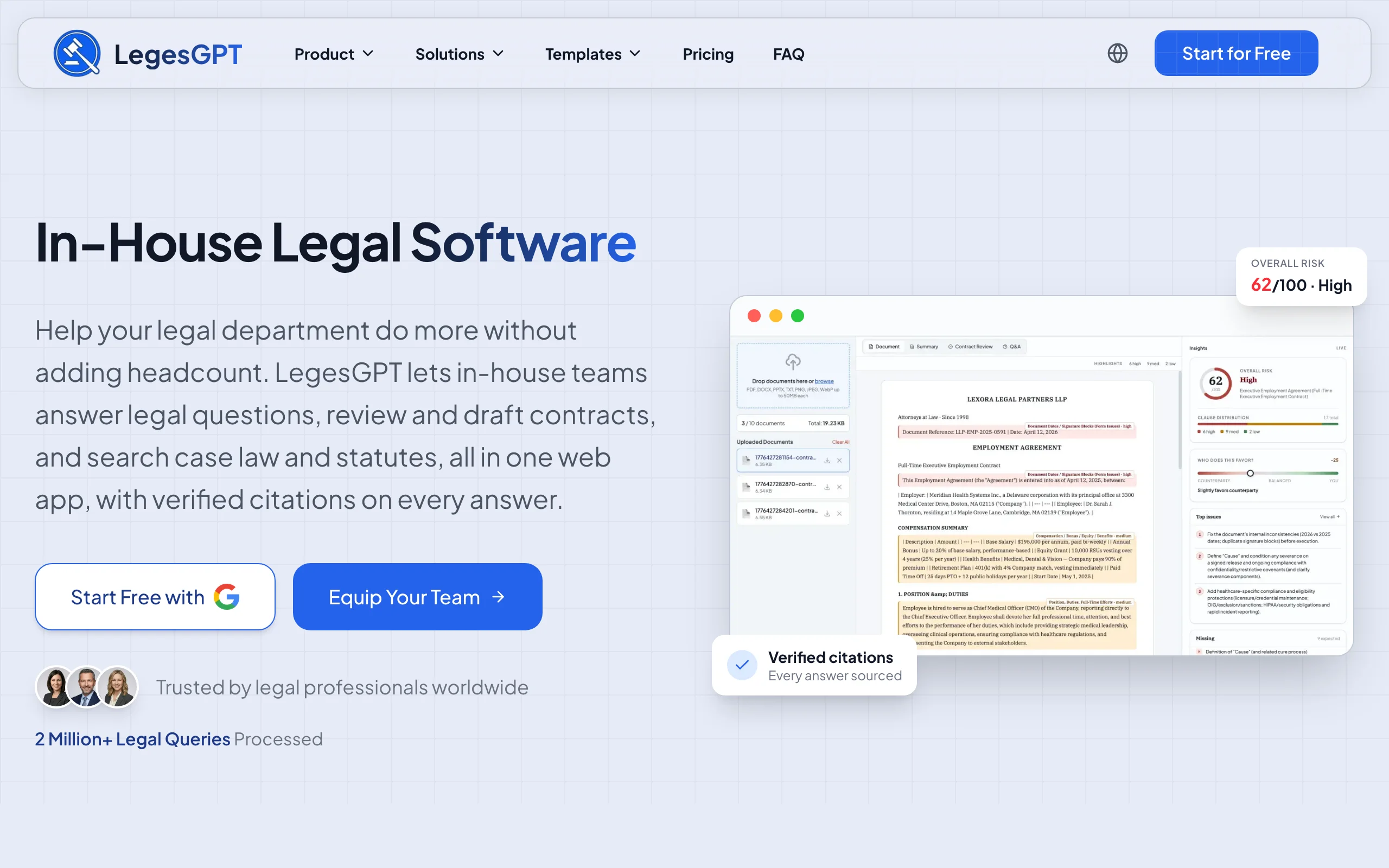
Review contracts, research risk, and draft documents in one place — LegesGPT gives in-house legal teams answers backed by verifiable citations.
Try LegesGPT for in-house teamsKnowledge management: the department finally remembers
Every legal department has paid the same tax: knowledge that lives in inboxes and in the heads of lawyers who leave. Positions get renegotiated from scratch because nobody remembers the last negotiation. New hires take months to learn what the department already decided years ago.
AI changes this by making your own repository queryable. Point it at prior contracts, negotiated positions, policies, and past advice, and "what is our standard position on liability caps with logistics vendors?" gets an answer with the source document attached, instead of an archaeology project.
The caveat is unglamorous: the answers are only as good as the repository. If your contracts live in seventeen folders and three inboxes, cleanup is part of the adoption work, not a separate project you can skip.
What AI means for in-house legal team structure and skills
Legal ops moves to the center. Someone has to own tooling, workflows, vendor management, and metrics. Gartner predicts legal technology budgets will double by 2028, and a doubling budget without an owner produces shelfware. In large departments that owner is a legal ops function; in a five-person team it is a hat someone wears deliberately, with time carved out for it.
Prompt literacy becomes a baseline skill. Not engineering. Knowing how to give an AI tool the right context and constraints, and how to check its output, is becoming as basic as knowing how to run a database search was in 2010. The pressure is coming from above: in the 2026 ACC Chief Legal Officers Survey of 1,049 CLOs across 43 countries, 47% said their CEOs now expect them to develop technology and AI proficiency.
The division of labor clarifies. AI takes the first pass: drafts, reviews, summaries, classification. Lawyers keep judgment: negotiation strategy, risk decisions, the final sign-off, and everything where being wrong is expensive. Notably, this is not translating into shrinking teams. In the same ACC survey, 63% of CLOs expect headcount to remain stable. The realistic outcome is the same team covering more of the business, not a smaller team covering the same ground.
The strategic seat is real, but it is not automatic. A record 84% of CLOs now report directly to their CEO. Yet Thomson Reuters found a blunt perception gap: 86% of GCs believe their department contributes significantly to business success, while only 17% of C-suite executives agree. AI frees capacity; the departments that convert that into standing redeploy it visibly, into deal velocity, business enablement, and risk foresight. Otherwise AI just makes the cost center marginally cheaper, and the perception gap stays.
The guardrails: privilege, confidentiality, and AI governance
Adoption without governance is how a productivity story becomes an incident report. Four areas need to be settled before you scale, not after.
Confidentiality. Company data does not go into consumer AI tools that may train on your inputs. Vet AI vendors the way you vet any processor of sensitive data: contractual commitments not to train on your data, retention limits, security certifications, and a data processing agreement where personal data is involved.
Privilege. Attorney-client privilege depends on confidentiality, and routing privileged material through a third-party tool without contractual confidentiality protections invites an argument that protection was compromised. Courts are still mapping how privilege applies to AI workflows, so the safe posture is conservative: enterprise agreements with confidentiality terms, clear rules about which matters may touch AI at all, and counsel involved in how tools are configured.
Verification. The cautionary tale is Mata v. Avianca (S.D.N.Y. 2023), where lawyers were sanctioned $5,000 after filing a brief containing cases ChatGPT had invented. The rule it produced belongs in every legal department: no AI-generated citation gets relied on until a human confirms it in the primary source. Prefer tools that verify citations and link to sources, because they make the check take seconds instead of hours.
A written AI use policy. The era of blanket bans is over: only 9% of in-house respondents now say company policy prohibits generative AI use, down from 29% a year earlier (ACC/Everlaw). What replaces prohibition is governance. A workable policy covers the approved tool list, the data classes each tool may and may not touch (privileged material, trade secrets, personal data), verification requirements before AI-assisted work product leaves legal, when AI use must be disclosed, an escalation path for edge cases, training requirements, and a review cadence. Quarterly reviews are reasonable; the tools change faster than annual policy cycles.
A 90-day AI roadmap for a lean in-house legal team
You do not need a transformation office. You need one focused quarter.
Days 1-30: pick one workflow and measure it.
- Choose something high-volume and low-risk. NDA review and intake triage are the usual candidates, and for good reason.
- Baseline the current state: monthly volume, average turnaround, lawyer hours consumed. Without a baseline you will have nothing to report in day 90.
- Write a one-page AI use policy covering approved tools, prohibited data, and verification. One page is enough to start; it will grow.
- Shortlist two or three tools and test them on your own documents, not the vendor's demo files. Your messy third-party paper is the real exam.
Days 31-60: pilot with real work.
- Have two or three lawyers run the chosen workflow through the tool alongside the normal process.
- Write the playbook as you go: standard positions, acceptable ranges, escalation triggers. The playbook outlasts any tool choice.
- Track the same metrics you baselined, and log the failure modes honestly. Where the tool is wrong matters more than how often it is right.
Days 61-90: expand and report.
- Roll the workflow out to the full team and add a second one.
- Pilot self-service with one friendly business unit, with legal reviewing only escalations.
- Report the before-and-after numbers to your CFO or CEO. Turnaround time and hours redeployed are the figures they will remember.
One practical note on tooling: enterprise legal AI platforms often carry procurement and onboarding cycles that consume your entire 90 days before anyone runs a document through them. Self-serve platforms built for in-house legal work, covering research, contract review, and AI contract drafting in one subscription, let the pilot start the same day, which is the point of a 90-day plan.
All of LegesGPT for $1
Verified-citation answers, case law search, document review, AI drafting, and e-signature in one subscription. 3-day trial for $1, cancel anytime.
Start the $1 trialFrequently Asked Questions
Will AI replace in-house lawyers?
The evidence points to redistribution, not replacement. In the 2026 ACC Chief Legal Officers Survey, 63% of CLOs expect headcount to remain stable even as AI adoption accelerates. AI absorbs first drafts, first-pass review, and triage, while judgment, negotiation, and accountability for risk stay with lawyers. The practical effect is the same team covering more of the business.
How are in-house legal teams using AI?
The most common uses are contract drafting and review, legal intake and triage, legal research, regulatory monitoring, and knowledge management. Adoption is mainstream: 52% of in-house counsel actively use generative AI in their practice according to the 2025 ACC/Everlaw survey, more than double the year before. Most teams start with one high-volume workflow, usually NDAs or intake, and expand from there.
What should an AI use policy for a legal department cover?
Seven things: an approved tool list, the data classes each tool may touch (with privileged material, trade secrets, and personal data handled most restrictively), citation and output verification requirements, when AI use must be disclosed, an escalation path for cases the policy does not anticipate, training requirements, and a review cadence. Keep it to a page or two at first. A policy nobody reads governs nothing.
Does using AI put attorney-client privilege at risk?
It can if it is done carelessly. Privilege rests on confidentiality, so sending privileged material to a consumer tool that may train on inputs or retain data creates avoidable risk. The conservative posture is to use enterprise tools with contractual confidentiality protections, restrict which matters may touch AI, and keep counsel involved in configuration. Courts are still working through how privilege applies to AI workflows, which is exactly why caution is the default.
How much can AI reduce outside counsel spend?
Expectations are high but the savings are gradual. In the ACC/Everlaw survey, 64% of in-house teams expect to rely less on outside counsel because of generative AI and 50% expect lower costs, yet Thomson Reuters found more GCs still plan to increase outside counsel spend than decrease it in the near term. The realistic model is a shift in mix: routine drafting, review, and research move in-house first, while specialized and high-stakes work stays external.
Is there a GPT built for in-house legal teams?
General-purpose chatbots can summarize and draft, but they are not built for legal work: they lack verified citations, document review against your positions, and legal-specific guardrails. Purpose-built platforms fill that gap. LegesGPT, for example, combines cited legal research, AI document review, and contract drafting in one subscription, self-serve with a 3-day $1 trial, which makes it a practical starting point for a lean legal team running the 90-day roadmap above.