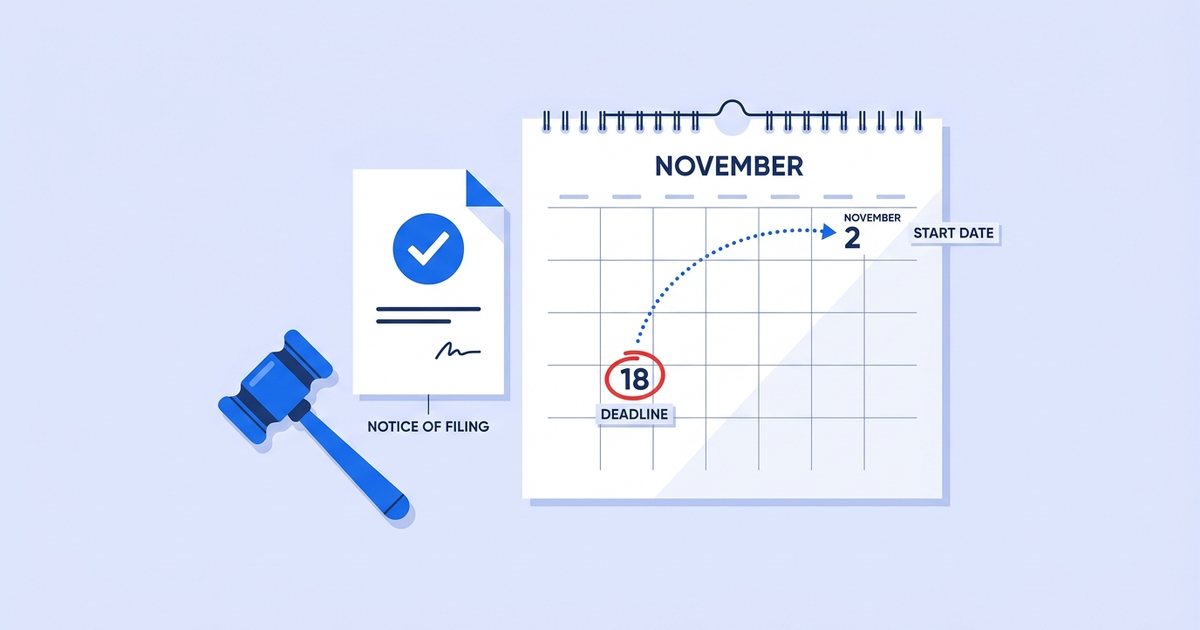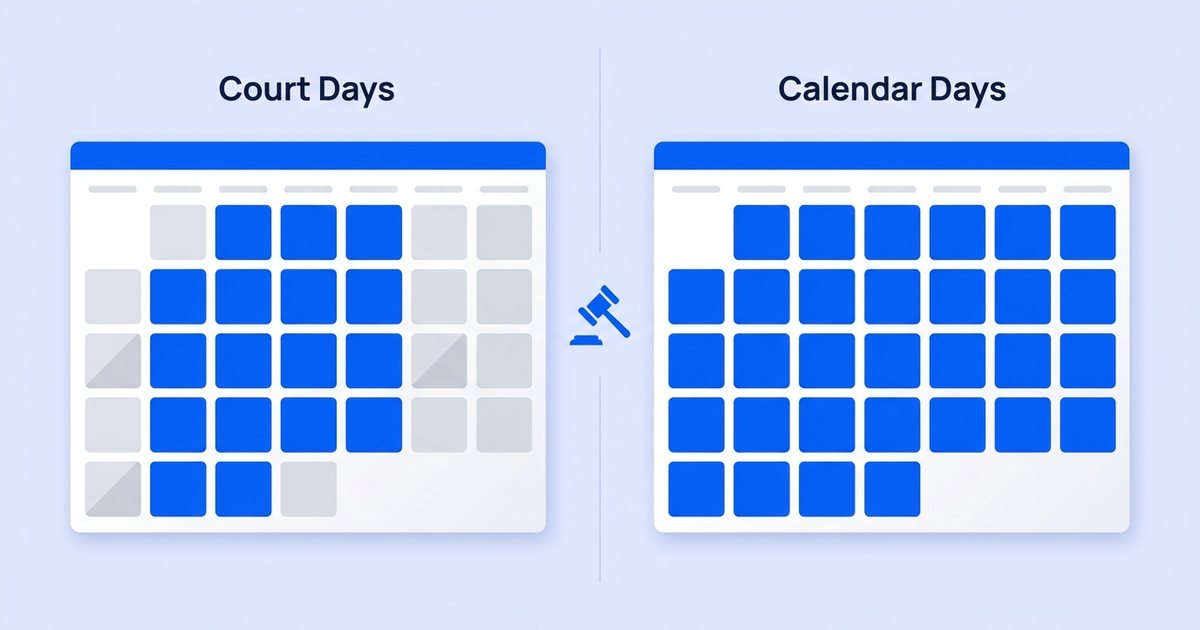
Miss a filing deadline by a single day and you can lose a motion, a right to appeal, or the whole case. A surprising amount of that risk comes down to one question: are you counting court days or calendar days? The two look similar, but on a real deadline they can be a week apart.
This guide explains what court days and calendar days are, how to count each one, and how weekends and holidays change the result. If you would rather skip the arithmetic, our free court date calculator counts court days or calendar days from any date for you.
What is a court day?
A court day is any day the court is actually open for business. In practice that means every weekday except the holidays the courts observe. Court days exclude:
- Saturdays and Sundays
- Holidays when the clerk's office is closed (federal holidays in federal court, and state judicial holidays in state court)
So if a rule gives you "10 court days," you count only the days the courthouse is open, skipping weekends and holidays as you go.
What is a calendar day?
A calendar day is simply a day on the calendar — every day of the year, including weekends and holidays. "30 calendar days" means 30 days straight through, whether or not the court is open. Most statutes of limitations and many federal deadlines are counted this way.
Court days vs. calendar days: the key difference
| Court days | Calendar days | |
|---|---|---|
| Weekends counted? | No | Yes |
| Holidays counted? | No | Yes |
| Typical use | Short notice periods; many state deadlines | Statutes of limitations; federal periods |
| "10 days" spans... | About two calendar weeks | Exactly 10 days |
The gap grows with the number of days and the holidays in between. Ten court days that start on a Monday usually land two full weeks later; ten calendar days land the following Thursday.
How to count court days, step by step
- Start with the triggering date — the day of service, filing, or the order. Do not count that day itself.
- Move to the next day the court is open. That is court day 1.
- Keep counting forward, skipping every weekend and holiday, until you reach the required number of court days.
- Land on a court day. Because you skip closed days as you go, the final day is always a day the court is open.
Example. A rule requires an act 5 court days after an order entered on Friday, July 2. You skip the July 3 holiday and the weekend, then count Monday July 6 (1), Tuesday July 7 (2), Wednesday July 8 (3), Thursday July 9 (4), Friday July 10 (5). The deadline is Friday, July 10. Counted as 5 calendar days, the deadline would have been Wednesday, July 7 — three days earlier.
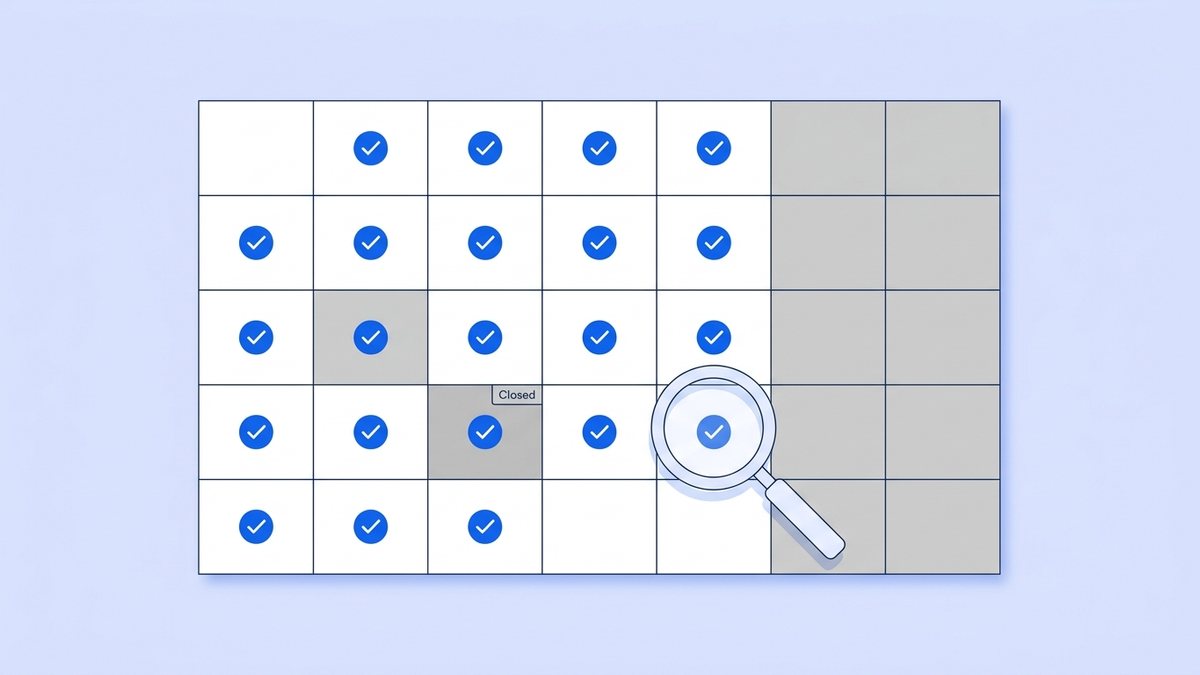
Our court date calculator does this counting automatically; switch between court days and calendar days to see the difference for your own dates.
How weekends and holidays change the count
Even when a deadline is counted in calendar days, weekends and holidays still matter at the end. Under Federal Rule of Civil Procedure 6(a), if the last day of a period falls on a Saturday, Sunday, or legal holiday, the deadline rolls forward to the next day that is not a weekend or holiday.
The federal courts observe the 11 legal holidays set by 5 U.S.C. § 6103: New Year's Day, the Birthday of Martin Luther King Jr., Washington's Birthday, Memorial Day, Juneteenth National Independence Day, Independence Day, Labor Day, Columbus Day, Veterans Day, Thanksgiving Day, and Christmas Day. When one of these falls on a weekend, the courts observe it on the nearest weekday.
Do federal courts count in court days or calendar days?
This trips up a lot of people. Since the 2009 amendments, the federal rules use an "every day counts" method: under FRCP 6(a)(1), you exclude the triggering day, then count every day — including intermediate weekends and holidays — and only the last day rolls forward if it is a weekend or holiday. In other words, most federal deadlines are calendar-day counts, not court-day counts.
Many state deadlines are different. California, for example, counts important deadlines in court days: a motion must be served and filed at least 16 court days before the hearing under CCP § 1005(b), and California defines court days by excluding weekends and judicial holidays. Always check whether your specific rule says "days" (calendar) or "court days."
Common mistakes to avoid
- Assuming "days" means business days. Unless a rule says "court days" or "business days," it usually means calendar days.
- Forgetting the last-day roll. A calendar-day deadline that lands on a holiday moves to the next open day — but intermediate weekends still count.
- Mixing up state and federal methods. The same "10 days" can be counted two different ways depending on the court.
- Ignoring the mail rule. Some deadlines get extra days when papers are served by mail. See our guide on how to calculate court deadlines for the full method.
Count it automatically
When a missed day carries real consequences, do not count on your fingers. Use the free court date calculator to count court days or calendar days before or after any date, with weekends and federal holidays handled for you. For rule-based deadlines by case type, try the legal deadline calculator.
This guide is general information, not legal advice. Court rules and holidays vary by jurisdiction and change over time — always confirm the rule that governs your deadline and consult a licensed attorney for important matters.
Frequently Asked Questions
What is the difference between court days and calendar days?
Calendar days count every day of the year, including weekends and holidays. Court days count only the days the court is actually open, so Saturdays, Sundays, and holidays when the clerk's office is closed are skipped. Because of that, ten court days usually span about two calendar weeks, while ten calendar days is exactly ten days.
How do you count court days?
Start with the triggering date but do not count that day. Move to the next day the court is open and call it court day one, then keep counting forward, skipping every weekend and holiday, until you reach the required number. Because closed days are skipped as you go, the final day always lands on a day the court is open.
Is a weekend a court day?
No. Courts are closed on Saturdays and Sundays, so weekends are never court days. They are still counted as calendar days, which is why the two counting methods drift apart the longer the period runs.
Are court days the same as business days?
They are close but not identical. Both exclude weekends. Court days also exclude the specific holidays the court observes (judicial holidays), which can differ slightly from the holidays a private business closes for. Always use the court's holiday schedule, not a generic business calendar.
Do federal courts count in court days or calendar days?
Federal deadlines under FRCP 6(a) are counted in calendar days — you exclude the triggering day, count every day including intermediate weekends and holidays, and only the last day rolls forward if it falls on a weekend or holiday. Many state deadlines are different; California, for example, counts key deadlines in court days.