
Ask ChatGPT for a non-disclosure agreement and it will hand you one in about thirty seconds: parties, definitions, confidentiality obligations, a governing-law clause, the lot. So if you're wondering whether ChatGPT can write legal documents, the honest answer is yes. It produces drafts that look like the real thing.
The problem is the gap between "looks like a contract" and "protects you when the deal goes wrong". ChatGPT does not know your jurisdiction unless you tell it, it invents legal authority with total confidence, and on default settings it may use what you paste to train future models.
This guide covers what ChatGPT genuinely does well on legal documents, the five risks that matter in practice, a safe step-by-step workflow, and when a purpose-built legal AI is the better tool. (If your question is about advice rather than drafting, we've covered whether ChatGPT can give legal advice separately.)
What ChatGPT does well on legal documents
Used with realistic expectations, ChatGPT is genuinely useful in four ways.
Fast first drafts. It turns a blank page into structured contract language in under a minute. For a simple services agreement, an NDA, or a demand letter, a draft you can react to beats staring at an empty document. First drafts are where it earns its keep, not final versions.
Plain-language interpretation. Paste a clause you don't understand and ask what it means, who it favors, and what happens if you sign it as written. This is arguably the safest legal use of ChatGPT: you're using it to interpret legal documents and ask better questions, not to create binding obligations.
Clause brainstorming. Ask "what protections is this contract missing for the service provider?" or "list ten things a freelancer should negotiate in this agreement" and it produces a solid checklist to discuss with the other side or your lawyer.
Document handling. The current product is built for document work: you can upload PDFs, Word files, and presentations for analysis, edit drafts side by side in the canvas editor, and export the result as a PDF, DOCX, or Markdown file.
None of this makes ChatGPT a lawyer. It makes it a fast, articulate drafting assistant with no legal accountability, which is exactly how you should treat it.
The five real risks of using ChatGPT for legal documents
These are not hypothetical. Each one has either sanctioned real lawyers or sits in OpenAI's own policies.
1. It invents clauses and citations that look real
Large language models generate plausible text, and in law "plausible" is dangerous. In Mata v. Avianca, a New York federal court fined two lawyers and their firm $5,000 in 2023 after they filed a brief containing six nonexistent cases invented by ChatGPT, complete with fabricated quotes and citations. When challenged, ChatGPT assured them the cases were real and "can be found in reputable legal databases".
The scale of the problem is measurable. Stanford researchers who tested general-purpose models on legal questions found hallucination rates of 58% to 88%, and the models were poor at predicting their own errors. Those tests ran on 2023-era models and newer ones do better, but no general chatbot verifies legal authority before asserting it.
In a contract, hallucination looks subtler than a fake case. It looks like a reference to a statute that doesn't apply, a "standard" clause that isn't standard in your industry, or a termination provision that quietly contradicts the payment terms three pages earlier.
2. It is jurisdiction-blind by default
Contract law is local. A non-compete that is enforceable in one state is void in another, consumer protections differ between the US, the UK, and the EU, and notice periods, cooling-off rights, and mandatory clauses vary by country. ChatGPT defaults to generic, vaguely American boilerplate unless you specify a jurisdiction, and even when you do, it cannot verify that its output reflects that jurisdiction's current law.
The failure mode is quiet. The document reads fine, both sides sign it, and the problem only surfaces when a clause is tested and turns out to be unenforceable where you live. By then, renegotiating is expensive or impossible.
3. It does not know your deal
A contract's job is to record what you actually agreed: the price, the milestones, the IP split, who carries which risk. ChatGPT knows none of that. It fills the gaps with averages, which is how you end up with a liability cap you never negotiated or an auto-renewal clause nobody wanted. A generic term that misstates your deal is worse than a missing one, because a court will hold you to what you signed, and an ambiguous clause is how a working relationship turns into a breach of contract dispute.
4. What you paste may be stored, reviewed, or subpoenaed
On consumer plans, OpenAI may use your conversations to train its models unless you opt out in settings or use a temporary chat. Business and Enterprise data is excluded by default, but most people drafting a quick contract are not on those plans.
There is also no privilege. Sam Altman himself warned in 2025 that conversations with ChatGPT carry no legal confidentiality, and that OpenAI could be required to produce user chats in litigation. Anything privileged you paste into a consumer chatbot may lose the protection that attorney-client privilege would have given the same conversation with your lawyer.
5. It cannot execute the document
A drafted contract is not a signed contract. ChatGPT outputs text; it does not manage signature blocks for entities versus individuals, witnessing or notarization where the document requires it (wills and some affidavits fail on formalities alone), or the actual signing. E-signature laws such as the US ESIGN Act and the EU's eIDAS regulation make electronic signatures binding, but ChatGPT has no e-signing workflow, so you still need a separate tool to get the document executed and stored.
How to use ChatGPT for legal documents safely
If you're going to use ChatGPT anyway, and plenty of lawyers and business owners do, this workflow removes most of the avoidable risk.
- Start from a real template, not a blank prompt. Give ChatGPT an attorney-drafted starting point and ask it to adapt the variable parts. You can pull one from a library of legal document templates rather than trusting the model to invent the skeleton.
- Write instructions like a brief, not a wish. Name the parties, the deliverables, the price, payment terms, term and termination, IP ownership, and liability. Every fact you leave out gets replaced by a guess.
- State the jurisdiction explicitly. Say "governed by the laws of [state/country]" and ask it to flag any clause that may be unenforceable there, then treat those flags as questions for verification, not answers.
- Make it explain the draft back to you. Ask what each clause does, which terms favor the other side, and what is missing. You catch more errors interrogating a draft than reading it.
- Never paste confidential or privileged material. Redact names, numbers, and secrets, turn off model training in data controls or use a temporary chat, and keep anything privileged out of consumer chatbots entirely.
- Get professional review before anyone signs. OpenAI's own usage policies, updated in October 2025, prohibit using ChatGPT for tailored legal advice "without appropriate involvement by a licensed professional". For low-stakes documents, a purpose-built legal AI review is a strong baseline; for high-value or unusual deals, pay a lawyer to review the draft. Review is far cheaper than drafting from scratch.
Make a contract online in minutes
Pick a professional template, fill in your details, and download your contract as PDF or Word — LegesGPT's free online contract maker, no signup required.
Make a contract freeWhen to use a purpose-built legal AI instead
ChatGPT is a general assistant that happens to produce legal-sounding text. A purpose-built legal AI starts from the opposite end: verified legal content first, text generation second. That difference shows up at every step, from AI contract drafting through to signature.
LegesGPT was built for exactly the gaps this article describes. Instead of inventing a document skeleton, it drafts from a library of 100+ attorney-drafted templates, so the structure and the boilerplate were written by lawyers, not predicted by a model. Drafting is jurisdiction-aware: you set your country up front and the draft follows that legal system instead of defaulting to generic US boilerplate.
The review side closes the loop on your existing paperwork. Upload a contract and you can review legal documents with AI that flags risky clauses, explains them in plain language, and proposes concrete changes, rather than a general summary. When the draft is ready, built-in e-signature lets you sign and send it from the same place, which fixes the execution gap ChatGPT leaves open.
An honest scope note: LegesGPT is not a law firm either. For litigation, regulatory filings, or a high-stakes negotiation, you still want a lawyer, and LegesGPT runs in the browser rather than inside Microsoft Word, if that's where you live. What it removes is the blank page, the jurisdiction blindness, and the silent errors that make raw ChatGPT drafts risky.
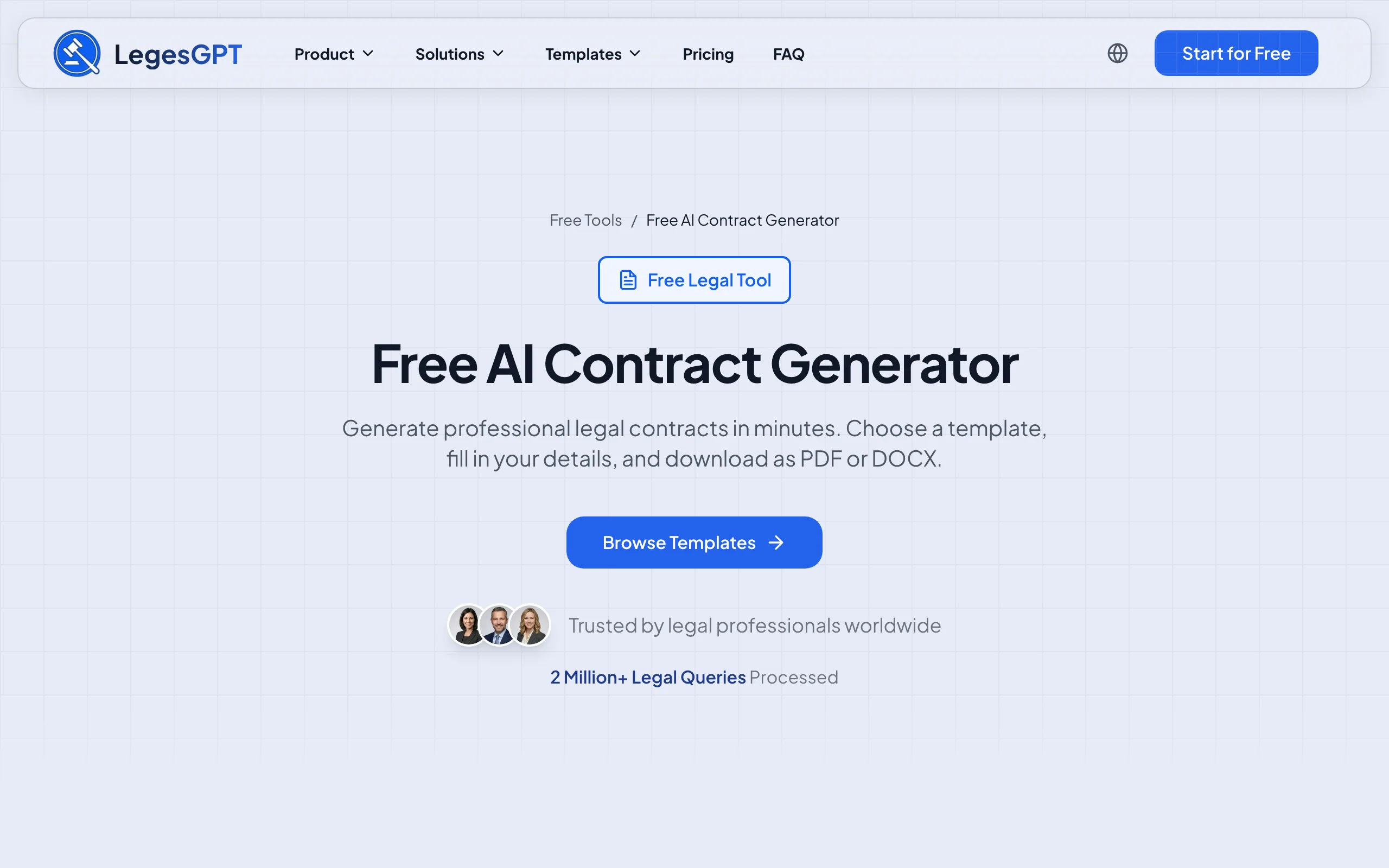
You can test the difference without a subscription: the free AI contract generator produces a jurisdiction-aware contract draft in a few minutes. The full platform starts at $19.99/month with document upload and review from the $49.99/month Plus plan, and a 3-day trial costs $1.
Generate any legal document in minutes
From NDAs to leases to letters — describe what you need and LegesGPT drafts a tailored, ready-to-edit legal document in minutes.
Generate a documentFrequently Asked Questions
Can ChatGPT write a contract?
Yes. ChatGPT can produce structured contract text for common agreements like NDAs, service agreements, and leases in under a minute. Treat the output as a first draft: it uses generic terms, does not tailor to your jurisdiction unless instructed, and can invent clauses or references, so it needs review before anyone signs.
Is it legal to use ChatGPT to write legal documents?
Generally yes, for your own documents. Drafting your own contract is legal self-help in most places. Two caveats: OpenAI's usage policies prohibit tailored legal advice without a licensed professional involved, and drafting documents for other people can cross into unauthorized practice of law in many jurisdictions.
Will a contract written by ChatGPT hold up in court?
A contract is not invalid just because AI drafted it. Courts care about the usual requirements: agreement between the parties, valid terms, proper execution. The real risk is quality, not authorship: an AI-drafted clause that is ambiguous, unenforceable in your jurisdiction, or missing required formalities can sink the document regardless of who or what wrote it.
Can ChatGPT review a contract?
Yes, you can upload a contract and get a summary, plain-language explanations, and a list of concerns, which is useful triage. But it may miss cross-reference errors, cannot check clauses against your jurisdiction's current law, and consumer chats are not confidential by default. A purpose-built review tool, plus a lawyer for high-stakes documents, is the safer path.
Can ChatGPT interpret legal documents?
Interpretation is one of its stronger uses. Asking ChatGPT to explain a clause, translate legalese into plain English, or identify who a term favors is low-risk because you are gaining understanding, not creating obligations. Just remember that how a court would interpret an ambiguous clause depends on jurisdiction-specific rules it cannot verify.
Is it safe to paste a confidential contract into ChatGPT?
Not on default consumer settings. Conversations may be used for model training unless you opt out, they carry no legal privilege, and OpenAI could be compelled to produce them in litigation. Redact sensitive details, disable training or use a temporary chat, or use a legal tool that keeps documents out of model training.
Can lawyers use ChatGPT for legal documents?
Yes, and many do, but professional duties apply. Bar guidance in multiple jurisdictions ties AI use to the duties of competence and confidentiality: verify everything the model produces and keep client data out of tools that may train on it. Some judges also require disclosure or certification of AI use in filings, so check standing orders before submitting anything AI-assisted to a court.
What should I use instead of ChatGPT for legal documents?
If documents are the actual job, use a legal-specific tool. LegesGPT combines attorney-drafted templates, jurisdiction-aware AI drafting, document review that flags risks and proposes fixes, and e-signature in one subscription, with a $1 trial to test it on your own documents. Keep ChatGPT for brainstorming and plain-language explanations.