

LexisNexis is one of the two names every lawyer learns, and its Lexis+ with Protégé platform is a genuinely deep research tool. It is also expensive, sold on custom quotes, and bundled in ways that push the newest AI features into higher tiers. For solo practitioners, small firms, and in-house teams, that adds up to a bill that is hard to predict and harder to justify when you mostly need reliable case law, statutes, and a citation you can trust.
The good news: you have real choices now. AI assistants answer legal questions with verified citations, search case law and statutes, and draft from what they find, often for a fraction of LexisNexis pricing; see our comparison of AI tools for legal research for the AI-first options. This guide compares the best LexisNexis alternatives for lawyers and legal teams. For each tool you get what it does, key features, pricing, and who it fits, plus a framework to match the right one to your practice. We start with LegesGPT, an affordable all-in-one option you can try today without a sales call.
Why look for a LexisNexis alternative?
LexisNexis is comprehensive and well-trusted, and for large firms that need every secondary source and the Shepard's citator, it earns its keep. Lawyers still shop around for a few practical reasons:
- Quote-only pricing. LexisNexis does not publish rates; cost depends on firm size, content bundles, and negotiation, so you cannot budget without a sales conversation.
- AI sits in the premium tiers. The Protégé assistant and the strongest agentic features are concentrated in higher-priced plans, on top of a base subscription many lawyers already find costly.
- Enterprise contracts and lock-in. Multi-year agreements and seat minimums fit big firms better than a solo or a five-person practice that wants to start this afternoon.
If transparent pricing, built-in AI, or a lighter footprint matters to you, the tools below cover the same core research and often more.
Best LexisNexis alternatives: a brief overview
- LegesGPT: Best overall for solo and small firms: verified-citation answers, case law and statute search, document review, and drafting in one affordable, self-serve plan.
- Westlaw (Thomson Reuters): Best full-service rival, with the KeyCite citator and the deepest secondary-source library.
- vLex (Vincent AI): Best for global and multi-jurisdiction research across 100+ countries.
- Bloomberg Law: Best for litigation analytics and business intelligence alongside primary law.
- Fastcase: Best low-cost access, often free through a state or local bar association.
| Tool | Best for | Starting price | Free trial | Coverage |
|---|---|---|---|---|
| LegesGPT | All-in-one for solo & small firms | From $19.99/mo | 3-day trial | 38+ countries |
| Westlaw | Full-service rival with KeyCite | Custom (quote-only) | Demo / by request | US primary + secondary |
| vLex (Vincent AI) | Global, multi-jurisdiction research | Custom (quote-only) | Trial by request | 100+ countries |
| Bloomberg Law | Litigation analytics + business news | Custom (quote-only) | Trial by request | US + dockets |
| Fastcase | Low-cost / bar-bundled access | Often free via bar; ~$65/mo | Trial by request | US (50 states + fed) |
1. LegesGPT, best overall for solo and small firms
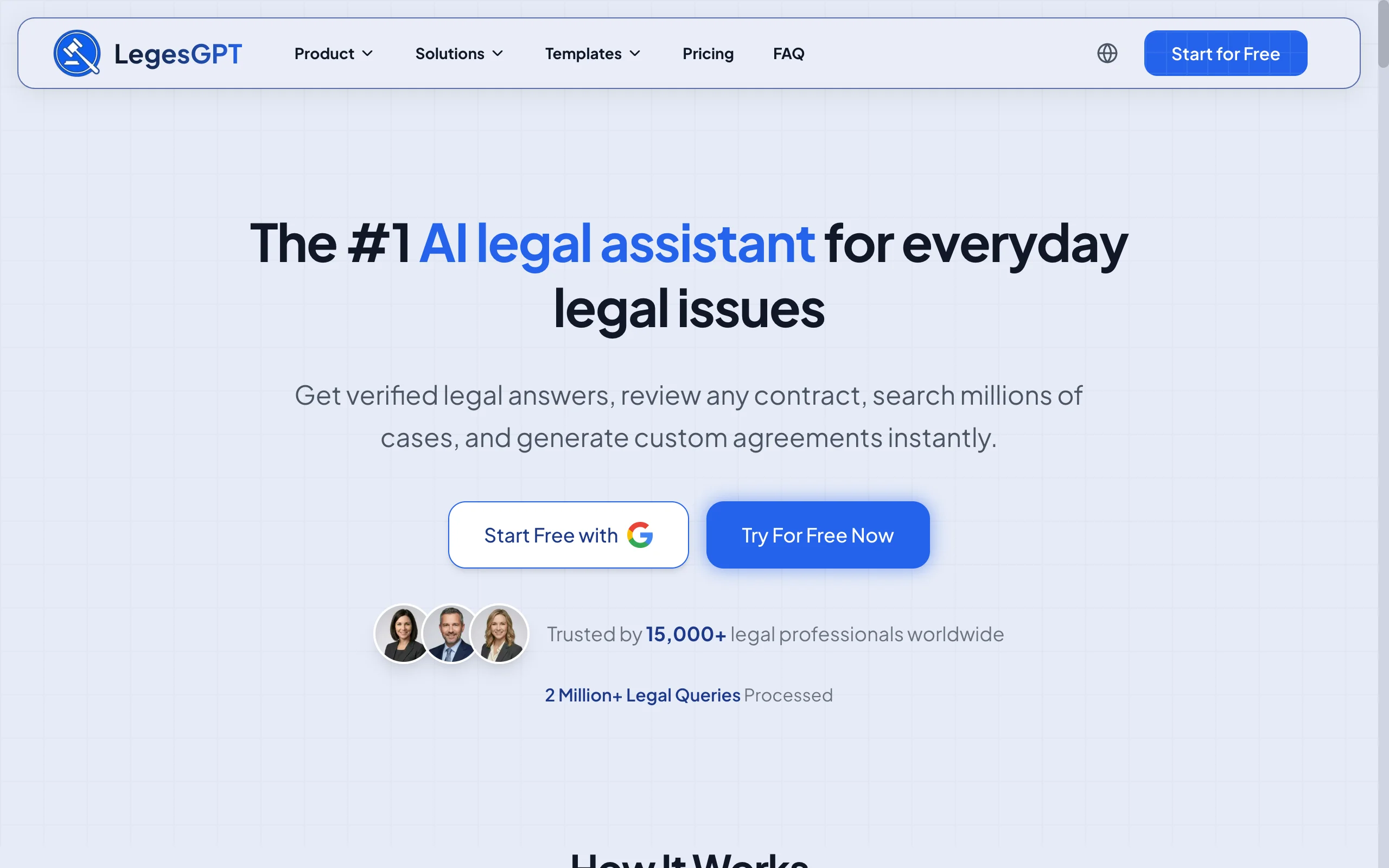
LegesGPT is built around the question most lawyers actually ask LexisNexis: "what does the law say, and can I trust the answer?" It answers legal questions with verified citations and clickable source links, searches case law and statutes, reviews uploaded documents to flag risks and propose fixes, and drafts contracts and legal documents, all in one browser app. Where LexisNexis gates its AI assistant behind premium tiers and a sales cycle, LegesGPT puts research, review, drafting, and e-signature in one self-serve subscription you can start in minutes.
Key features
- Legal questions answered with verified citations and direct source links, so every answer is fast to check against the record
- Case law and statute search, with a Deep Research mode for multi-step questions
- AI document review for PDF, DOCX, PPTX, TXT, and images: flags risky clauses, proposes edits, and gives plain-language summaries
- AI drafting of contracts and legal documents, plus 100+ attorney-drafted templates
- Built-in e-signature, web search for recent developments, and free tools like a contract generator and citation generator
Best for
- Solo practitioners and 2 to 50 attorney firms that want research plus drafting in one tool
- In-house counsel and legal ops teams that need cited answers, not a research library to administer
- Paralegals and law students who want self-serve access without enterprise procurement
Pricing
- Basic, $19.99/month: unlimited AI queries, case law and statute search, citation verification
- Plus, $49.99/month: adds document and image upload plus 50 document reviews/month
- Premium, $99.99/month: adds unlimited document review, Deep Research, and web search
- 3-day trial (with a $1 activation fee) and roughly 30% off annual billing
Pros
- Verified citations with source links make answers quick to confirm before you rely on them
- Covers research, review, drafting, and signing in one low-cost plan, not just case search
- Self-serve signup with no seat minimums and no sales call
- A fraction of the price of Lexis+, Westlaw, or enterprise AI platforms
Cons
- Newer brand with a smaller footprint than LexisNexis or Westlaw
- Web-only, with no native mobile app, public API, or Microsoft Word add-in
- Not built to replace an exhaustive secondary-source library the way the legacy databases are
If your main reason for leaving LexisNexis is price or the all-in-one workflow, LegesGPT is the most direct upgrade for everyday research and drafting.
2. Westlaw (Thomson Reuters), best full-service rival
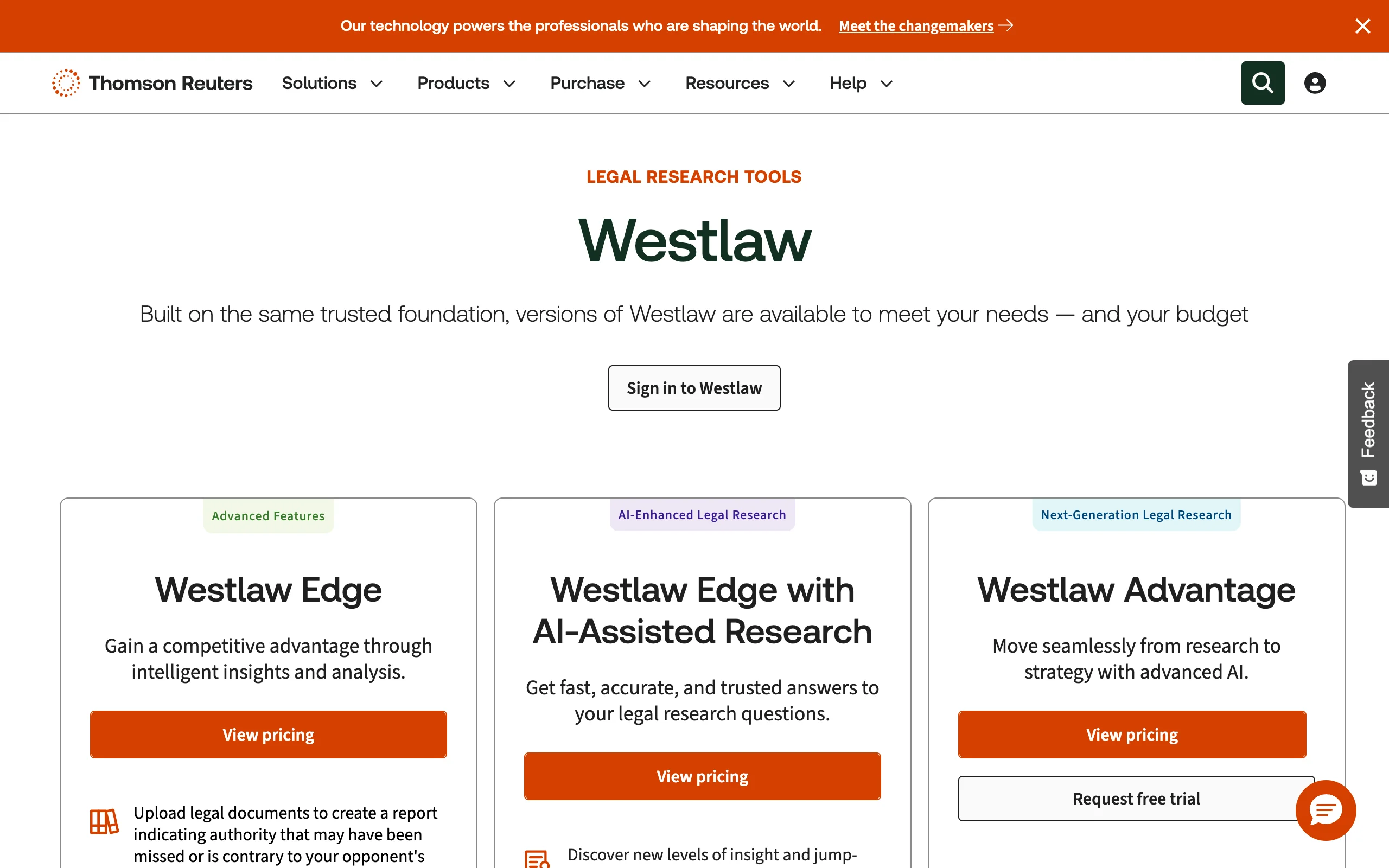
Westlaw is the other half of the research duopoly and the most natural head-to-head alternative to LexisNexis. It matches Lexis on depth: comprehensive case law, statutes, regulations, and an enormous secondary-source library, anchored by the KeyCite citator for checking whether a case is still good law. Its AI-assisted research and the CoCounsel assistant add agentic workflows on top. For firms that simply want to pit the two giants against each other, Westlaw is the rival to price out.
Key features
- KeyCite citator for validating the treatment of a case
- Deep case law, statutes, regulations, and secondary sources
- AI-assisted research and the CoCounsel assistant for drafting and analysis
- Practice tools, headnotes, and the Key Number System
Best for
- Firms that want a full-service database and citator comparable to Lexis
- Research and litigation-heavy practices that use secondary sources daily
Pricing
- Quote-only; Thomson Reuters does not publish rates
- Reported solo and small-firm rates run from roughly $133 to $381 per user per month, climbing with content bundles and AI tiers (confirm with the vendor)
- Demo-based evaluation; trials by request
Pros
- KeyCite is a mature, deeply trusted citator
- Unmatched breadth of secondary sources and editorial tools
Cons
- Quote-only pricing that skews enterprise, like Lexis itself
- The newest AI features cost extra on top of the base subscription
For a wider view of how the big databases stack up, see our guide to the best legal research tools for lawyers.
3. vLex (Vincent AI), best for global and multi-jurisdiction research
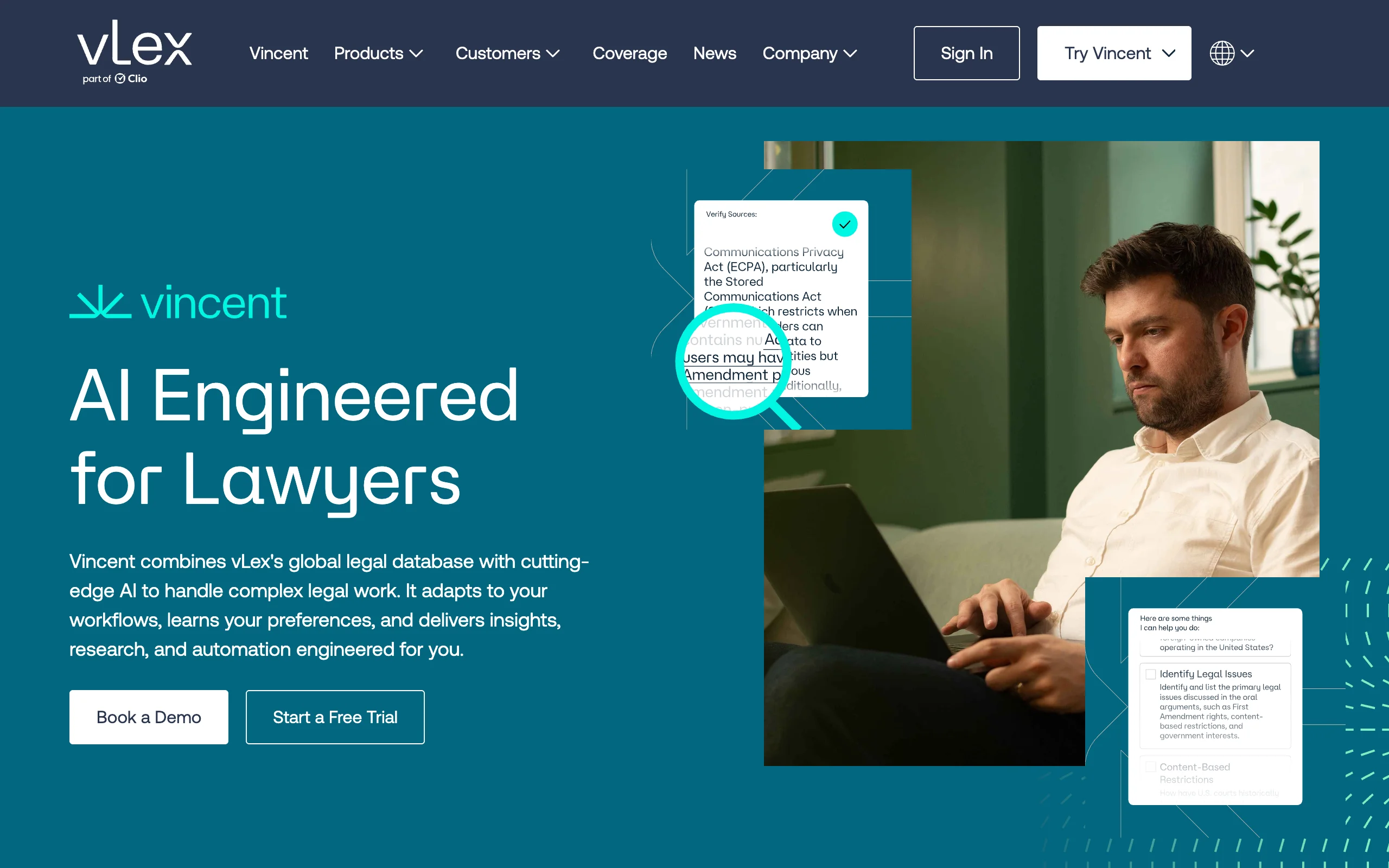
vLex, with its Vincent AI assistant, is built for reach: it covers more than 100 countries and pairs that breadth with cited AI answers and a "compare jurisdictions" workflow. Now a Clio company (vLex acquired Fastcase in 2023, and Clio acquired vLex in late 2025), it is the natural pick when your research crosses borders instead of staying inside US primary law, where LexisNexis is strongest.
Key features
- Vincent AI assistant with cited answers and 20+ legal workflows
- Coverage across 100+ countries, with jurisdiction comparison
- Document analysis and drafting tools
- Docket data and citators
Best for
- Firms doing cross-border or international research
- Teams that want one platform spanning many jurisdictions
Pricing
- Quote-only; one third-party directory estimates around $399 per user per month (unconfirmed)
- Trial available by request; no published self-serve free tier
Pros
- Unmatched multi-jurisdiction and international coverage
- Vincent AI ties research, analysis, and drafting together
Cons
- Pricing is not published, so budgeting needs a quote
- More breadth than a US-only practice typically needs
4. Bloomberg Law, best for litigation analytics and business intelligence
Bloomberg Law combines primary law with the kind of business and litigation intelligence that Lexis users often buy as add-ons. Its BCite citator, Litigation Analytics on judges and courts, and deep docket coverage make it strong for litigators and transactional lawyers who want market and company data sitting next to their case research.
Key features
- BCite citator for case-treatment signals
- Litigation Analytics on judges, courts, firms, and attorneys
- Federal and 1,800+ state court docket coverage
- Bloomberg business news, company data, and AI research tools
Best for
- Litigators who want judge and court analytics with their research
- Corporate and transactional teams that need legal plus business intelligence
Pricing
- Quote-only; no reputable public per-user figure
- Free unlimited access for law students; free for legal-aid and pro-bono work
- Trial available by request
Pros
- Excellent analytics and docket coverage in one platform
- Business and legal intelligence under one subscription
Cons
- Custom pricing with no published rates to compare
- Heavier and pricier than a focused research tool for pure case lookup
5. Fastcase, best low-cost or bar-bundled access
Fastcase (now part of vLex) is the budget-friendly research staple, and many lawyers already have it free through a state or local bar association membership. It covers federal and 50-state case law, statutes, and regulations, with citation analysis and visualization, making it a practical LexisNexis substitute for everyday lookups at little or no extra cost.
Key features
- Federal and 50-state case law, statutes, and regulations
- Negative-treatment checking and citation analytics
- Data visualization for citation relationships
- Vincent AI and Docket Alarm integration
Best for
- Solos and small firms watching costs
- Bar association members who get Fastcase as a benefit
Pricing
- Often free as a state or local bar association member benefit
- Standalone reported from roughly $65 per user per month
- Benefits vary by bar and can change, so confirm your current access
Pros
- Free or low-cost access to solid primary-law research
- Now backed by vLex's broader platform and AI
Cons
- Bar-provided access varies and is not guaranteed long term
- Lighter on secondary sources and analytics than the premium databases
How to choose the best LexisNexis alternative for your practice
The right tool depends on what you research, how big your team is, and whether you want AI built in. Use these questions to narrow it down.
1) Do you need a full research library, or fast answers with citations?
- If you mainly need reliable answers, case law, and statutes with verified citations: LegesGPT covers everyday research plus drafting in one plan.
- If you need an exhaustive database with a mature citator and deep secondary sources: Westlaw or Bloomberg Law.
2) How big is your team and budget?
- Solo to 50 attorneys who want predictable, self-serve pricing: LegesGPT from $19.99/month, with a 3-day trial.
- Cost-conscious lawyers with bar membership: check whether you already get Fastcase free.
- Enterprise legal departments with procurement and budget for custom contracts: Westlaw or Bloomberg Law.
3) Does your research cross jurisdictions or stay local?
- Cross-border or international work: vLex (Vincent AI) for 100+ country coverage.
- Standard US primary law: LegesGPT, Fastcase, or the incumbents all cover it.
4) Do you want AI built in, or layered on an existing subscription?
- Standalone AI research without buying into a legacy database: LegesGPT.
- AI grounded in a legacy corpus, if you stay in that ecosystem: Westlaw with CoCounsel.
Whatever you shortlist, test it on your own work first. Run a handful of real research questions through each tool, check the citations against the source, and compare the price-to-value math before committing. If you are weighing AI research assistants specifically, our roundup of the best Casetext and CoCounsel alternatives goes deeper on that category.
Frequently Asked Questions
What is the best alternative to LexisNexis?
For solo practitioners, small firms, and budget-conscious in-house teams, LegesGPT is the best all-around alternative. It answers questions with verified citations, searches case law and statutes, reviews documents, and drafts, all in one self-serve plan from $19.99/month with a 3-day trial. Larger firms that need an exhaustive secondary-source library and a mature citator may prefer Westlaw or Bloomberg Law.
Why do lawyers look for a LexisNexis alternative?
LexisNexis is comprehensive but expensive, and it sells on custom quotes rather than published prices. Its AI assistant sits in the higher tiers, and contracts tend to favor larger firms. Lawyers who want predictable pricing, built-in AI, or a lighter footprint often look for a tool with a simpler buying process.
Is there a cheaper alternative to LexisNexis?
Yes. LegesGPT starts at $19.99/month with transparent self-serve pricing, and many lawyers get Fastcase free through a bar association. Because LexisNexis quotes pricing privately, the most reliable way to compare cost is to get a quote and weigh it against a tool you can test today.
Which LexisNexis alternative has a real citator?
Westlaw has KeyCite and Bloomberg Law has BCite, both mature citators for checking whether a case is still good law. Fastcase offers negative-treatment checking. Free tools do not provide a true citator, which is a key reason to use a paid platform for anything you rely on.
Are AI legal research tools accurate enough to rely on?
AI tools speed up research, but they do not remove the lawyer's duty to verify. Tools that link to sources, like LegesGPT's verified citations, make checking faster, but you should still read every cited case and confirm its treatment before relying on it. Treat AI output as a strong first pass, not final authority.
Do I need to replace Shepard's to leave LexisNexis?
Not exactly, but you do need a citator. Shepard's is specific to LexisNexis, so if you leave, plan to use KeyCite (Westlaw) or BCite (Bloomberg Law) for validating case treatment, or pair an AI research tool with careful manual confirmation of every authority you cite.
I mainly need affordable research with citations plus drafting. What should I use?
LegesGPT is built for exactly that. It answers legal questions with verified citations and source links, searches case law and statutes, reviews documents, and drafts, in one self-serve subscription from $19.99/month with a 3-day trial, so you can test it on your own research before committing.