
Writing a contract from a blank page is slow, and copying last year's agreement forward is how outdated clauses and wrong party names slip through. Contract authoring software fixes both problems: it turns a deal description or a proven template into a clean first draft in minutes, keeps language consistent, and routes the finished document for signature.
The catch is that "contract authoring" covers everything from a $19.99/month AI assistant to a $500,000 enterprise platform, and vendors rarely publish prices. In this guide we compare the best contract authoring software for legal, sales, and procurement teams, with verified pricing, real strengths and trade-offs, and a decision framework to match a tool to your contract volume and budget.
Best contract authoring software: a brief overview
- LegesGPT: Best overall contract authoring software: describe the deal in plain language and get a jurisdiction-aware first draft, or start from 100+ attorney-drafted templates, then e-sign, all from $19.99/month.
- Juro: Best for in-house teams automating high-volume routine contracts: browser-native templates, approval workflows, and unlimited users on every plan.
- Spellbook: Best for lawyers who author contracts inside Microsoft Word: AI drafting and review without leaving the document you already work in.
- Ironclad: Best for enterprise contract workflows at scale: powerful workflow designer and repository for legal teams processing thousands of contracts a year.
- Concord: Best for teams that want predictable flat-fee pricing: published plans, unlimited documents, and unlimited e-signatures.
- ContractPodAi (Leah): Best for legal departments adopting agentic AI: an assistant-led platform that spans authoring, review, and legal operations.
- Icertis: Best for global enterprises in regulated industries: deep clause governance and compliance controls across huge contract estates.
| Tool | Best for | Starting price | Free trial | Platforms |
|---|---|---|---|---|
| LegesGPT | All-in-one authoring for solo, small, and lean teams | From $19.99/mo | 3-day, $1 | Web |
| Juro | High-volume routine contracts in-house | Custom (~$18K-$35K/yr) | Demo only | Web |
| Spellbook | Authoring inside Microsoft Word | Custom (per user) | 7-day | Word add-in |
| Ironclad | Enterprise workflow automation | Custom (~$40K-$80K/yr) | Demo only | Web |
| Concord | Predictable flat-fee plans | From $499/mo | Free trial | Web |
| ContractPodAi (Leah) | Agentic AI for legal departments | Custom (~$50K+/yr) | Demo only | Web |
| Icertis | Global regulated enterprises | Custom (~$150K+/yr) | Demo only | Web |
1. LegesGPT, best overall contract authoring software
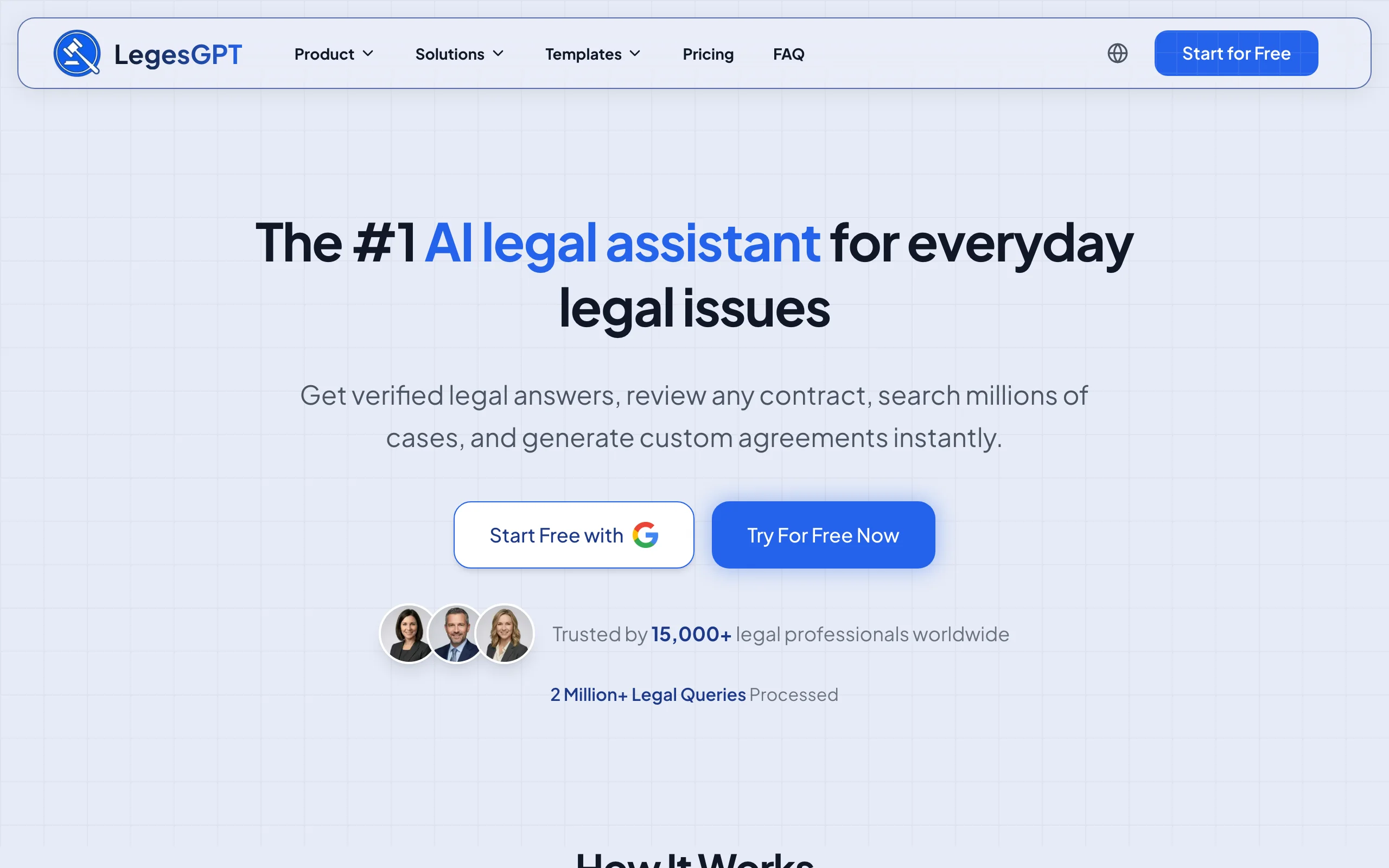
LegesGPT is built for the authoring-from-zero problem: you describe the deal (parties, terms, jurisdiction, special conditions) in plain language, and its AI contract generator returns a structured first draft you can refine clause by clause. If you would rather not start from a prompt, there are 100+ attorney-drafted legal contract templates covering NDAs, service agreements, employment contracts, leases, and more. When the document is ready, built-in e-signature lets you sign and send it without exporting to another tool.
That end-to-end flow (generate, refine, review for risks, sign) is what makes it stand out at the price. Solo practitioners, small firms, founders, and procurement or sales teams without a legal ops budget use it to produce agreements that would otherwise wait days for outside counsel.
Key features:
- AI contract generation: describe the deal in plain language, get a first draft in minutes
- 100+ attorney-drafted templates for common commercial, employment, and personal agreements
- Built-in e-signature to sign and send finished contracts
- AI review that flags risky clauses in drafts or counterparty paper and proposes changes
- Legal questions answered with verified citations, useful when a clause needs a statutory check
Best for:
- Solo practitioners and firms of 2-50 attorneys creating client agreements from scratch
- Sales, procurement, and operations teams at small businesses that self-serve routine contracts
- Anyone who wants generation, review, and signing in one subscription instead of three tools
Pricing:
- Basic: $19.99/month for unlimited AI queries, case law and statute search, citation verification
- Plus: $49.99/month adds document upload and 50 document reviews per month
- Premium: $99.99/month adds unlimited document review, Deep Research, and web search
- 3-day trial for $1; roughly 30% off with annual billing
Pros:
- A working first draft from a plain-language description, no template hunting required
- Authoring, risk review, and e-signature in one place, so a contract never leaves the platform
- Self-serve signup with a $1 trial, no demos, no seat minimums, no sales cycle
Cons:
- Web-only: no Microsoft Word add-in, public API, or native mobile app
- Not a full contract lifecycle management suite: no contract repository with renewal tracking or approval-chain automation like Juro or Ironclad
Draft a contract from a plain-English prompt
Describe the deal and LegesGPT drafts a complete, clause-by-clause contract you can refine in seconds and export ready to sign.
Draft a contract2. Juro, best for in-house teams automating high-volume contracts
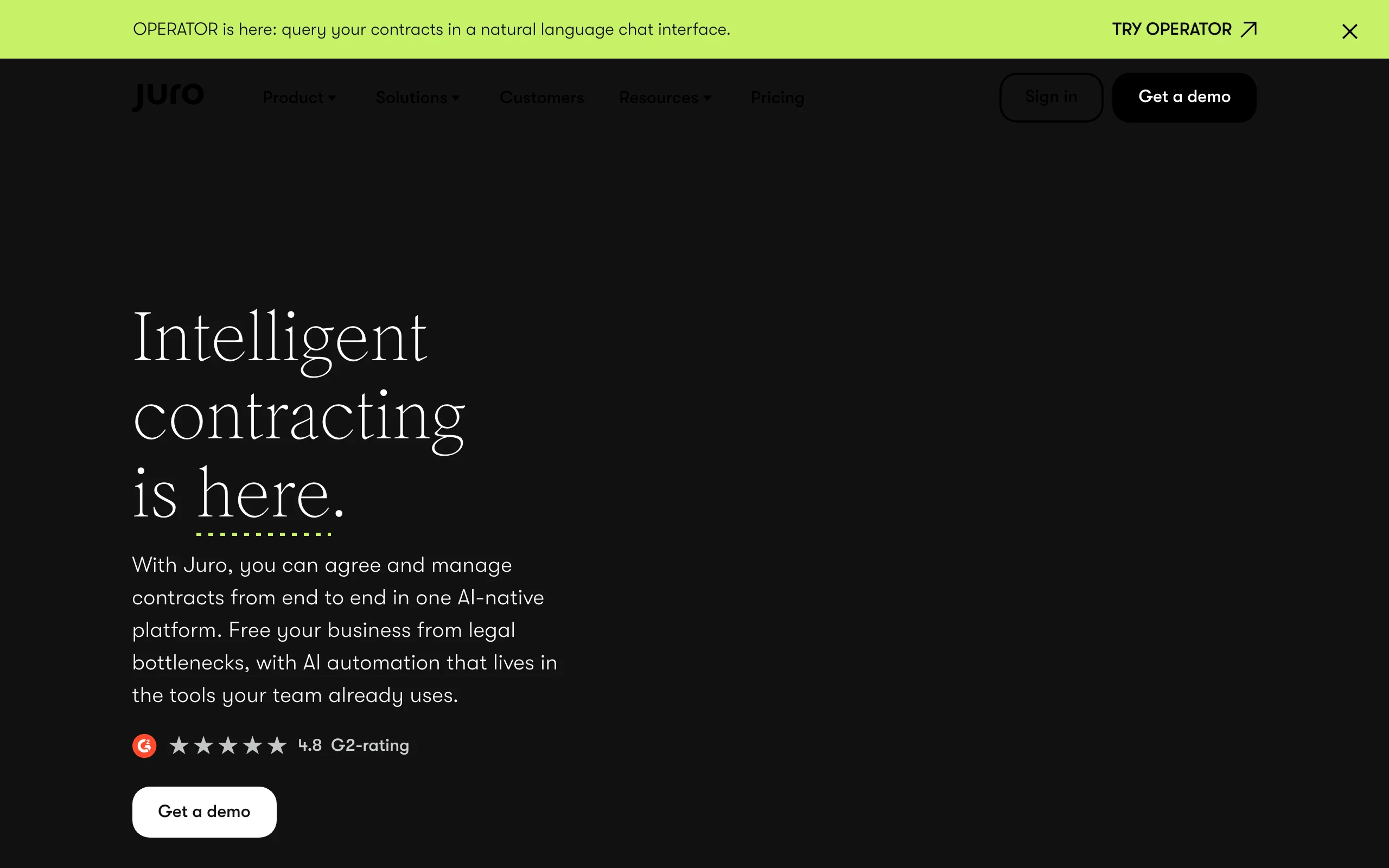
Juro is a browser-native contract automation platform aimed at in-house legal and the business teams they support. Its core authoring idea is the self-serve template: legal builds an approved template once, then sales or HR generate compliant contracts themselves through guided forms, with approval workflows catching anything non-standard. Contracts are created, negotiated, signed, and stored in one workspace, and every plan includes unlimited users.
Key features:
- Template-driven self-serve contract generation for business teams
- AI assistant for drafting and summarizing terms
- Approval workflows and conditional logic on templates
- Native e-signature and a searchable contract repository
- Unlimited users, workflows, and templates on all plans
Best for:
- In-house legal teams enabling sales and HR to generate their own routine contracts
- Scale-ups pushing hundreds of NDAs, offer letters, and order forms a month
Pricing:
- Not published; quote-based through sales
- Third-party pricing analyses report typical contracts around $18,000-$35,000/year for smaller teams, with an average buyer near $34,500/year
Pros:
- Business users can generate compliant contracts without pinging legal each time
- Unlimited-user model avoids per-seat math as the company grows
Cons:
- Pricing is opaque and starts at a level that shuts out solos and small firms
- Less suited to bespoke, heavily negotiated agreements than template-friendly routine paper
3. Spellbook, best for authoring contracts inside Microsoft Word
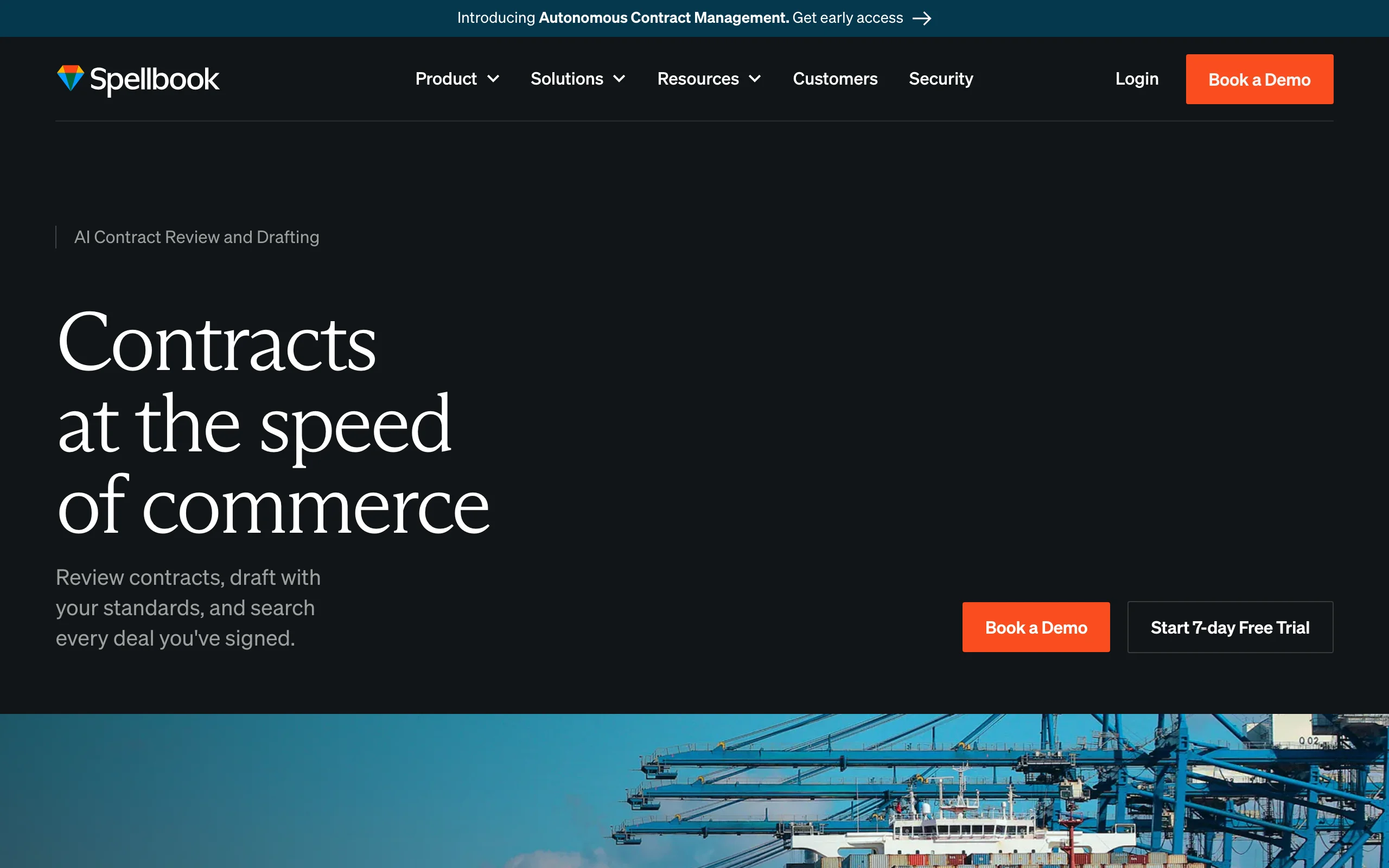
Spellbook takes the opposite approach to browser platforms: it embeds AI directly in Microsoft Word, where most lawyers already author contracts. It suggests clauses and full sections as you write, redlines counterparty drafts, and benchmarks terms against market standards. For transactional lawyers who live in Word and .docx redlines, the zero-workflow-change pitch is compelling.
Key features:
- Clause and section suggestions generated inside Word
- Review mode that redlines and flags aggressive terms in counterparty paper
- Benchmarking of terms against market standards
- Custom clause libraries for team-approved language
Best for:
- Transactional lawyers and firms whose authoring workflow is Word plus tracked changes
- Legal teams that want AI assistance without adopting a new platform
Pricing:
- Custom, based on the number of team members; no prices published on the official page
- Third-party analyses report roughly $149/user/month for Professional and about $199/user/month for Enterprise (10-seat minimum), with monthly billing adding around 20%
- 7-day free trial
Pros:
- No workflow change: authoring, redlining, and AI all happen inside Word
- Strong clause-level suggestions tuned for legal language
Cons:
- Per-user pricing adds up quickly for teams, and you must talk to sales to learn it
- No e-signature or contract repository: it assists authoring but does not manage the contract afterward
4. Ironclad, best for enterprise contract workflows at scale
Ironclad is a contract lifecycle management platform whose strength is workflow design. Legal ops teams build intake forms and approval chains in a no-code designer, so a sales contract can be generated, approved, signed, and filed with every step logged. Its AI (including the Jurist assistant) helps generate and review language, but the platform's center of gravity is process automation and repository intelligence for organizations handling thousands of contracts a year.
Key features:
- No-code workflow designer for intake, generation, and approvals
- AI-assisted drafting, review, and clause extraction
- Searchable repository with obligation and renewal tracking
- Integrations with Salesforce, Coupa, and enterprise SSO stacks
Best for:
- Enterprise legal and legal ops teams standardizing contract processes company-wide
- Organizations processing 1,000+ contracts a year across departments
Pricing:
- Quote-based; no published tiers
- Third-party data puts typical mid-market core-platform quotes at $40,000-$80,000/year, average reported spend around $66,000/year, and enterprise deployments at $200,000+, with implementation fees of $5,000-$50,000 on top
Pros:
- Best-in-class workflow automation once configured
- Scales to very high contract volumes with full audit trails
Cons:
- Significant cost and implementation lift; overkill below the mid-market
- Authoring is one piece of a large platform, so simple "give me a draft" jobs carry heavy overhead
5. Concord, best for predictable flat-fee contract creation
Concord stands out in a category full of "contact sales" buttons by publishing its prices. Plans start at a flat $499/month with five users included, and every tier bundles unlimited documents and unlimited e-signatures. Teams author contracts from templates in a collaborative editor, negotiate with live redlining, and sign, all in the browser. An AI copilot handles drafting help and data extraction.
Key features:
- Template-based authoring with a collaborative online editor
- Unlimited e-signatures and unlimited documents on every plan
- AI copilot for drafting assistance and clause extraction
- Approval workflows and deadline reminders (Business tier and up)
Best for:
- Small and mid-size businesses that want CLM basics at a known monthly cost
- Teams signing often enough that per-envelope e-signature fees sting
Pricing:
- Essentials: $499/month (paid annually), 5 users included, extra users $49/user/month
- Business: $899/month, extra users $69/user/month; Enterprise: $1,299/month, extra users $89/user/month
- Free trial available
Pros:
- Transparent published pricing, rare in this category
- Unlimited e-signatures included at every tier
Cons:
- $499/month floor is still steep for solos and very small teams
- AI authoring is lighter than dedicated AI-first tools
6. ContractPodAi (Leah), best for legal departments adopting agentic AI
ContractPodAi, whose platform is now branded Leah, wraps contract authoring inside an agentic AI system for corporate legal departments. Rather than a single drafting box, Leah offers task-specific AI agents that generate contracts from playbooks, review third-party paper, extract obligations, and support broader legal operations. It suits departments that want one AI layer across the whole legal function, not just contract creation.
Key features:
- AI agents for contract generation from approved playbooks
- Review and negotiation support against third-party paper
- Obligation extraction and repository analytics
- Modules extending beyond contracts into legal ops, procurement, and finance workflows
Best for:
- Corporate legal departments standardizing on one AI platform across workflows
- Teams with playbooks and precedent banks they want the AI to enforce
Pricing:
- Quote-based; no published pricing
- Third-party analyses report roughly $50,000/year for mid-market deployments and $200,000+ for large enterprises
Pros:
- Broad agentic scope: one platform covers authoring, review, and legal operations
- Playbook-driven generation keeps output aligned with company positions
Cons:
- Enterprise sales cycle and cost put it out of reach for small teams
- The January 2026 rebrand to Leah means documentation and reviews are split across two names
7. Icertis, best for global enterprises in regulated industries
Icertis Contract Intelligence (ICI) is the heavyweight of this list, built for multinationals managing enormous contract estates under regulatory scrutiny. Authoring happens through governed clause and template libraries: legal defines approved language and fallback positions, and business units assemble compliant contracts from those blocks. AI models trained on contract data surface risk, deviations, and obligations across the portfolio.
Key features:
- Governed clause libraries and template management at global scale
- Rule-based authoring with approved fallbacks and deviation tracking
- AI-driven risk, obligation, and compliance analytics across the repository
- Deep integrations with SAP, Microsoft, and Salesforce ecosystems
Best for:
- Enterprises (often $1B+ revenue) in regulated industries such as pharma, energy, and finance
- Procurement and legal organizations managing tens of thousands of active contracts
Pricing:
- Quote-based; no public pricing
- Third-party sources report annual subscriptions commonly in the $150,000-$500,000+ range, with implementations often taking 6-12 months
Pros:
- Unmatched governance and compliance depth for regulated, global contract estates
- Strong ecosystem integrations for enterprise IT stacks
Cons:
- Cost and 6-12 month implementations rule out anyone below large enterprise
- Authoring flexibility is constrained by design; ad hoc creative drafting is not the point
How to choose the best contract authoring software for your team
Four questions narrow the field quickly.
1) Are you creating contracts from scratch or systematizing existing templates?
- If you need a first draft from a blank page: LegesGPT (describe the deal, get a draft) or Spellbook (AI suggestions while you write in Word) are built for generation.
- If legal already has approved templates and the goal is letting sales or HR self-serve: Juro, Concord, or Ironclad, which are template-and-workflow platforms first.
- If your team mostly redlines and improves existing agreements rather than authoring new ones, see our guide to the best AI contract drafting tools, which covers that workflow in depth.
2) What is your realistic budget?
- Under $100/month: LegesGPT is effectively the only serious option; every other tool here starts at $499/month or a five-figure annual quote.
- $500-$2,000/month: Concord offers published flat-fee plans; Spellbook fits if you have a handful of Word-centric lawyers.
- Five to six figures annually: Juro, Ironclad, ContractPodAi, and Icertis, roughly in ascending order of typical deployment size.
- Do the price-to-value math on volume: at 10 contracts a month, a $60,000/year platform costs $500 per contract before anyone reads it.
3) Where do you want to author: browser or Word?
- If your lawyers refuse to leave Word and tracked changes, Spellbook is the natural fit.
- If you want browser-based creation with e-signature attached, LegesGPT, Juro, and Concord all keep the whole process in one tab. LegesGPT also lets you make a contract online from a guided flow when a full AI prompt is more than the job needs.
4) Do you need lifecycle management after signature?
- If you need renewal tracking, obligation management, and repository analytics, that is CLM territory: Ironclad, Icertis, ContractPodAi, or Juro.
- If your need ends at "author it, get it reviewed, get it signed," LegesGPT or Concord cover the workflow without CLM overhead. For the review step in between, AI contract review can flag risky clauses before anything goes out for signature.
Whatever the shortlist, test each finalist on three of your real contracts before committing. A tool that nails your actual MSA matters more than any feature grid.
All of LegesGPT for $1
Verified-citation answers, case law search, document review, AI drafting, and e-signature in one subscription. 3-day trial for $1, cancel anytime.
Start the $1 trialFrequently Asked Questions
What is contract authoring software?
Contract authoring software helps you create contracts, either by generating a draft with AI from a plain-language description, or by assembling one from approved templates and clause libraries. It sits at the start of the contract lifecycle, before negotiation, signature, and ongoing management.
What is the difference between contract authoring and contract lifecycle management (CLM)?
Authoring is the creation step: producing the first draft. CLM platforms like Ironclad and Icertis cover the whole lifecycle, including approvals, negotiation, signature, storage, renewals, and obligation tracking. Authoring-focused tools are cheaper and faster to adopt; CLM suites make sense once contract volume and post-signature obligations justify the cost.
Can AI write a contract from scratch?
Yes. Tools like LegesGPT generate a complete first draft from a description of the deal: the parties, key terms, jurisdiction, and any special conditions. The output is a starting point, not a finished product, so a qualified person should still review terms, especially for high-value or unusual agreements.
What is the cheapest contract authoring software?
Among tools worth using, LegesGPT is the least expensive at $19.99/month, with a 3-day trial for $1. Concord is the cheapest option with published pricing among the CLM-style platforms at $499/month. Everything else on this list is quote-based and typically lands in five or six figures annually.
Do contract authoring tools include e-signature?
Some do. LegesGPT, Juro, Ironclad, and Concord include built-in e-signature, and Concord makes signatures unlimited on every plan. Spellbook does not, since it focuses on the authoring step inside Word, so you would pair it with a separate signing tool.
Is it safe to author contracts with AI?
Generally yes, with two caveats. First, check the vendor's data handling: reputable legal AI tools do not train public models on your documents, but confirm this in the security documentation. Second, always review AI output before sending, since generated language can miss deal-specific nuances or jurisdiction rules.
Do sales and procurement teams need different authoring tools than legal?
Usually not different tools, but different modes. Sales and procurement mostly need guided, template-based self-service with guardrails (Juro and Ironclad specialize in this at scale), while legal needs free-form generation and clause-level control. LegesGPT and Concord serve both modes at small-team prices.
If I mainly need to create contracts from scratch or from templates, what should I use?
Start with LegesGPT. It combines plain-language AI generation, 100+ attorney-drafted templates, risk review, and e-signature in one subscription starting at $19.99/month, and the $1 three-day trial lets you test it on your own contracts before paying full price.