
Banking and finance work runs on documents that punish inattention: a 180-page credit agreement, a security package spread across a dozen files, a regulator's guidance note that changed last quarter. The right AI tools for banking and finance lawyers now handle the first pass on much of this, flagging risky clauses, extracting covenants, checking regulatory questions against primary sources, and producing first drafts you refine instead of write.
The gains are concrete: hours saved per agreement, fewer missed cross-default triggers, and research answers you can actually cite. But the market is confusing because tools built for a 50-bank syndicate desk get recommended to three-lawyer practices, and vice versa.
This guide compares seven AI tools against the jobs banking and finance lawyers actually do: loan and credit agreement review, regulatory research, covenant extraction, drafting, and due diligence. You get pricing, strengths, honest trade-offs, and a decision framework.
Best AI tools for banking and finance lawyers: a brief overview
- LegesGPT: Best overall for solo and small-firm banking and finance lawyers: reviews credit agreements and finance contracts with risk flagging, answers regulatory questions with verified citations, and drafts documents, all from $19.99/mo.
- DraftWise: Best for precedent-driven drafting: turns your firm's own credit agreement history into a searchable clause bank inside Microsoft Word.
- Harvey: Best for large-firm finance and capital markets teams that need enterprise-grade AI across due diligence, deal management, and research.
- CoCounsel: Best for regulatory research inside the Westlaw ecosystem, with AI skills layered on Thomson Reuters' primary-law content.
- Spellbook: Best for in-Word markup of loan and security documents at smaller deal teams that live in tracked changes.
- Luminance: Best for large-scale portfolio due diligence: reviewing thousands of facility agreements in one pass, including multilingual sets.
- Arteria AI: Best for in-house documentation operations at financial institutions, from trading agreements to loan-notice processing.
| Tool | Best for | Starting price | Free trial | Platform |
|---|---|---|---|---|
| LegesGPT | Solo & small-firm finance practices | From $19.99/mo | 3-day, $1 | Web |
| DraftWise | Precedent-driven credit agreement drafting | Custom | Demo only | Word add-in + web |
| Harvey | Large-firm finance & capital markets teams | Custom (enterprise) | Demo only | Web + mobile |
| CoCounsel | Regulatory research on Westlaw content | Quote-based (configurator) | Free trial (Essentials) | Web + Word add-in |
| Spellbook | In-Word loan document markup | Custom (per seat) | 7-day | Word add-in |
| Luminance | Large-scale portfolio due diligence | Custom (enterprise) | Demo only | Web |
| Arteria AI | In-house bank documentation ops | Custom (enterprise) | Demo only | Web (enterprise) |
1. LegesGPT, best overall for solo and small-firm banking and finance lawyers
LegesGPT covers the three jobs that fill most finance lawyers' days: reviewing finance contracts, researching regulatory and statutory questions, and drafting. Upload a credit agreement, guarantee, or intercreditor deed and the AI document review identifies risks, flags problematic clauses (think uncapped indemnities, broad cross-default language, or missing cure periods), and proposes concrete changes with plain-language summaries. Ask a question about lending regulation or enforcement of security and you get an answer with verified citations linking to the underlying source, so you can check the authority before you rely on it.
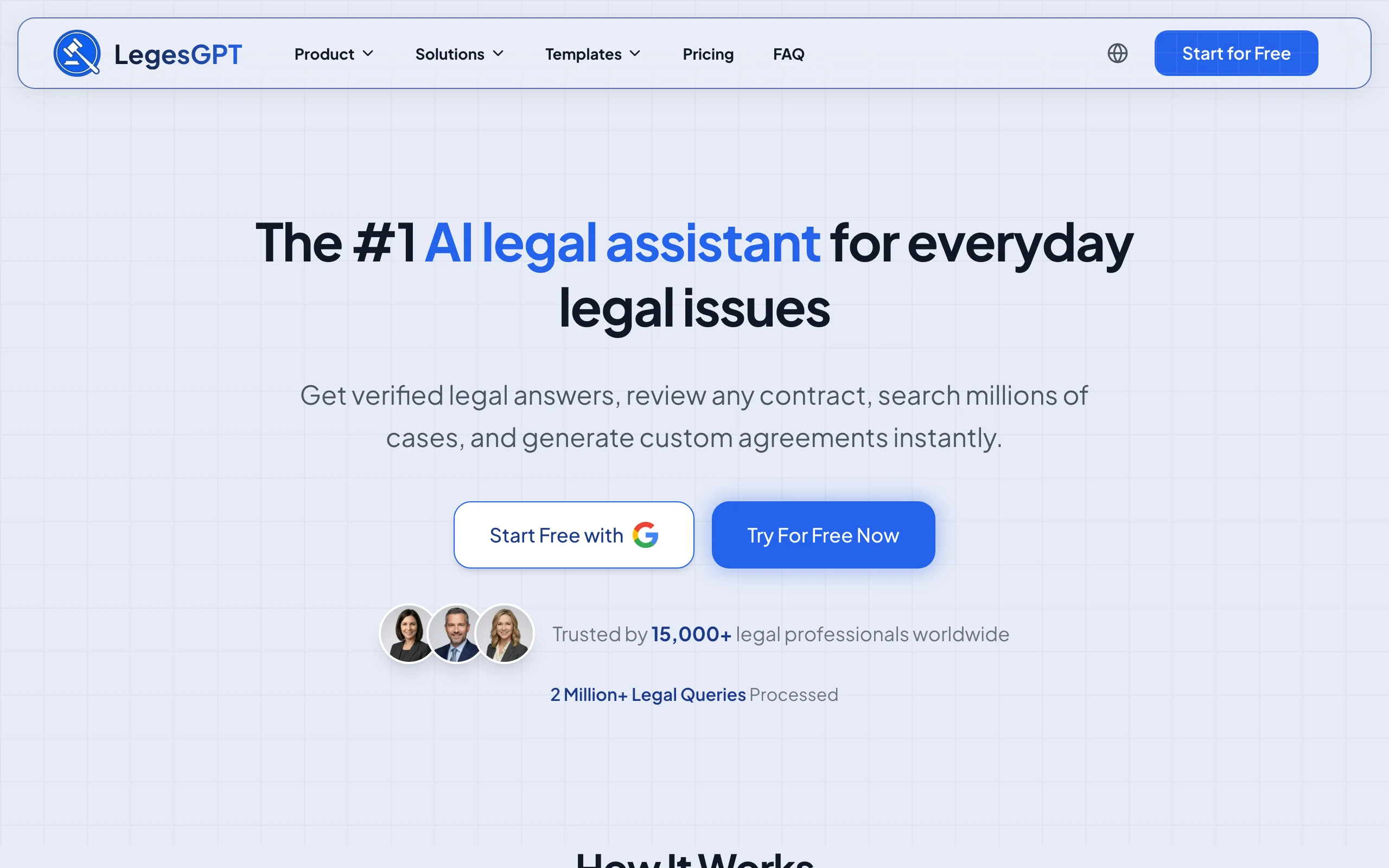
The pitch is simple: the core of what enterprise finance-AI platforms do, self-serve, at solo and small-practice prices. There is no sales call, no seat minimum, and no annual contract to negotiate.
Key features:
- Document review for credit agreements, guarantees, and security documents: risk identification, clause flagging, and proposed redline-style changes
- Regulatory and statute research with verified citations and direct source links, plus the ability to search case law and statutes directly
- AI drafting of finance-adjacent documents (loan summaries, demand letters, board consents, engagement letters) plus 100+ attorney-drafted templates
- Deep Research mode for multi-step questions, like tracing how a regulation applies across scenarios
- Web search integration for recent regulatory developments
- E-signature to send finished documents for signing
Best for:
- Solo practitioners and 2-50 lawyer firms advising borrowers, lenders, or funds without enterprise budgets
- In-house counsel at smaller lenders or fintechs who need review plus research in one subscription
Pricing:
- Basic: $19.99/mo for unlimited AI queries, case law and statute search, and citation verification
- Plus: $49.99/mo adds document upload and 50 document reviews per month
- Premium: $99.99/mo adds unlimited document review, Deep Research, and web search
- 3-day trial for $1; roughly 30% off with annual billing
Pros:
- A fraction of the cost of enterprise finance-AI platforms, with instant self-serve signup
- Review, research, drafting, and e-signature in one subscription instead of three tools
- Citations link to sources, which matters when a regulator or opposing counsel asks "says who?"
Cons:
- Web-only: no Microsoft Word add-in, public API, or native mobile app, so redlining happens in the browser rather than in your DOCX
- Not built for bulk portfolio diligence across thousands of documents at once; that scale is Luminance territory
Put your next credit agreement through AI review
LegesGPT scans any contract clause-by-clause, flags one-sided and missing terms, and backs every finding with a citation you can check.
Review a contract2. DraftWise, best for precedent-driven credit agreement drafting
DraftWise is built around a truth every finance lawyer knows: your best drafting resource is what your firm has already negotiated. It ingests your prior contracts and deal documents into a secure, indexed knowledge base, then surfaces your own precedent clauses, preferred positions, and fallbacks inside Microsoft Word as you draft and negotiate. That precedent-driven model is a natural fit for banking and finance practices, whose value lives in negotiated deal history, and the security posture (SOC 2 Type II, ISO 27001, DMS permission mirroring) is designed for firms answering bank-grade vendor questionnaires.
Key features:
- Clause and precedent search across your firm's own contract history
- Drafting, review, and redlining assistance directly in Microsoft Word
- Playbook-style guidance reflecting your firm's negotiated standards
- Mirrors your document management system's permissions for access control
Best for:
- Finance and transactional practices with a deep precedent bank of credit agreements and security documents
- Firms that negotiate the same document families repeatedly and want consistency across associates
Pricing:
- Custom quotes only; no public pricing published
- Demo-based sales process
Pros:
- Output reflects your firm's actual positions, not generic model text
- Lives where finance drafting actually happens: Word and your DMS
Cons:
- Value depends heavily on the quality and volume of your existing precedent library
- No self-serve tier or public pricing, so budgeting requires a sales conversation
3. Harvey, best for large-firm finance and capital markets teams
Harvey is the enterprise legal AI platform many AmLaw-scale firms have standardized on. For finance teams, the relevant pieces are Assistant (questions, document analysis, drafting), Vault (bulk storage and analysis of deal documents), Knowledge (research across legal, regulatory, and tax domains), and Agents that execute multi-step work end to end. Its transactional tooling targets due diligence, contract analysis, deal management, and fund formation, which maps well onto acquisition finance and funds-lending work.
Key features:
- Assistant for document analysis and drafting with domain-specific AI
- Vault for bulk-analyzing large deal document sets
- Knowledge for complex legal, regulatory, and tax research
- Purpose-built agents for end-to-end workflows, plus mobile access
Best for:
- Large firms and bank legal departments running high-value, document-heavy finance transactions
- Teams that want one AI platform standardized across practice groups
Pricing:
- Custom enterprise contracts only; no public pricing, free tier, or self-serve signup
- Expect annual commitments and minimum seat counts (per third-party buyer reports)
Pros:
- Breadth across research, diligence, and drafting at enterprise scale
- Strong adoption among top firms means polished workflows for deal teams
Cons:
- Inaccessible to solo and small-firm lawyers: no trial, no published pricing, sales-led onboarding
- Costs land at enterprise levels that only sustained deal flow justifies
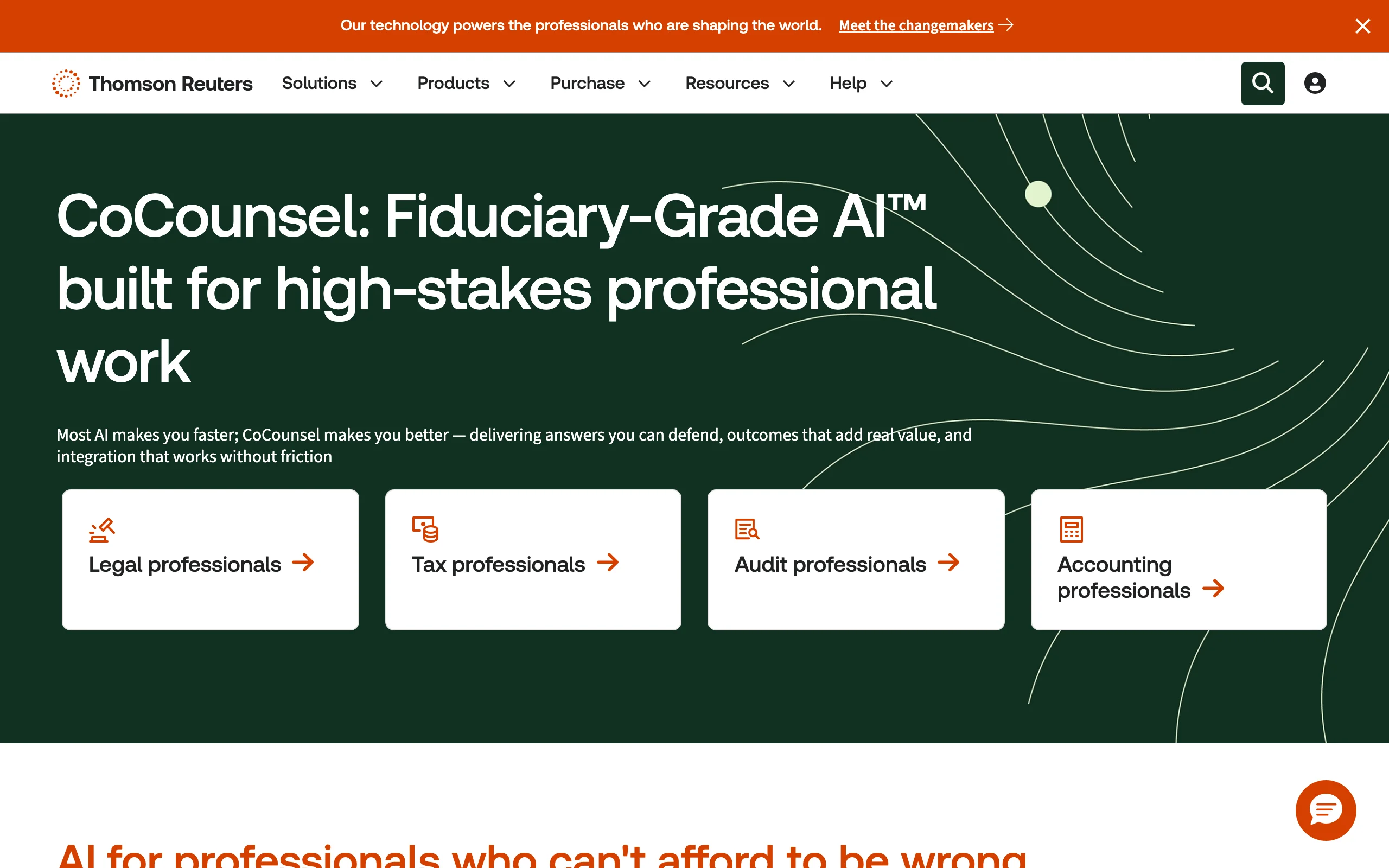
4. CoCounsel, best for regulatory research inside the Westlaw ecosystem
CoCounsel is Thomson Reuters' AI assistant. A standalone Essentials tier handles document analysis and drafting from the web into Microsoft Word, while the flagship CoCounsel Legal plan bundles Westlaw Advantage and Practical Law. For banking and finance lawyers, the edge is the content underneath those higher tiers: AI research grounded in Westlaw's primary law, with skills for summarizing documents, reviewing contracts, and preparing for depositions. If your regulatory questions span federal banking statutes, state lending laws, and agency materials, having the AI layered on an authoritative research corpus reduces the verification burden.
Key features:
- AI-assisted legal research grounded in Westlaw content
- Document summarization and contract review skills
- Timeline building and deposition preparation for finance litigation
- Integration with the broader Thomson Reuters product family
Best for:
- Firms already paying for Westlaw that want AI research without adding a separate vendor
- Regulatory-heavy practices where citations to primary law are non-negotiable
Pricing:
- Quote-based: a self-serve online configurator prices plans for firms up to 10 attorneys; larger firms go through sales
- Price varies significantly by plan, jurisdictional coverage, and contract term; a standalone Essentials tier (with a free trial) sits below the Westlaw-bundled plans
Pros:
- Research answers tied to one of the two dominant primary-law databases
- One vendor relationship if you are already a Thomson Reuters shop
Cons:
- The research strength that justifies it for regulatory work sits in the Westlaw-bundled tiers, a big commitment if you only wanted the AI assistant
- Configurator pricing makes cost comparison harder than a published price list
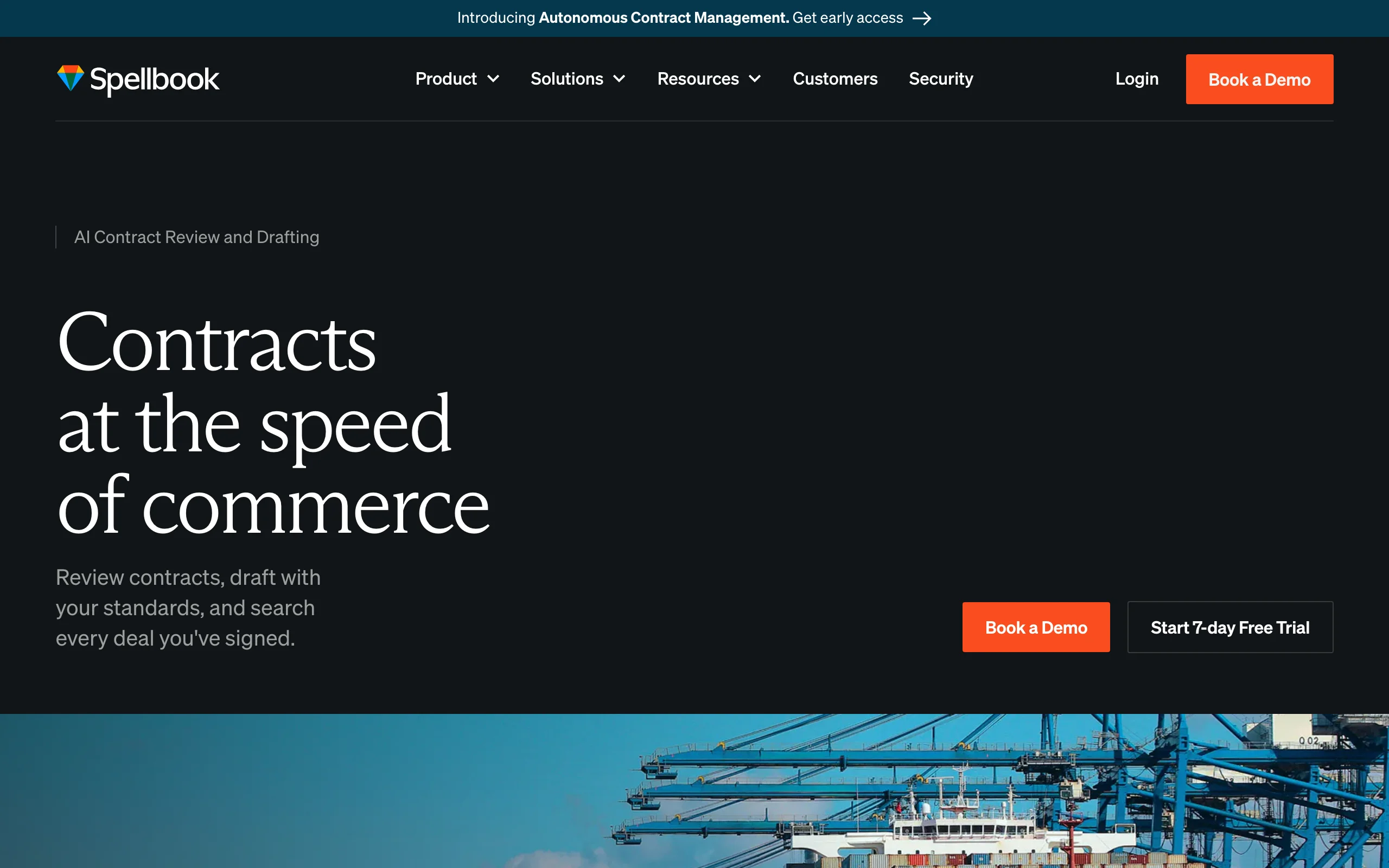
5. Spellbook, best for in-Word markup of loan and security documents
Spellbook is an AI contract drafting and review add-in that lives inside Microsoft Word. It suggests clauses, flags risky terms, generates redlines, and drafts new language without leaving the document. For deal teams that negotiate facility letters, guarantees, and security agreements in tracked changes all day, that placement matters more than any feature list. It offers a 7-day free trial, which is rare in this market segment.
Key features:
- Microsoft Word add-in, so review happens in the negotiation document itself
- AI clause suggestions and risk flagging as you review
- Redline generation against your preferred positions
- Drafting assistance powered by multiple frontier AI models
Best for:
- Small and mid-sized deal teams that negotiate finance documents in Word and want AI in the same window
- Lawyers who want to trial an in-Word tool before committing
Pricing:
- Custom pricing determined by the number of team members on a license; no public dollar amounts
- 7-day free trial; separate plans for law firms and in-house teams
Pros:
- Zero workflow change for Word-native negotiation
- Free trial lets you test it on your own loan documents before buying
Cons:
- Pricing is opaque until you talk to the team, which slows procurement
- Drafting and review focused: it is not a regulatory research tool, so you still need one
6. Luminance, best for large-scale portfolio due diligence
Luminance is an enterprise AI contract platform whose sweet spot is volume: reviewing thousands of documents in one pass for due diligence, compliance, and portfolio analysis. For banking work, that looks like loan portfolio acquisitions, LIBOR-transition-style repapering exercises, or diligence across a target's entire facility stack. Its tooling spans due diligence, compliance monitoring, and anomaly detection, and multilingual review capability suits cross-border lending books.
Key features:
- Bulk document review and clause extraction across very large data sets
- Due diligence workflows for M&A, repapering, and regulatory review projects
- Multilingual contract review for cross-border portfolios
- Compliance and anomaly detection across a document estate
Best for:
- Firms and institutions running diligence or repapering across thousands of agreements
- Cross-border finance teams with multilingual document sets
Pricing:
- Custom enterprise quotes based on users, document volume, and modules; no public pricing or self-serve tier
- Demo-based sales process
Pros:
- Built for a scale of review that per-document tools cannot handle
- Strong fit for one-off, high-volume projects like portfolio sales
Cons:
- Enterprise cost structure is hard to justify for day-to-day single-agreement work
- No trial or published pricing, so evaluation takes a procurement cycle
All of LegesGPT for $1
Verified-citation answers, case law search, document review, AI drafting, and e-signature in one subscription. 3-day trial for $1, cancel anytime.
Start the $1 trial7. Arteria AI, best for in-house documentation operations at financial institutions
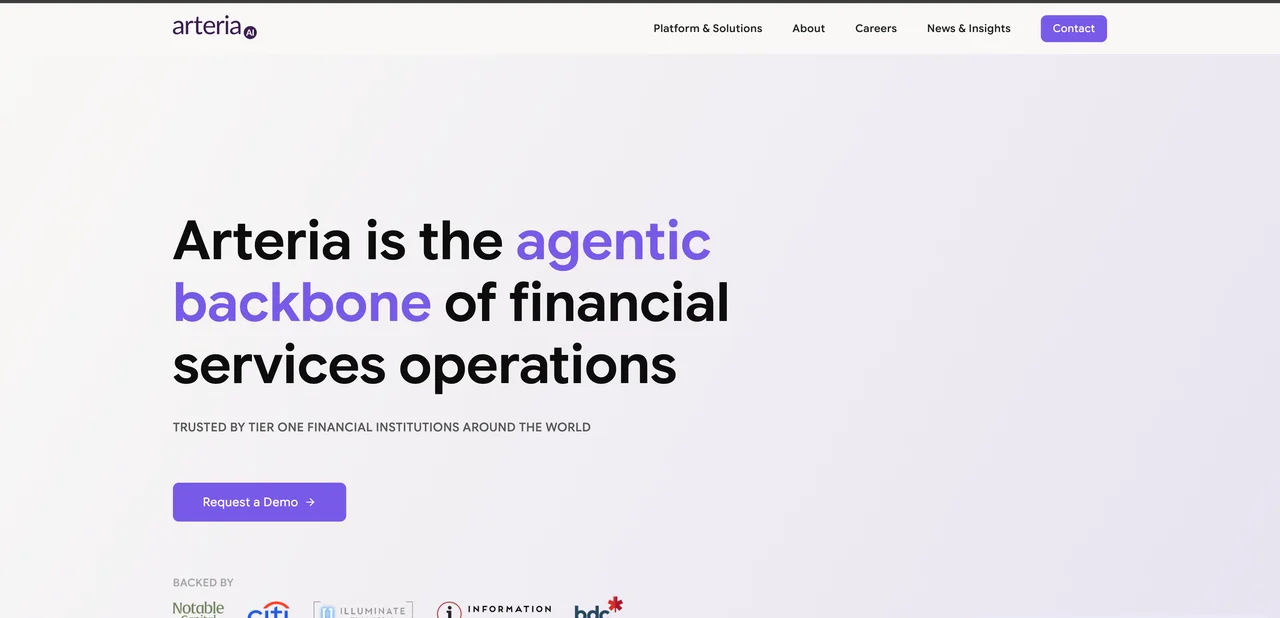
Arteria AI is built exclusively for financial services, and it shows in the use cases: generating and negotiating documentation at scale, extracting data from client documents and comparing it against key covenants, and processing loan notices automatically. It is less a lawyer's research assistant and more documentation infrastructure for banks, broker-dealers, and asset managers, sitting with legal ops and business teams as much as with counsel. SOC 2 Type II and ISO 27001 certifications reflect its regulated-industry focus.
Key features:
- End-to-end document generation and negotiation for financial institutions
- Data extraction with automated comparison against key covenants
- Automated loan-notice and tax-form processing
- No-code configuration of workflows across use cases
Best for:
- In-house legal and documentation teams at banks and financial institutions handling high document volumes
- Institutions digitizing trading, lending, or onboarding documentation end to end
Pricing:
- Custom enterprise pricing only; no public rate card or self-serve option
- Sales-led implementation scoped to the institution
Pros:
- Purpose-built for financial services rather than adapted from general legal AI
- Turns executed documents into structured data the business can query
Cons:
- Aimed at institutions, not law firms or individual practitioners
- Procurement and implementation are significant projects, not a signup form
How to choose the best AI tool for your banking and finance practice
Four questions sort the market for AI tools for banking and finance lawyers quickly.
1) What does your finance workload actually look like?
- If your days are single-document work (reviewing a credit agreement, answering a regulatory question, drafting a guarantee): LegesGPT covers all three jobs in one subscription, and Spellbook adds in-Word markup if you live in tracked changes.
- If you draft the same document families constantly from firm precedent: DraftWise converts your negotiation history into an asset.
- If the job is diligence across hundreds or thousands of documents: Luminance (law-firm side) or Arteria AI (institution side) are built for that scale.
2) How big is your team and budget?
- Solo to roughly 50 lawyers: start with self-serve tools you can price today. LegesGPT publishes pricing from $19.99/mo with a $1 trial; Spellbook offers a 7-day trial with quote-based pricing.
- Large firms and bank legal departments: Harvey, Luminance, and DraftWise assume enterprise contracts, minimum seats, and procurement cycles. Budget for implementation, not just licenses.
- Do the math per matter: if AI review saves two hours on a credit agreement, a $49.99/mo plan pays for itself in the first document. An enterprise contract needs sustained deal flow to do the same.
3) Do you need the AI inside Word, or is a standalone workspace fine?
- If negotiation happens in DOCX redlines with opposing counsel: Spellbook and DraftWise work inside Word itself.
- If the job is analysis, research, and first drafts you then move into your own template: a web workspace like LegesGPT or an AI legal assistant session is simpler and cheaper, with no add-in for IT to approve.
4) How much does citation accuracy matter to your research?
- For regulatory questions you will act on, insist on tools that show verifiable sources: LegesGPT links every answer to the underlying authority, and CoCounsel grounds research in Westlaw content.
- General-purpose chatbots without citation verification are fine for brainstorming but risky for advice; our guide on best legal research tools covers the research-specific market in more depth.
Whatever you shortlist, test it on 3-5 of your own documents (a real facility agreement, a real security document) before committing. Marketing demos use clean contracts; your matters will not be. And if your practice mixes finance work with broader company-side matters, our guide to AI for corporate legal work is a useful companion read, as is the wider overview of AI tools for lawyers across practice areas.
The pragmatic starting point for most solo and small-firm finance lawyers: run the $1 LegesGPT trial on a live credit agreement review and a real regulatory question this week, and let the output, not the marketing, make the decision.