

A healthcare practice manages two kinds of risk at once. The first lives in contracts: business associate agreements, physician employment deals, management services agreements, payer contracts. The second lives in regulation: HIPAA, the Stark Law, the Anti-Kickback Statute, and state telehealth rules that shift midyear. The best AI tools for healthcare lawyers now carry real weight on both sides, flagging a one-sided indemnification clause in a BAA or pulling the actual regulatory text behind a Stark question in minutes.
Healthcare adds a constraint most tool roundups ignore, though: some of your documents contain protected health information, and PHI cannot go into just any chatbot. This guide compares seven options, including a HIPAA-compliant AI with a signed BAA for PHI-heavy matters, with current pricing, honest trade-offs, and a framework for matching tools to hospital, physician-group, and digital health clients.
Best AI tools for healthcare lawyers: a brief overview
- LegesGPT: Best overall for healthcare legal work: reviews BAAs and provider agreements with flagged risks, answers regulatory questions with verified citations, and drafts physician employment and vendor agreements, all from $19.99/month.
- CoCounsel: Best for deep regulatory research at larger firms: agentic AI workflows built on Westlaw and Practical Law content.
- Spellbook: Best for redlining provider contracts inside Microsoft Word, benchmarked against your firm's standards.
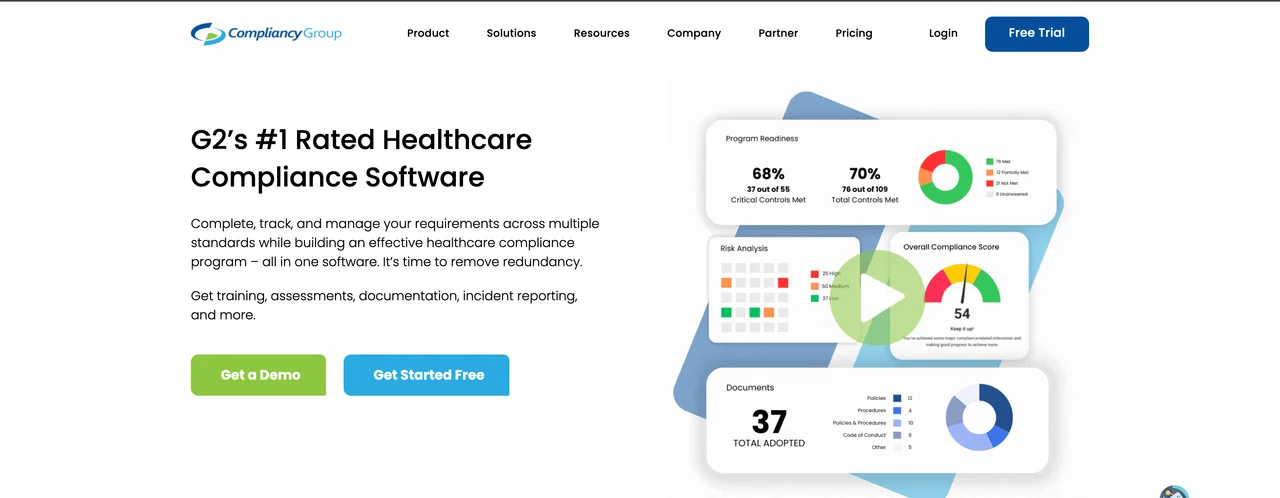
- Compliancy Group: Best for administering HIPAA compliance programs for provider clients, with policy management and training in one dashboard.
- Hyperproof: Best for digital health and health-tech clients that must juggle HIPAA alongside SOC 2 and ISO 27001.
- BastionGPT: Best HIPAA-compliant AI for work that touches PHI: a signed BAA on every plan means medical records and breach documents can actually go into the chat.
- Claude: Best general-purpose AI for long healthcare documents: strong at digesting hundred-page regulations and policy sets.
| Tool | Best for | Starting price | Free trial | Platforms |
|---|---|---|---|---|
| LegesGPT | All-in-one healthcare legal work | From $19.99/mo | 3-day, $1 | Web |
| CoCounsel | Large-firm regulatory research | Custom | Trial (Essentials) | Web + Word |
| Spellbook | Contract redlining in Word | Custom | 7-day | Word add-in |
| Compliancy Group | Client HIPAA compliance programs | Custom | Demo only | Web |
| Hyperproof | Multi-framework compliance ops | Custom | Demo only | Web |
| BastionGPT | PHI-safe AI with signed BAA | From $20/user/mo | 7-day | Web |
| Claude | Long-document analysis | From $20/mo | Free tier | Web, desktop, mobile |
1. LegesGPT, best overall for healthcare legal work
LegesGPT covers the three jobs that eat most of a healthcare lawyer's week in a single subscription. Upload a business associate agreement or physician employment contract and it identifies risks, flags problematic clauses (one-sided indemnification, missing breach notification terms, non-compete scope), and proposes concrete changes. Ask a regulatory question and it answers with verified citations and direct links to the underlying statutes and regulations, so you can confirm a HIPAA Privacy Rule, Stark Law, or Anti-Kickback answer against the source instead of trusting a chatbot's memory.
When you move from review to drafting, the same workspace handles AI contract drafting for physician employment agreements, vendor contracts, payer agreements, and telehealth service agreements, then lets you sign and send them with built-in e-signature.
Key features:
- Document review that flags risky clauses in BAAs, provider agreements, payer contracts, and vendor agreements, with proposed fixes and plain-language summaries
- Regulatory answers with verified citations and source links, plus the ability to search case law and statutes directly
- AI drafting for physician employment, vendor, and telehealth agreements, with 100+ attorney-drafted templates
- Deep Research mode for multi-step questions, like tracing how a state's telehealth rules interact with federal requirements
- Web search integration for recent enforcement actions and rule changes
- E-signature to execute the documents you draft
Best for:
- Solo and small-firm healthcare lawyers advising physician groups, clinics, and health startups
- In-house counsel at provider organizations who need research, review, and drafting without three separate subscriptions
Pricing:
- Basic: $19.99/month for unlimited AI queries, case law and statute search, and citation verification
- Plus: $49.99/month adds document upload and 50 document reviews per month
- Premium: $99.99/month adds unlimited document review, Deep Research, and web search
- 3-day trial for $1; roughly 30% off with annual billing
Pros:
- Research, contract review, drafting, and e-signature in one subscription, at a fraction of enterprise legal AI pricing
- Verified citations reduce the checking burden that makes general chatbots risky for regulatory work
- Self-serve signup with a $1 trial; no sales calls or seat minimums
Cons:
- Web-only: no Microsoft Word add-in, native mobile app, or API
- Not a compliance-management platform; it will not track a client's HIPAA training or audit evidence the way Compliancy Group or Hyperproof do
Review your next BAA in minutes
Upload a contract and LegesGPT flags risky clauses, surfaces obligations and deadlines, and answers questions with citations you can verify.
Try AI document review2. CoCounsel, best for large-firm healthcare regulatory research
CoCounsel is Thomson Reuters' legal AI, and its advantage for healthcare work is the content behind it: answers draw on Westlaw and Practical Law rather than the open web. For a regulatory practice that lives in Stark Law advisory opinions, CMS rulemaking, and state licensure regimes, that grounding matters. The flagship CoCounsel Legal plan adds agentic workflows and Deep Research that can run multi-step research tasks, while CoCounsel Essentials focuses on document analysis and contract review inside Word.
Key features:
- AI research grounded in Westlaw and Practical Law content
- Deep Research and agentic workflows for multi-step regulatory questions
- Litigation Document Analyzer for disputes and payer litigation
- Contract review and clause drafting inside Microsoft Word (Essentials)
Best for:
- Healthcare regulatory groups at mid-size and large firms already committed to the Thomson Reuters ecosystem
- Litigation teams handling payer disputes, False Claims Act matters, and medical staff proceedings
Pricing:
- Custom: Thomson Reuters does not publish fixed prices; firms up to 10 attorneys use an online configurator, larger firms get a sales quote
- Third-party reporting has pegged the legacy CoCounsel Core tier around $4,500 per user per year (roughly $225/user/month), with bundled Westlaw plans well above that
- Free trial available for CoCounsel Essentials
Pros:
- The strongest primary-source foundation of any legal AI for US regulatory research
- Practical Law integration gives transactional healthcare lawyers vetted templates and know-how
Cons:
- Pricing is opaque and sits at the enterprise end; solo practitioners will find the math hard to justify
- Full value requires Westlaw and Practical Law subscriptions, which compounds the cost
3. Spellbook, best for redlining provider contracts in Word
Spellbook lives inside Microsoft Word, which is where most provider contracts actually get negotiated. It reviews an agreement against your standards, suggests redlines, and benchmarks terms against market language. For a healthcare transactional practice that turns physician employment agreements, management services agreements, and payer contracts all day, the appeal is that nothing leaves the document you are already editing. Its Associate agent extends this to multi-document work.
Key features:
- Word add-in with Review, Draft, Ask, Benchmarks, and Playbooks
- Redlines contracts against your firm's playbook standards
- Associate, a multi-document agent for larger transactions
- Clause benchmarking against market terms
Best for:
- Transactional healthcare lawyers who negotiate contracts in tracked changes and never want to leave Word
- In-house teams at provider organizations standardizing contract review with playbooks
Pricing:
- Custom: pricing is structured around the number of team members on your license, quoted after a demo
- 7-day free trial
Pros:
- The most polished Word-native contract workflow on this list
- Playbooks let you encode healthcare-specific positions (BAA terms, non-compete limits) once and apply them everywhere
Cons:
- No published rate card, so budgeting requires a sales conversation
- Contract-focused: it is not built for regulatory research or compliance program management
4. Compliancy Group, best for running client HIPAA compliance programs
Compliancy Group is not a legal drafting tool; it is HIPAA compliance software, and that is exactly why healthcare lawyers end up recommending or administering it. Its platform, The Guard, walks covered entities and business associates through the full compliance lifecycle: risk assessments, policy management, workforce training, incident reporting, and documentation. When OCR comes knocking after a breach, the question is whether your client can produce evidence of a compliance program. This is the system that generates that evidence.
Key features:
- The Guard dashboard tracking HIPAA compliance status across a whole organization
- Policy Manager for maintaining and attesting to privacy and security policies
- Workforce compliance training with completion tracking
- Incident reporting and risk management workflows
Best for:
- Lawyers who advise physician practices, dental groups, and small provider organizations on HIPAA and want clients on a managed program
- Compliance counsel who need audit-ready documentation rather than ad hoc policies
Pricing:
- Custom: no published pricing; quotes scale with organization size
- Demo required; no self-serve trial
Pros:
- Purpose-built for HIPAA rather than a generic framework tool, with guided onboarding
- Produces the documentation trail that matters in an OCR investigation
Cons:
- Not an AI assistant: it will not draft or review a contract or answer a research question
- HIPAA-centric by design; clients stacking several security frameworks at once will outgrow it faster than a multi-framework platform like Hyperproof
5. Hyperproof, best for health-tech clients managing HIPAA plus SOC 2
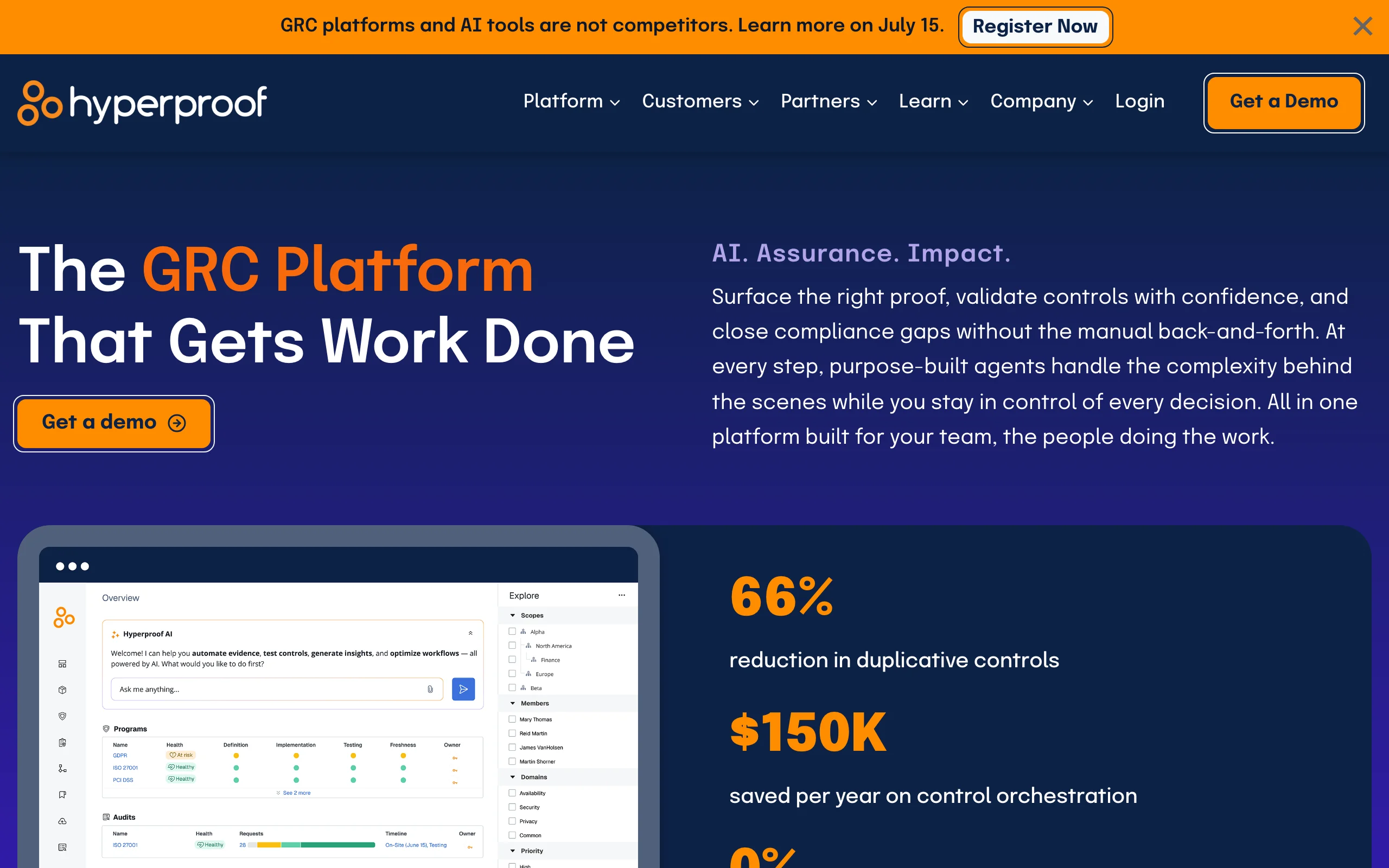
Hyperproof is a compliance operations platform that manages controls, evidence, and audits across many frameworks at once: HIPAA, SOC 2, ISO 27001, GDPR, and more. That multi-framework design is the healthcare angle. Digital health startups and health-tech vendors rarely stop at HIPAA; their hospital customers demand SOC 2 reports and security questionnaires in the same breath. Counsel advising these companies through due diligence or a security review can point them to one system instead of parallel spreadsheets.
Key features:
- Controls and evidence mapped across HIPAA, SOC 2, ISO 27001, and other frameworks simultaneously
- Automated evidence collection and continuous control monitoring
- Risk assessments aligned to the HIPAA Security Rule
- Audit management for external assessments
Best for:
- Outside counsel and in-house lawyers at digital health and health-tech companies facing overlapping security obligations
- Legal and security teams preparing for investor or acquirer due diligence
Pricing:
- Custom: no official rate card; third-party reporting puts entry packages around $12,000/year, with typical contracts higher
- Demo required; no self-serve trial
Pros:
- One control set satisfies several frameworks, which cuts duplicated compliance work for clients
- Continuous monitoring beats point-in-time spreadsheet audits
Cons:
- Priced and designed for organizations, not for a law practice itself; overkill for a solo lawyer's internal needs
- Broad GRC scope means less HIPAA-specific hand-holding than Compliancy Group
6. BastionGPT, best HIPAA-compliant AI for work that touches PHI
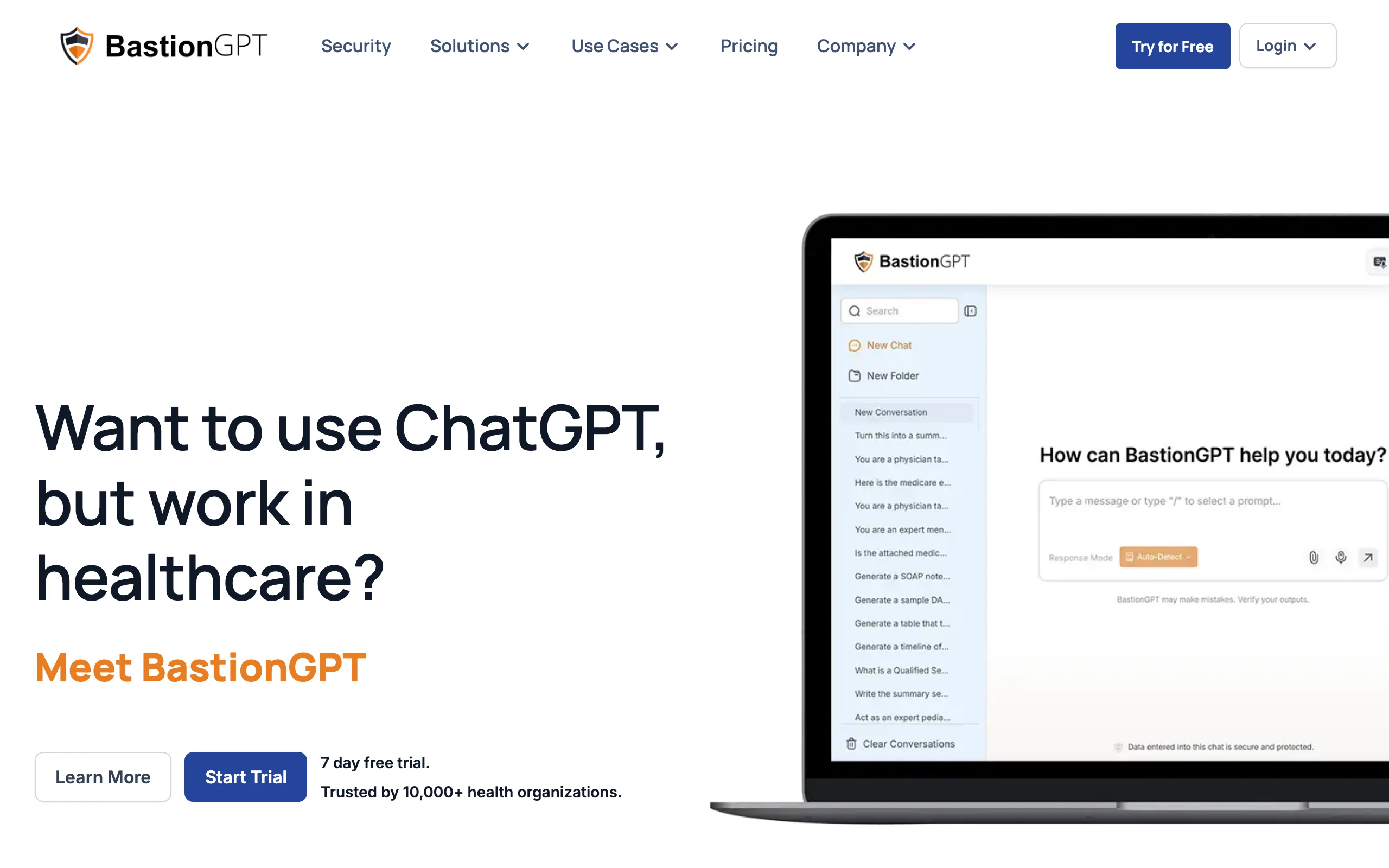
BastionGPT answers the question every general chatbot fails: what do you do when the document contains protected health information? It is a healthcare-grade AI workspace that runs current GPT, Claude, and Gemini models inside a private, isolated HIPAA-compliant environment, with a signed business associate agreement included on every plan, the free trial included. That changes what is usable. Medical records in a payer dispute, incident documentation in a breach response, a client's clinical policies: material you could never paste into a consumer chatbot can go into the chat.
BastionGPT is built for clinicians first (its user base skews toward physicians and mental health professionals, and it ships an AI scribe that generates clinical note formats), but the BAA-covered document analysis is what earns it a slot in a legal stack. It is also the answer when a provider client asks which AI their staff can safely use.
Key features:
- Signed BAA on every plan, including the 7-day free trial, with PHI kept in a private, isolated environment
- Access to current GPT, Claude, and Gemini models, with automatic model routing and manual model selection on Professional Plus
- Document analysis up to 30 pages on Professional; multi-document analysis of 1,000+ pages plus image, chart, and spreadsheet handling on Professional Plus
- Unlimited audio transcription for sessions up to 240 minutes, with Zoom, Teams, and Google Meet support
- AES-256 encryption, independent third-party security testing, and PIPEDA (Canada) and APP (Australia) coverage alongside HIPAA
Best for:
- Healthcare lawyers whose matters routinely include PHI: payer disputes, breach response, medical staff investigations
- Counsel who need a safe AI recommendation for provider clients adopting AI internally
Pricing:
- Professional: $20/user/month; Professional Plus: $45/user/month with larger document capacity and model selection
- Ultra: $75/user/month for deployments of 100+ users, with custom security configurations
- 7-day free trial with a BAA included, plus a 45-day money-back guarantee
Pros:
- The BAA on every tier removes the PHI blocker that rules out consumer chatbots for healthcare matters
- Multi-model access at a general-AI price point, on HIPAA-compliant infrastructure
Cons:
- Built for clinicians, not lawyers: no verified legal citations, no case law search, and its output templates are clinical note formats
- Will not replace a legal AI for research, contract review, or drafting; it is the PHI-safe layer, not the legal layer
7. Claude, best general-purpose AI for long healthcare documents
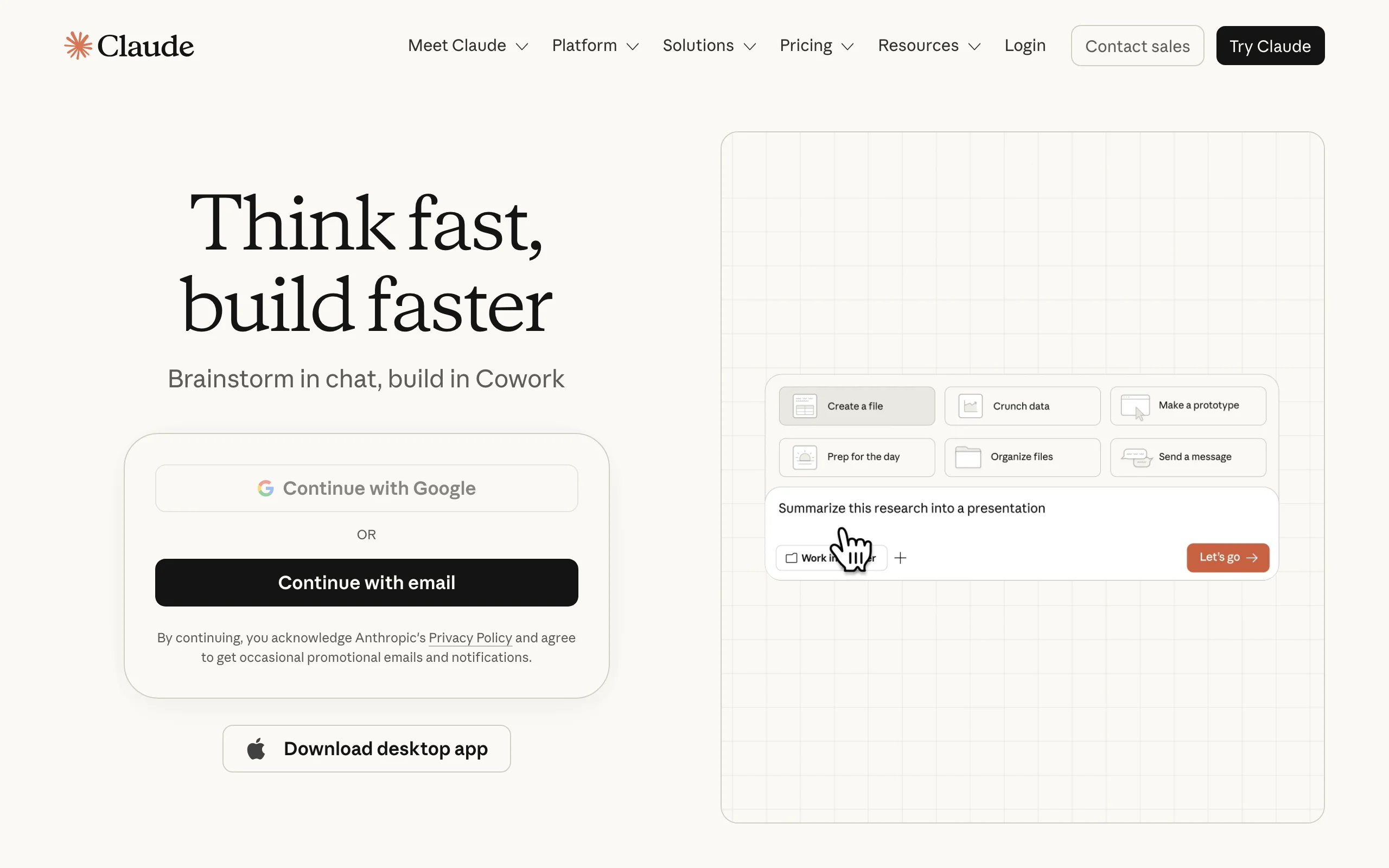
Claude, Anthropic's AI assistant, is the strongest general-purpose model on this list for long-document work. Healthcare law generates exactly that: hundred-page CMS final rules, hospital policy manuals, multi-exhibit management services agreements. Claude can hold very long documents in context and answer questions across them, summarize a rule's changes from the proposed version, or compare two BAA drafts. Projects let you keep a client's key documents together for ongoing Q&A.
Key features:
- Long-context analysis suited to lengthy rules, manuals, and agreement packages
- Projects for organizing documents and instructions per client or matter
- Strong drafting and summarization quality for memos and client alerts
- Web, desktop, and mobile apps
Best for:
- Healthcare lawyers who want a capable generalist for summarizing rules, comparing drafts, and tightening memos
- Teams that already have research and review tools and need thinking-and-writing support
Pricing:
- Free tier with usage limits
- Pro: $20/month (about $17/month billed annually); Max plans from $100/month for heavier usage
- Team: from $20 per seat/month billed annually ($25 monthly)
Pros:
- Excellent reasoning and prose quality for complex regulatory summaries
- Inexpensive relative to legal-specific AI
Cons:
- No verified legal citations: every authority it names must be checked before it goes in a memo
- Standard consumer plans come without a BAA, so keep PHI out and route patient-identifiable work to a BAA-covered tool like BastionGPT
How to choose AI tools for healthcare lawyers
Most healthcare practices end up with two or three tools, not one: a legal AI for research and documents, a BAA-covered AI if PHI crosses your desk, and a compliance platform for clients who need a managed HIPAA program. Work through these five questions.
1) What is your core workflow: research, contracts, or compliance programs?
- If your week is regulatory questions and document review: LegesGPT covers both, and CoCounsel is the large-firm alternative if you are already paying for Westlaw.
- If you mainly negotiate contracts in Word: Spellbook fits your muscle memory best; if you would rather review contracts with AI in a browser and also need research and drafting, LegesGPT covers more ground for less.
- If the real need is a client's HIPAA program: Compliancy Group for provider practices, Hyperproof for health-tech companies stacking HIPAA with SOC 2.
2) Will protected health information touch the tool?
- Most contract work does not involve PHI: a BAA template, a physician employment agreement, or a payer contract contains business terms, not patient data, so legal AI tools handle it without HIPAA exposure.
- The moment actual records enter the matter (payer disputes, breach response, medical staff peer review), general chatbots are out. Use a tool with a signed BAA, like BastionGPT, or keep the analysis manual.
- Apply the same test to your clients: if their staff are already pasting notes into free chatbots, that is a compliance conversation waiting to happen.
3) What does the budget honestly support?
- Solo and small firm: LegesGPT ($19.99 to $99.99/month) plus a free-tier general AI covers research, review, and drafting for under $120/month; add BastionGPT at $20/user/month only if PHI is a regular part of your matters.
- Mid-size firm with Thomson Reuters contracts: CoCounsel is the natural add-on; run the per-user math against how many lawyers will actually use it.
- Quote-based tools (Spellbook, Compliancy Group, Hyperproof): get the number in writing early. A demo that hides pricing until the end is a negotiation, not an evaluation.
4) How much citation risk can the task tolerate?
- Anything that states legal authority (compliance memos, advice letters, briefs) needs verified citations: LegesGPT or CoCounsel, with sources checked.
- Drafting support, summaries, and internal notes tolerate general AI: Claude is fine there, checked before anything client-facing ships.
- A useful test before you commit: run three to five of your real documents (a BAA, a physician employment agreement, a vendor contract) through a trial and see what each tool actually catches. Our contract review checklist gives you a scoring rubric.
5) Who else touches the work?
- If clients handle their own first-pass documents, point them somewhere safe: many AI tools for lawyers have client-friendly equivalents, and physicians reviewing their own employment offers can start with our guide to physician contract review before escalating to you.
- If paralegals and compliance staff will run the tools daily, favor self-serve platforms without per-seat sales cycles; subpoena responses for medical records and due diligence document pulls are exactly the volume work AI review accelerates.
The verdict
Build the stack around the work, not the hype. A legal AI handles the research, review, and drafting that fill a healthcare lawyer's week; for most solo and small-firm practices that is LegesGPT, with CoCounsel as the large-firm alternative and Spellbook for Word-heavy negotiators. Add BastionGPT when PHI is part of your matters, and put clients who need a managed HIPAA program on Compliancy Group or Hyperproof.
Before committing to anything, run the same three real documents through each trial: a BAA, a physician employment agreement, and a payer or vendor contract. The tool that catches the issues you already know are in there is the one that will catch the ones you do not.
Put an AI legal assistant on your healthcare matters
Verified-citation answers, case law search, document review, AI drafting, and e-signature in one subscription. 3-day trial for $1, cancel anytime.
Start the $1 trialFrequently Asked Questions
What are the best AI tools for healthcare lawyers?
LegesGPT is the best overall pick for healthcare legal work, combining BAA and provider contract review, regulatory research with verified citations, and AI drafting from $19.99/month. CoCounsel suits large-firm regulatory research, Spellbook handles Word-based contract redlining, Compliancy Group and Hyperproof cover client HIPAA compliance programs, and BastionGPT adds a HIPAA-compliant AI with a signed BAA for matters that involve PHI.
Can AI review a business associate agreement (BAA)?
Yes. AI document review tools like LegesGPT analyze a BAA in minutes, flag risky or missing terms such as one-sided indemnification and weak breach notification language, and propose specific changes. A lawyer should still make the final call, but AI review catches issues faster than a first manual pass.
Can healthcare lawyers put PHI into tools like ChatGPT or Claude?
Not on standard consumer plans, which come without a business associate agreement. Contract and regulatory work usually contains no patient data, so legal AI tools are fine there, but the moment medical records or incident files enter a matter, use a BAA-covered environment such as BastionGPT, which includes a signed BAA on every plan.
Can AI help with Stark Law and Anti-Kickback compliance?
AI research tools with verified citations can pull the relevant statutes, regulations, and advisory opinions, and AI contract review can flag compensation and referral terms in physician agreements that deserve scrutiny. Judgments like fair market value and commercial reasonableness remain lawyer work; treat AI as the tool that finds the issues and the authority faster.
What is the difference between legal AI tools and HIPAA compliance software?
Legal AI tools like LegesGPT, CoCounsel, and Spellbook do lawyer work such as research, contract review, and drafting. HIPAA compliance software like Compliancy Group and Hyperproof manages an organization's compliance program: risk assessments, policies, training, and audit evidence. Many healthcare practices use one of each.
How much do AI tools for healthcare lawyers cost?
LegesGPT runs $19.99 to $99.99 per month with a 3-day trial for $1. Claude starts around $20 per month, and BastionGPT's HIPAA-compliant plans start at $20 per user per month with a 7-day free trial. CoCounsel, Spellbook, Compliancy Group, and Hyperproof all use custom quotes, with reported figures ranging from roughly $225 per user per month for CoCounsel's legacy Core tier to five-figure annual contracts for compliance platforms.
Are AI legal citations reliable for healthcare regulatory work?
Only if the tool verifies them. General chatbots regularly invent statutes and cases, which is disqualifying for compliance memos and advice letters. Use a tool with verified citations and direct source links, like LegesGPT, and confirm each authority against the linked source before it goes into client work.
If I mainly need to review provider contracts and research healthcare regulations, what should I use?
LegesGPT is the strongest fit for that combination. The Plus plan at $49.99/month covers document upload with 50 reviews per month plus regulatory research with verified citations, and you can test it on your own BAAs and physician agreements with the 3-day $1 trial.