
Twenty-three disclosure items, a franchise agreement written to favor the franchisor, and a filing calendar that looks different in every registration state: that is the workload a single franchise engagement can drop on your desk. The best AI tools for franchise lawyers compress it. They flag risky FDD items in minutes, propose redlines to franchise agreements, benchmark a system's fees against the rest of the industry, and answer multi-state compliance questions with citations you can check.
This guide compares seven tools worth considering in 2026, including two built specifically for the franchise industry. For each one you get pricing, key features, honest pros and cons, and a decision framework so you can match a tool to the way your franchise practice actually works.
Best AI tools for franchise lawyers: a brief overview
- LegesGPT: Best overall for franchise lawyers: reviews FDDs and franchise agreements with flagged risks and proposed changes, researches state franchise statutes with verified citations, and drafts franchise documents, all from $19.99/month.
- Spellbook: Best for drafting and redlining franchise agreements inside Microsoft Word, if your workflow lives in Word and your budget supports per-seat legal AI.
- CoCounsel: Best for firms already committed to the Westlaw ecosystem that want AI research and document skills tied into Thomson Reuters content.
- FRANdata: Best for franchise system intelligence: the largest commercial FDD archive for pulling competitor FDDs, prior-year versions, and redlined comparisons. A data platform rather than an AI assistant.
- FranConnect: Best franchise sales compliance infrastructure: the management platform franchisor clients run their systems on, with electronic FDD delivery, receipt tracking, and AI agents. Counsel work with it rather than buy it.
- FranchiseIQ: Best for fast FDD benchmarking: AI-analyzed data from more than 21,000 FDD filings plus SBA loan default rates, at consumer pricing, for context before the legal review starts.
- Claude: Best general-purpose AI for reading very long documents: strong at summarizing a full FDD or comparing two franchise agreements in one conversation.
| Tool | Best for | Starting price | Free trial | Platforms |
|---|---|---|---|---|
| LegesGPT | All-in-one FDD review, research, drafting | From $19.99/mo | 3-day, $1 | Web |
| Spellbook | Franchise agreement drafting in Word | Custom (per user) | 7-day | Word add-in |
| CoCounsel | Firms in the Westlaw ecosystem | ~$104/user/mo | Demo | Web |
| FRANdata | FDD archive and franchise system data | Custom (per report) | None | Web |
| FranConnect | Franchisor sales compliance operations | Custom (quote) | Demo | Web |
| FranchiseIQ | AI FDD benchmarks and SBA loan data | $19.99 one-time | Free tools | Web |
| Claude | Long-document reading and analysis | From $20/mo | Free tier | Web, desktop, mobile |
1. LegesGPT, best overall for franchise lawyers
LegesGPT covers the three jobs that eat most of a franchise lawyer's week: reviewing long disclosure documents, researching state-by-state franchise law, and drafting. Upload an FDD or franchise agreement and it works through the document flagging risks, from a franchisor-friendly liquidated damages clause to a non-compete that overreaches under state law, and proposes specific changes rather than just summarizing. Ask it a registration or relationship-law question and it answers with verified citations that link to the underlying statute or case, so you can confirm the authority before it goes in a memo.
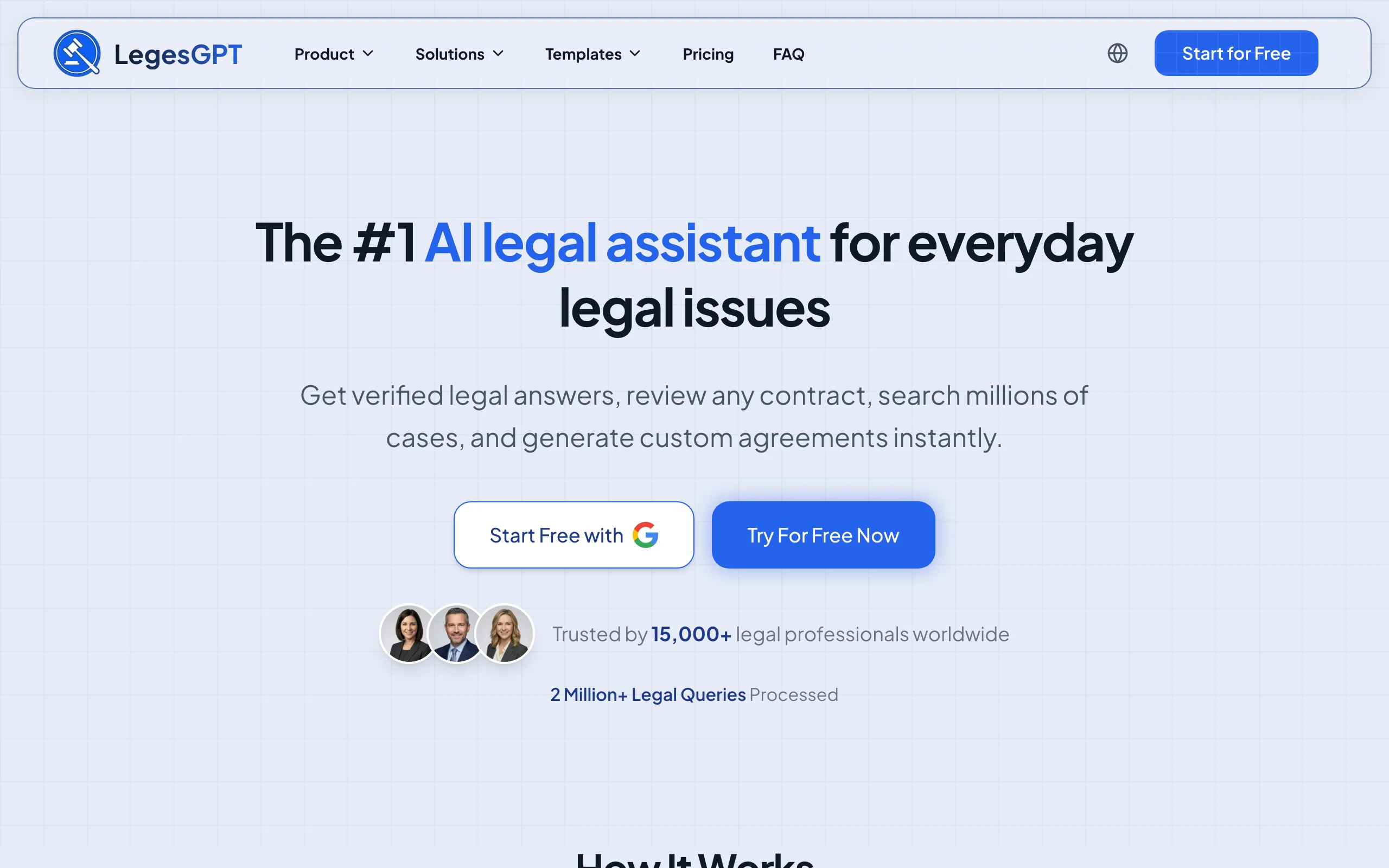
Because it also handles AI contract drafting and e-signature, a solo franchise practitioner can take an engagement from FDD review to a signed amendment without leaving one subscription.
Key features:
- Document review that flags risks item by item in FDDs and franchise agreements, with proposed edits and plain-language summaries
- Legal research with verified, linked citations across state and federal law, useful for multi-state registration and relationship statutes
- Ability to search case law and statutes directly when a franchise dispute turns on precedent
- AI drafting for amendments, addenda, demand letters, and client-facing summaries, plus 100+ attorney-drafted templates
- Deep Research mode for layered questions, like comparing termination-notice requirements across several registration states
- E-signature to send and sign the finished documents
Best for:
- Solo franchise lawyers and small firms reviewing FDDs for prospective franchisees
- Attorneys who need research, review, and drafting in one tool instead of three subscriptions
Pricing:
- Basic: $19.99/month for unlimited AI queries, case law and statute search, and citation verification
- Plus: $49.99/month adds document upload and 50 document reviews per month
- Premium: $99.99/month adds unlimited document review, Deep Research, and web search
- 3-day trial for $1; roughly 30% off with annual billing
Pros:
- One subscription covers FDD review, statute research, drafting, and signing at a fraction of enterprise legal AI pricing
- Verified citations reduce the hallucination risk that makes general chatbots dangerous for compliance work
- Self-serve signup with a $1 trial, no demo call or seat minimums
Cons:
- Web-only: no Microsoft Word add-in, mobile app, or API, so Word-centric drafters will copy text between windows
- No franchise-specific FDD archive; you bring your own documents rather than pulling competitor FDDs from a database
Put your next FDD through an AI review
Upload the disclosure document, get flagged risks and proposed changes item by item, and walk into the client call prepared.
Try AI document review2. Spellbook, best for drafting franchise agreements in Word
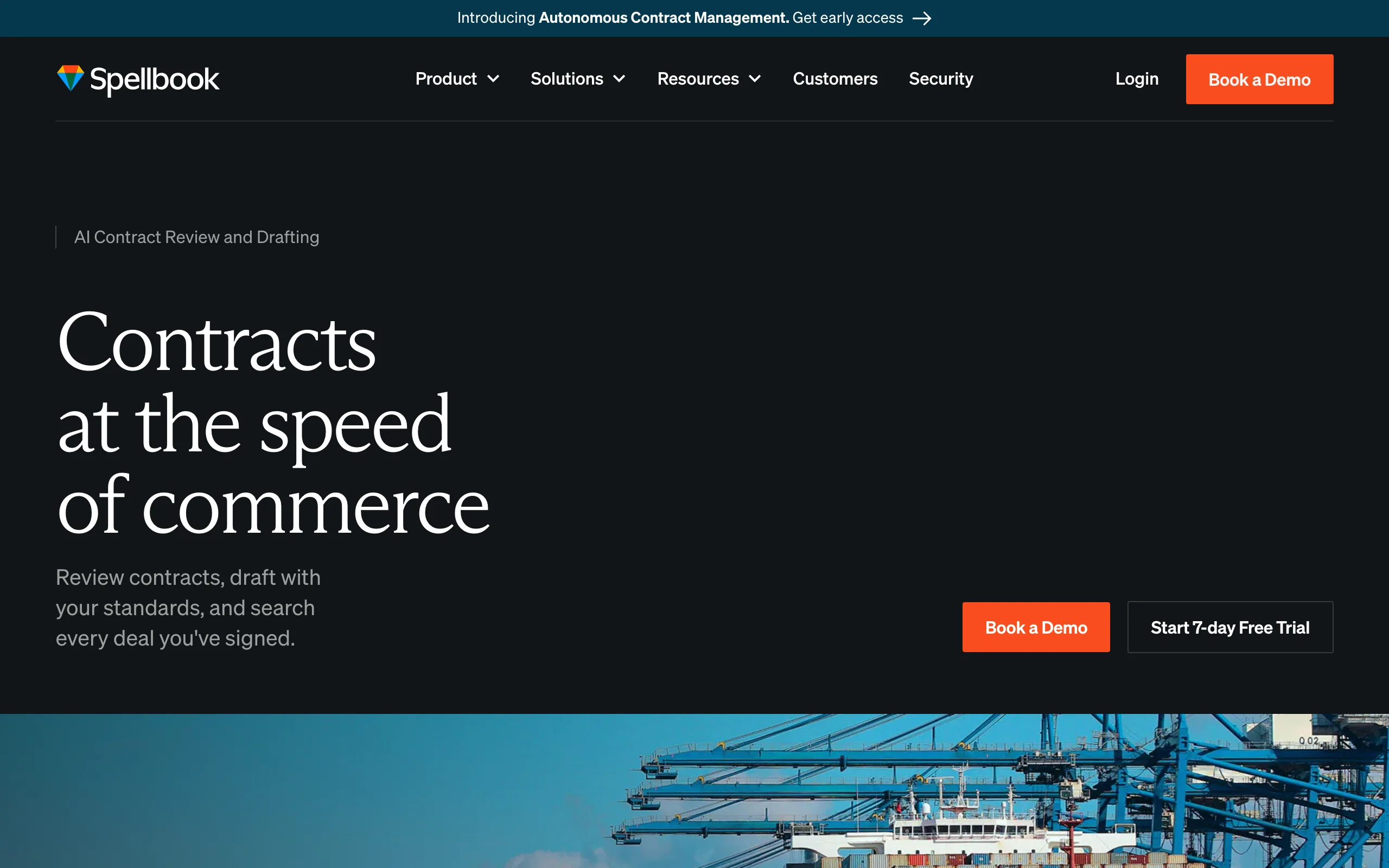
Spellbook is an AI add-in that lives inside Microsoft Word, which is exactly where most franchise agreements get drafted and negotiated. It suggests clauses as you type, benchmarks terms against comparable agreements, and generates redlines, so counsel for a franchisor can turn around the next unit agreement or a negotiated rider without exporting anything. For franchise lawyers who spend their day in tracked changes, the zero-context-switch workflow is the main draw.
Key features:
- AI drafting and clause suggestions directly in Microsoft Word
- Automated redlining and review of incoming agreements
- Benchmarking of terms against market-standard language
- Playbook-style review support for teams standardizing franchise agreement positions
Best for:
- Franchisor-side counsel producing and negotiating agreements in Word all day
- Firms that want AI assistance without changing their drafting environment
Pricing:
- Custom, quote-based pricing structured per team member; no public price list
- 7-day free trial; billed per user
Pros:
- The strongest Word-native experience of any tool on this list
- Redlining and clause benchmarking map neatly onto franchise agreement negotiation
Cons:
- Opaque pricing means a demo call before you know the cost, and per-seat legal AI adds up for small firms
- Focused on contracts: it will not research state registration requirements or franchise relationship statutes for you
3. CoCounsel, best for firms in the Westlaw ecosystem
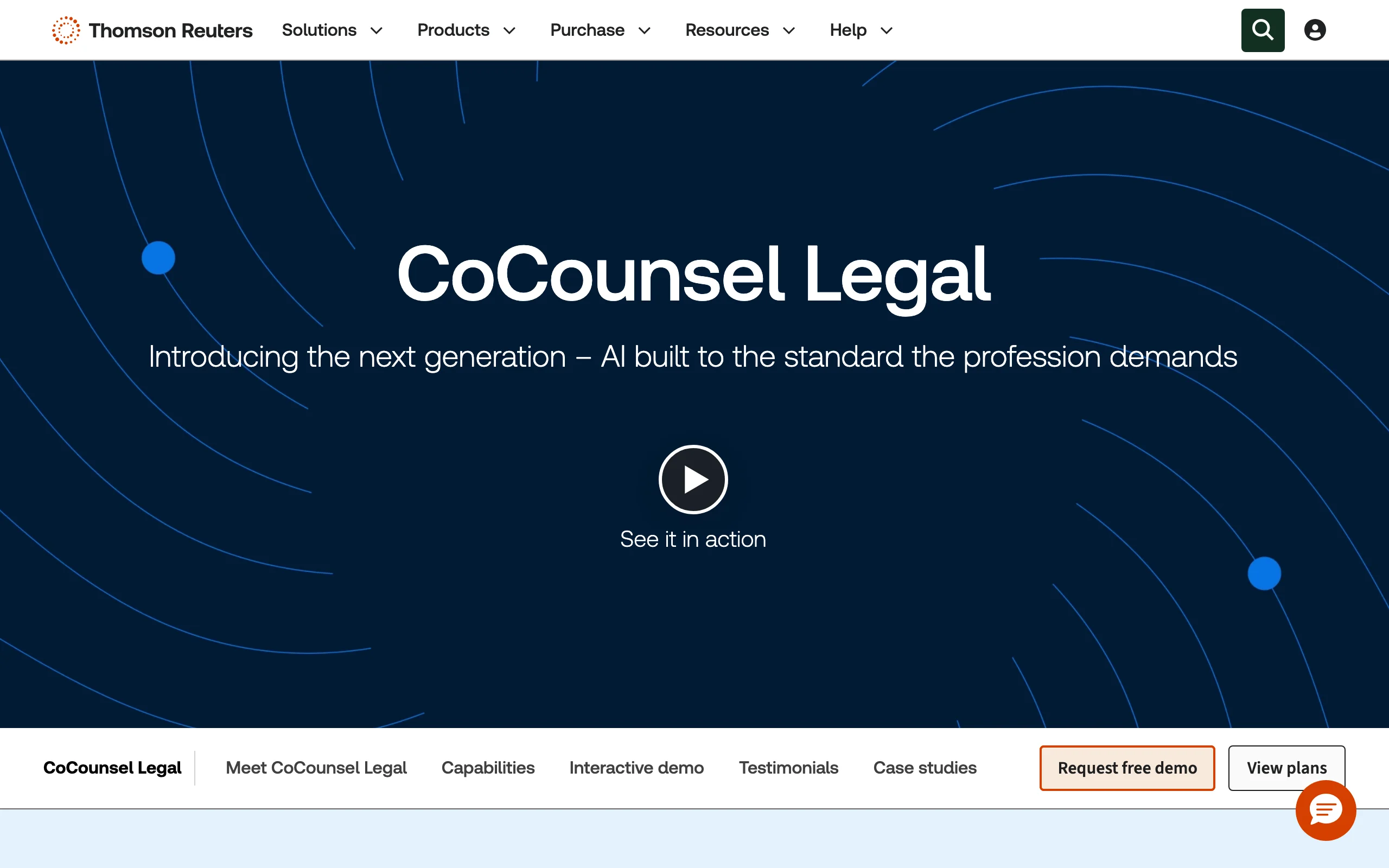
CoCounsel is Thomson Reuters' legal AI assistant, built around research and document skills like deposition preparation, document summarization, and contract policy compliance. For franchise litigators, its tight integration with Westlaw content is the selling point: research into franchise relationship-law claims or termination disputes draws on the same authority your firm already cites. Firms that hold Westlaw or Practical Law subscriptions get the most from it, since several plans bundle those products together.
Key features:
- AI research grounded in Thomson Reuters legal content
- Document review, summarization, and timeline building for disputes
- Contract policy compliance checks against your standards
- Bundles available with Westlaw and Practical Law
Best for:
- Franchise litigation teams already paying for Westlaw
- Mid-size firms that want one vendor for research content and AI
Pricing:
- No public price list; plans are configured through a self-serve tool for firms up to 10 attorneys and quoted by sales above that
- Third-party pricing research puts configurations at roughly $104 to $639 per user per month depending on plan, jurisdiction coverage, and term
Pros:
- Research answers tied to citable Westlaw authority, a real advantage in franchise disputes
- Mature document skills built for litigation workflows
Cons:
- Pricing is hard to predict and climbs quickly once Westlaw bundles enter the quote
- Overkill if your franchise practice is mostly transactional FDD and agreement work
4. FRANdata, best for FDD archives and franchise system data
FRANdata is not a generative AI assistant, and it earns its place on this list anyway. It operates the largest commercial archive of franchise disclosure documents, with nearly 40,000 FDD-related documents collected over roughly 25 years, including amendments, redlined year-over-year versions, and master franchise and area development documents. For a franchise lawyer, that archive answers questions AI chatbots cannot: what did this franchisor disclose three years ago, how did Item 19 change after the acquisition, and what do competing systems charge in royalties.
Pair it with an AI review tool and you get a strong due diligence workflow: pull the documents from FRANdata, then run the analysis with AI.
Key features:
- Archive of nearly 40,000 FDD-related documents spanning about 25 years
- Redlined FDD versions showing changes between years
- Sub-franchise, area development, and master franchise documents
- Franchise system reports and benchmarking data used by lenders and investors
Best for:
- Lawyers doing franchisor due diligence or benchmarking fee structures across systems
- Franchisor counsel tracking how competitors adjust disclosures year to year
Pricing:
- Individual FDDs and reports sold a la carte through the FRANdata store
- Library subscriptions and enterprise engagements priced on request (Custom)
Pros:
- Depth of historical FDD data no AI tool replicates
- Redlined comparisons save hours of manual document diffing
Cons:
- A data and reports platform, not an AI assistant; you still need a review tool for analysis
- Enterprise-oriented pricing model with no self-serve subscription tier for solos
5. FranConnect, best for franchisor sales compliance operations
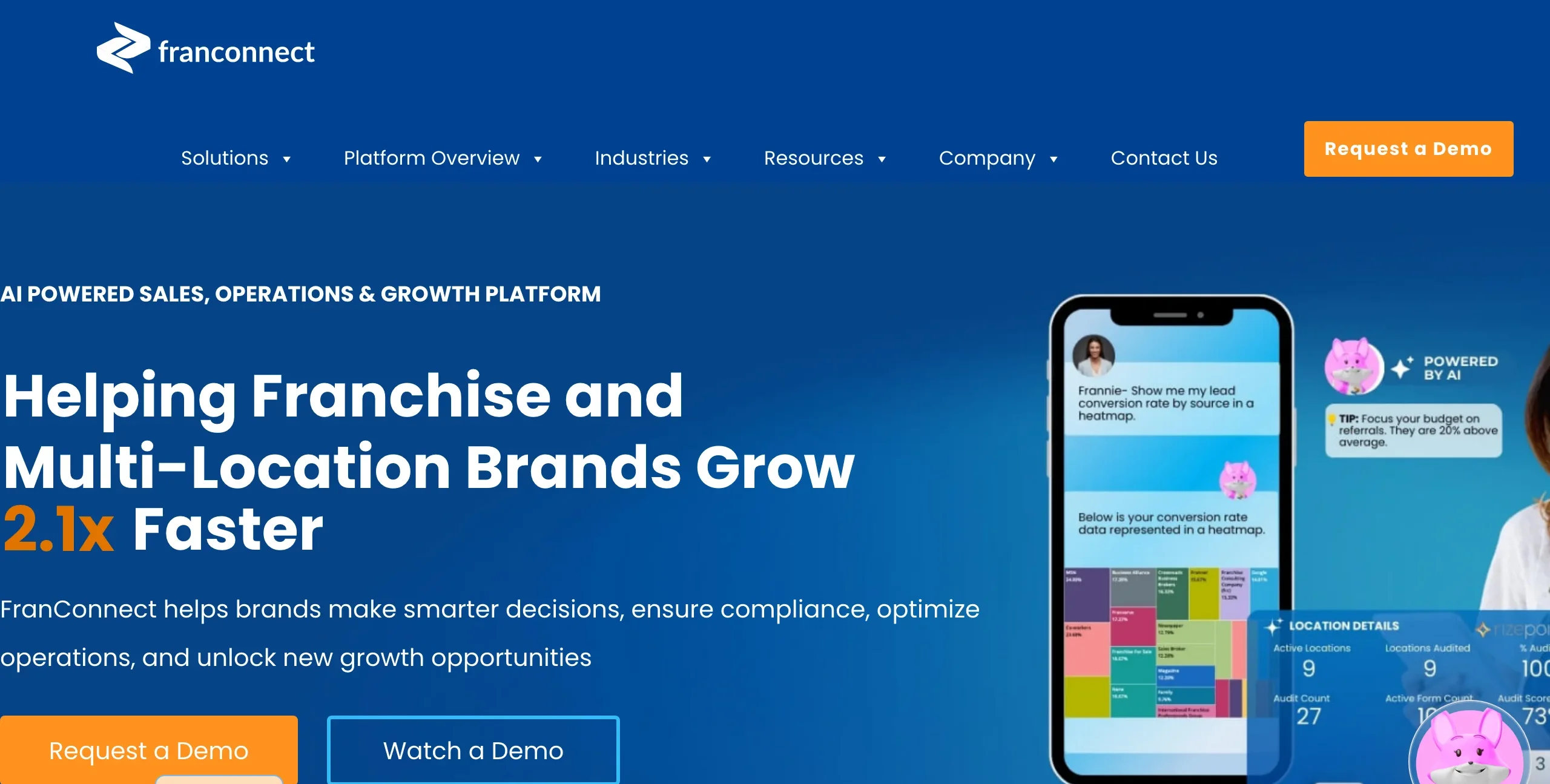
FranConnect is the franchise management platform more than 1,500 brands run their systems on, covering the lifecycle from franchise development and onboarding through operations and royalty management. Franchise lawyers rarely buy it themselves, but franchisor-side counsel should know it well, because it is where the sales compliance evidence lives. The sales module automates FDD creation, distributes disclosure documents electronically, and tracks receipts, which is exactly the paper trail you need when a franchisee later claims the FTC Franchise Rule's disclosure timing was missed. Its Frannie AI agents, launched in 2025, add generative AI for lead qualification, compliance workflows, and system analytics.
Key features:
- Automated FDD creation and electronic FDD distribution with receipt tracking
- Compliance workflows and reminders across the franchise sales process
- Frannie AI generative agents for sales coaching, data analysis, and operations insights
- Modules spanning development, onboarding, field operations, and royalty management
Best for:
- Franchisor general counsel and outside counsel who advise on franchise sales compliance
- Lawyers whose franchisor clients need a defensible record of when each candidate was disclosed
Pricing:
- No public price list; modular, quote-based pricing through a sales demo
- Third-party pricing research commonly cites roughly $1,000 to $2,000 per month depending on modules and user counts
Pros:
- Receipt-tracked electronic FDD delivery creates the disclosure-timing evidence that decides rescission claims
- The de facto industry standard, so advising franchisor clients usually means encountering it anyway
Cons:
- Operational software priced for franchisor budgets, not a tool a law firm subscribes to
- No legal research or document analysis; it manages the process, not the law behind it
6. FranchiseIQ, best for fast FDD benchmarking with SBA loan data
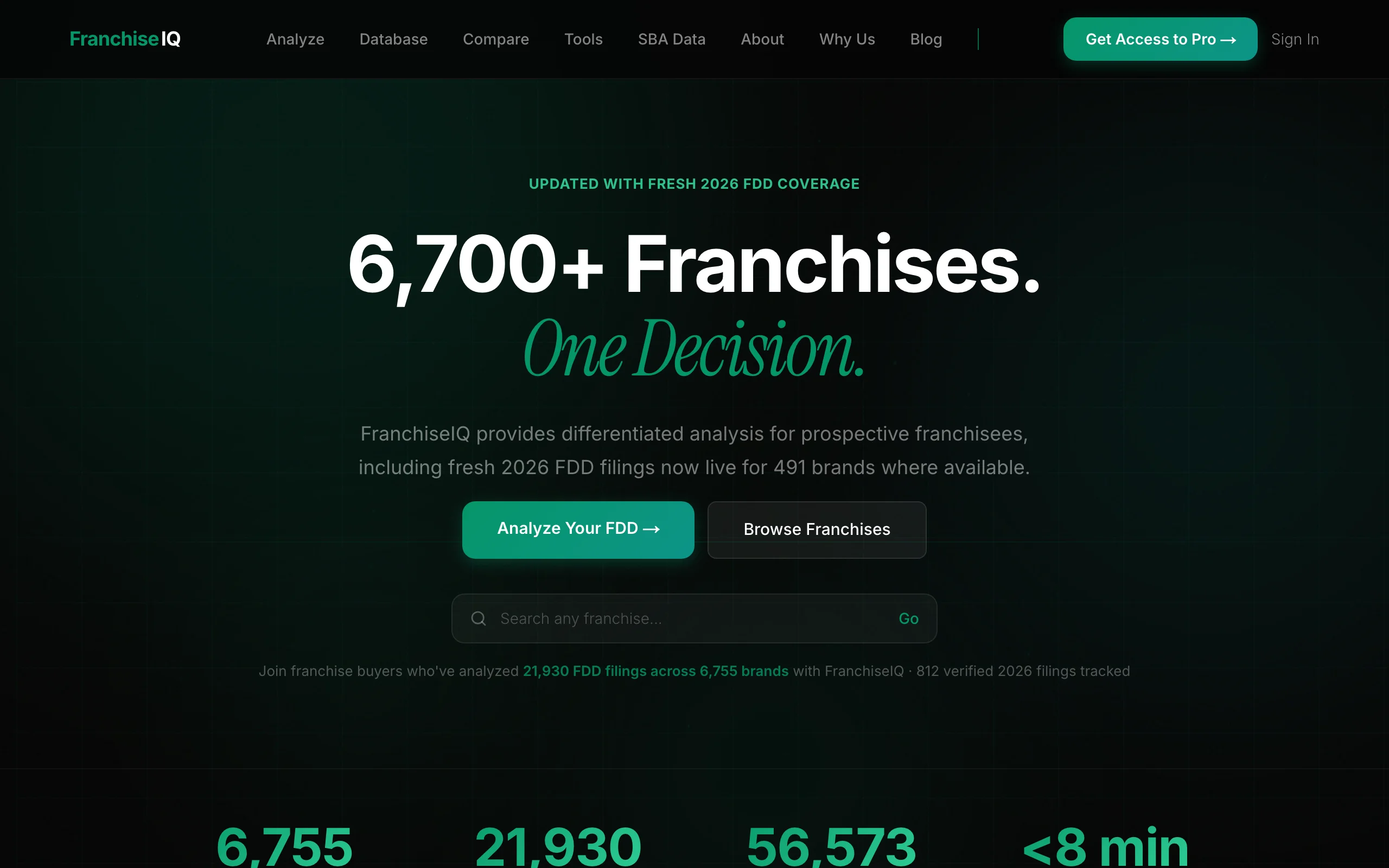
FranchiseIQ (at fddiq.com) is an AI-driven due diligence platform that has already analyzed 21,930 FDD filings across 6,755 franchise brands and mapped 56,573 SBA loans to those brands, default rates included. It is built for franchise buyers, and that is precisely why franchisee-side counsel should know it: clients increasingly arrive with its reports in hand, and its benchmarks answer questions a legal review of a single document cannot, like whether a system's royalty stack sits above the industry norm or how often its franchisees default on SBA loans. Red-flag detection runs across all 23 FDD items, and each report generates questions for the client to bring to their attorney.
Key features:
- AI analysis of a database of 21,930 FDD filings across 6,755 brands
- SBA loan data covering 56,573 loans, with default rates by franchise system
- Red-flag detection across all 23 FDD items, plus fee and royalty benchmarking
- Scenario modeling and automated question lists a client can bring to counsel
Best for:
- Franchisee-side lawyers who want fee, royalty, and default-rate context before the legal review
- Counsel who advise clients on which of several franchise systems merits full diligence spend
Pricing:
- FranchiseIQ Pro: $19.99 one-time for 10 FDD analysis reports and full database access, no subscription
- Free tools available without an account, including a comparison tool and sample report; 7-day satisfaction guarantee
Pros:
- Industry-wide benchmarks and SBA default data for less than the cost of a billable minute
- Knowing what its reports flag prepares you for the questions diligence clients now walk in with
Cons:
- Built for buyers, not lawyers: risk flags are data patterns, not legal analysis, and there are no legal citations
- A young product from a small operation, so verify any figure you plan to rely on in advice
7. Claude, best general-purpose AI for long documents
Claude, from Anthropic, is the general-purpose AI that handles very long documents most gracefully, which matters when your working documents are 200-page FDDs and 60-page franchise agreements. Paste or upload a full disclosure document and it can summarize each item, extract every fee into a table, or compare two franchise agreements clause by clause in a single conversation. Its careful, hedged style suits legal work better than most general chatbots.
Key features:
- Large context window suited to entire FDDs and multi-document comparisons
- File uploads for PDFs and Word documents
- Strong summarization, extraction, and plain-language explanation
- Projects for keeping a client's documents and instructions together
Best for:
- Lawyers who want a low-cost second reader for long franchise documents
- First-pass triage before a formal legal review
Pricing:
- Free tier available
- Pro: $20/month billed monthly, or $17/month on annual billing
- Max: from $100/month for heavy usage
Pros:
- Excellent long-document comprehension for the price of a lunch
- Careful reasoning style that flags its own uncertainty
Cons:
- No legal citation verification; statutes and cases it mentions must be checked independently
- No legal-specific workflow: no redlining, no clause playbooks, no e-signature
How to choose the best AI tool for your franchise practice
Four questions narrow the field quickly.
1) What is your core franchise workload?
- If you mainly review FDDs and franchise agreements for franchisees: LegesGPT covers review with flagged risks, research on the state statutes behind those risks, and drafting for the follow-up documents. Add FranchiseIQ when a client is still choosing between systems and needs benchmark data first.
- If you mainly draft and negotiate franchise agreements for franchisors: Spellbook's Word-native redlining fits that workflow best, with LegesGPT as the lower-cost alternative if you can draft in a browser.
- If you advise franchisors on sales compliance: get fluent in FranConnect, since your client's disclosure records, FDD receipts, and compliance workflows will live there.
- If franchise disputes and litigation dominate: CoCounsel makes sense when Westlaw is already your research backbone.
2) How much multi-state research do you do?
- If clients expand across registration states: prioritize tools with verified legal citations. LegesGPT's research links directly to statutes and cases, and its Deep Research mode handles layered questions like comparing renewal-notice rules across states.
- If you only need a first-pass summary of an unfamiliar state's landscape: Claude can outline it cheaply, but never file anything based on an unverified AI citation.
3) What is your budget per seat?
- Under $100/month: LegesGPT ($19.99 to $99.99) and Claude (from $20) both fit, and FranchiseIQ adds franchise benchmarks for a $19.99 one-time purchase. A solo could run all three for under $75 in month one.
- Several hundred dollars per user and up: Spellbook and CoCounsel live here and expect an annual commitment, while FranConnect is a four-figure monthly platform paid by the franchisor, not the firm. Do the math against your realistic usage before signing anything.
- Data budget: FRANdata is a per-document or per-report cost you incur per matter, more like an expert resource than a subscription.
4) Standalone tool or layered on what you have?
- If you want one tool to do most of the job: LegesGPT is the only option here that combines review, cited research, drafting, and e-signature in a single subscription, and you can use it as your everyday AI legal assistant beyond franchise work.
- If you already pay for Westlaw or live in Word: CoCounsel and Spellbook respectively extend those investments rather than replacing them.
- If your franchisor client already runs FranConnect: work inside their instance for compliance records and layer a legal AI tool on top for the analysis it does not do.
Whatever you choose, run the same test: take three real documents, one FDD, one franchise agreement, one research question you already know the answer to, and compare outputs before committing. For a broader look beyond franchise practice, see our guide to legal AI tools for lawyers.
Try LegesGPT on real franchise work for $1
Three days, full access. Review an FDD, research a registration question, and draft the follow-up letter before you decide.
Start the $1 trialFrequently Asked Questions
What is the best AI tool for franchise lawyers?
For most franchise lawyers, LegesGPT is the best starting point because it handles the three core jobs in one subscription: FDD and franchise agreement review with flagged risks, multi-state legal research with verified citations, and document drafting, from $19.99/month. Word-centric drafters may prefer Spellbook, and Westlaw-heavy litigators may prefer CoCounsel.
Can AI review a Franchise Disclosure Document?
Yes. AI review tools can work through all 23 FDD items, flag unusual fees, one-sided termination and renewal terms, litigation history concerns in Item 3, and gaps in Item 19 financial performance representations, and produce a plain-language summary. Treat the output as a prepared first pass: a lawyer still makes the judgment calls.
Are there AI tools built specifically for the franchise industry?
Yes, and they complement rather than replace legal AI. FranConnect embeds AI agents in the platform franchisors use to run sales compliance and operations, FranchiseIQ applies AI to a database of more than 21,000 FDD filings plus SBA loan default data, and FRANdata maintains the largest commercial FDD archive. None of them performs legal analysis, which is why franchise lawyers typically pair one of them with a legal AI tool like LegesGPT.
Is it safe to upload an FDD to an AI tool?
Use a tool with clear confidentiality terms and no training on your data before uploading client documents. Legal-specific platforms and business tiers of general tools typically commit to this; free consumer tiers may not. Also remember that an FDD itself is a disclosure document, but your annotations and client communications about it are privileged material.
Can AI draft a franchise agreement?
AI can produce a solid first draft of a franchise agreement, amendment, or addendum, and tools like LegesGPT and Spellbook can propose clause-level changes during negotiation. Franchise agreements carry state-specific requirements and registration consequences, so a franchise lawyer should always review and finalize the draft.
How much do AI tools for franchise lawyers cost?
The range is wide. FranchiseIQ costs $19.99 one-time, Claude runs $20/month, and LegesGPT runs $19.99 to $99.99/month depending on how much document review you need. Dedicated legal platforms like Spellbook and CoCounsel are quote-based and typically land in the low hundreds per user per month, while FranConnect is a quote-based franchisor platform commonly cited in the low four figures monthly.
Can AI handle multi-state franchise registration research?
AI tools can dramatically speed up multi-state research by surfacing each state's registration, filing, and relationship-law requirements in one place. The critical requirement is verified citations: LegesGPT links its answers to the underlying statutes so you can confirm each state's rule, whereas general chatbots frequently misstate state-specific requirements.
Will AI replace franchise lawyers?
No. AI compresses the reading, extraction, and first-draft work, but franchise practice turns on judgment: negotiating leverage, registration strategy, and advising a client whether a system's terms are worth accepting. Lawyers who use AI tools for lawyers effectively will simply spend more of their time on that judgment layer.
If I mainly need FDD and franchise agreement review, what should I use?
Start with LegesGPT. The Plus plan at $49.99/month covers 50 document reviews a month with flagged risks and proposed changes, plus cited research for the state-law questions those reviews raise. The 3-day trial costs $1, so you can test it on a live FDD before committing.