

An option agreement that has to close before a rights window lapses, a sync license the music supervisor needed yesterday, forty crew deal memos due before cameras roll: entertainment law moves at the speed of production, and the paperwork rarely keeps up. The best AI tools for entertainment lawyers close that gap by flagging risky royalty and exclusivity terms in minutes, drafting production and licensing agreements from scratch, and keeping rights data clean enough that nothing gets double-licensed.
The problem is fit. Generic legal AI has never seen a profit participation waterfall, and the industry platforms that model rights properly do not review contracts at all. This guide compares seven tools that entertainment and media lawyers actually use, with verified pricing, honest trade-offs, and a framework for assembling the right stack for your practice.
Best AI tools for entertainment lawyers: a brief overview
- LegesGPT: Best overall for talent and licensing agreement work: it reviews contracts with flagged risks (royalty terms, rights grants, exclusivity), drafts production and appearance agreements, and handles e-signature in one subscription.
- Spellbook: Best for redlining contracts inside Microsoft Word: suggests clause language and flags risks without leaving the document you are negotiating in.
- CoCounsel: Best for entertainment litigation and research-heavy disputes: agentic AI workflows backed by Westlaw content and Practical Law guidance.
- Rightsline: Best for enterprise film and TV rights management: tracks what rights you hold, where, and for how long, with conflict detection and royalty calculations.
- Synchtank: Best for music catalogs and sync licensing: labels, publishers, and production music libraries manage rights data, pitch sync opportunities, and generate licenses in one platform, with royalty accounting through its IRIS module.
- Filmustage: Best for pre-clearance script breakdown: AI tags every cast member, location, prop, and costume in a screenplay in about two minutes, handing production counsel the element list that drives releases and clearance work.
- DocuSign: Best for high-volume signature workflows: when a production needs dozens of releases and crew agreements executed fast.
| Tool | Best for | Starting price | Free trial | Platforms |
|---|---|---|---|---|
| LegesGPT | All-in-one talent and licensing agreement work | From $19.99/mo | 3-day, $1 | Web |
| Spellbook | Redlining contracts in Word | Custom | 7-day | Word add-in, web |
| CoCounsel | Litigation research and drafting | Custom (quote-based) | Essentials trial | Web, Word |
| Rightsline | Enterprise film and TV rights | Custom | Demo only | Web |
| Synchtank | Music rights and sync licensing | From $500/mo | Demo only | Web |
| Filmustage | Script breakdown before clearance | Free tier; $49/mo | Free tier | Web |
| DocuSign | High-volume signature workflows | From $11/mo | 30-day | Web, mobile |
1. LegesGPT, best overall for talent and licensing agreement work
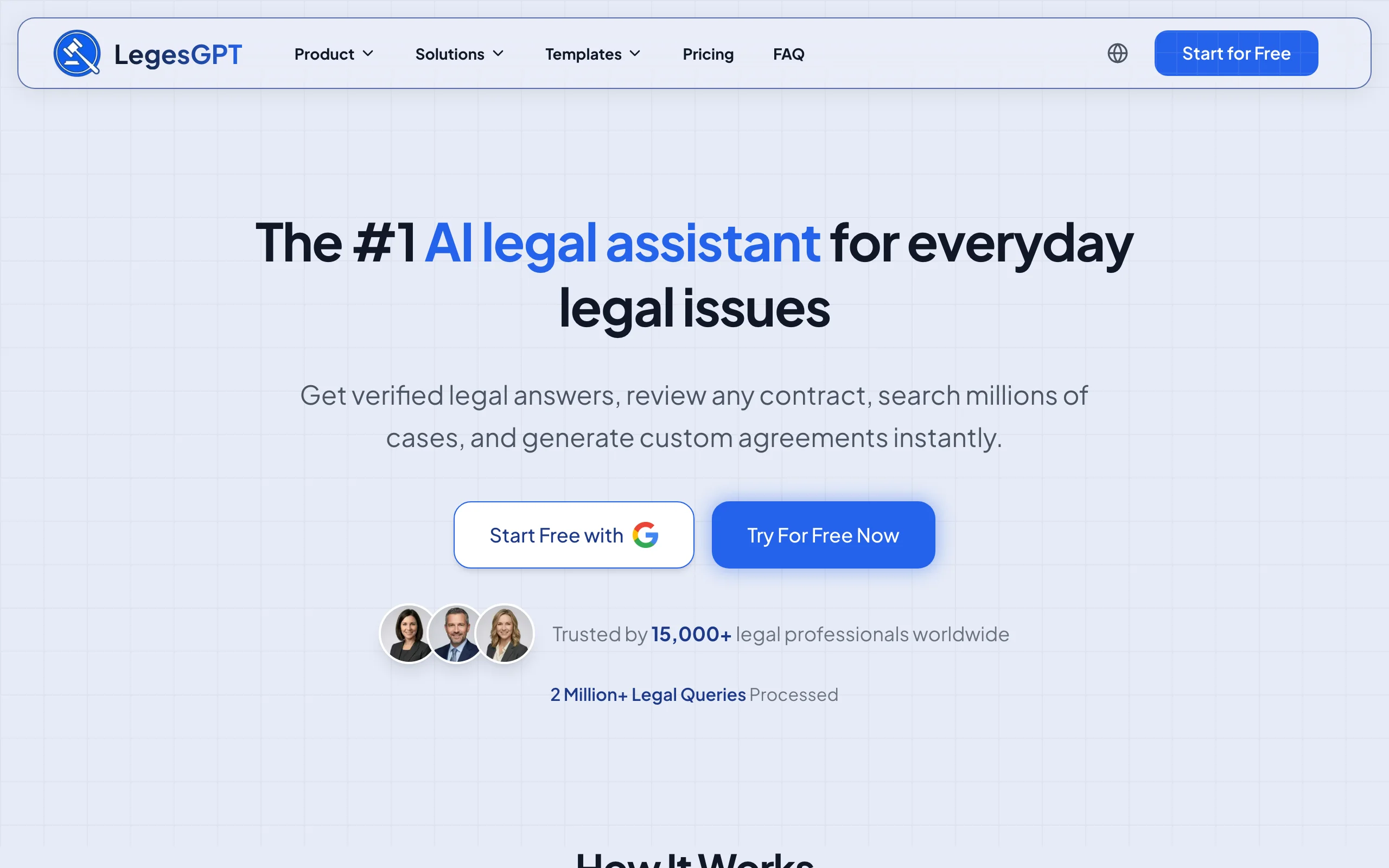
LegesGPT fits the daily rhythm of an entertainment practice: a client sends over a talent agreement or a licensing deal, and you need to know quickly where the risk sits. Upload the document and LegesGPT flags problematic clauses, including royalty structures, the scope of rights grants, exclusivity windows, and termination triggers, then proposes concrete revisions in plain language. When you are on the paper-drafting side, its AI contract drafting builds production, appearance, and licensing agreements clause by clause, and built-in e-signature lets you send a talent deal for execution without switching tools.
That end-to-end loop matters in entertainment work, where a deal memo can need to become a signed agreement before a shoot date. Research questions (say, whether a right of publicity claim survives a broad release in a given state) get answered with verified citations and direct source links, so you can check the authority yourself.
Key features:
- Contract review that flags royalty terms, rights grants, exclusivity, and indemnity risks with proposed fixes
- AI drafting of production, appearance, licensing, and services agreements
- E-signature to send and execute talent deals in the same workflow
- Legal question answering with verified citations and source links, plus case law and statute search
- 100+ attorney-drafted templates and free tools, including a contract generator
- Deep Research mode and web search for recent legal developments (Premium)
Best for:
- Solo entertainment lawyers and boutique media firms handling talent, licensing, and production paper
- Producers' counsel and business affairs teams that need AI contract review software and signing in one subscription
Pricing:
- Basic: $19.99/mo, unlimited AI queries, case law and statute search, citation verification
- Plus: $49.99/mo, adds document upload and 50 document reviews per month
- Premium: $99.99/mo, unlimited document review, Deep Research, web search
- 3-day trial for $1; roughly 30% off with annual billing
Pros:
- Review, drafting, research, and e-signature in one tool at a fraction of enterprise legal AI pricing
- Self-serve signup with a $1 trial, no sales calls or seat minimums
- Proposed revisions are concrete edits, not just risk labels
Cons:
- Web-only: no Microsoft Word add-in, mobile app, or API, so heavy Word redliners will still copy text across
- No rights or royalty database, so it complements rather than replaces a platform like Rightsline
Flag risky royalty and rights terms in minutes
Upload a contract and LegesGPT flags risky clauses, surfaces obligations and deadlines, and answers questions with citations you can verify.
Try AI document review2. Spellbook, best for redlining contracts in Microsoft Word
Spellbook is an AI contract drafting and review assistant that lives inside Microsoft Word, which is where most entertainment negotiations actually happen. As you work through a distribution agreement or an option purchase, it suggests clause language, flags risky terms, and generates redlines in place, so the markup you send opposing counsel never leaves the document. Its playbook feature lets a firm encode its standard positions (for example, preferred exclusivity carve-outs or credit provisions) and apply them consistently across deals.
For entertainment lawyers who spend their day trading redlines on long-form agreements, staying inside Word is the whole pitch. Spellbook sells to both law firms and in-house teams.
Key features:
- Clause suggestions and risk flags directly inside Microsoft Word
- Automated redline generation for negotiation rounds
- Custom playbooks that encode your firm's standard positions
- Spellbook Suite bundles the Word add-in with Associate, its multi-step drafting assistant
Best for:
- Firms negotiating long-form entertainment agreements in Word with heavy redline exchange
- Teams that want firm-standard clause positions applied consistently across associates
Pricing:
- Custom pricing, structured around the number of team members on the license; no public tiers
- 7-day free trial
Pros:
- Zero workflow change for Word-native negotiators
- Playbooks bring consistency to recurring deal types like licensing and talent agreements
Cons:
- No public pricing, so budgeting requires a sales conversation
- Focused on contracts; no legal research, e-signature, or rights tracking
3. CoCounsel, best for entertainment litigation and research-heavy disputes
CoCounsel is Thomson Reuters' legal AI assistant, and it is the strongest pick on this list when an entertainment matter turns into a dispute: profit participation claims, idea-submission suits, or a licensing breach heading to arbitration. Its agentic workflows run multi-step tasks like reviewing a production file for documents relevant to a claim, and the flagship CoCounsel Legal plan adds Deep Research grounded in Westlaw content plus a Litigation Document Analyzer designed to spot mischaracterizations and hallucinated case citations.
The entry-level Essentials plan covers document analysis and drafting in Microsoft Word, contract playbooks, and deposition preparation. The trade-off is cost and procurement: pricing is quote-based through a configurator or a sales representative, and the product is positioned within the broader Westlaw ecosystem.
Key features:
- Agentic AI workflows for multi-step review and drafting tasks
- Deep Research backed by Westlaw authoritative content (CoCounsel Legal plan)
- Litigation Document Analyzer that checks for mischaracterized or hallucinated cases
- Deposition preparation and contract playbooks on the Essentials plan
Best for:
- Litigation teams handling profit participation, rights, and idea-submission disputes
- Firms already committed to Westlaw and Practical Law
Pricing:
- Custom, quote-based: Thomson Reuters publishes no list price; quotes come from an online configurator (firms up to 10 attorneys) or sales
- Four plans, from CoCounsel Essentials up to CoCounsel Legal; free trial available on Essentials
Pros:
- Research answers grounded in Westlaw's citable content rather than the open web
- Strong litigation toolset that generic contract AI does not attempt
Cons:
- Opaque, enterprise-style pricing with bundle decisions to navigate
- Overkill if your practice is mostly transactional paper rather than disputes
4. Rightsline, best for enterprise film and TV rights management
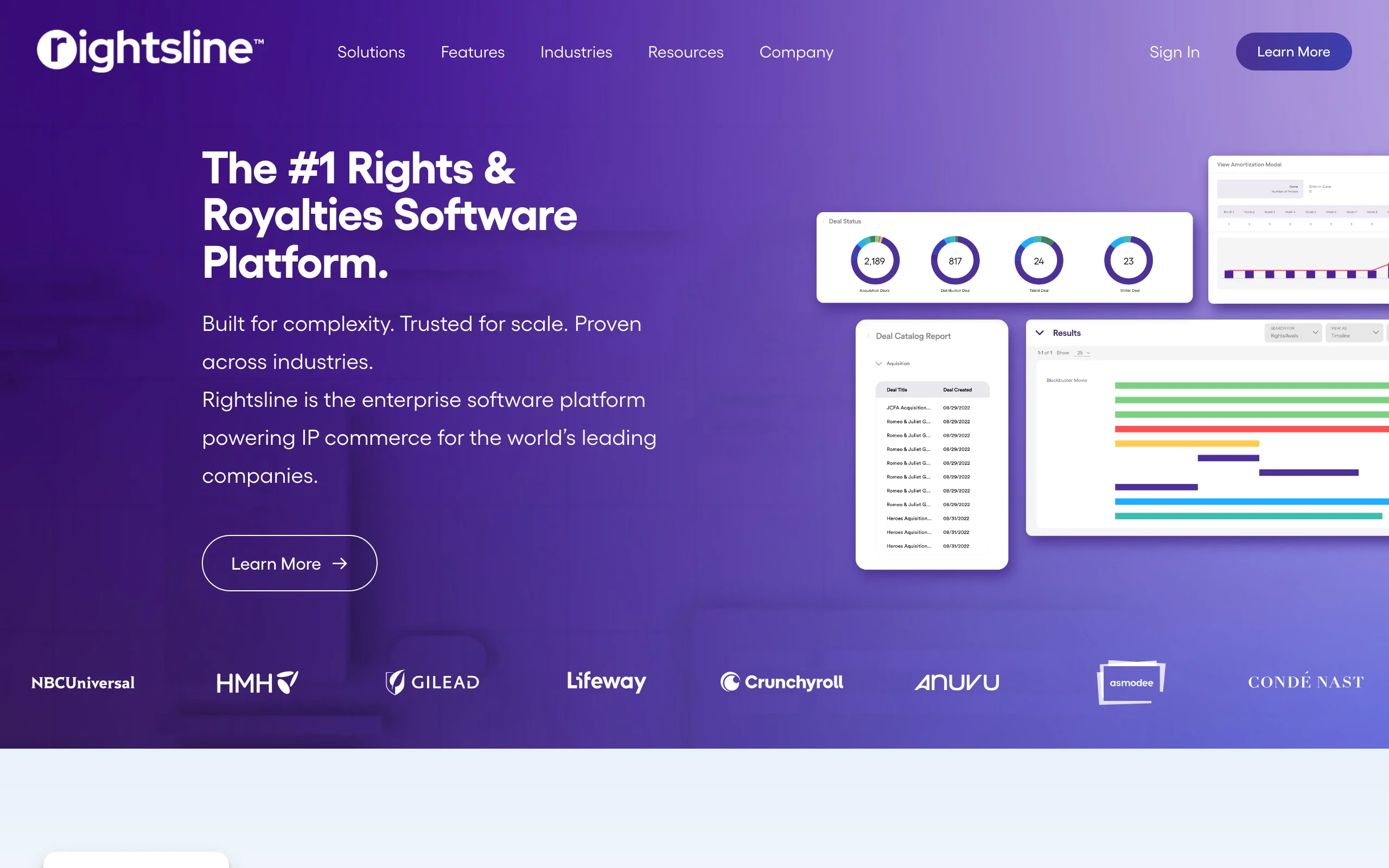
Rightsline is not a contract-review AI; it is the system of record for what rights you actually control. The platform tracks rights in and rights out across territory, language, platform, and time, runs real-time availability checks with conflict detection so a title never gets double-licensed, and calculates royalties and participations with support for advance recoupment, participant shares, and multi-currency deals. Media and entertainment IP owners use it to answer the question that underlies every licensing negotiation: can we even grant this?
For entertainment counsel at studios, distributors, and catalog owners, Rightsline is the infrastructure their deal work sits on. It integrates with ERPs, CRMs, and e-signature tools, so executed agreements flow into the rights database.
Key features:
- Rights availability and conflict detection across territory, language, platform, and time windows
- Royalty and participation engine with advance recoupment and multi-currency support
- Clearance and restriction tracking tied to underlying contracts
- Integrations with ERPs, CRMs, and e-signature platforms
Best for:
- Studios, distributors, and catalog owners managing large film and TV rights portfolios
- Legal and business affairs teams that need a single source of truth on what can be licensed
Pricing:
- Custom: pricing flexes on the modules you need, deal complexity, and business scale
- Quotes through sales; demo rather than self-serve trial
Pros:
- Purpose-built for entertainment rights, which generic legal AI does not model
- Availability checks prevent expensive double-licensing mistakes
Cons:
- Enterprise implementation project, not a tool you adopt in an afternoon
- No AI contract review; you still need a drafting and review layer alongside it
5. Synchtank, best for music catalogs and sync licensing
Synchtank does for music what Rightsline does for film and TV: it is the system of record, built around the recording-to-composition linking that makes music rights uniquely painful to track in spreadsheets. Labels, publishers, and production music libraries use the cloud platform to centralize catalog metadata, manage the rights and contracts behind it, and license it out. Its SyncUp module runs the sync licensing pipeline end to end: pitch tracks, send quotes, generate licenses, and manage the deal in one place. IRIS, its royalty accounting platform, collects, distributes, and reports on royalties, and can ingest PRO suspense files to surface unclaimed revenue sitting in collection-society accounts.
For music lawyers and business affairs teams, the draw is that the license paperwork and the catalog data live in the same system, so a quote never goes out on a track whose rights position is unclear.
Key features:
- Centralized catalog, rights, and contract management linking sound recordings to underlying works
- SyncUp module for pitching tracks, sending quotes, and generating sync licenses
- IRIS royalty accounting for collecting, distributing, and reporting royalties, including PRO suspense-file ingestion to find unclaimed income
- AI-assisted metadata tagging and search across large catalogs
- Song registrations and data exchange with global collection societies and partner systems
Best for:
- Counsel and business affairs teams at labels, publishers, and production music libraries running sync licensing at volume
- Music businesses that want royalty accounting tied to the same catalog data they license from
Pricing:
- Core Platform from $500/mo; additional modules and storage are priced through sales discovery calls
- Demo through sales; no self-serve trial
Pros:
- Models music-specific complexity (works versus recordings, PRO data) that generic rights tools flatten
- Quote-to-license sync workflow replaces the email-and-attachment churn of licensing deals
Cons:
- Built for music businesses, not individual artists or songwriters, and small catalogs will find it heavy
- No contract review or drafting AI; it manages the rights your agreements create, not the agreements themselves
6. Filmustage, best for script breakdown ahead of clearance work
Filmustage is the outlier on this list: an AI pre-production tool rather than legal software, and useful to production counsel for exactly that reason. Upload a screenplay and its AI breaks it down in about two minutes, tagging cast, props, locations, costumes, and VFX scene by scene, with co-references linking every mention of the same element. That breakdown doubles as a map of the production's legal workload: the cast list becomes the talent and day-player agreements to paper, the location list becomes location agreements and permits, and tagged props and costumes surface the branded items a clearance review has to catch. Custom tag categories let a team layer its own clearance flags on top.
Because producers and assistant directors already use Filmustage for scheduling and budgeting, counsel works from the same element list as the production office instead of rebuilding it by hand, and everything exports to PDF, Excel, and Movie Magic.
Key features:
- AI script breakdown in about two minutes, tagging cast, props, locations, costumes, and VFX with scene-level co-references
- Custom tag categories, usable for clearance-relevant elements
- Production-side tools: scheduling with day-out-of-days, AI budgeting, call sheets, and shot lists
- Exports to PDF, Excel, Movie Magic Scheduling, and Gorilla Scheduling
Best for:
- Production counsel and business affairs teams that want the full element list before release and clearance work starts
- Indie producers wearing the legal hat who need breakdown, scheduling, and budgeting in one inexpensive tool
Pricing:
- Free plan: all non-AI tools, one active project, and an AI breakdown of roughly 20% of scenes to test it
- Director's Cut: $49/mo with 1,000 AI credits per billing cycle; bonus months with annual billing
- Enterprise: custom pricing for studios, with added security and tailored contracts
Pros:
- Turns a days-long manual breakdown into minutes, so clearance prep can start the week the script locks
- Genuinely free tier with self-serve signup, rare in production software
Cons:
- Not a legal tool: no clearance opinions, contract features, or risk flags, just the element inventory
- Credit-based AI usage makes costs at heavy volume less predictable
7. DocuSign, best for high-volume signature workflows
DocuSign earns its place because entertainment deals die in the execution gap: a production may need location releases, appearance releases, crew deal memos, and vendor agreements signed by dozens of people before cameras roll. DocuSign's envelope-based workflow handles bulk sending, signing order, reminders, and a complete audit trail, and its mobile signing means talent can execute from a trailer rather than a desk.
For a solo lawyer whose signature volume is a handful of talent deals a month, a standalone e-signature subscription may be unnecessary (LegesGPT includes signing in its plans). DocuSign is the pick when volume and multi-party routing are the problem.
Key features:
- Envelope-based sending with signing order, reminders, and audit trails
- Templates for recurring release and deal-memo formats
- Mobile signing for talent and crew on location
- Integrations across CRMs and document platforms
Best for:
- Productions and agencies executing releases and crew agreements at volume
- Business affairs teams that route agreements through multiple approvers
Pricing:
- Personal: $11/mo (annual billing), capped at 5 envelopes per month
- Standard: $30/user/mo; Business Pro: $45/user/mo (annual billing)
- 30-day free trial, no credit card required
Pros:
- The de facto standard, so counterparties rarely push back on it
- Bulk workflows and audit trails built for signature volume
Cons:
- Envelope caps make the entry plan tight for busy productions
- Signature only at these tiers; drafting and review need other tools
How to choose the best AI tools for your entertainment practice
Most entertainment practices end up with a small stack rather than a single tool. Work through these four questions.
1) Is your core workload transactional paper or disputes?
- If your week is talent agreements, licensing deals, and production contracts: start with LegesGPT for review, drafting, and signing, and add Spellbook if your negotiations live in heavy Word redlines.
- If you handle profit participation claims, rights litigation, or arbitration: CoCounsel's Westlaw-grounded research and litigation analysis tools justify their quote-based pricing.
2) Do you need to manage rights, and if so, whose?
- If you represent a studio, distributor, or film and TV catalog owner: Rightsline is infrastructure, and your AI review tool sits on top of it.
- If your clients are labels, publishers, or production music libraries: Synchtank models the works-versus-recordings split and the sync licensing pipeline that film-centric rights platforms handle poorly.
- If you paper individual deals and clearances: skip the enterprise rights system and put the budget into contract review and drafting instead. This roundup of legal AI tools for lawyers covers the broader review-and-drafting field if you want more options.
3) How much of your work sits on the production side?
- If clearance and release paper starts with a script: Filmustage's two-minute breakdown gives you the element list weeks before a manual pass would, and its free plan covers the occasional production.
- If a shoot needs dozens of releases executed before day one: DocuSign's bulk envelopes and mobile signing are built for exactly that.
- If you send a handful of talent deals a month: LegesGPT's built-in e-signature covers it without a second subscription.
4) What is the realistic budget?
- Under $100/mo: LegesGPT Plus at $49.99/mo covers review, drafting, and signing, and Filmustage's free plan (or Director's Cut at $49/mo) handles breakdown prep, so a working solo stack lands under $100.
- Enterprise budget: CoCounsel plus Rightsline is the studio-grade stack, with Synchtank alongside if music is core to the catalog, but expect sales cycles and implementation timelines.
Whatever you shortlist, run the same test: take three of your own recent agreements (a talent deal, a license, and a release) and put them through each tool's trial. The differences in how they flag a royalty definition or an exclusivity clause will tell you more than any feature table. Most AI tools for lawyers look similar in a demo; they separate fast on your actual paper.
Frequently Asked Questions
Which AI tools do entertainment lawyers actually use in 2026?
The strongest stack in 2026 combines LegesGPT for talent and licensing agreement review, drafting, and e-signature; Spellbook for redlining in Word; CoCounsel for litigation research; Rightsline for film and TV rights management; Synchtank for music catalogs and sync licensing; Filmustage for AI script breakdown ahead of clearance; and DocuSign for high-volume signatures.
Can AI catch risky royalty or exclusivity terms in a talent agreement?
Yes. Upload a talent agreement to a tool like LegesGPT and it flags problematic clauses, including royalty structures, the scope of rights grants, exclusivity windows, and termination triggers, then proposes concrete revisions. The lawyer still makes the final call, but first-pass issue spotting takes minutes instead of hours.
What does rights management software add that legal AI does not?
Legal AI tools like LegesGPT and Spellbook analyze and draft the contracts themselves. Rights platforms like Rightsline and Synchtank are databases that track what those contracts granted, by territory, platform, and time window, so a title or track never gets double-licensed. Studios, labels, and catalog owners typically need both layers.
What should a music lawyer use for sync licensing at volume?
Synchtank is the purpose-built option: its SyncUp module handles pitching, quotes, and license generation against the same catalog data that tracks the underlying rights, and its IRIS module manages royalty accounting. It is enterprise software for music businesses, though, so counsel papering the occasional one-off sync deal can manage with a review tool and templates instead.
Does a production lawyer really need script breakdown software?
It is not a legal tool, but it accelerates legal work. An AI breakdown from Filmustage inventories every cast member, location, prop, and costume in about two minutes, which is the raw material for talent agreements, location agreements, and clearance review. Counsel who wait for a manual breakdown start that work weeks later.
What should an entertainment practice budget for AI tools?
A working solo stack costs under $100/mo: LegesGPT Plus at $49.99/mo for review, drafting, and signing, plus Filmustage's free plan for breakdown prep. DocuSign starts at $11/mo if signature volume demands it. Enterprise platforms (CoCounsel, Rightsline, Synchtank from $500/mo) are quote-driven and belong in studio and label budgets.
Are client agreements confidential when uploaded to an AI tool?
Stick to platforms built for legal work with clear data practices, and confirm whether your inputs are used for model training. Purpose-built legal tools are designed around confidential documents; for general-purpose AI assistants, review privacy settings before uploading anything privileged and anonymize where you can.
Where should I start if my week is mostly talent and licensing agreements?
Start with LegesGPT. It flags royalty, rights-grant, and exclusivity risks in uploaded agreements, proposes revisions, drafts production and appearance contracts, and sends them for e-signature in one subscription. The Plus plan at $49.99/mo covers 50 document reviews a month, and the 3-day $1 trial lets you test it on your own paper first. <leges-cta preset="trial" title="Put LegesGPT on your next talent agreement"></leges-cta>